
2
UNITED STATES
SECURITIES AND EXCHANGE COMMISSION
WASHINGTON, D.C. 20549
FORM | |||||
For the fiscal year ended December 31 , 2024
or
For the transition period from to .
Commission File Number 001-35500
(Exact name of registrant as specified in its charter) | ||||||||
| (State or other jurisdiction of incorporation or organization) | (I.R.S. Employer Identification Number) | ||||
Telephone: (213 ) 830-6300
(Address, zip code, and telephone number, including
area code, of registrant’s principal executive offices)
Securities registered pursuant to Section 12(b) of the Act:
| Title of each class | Trading Symbol(s) | Name of each exchange on which registered | ||||||
Securities registered pursuant to Section 12(g) of the Act: None
Indicate by check mark if the registrant is a well-known seasoned issuer, as defined in Rule 405 of the Securities Act. Yes ☐ No ☒
Indicate by check mark if the registrant is not required to file reports pursuant to Section 13 or Section 15(d) of the Act. Yes ☐ No ☒
Indicate by check mark whether the registrant (1) has filed all reports required to be filed by Section 13 and 15(d) of the Securities Exchange Act of 1934 during the preceding 12 months (or for such shorter periods that the registrant was required to file such reports), and (2) has been subject to such filing requirements for the past 90 days. Yes ☒ No ☐
Indicate by check mark whether the registrant has submitted electronically every Interactive Data File required to be submitted and posted pursuant to Rule 405 of Regulation S-T during the preceding 12 months (or for such shorter period that the registrant was required to submit such files). Yes ☒ No ☐
Indicate by check mark whether the registrant is a large accelerated filer, an accelerated filer, a non-accelerated filer, or a smaller reporting company. See the definitions of “large accelerated filer,” “accelerated filer” and “smaller reporting company” in Rule 12b-2 of the Exchange Act:
| Large Accelerated Filer | ☐ | Accelerated Filer | ☐ | |||||||||||
☒ | Smaller Reporting Company | |||||||||||||
| Emerging Growth Company | ||||||||||||||
If an emerging growth company, indicate by check mark if the registrant has elected not to use the extended transition period for complying with any new or revised financial accounting standards provided pursuant to Section 13(a) of the Exchange Act. ☐
Indicate by check mark whether the registrant has filed a report on and attestation to its management’s assessment of the effectiveness of its internal control over financial reporting under Section 404(b) of the Sarbanes-Oxley Act (15 U.S.C. 7262(b)) by the registered public accounting firm that prepared or issued its audit report. ☐
If securities are registered pursuant to Section 12(b) of the Act, indicate by check mark whether the financial statements of the registrant included in the filing reflect the correction of an error to previously issued financial statements. ☐
Indicate by check mark whether any of those error corrections are restatements that required a recovery analysis of incentive-based compensation received by any of the registrant’s executive officers during the relevant recovery period pursuant to §240.10D-1(b). ☐
Indicate by check mark whether the registrant is a shell company (as defined in Rule 12b-2 of the Exchange Act). Yes ☐ No ☒
As of March 20, 2025, there were 116,373,234 Class A units and 43,837,045 Class B units of the registrant outstanding.
DOCUMENTS INCORPORATED BY REFERENCE
TABLE OF CONTENTS
| Page | ||||||||
| PART I. | ||||||||
| PART II. | ||||||||
| PART III. | ||||||||
| PART IV. | ||||||||
2
FORWARD-LOOKING STATEMENTS
This annual report contains forward-looking statements within the meaning of Section 27A of the U.S. Securities Act of 1933, as amended (the “Securities Act”), and Section 21E of the U.S. Securities Exchange Act of 1934, as amended (the “Exchange Act”), which reflect our current views with respect to, among other things, our future results of operations and financial performance. In some cases, you can identify forward-looking statements by words such as “anticipate,” “approximately,” “believe,” “continue,” “could,” “estimate,” “expect,” “intend,” “may,” “outlook,” “plan,” “potential,” “predict,” “seek,” “should,” “will” and “would” or the negative version of these words or other comparable or similar words. These statements identify prospective information. Important factors could cause actual results to differ, possibly materially, from those indicated in these statements. Forward-looking statements are based on our beliefs, assumptions and expectations of our future performance, taking into account all information currently available to us. Such forward-looking statements are subject to risks and uncertainties and assumptions relating to our operations, financial results, financial condition, business prospects, growth strategy and liquidity.
In addition to factors identified elsewhere in this annual report, the following factors, among others, could cause actual results to differ materially from forward-looking statements and information or historical performance: the ability of Brookfield Oaktree Holdings, LLC (“BOH”) to retain and hire key service providers; the continued availability of capital and financing; the business, economic and political conditions in the markets in which BOH operates; changes in BOH’s anticipated revenue and income, which are inherently volatile; changes in the value of BOH’s investments; the pace of Oaktree’s raising of new funds; changes in assets under management; the timing and receipt of, and impact of taxes on, carried interest; distributions from and liquidation of Oaktree’s existing funds; the amount and timing of distributions on BOH’s preferred units; changes in BOH’s operating or other expenses; the degree to which BOH encounters competition; and general political, economic and market conditions.
Any forward-looking statements and information speak only as of the date of this annual report or as of the date they were made, and except as required by law, BOH does not undertake any obligation to update forward-looking statements and information. For a more detailed discussion of these factors, also see the information under the captions “Risk Factors” and “Management’s Discussion and Analysis of Financial Condition and Results of Operations” in this annual report, and in each case any material updates to these factors contained in any of BOH’s future filings.
As for the forward-looking statements and information that relate to future financial results and other projections, actual results will be different due to the inherent uncertainties of estimates, forecasts and projections and may be better or worse than projected and such differences could be material. Given these uncertainties, you should not place any reliance on these forward-looking statements and information.
This annual report and its contents do not constitute and should not be construed as (a) a recommendation to buy, (b) an offer to buy or solicitation of an offer to buy, (c) an offer to sell or (d) advice in relation to, any securities of BOH or securities of any Oaktree investment fund.
Risk Factor Summary
We are providing the following summary of the risk factors contained in this annual report to enhance the readability and accessibility of our risk factor disclosures. We encourage you to carefully review the full risk factors contained in this annual report in their entirety for additional information regarding the material factors that make an investment in our preferred units speculative or risky. These risks and uncertainties include, but are not limited to, the following:
•Oaktree or we may alter the terms under which it or we do business when Oaktree or we deem it appropriate;
•Our business could be materially harmed by conditions in the global financial markets and economies;
•Inflation has adversely affected and may continue to adversely affect our business and results of operations and the financial condition of Oaktree’s funds and their portfolio companies;
•If Oaktree were unable to raise capital from investors, it would adversely affect our financial condition;
•We depend on OCM and certain of its affiliates to advise the funds in which we invest and to support Oaktree’s operations;
3
•Our revenues are volatile due to the nature and structure of Oaktree’s business;
•Conflicts of interest or inter-fund governance matters could cause reputational harm to us;
•The investment management business is intensely competitive, and poor performance of Oaktree funds could adversely affect Oaktree’s ability to raise capital for future funds and, in the case of funds in which we are directly or indirectly invested, could negatively affect our financial performance;
•Oaktree may not be able to maintain Oaktree’s current incentive fee structure as a result of industry pressure from clients to reduce fees, which could have an adverse effect on our profit margins and results of operations;
•Oaktree’s funds often pursue investment opportunities that involve business, regulatory, legal or other complexities;
•Technological developments in artificial intelligence could disrupt the markets in which Oaktree operates and subject Oaktree to increased competition, legal and regulatory risks and compliance costs;
•Extensive regulation and/or legal and regulatory changes, as well as regulatory compliance failures and negative publicity surrounding the financial industry in general, could adversely affect us;
•SEC rules barring so-called “bad actors” from relying on Rule 506 of Regulation D in private placements could materially adversely affect Oaktree’s business, financial condition and results of operations;
•Oaktree’s failure to comply with, or changes to, “pay to play” regulations could adversely affect our reputation;
•Oaktree’s failure to maintain the security of its information and technology networks or a cybersecurity breach or other incident could have a material adverse effect on us;
•Interruption of Oaktree’s information technology, communications systems or data services could disrupt our business, result in losses and/or limit our growth;
•Oaktree is subject to substantial litigation risks and may face significant liabilities and damage to our professional reputation as a result;
•Oaktree employee misconduct could harm Oaktree’s reputation;
•The historical returns attributable to Oaktree’s funds should not be considered indicative of future results;
•Certain of Oaktree’s funds make investments in distressed businesses that involve significant risks and potential liabilities;
•Certain of Oaktree’s funds may be subject to risks arising from potential control group liability;
•Poor investment performance during periods of adverse market conditions may result in relatively high levels of investor redemptions, which can adversely impact the affected funds;
•Valuation methodologies for certain assets in Oaktree’s funds can be subject to significant subjectivity, and the values of assets established pursuant to the methodologies may never be realized;
•Oaktree’s funds make investments in companies that are based outside the United States, which exposes us to additional risks;
•We have made and expect to continue to make significant investments in Oaktree’s current and future funds, and we may lose money on some or all of our investments;
•Oaktree’s funds often invest in companies that are highly leveraged, a fact that may increase the risk of loss;
•The use of leverage by Oaktree’s funds could have a material adverse effect on us;
4
•Changes in the debt financing markets and higher interest rates may negatively impact Oaktree’s funds and their portfolio companies;
•Oaktree’s funds are subject to risks in using agents and third-party service providers;
•The market price of our preferred units could be adversely affected by various factors;
•If we, including any service organizations that we use, fail to maintain effective internal controls over our financial reporting in the future, the accuracy and timing of our financial reporting may be adversely affected;
•Distributions on the preferred units are discretionary and non-cumulative;
•We have an indirect economic interest in only a portion of the Oaktree Operating Group, which may negatively impact our ability to pay distributions on our preferred units;
•If we or any of Oaktree’s private funds were deemed an investment company under the Investment Company Act, applicable restrictions could make it impractical for us to continue our business or for Oaktree to continue such funds;
•Our operating agreement contains provisions that substantially limit remedies available to our preferred unitholders for actions that might otherwise result in liability for our officers and/or directors;
•Our ability to make distributions to holders of any series of preferred units may be limited;
•If the amount of distributions on the preferred units is greater than our gross ordinary income, then the amount that a holder of preferred units would receive upon liquidation may be less than the preferred unit liquidation value;
•Holders of preferred units who are U.S. taxpayers should anticipate the need to file annually a request for an extension of the due date of their income tax return, and may be required to file amended income tax returns;
•An investment in preferred units will give rise to UBTI to certain tax-exempt holders;
•Non-U.S. holders face unique U.S. tax issues from owning preferred units that may result in adverse tax consequences to them;
•Holders of preferred units may be subject to state and local taxes and return filing requirements as a result of investing in our preferred units;
•Amounts distributed in respect of the preferred units could be treated as “guaranteed payments” for U.S. federal income tax purposes; and
•Holders of preferred units who do not hold the units through the record date for a distribution may be allocated gross ordinary income even though no distribution is received.
5
MARKET AND INDUSTRY DATA
This annual report includes market and industry data and forecasts that are derived from independent reports, publicly available information, various industry publications, other published industry sources and our internal data, estimates and forecasts. Independent reports, industry publications and other published industry sources generally indicate that the information contained therein was obtained from sources believed to be reliable. We have not commissioned, nor are we affiliated with, any of the sources cited herein.
Our internal data, estimates and forecasts are based upon information obtained from investors in Oaktree funds, partners, trade and business organizations, and other contacts in the markets in which Oaktree operates and Oaktree’s management’s understanding of industry conditions.
In this annual report, unless the context otherwise requires:
“Oaktree” refers to (i) Brookfield Oaktree Holdings, LLC and, where applicable, its subsidiaries and affiliates prior to October 1, 2019 and (ii) the Oaktree Operating Group and, where applicable, their respective subsidiaries and affiliates after September 30, 2019.
“BOH,” “Company,” “we,” “us,” “our” or “our company” refers to Brookfield Oaktree Holdings, LLC and, where applicable, its subsidiaries and affiliates, including, as the context requires, affiliated Oaktree Operating Group members after September 30, 2019.
“OCM” refers to Oaktree Capital Management, L.P. and, where applicable, its subsidiaries and affiliates. OCM is one of the Oaktree Operating Group entities but not one of our subsidiaries. OCM acts as the U.S. registered investment adviser to most of the Oaktree funds.
“Oaktree Operating Group,” or “Operating Group,” refers collectively to the entities that either (i) act as or control the general partners and investment advisers of the Oaktree funds or (ii) hold interests in other entities or investments generating income for the business of Oaktree.
“OCGH” refers to Oaktree Capital Group Holdings, L.P., a Delaware limited partnership, which holds an interest in the Oaktree Operating Group and all of our Class B units.
“OCGH unitholders” refers collectively to Oaktree’s senior executives, current and former Oaktree employees and their respective transferees who hold interests in the Oaktree Operating Group through OCGH.
“OEP” refers to Oaktree Equity Plan, L.P., a Delaware limited partnership, which holds an interest in the Oaktree Operating Group.
“OEP II” refers to Oaktree Equity Plan II, L.P., a Delaware limited partnership, which holds an interest in the Oaktree Operating Group.
“assets under management,” or “AUM,” generally refers to the sum of (i) the assets Oaktree manages and equals the NAV (as defined below) of the assets Oaktree manages, (ii) the leverage on which management fees are charged, (iii) the undrawn capital that Oaktree is entitled to call from investors in the funds pursuant to their capital commitments, (iv) investment proceeds held in trust for use in investment activities, (v) Oaktree’s pro rata portion of AUM managed by its equity method investments such as DoubleLine Capital LP and its affiliates (“DoubleLine”) and Duration Capital LP and its affiliates, in which Oaktree holds minority ownership interests, and (vi) 100% of the AUM managed by 17Capital LLP and its affiliates, in which Oaktree acquired a majority ownership interest in 2022. For Oaktree’s collateralized loan obligation vehicles, AUM represents the aggregate par value of collateral assets and principal cash; for Oaktree’s business development companies, gross assets (including assets acquired with leverage), net of cash; for Oaktree’s special purpose acquisition companies (“SPACs”), the proceeds of any initial public offering held in trust for use in a business combination; and for DoubleLine funds, NAV. Oaktree’s AUM amounts include AUM for which Oaktree charges no management fees. Oaktree’s definition of AUM is not based on any definition contained in our operating agreement or the agreements governing the funds that Oaktree manages. Oaktree’s calculation of AUM below may not be directly comparable to the AUM metrics of other investment managers.
“Class A units” refer to the common units of BOH designated as Class A units.
“CLOs” refer to collateralized loan obligation vehicles.
6
“common units” or “common unitholders” refer to the Class A common units of BOH or Class A common unitholders, respectively, unless otherwise specified.
“consolidated funds” refers to the funds that we are required to consolidate as of the applicable reporting date.
“funds” refers to investment funds and, where applicable, CLOs and separate accounts that are managed by Oaktree or its subsidiaries.
“net asset value,” or “NAV,” refers to the value of all the assets of a fund (including cash and accrued interest and dividends) less all liabilities of the fund (including accrued expenses and any reserves established by the general partner or investment manager of such fund in their discretion, for contingent liabilities) without reduction for accrued incentives because they are reflected in the partners’ capital of the fund.
“preferred units” or “preferred unitholders” refers to the Series A and Series B preferred units of BOH or Series A and Series B preferred unitholders, respectively, unless otherwise specified.
7
Part I.
Item 1. Business
Overview
Brookfield Oaktree Holdings, LLC holds Credit, Real Estate and Equity investments managed by leading alternative asset management firms Oaktree Capital Management, L.P. and Brookfield Asset Management Ltd. The Company both directly invests in funds and other managed investment vehicles and has indirect exposure through its approximately 72% economic interest in Oaktree Capital I, L.P. (“Oaktree Capital I”), which holds a majority of Oaktree’s investments in Oaktree funds.
Oaktree is a leader among global investment managers specializing in alternative investments. Oaktree emphasizes an opportunistic, value-oriented and risk-controlled approach to investments in credit, equity, and real estate. Funds managed by Oaktree (the “Oaktree funds”) include commingled funds, separate accounts, collateralized loan obligation vehicles (“CLOs”) and business development companies (“BDCs”).
The Company was formed on April 13, 2007 under the name Oaktree Capital Group, LLC. The Company’s ownership and operational structure through December 31, 2024 are the result of certain mergers and restructurings. The Company’s holdings and operations currently primarily represent (i) limited partner investments in certain of Oaktree’s flagship opportunistic credit funds, (ii) an approximately 72% economic interest in Oaktree Capital I, which holds a majority of Oaktree’s investments in its funds, and (iii) an indirect ownership interest in Brookfield Real Estate Income Trust Inc. (“Brookfield REIT”). The Company is the issuer of the Series A and Series B preferred units listed on the NYSE.
The Company’s ownership and operational structure through December 31, 2024 were the result of (i) certain mergers with affiliates of Brookfield Corporation (“Brookfield”) completed on September 30, 2019 (the “Mergers”) and the subsequent restructuring completed on October 1, 2019 in connection with the Mergers (the “2019 Restructuring”), (ii) the restructuring completed on November 30, 2022 in connection with an internal Oaktree reorganization to facilitate the separation of Brookfield’s capital business and asset management business (the “2022 Restructuring”) and (iii) the restructuring completed on July 1, 2024 in connection with an internal Oaktree reorganization effected to facilitate the change of the general partner of Oaktree Capital I from Brookfield OCM Holdings II, LLC to Oaktree Capital I GP, LLC, a newly formed subsidiary of Oaktree Capital Holdings, LLC (“OCH”) (the “2024 Restructuring”). See Part I, Item I included in the Company’s Annual Report on Form 10-K for the year ended December 31, 2019 filed with the Securities and Exchange Commission (the “SEC”) on March 2, 2020 for more information regarding the Mergers and the 2019 Restructuring. See Item 1.01 of the Company’s Current Report on Form 8-K filed with the SEC on December 6, 2022 and Part I, Item I included in the Company’s Annual Report on Form 10-K for the year ended December 31, 2022 filed with the SEC on March 21, 2023 for more information about the 2022 Restructuring. See Item 8.01 of the Company’s Current Report on Form 8-K filed with the SEC on July 1, 2024 for more information about the 2024 Restructuring.
The results of the Company are largely driven by the performance of certain funds and other investments held directly or indirectly by Oaktree Capital I, which is one of the key operating entities of Oaktree, and managed by Oaktree. The distributions to holders of the Series A and Series B preferred units listed on the NYSE are generally serviced by the distributions from Oaktree Capital I, and payments to the preferred unitholders must be satisfied prior to declaration of any distributions to Class A or Class B unitholders, subject to the terms of the Series A and Series B preferred units and certain limitations and exceptions set forth therein.
OCM provides certain administrative and other services relating to the operations of the Company’s business pursuant to the Services Agreement between the Company and OCM.
Structure and Operation of Our Business
Following the 2022 Restructuring and prior to the 2024 Restructuring, the Company’s operations were conducted through an indirect economic interest in Oaktree Capital I, and the Company’s revenue included the incentive income generated by certain funds that OCM manages for which the Company, via Oaktree Capital I, acted as general partner and the investment income earned from the investments the Company makes in Oaktree funds, third-party funds and other companies. Investment income during such period generally reflected the investment return on a mark-to-market basis and the Company’s equity participation on the amounts that it invested in Oaktree and third-party funds.
8
As a result of the 2024 Restructuring, the Company no longer consolidates the operations of Oaktree Capital I, but rather accounts for the Company’s approximately 72% interest in Oaktree Capital I under the equity method of accounting. As such, subsequent to the 2024 Restructuring, the Company’s revenue is primarily the investment income earned from (i) limited partner investments in certain of Oaktree’s flagship opportunistic funds, (ii) an equity method investment in Oaktree Capital I, and (iii) an indirect ownership in Brookfield REIT.
OCM, an affiliate of the Company, has since the 2019 Restructuring provided certain administrative and other services relating to the operations of the Company’s business. These services are provided pursuant to a Services Agreement between the Company and OCM (as amended from time to time, the “Services Agreement”).
Structure of Funds
Closed-end Funds
Oaktree’s closed-end funds are typically structured as limited partnerships that have a 10- or 11-year term and have a specified period during which clients can subscribe for limited partnership interests in the fund. Once a client is admitted as a limited partner, that client is required to contribute capital when called by Oaktree as the general partner, and generally cannot withdraw its investment. These closed-end funds have an investment period that generally ranges from three to five years, during which Oaktree is permitted to call the committed capital of those funds to make investments. As closed-end funds liquidate their investments, Oaktree typically distributes the proceeds to the clients, although during the investment period Oaktree generally has the ability to retain or recall such proceeds to make additional investments. Once a fund has committed to invest approximately 80% of its capital, Oaktree typically raises a new fund in the same strategy, generally ensuring that it always has capital to invest in new opportunities. Oaktree may also provide discretionary management services for clients within its closed-end fund strategies through a separate account or through a limited partnership or limited liability company managed by Oaktree with the client as the sole limited partner or sole non-managing member (a “fund-of-one”).
Oaktree’s closed-end funds also include special purpose acquisition companies managed by Oaktree and CLOs for which it serves as collateral manager. CLOs are structured finance vehicles in which Oaktree makes an investment and for which it is entitled to earn management fees. Investors in CLOs are generally unable to redeem their interests until the CLO liquidates, is called or otherwise terminates. Subsequent to the 2022 Restructuring, the Company no longer consolidates the CLOs as their direct ownership interests are held by Oaktree Capital Management (Cayman), L.P. (“OCM Cayman”).
Open-end Funds
Oaktree’s commingled open-end funds are typically structured as limited partnerships that are designed to admit clients as new limited partners (or accept additional capital from existing limited partners) on an ongoing basis during the fund’s life. Clients in commingled open-end funds typically contribute all of their committed capital upon being admitted to the fund. These funds do not have an investment period and do not distribute proceeds of realized investments to clients, though some open-end funds may distribute current income to clients. Oaktree is permitted to commit the fund’s capital (including realized proceeds) to new investments at any time during the fund’s life. Clients in commingled open-end funds generally have the right to withdraw their capital from the fund on a monthly basis (with prior written notice of up to 90 days).
Oaktree also provides discretionary management services for clients through separate accounts within the open-end fund strategies. Clients establish accounts with Oaktree by depositing funds or securities into accounts maintained by qualified independent custodians and granting Oaktree discretionary authority to invest such funds pursuant to their investment needs and objectives, as stated in an investment management agreement. Separate account clients generally may terminate Oaktree’s services at any time by providing Oaktree with prior notice of 30 days or less.
9
Evergreen Funds
Oaktree’s evergreen funds invest in marketable securities, private debt and equity, and in certain cases on a long or short basis. As with open-end funds, commingled evergreen funds are designed to accept new capital on an ongoing basis and generally do not distribute proceeds of realized investments to clients. Oaktree also provides discretionary management services for clients through separate accounts or funds-of-one within its evergreen fund strategies. Clients in evergreen funds are generally subject to a lock-up, which restricts their ability to withdraw their entire capital for a certain period of time after their initial subscription. Evergreen funds include business development companies (“BDCs”).
Incentive Income
Historically, we had the potential to earn incentive income from many of the closed-end funds and certain evergreen funds managed by Oaktree in Oaktree Capital I’s capacity as the general partner of those funds. These closed-end funds generally provided that we received incentive income only after we had returned to Oaktree’s investors all of their contributed capital plus an annual preferred return, typically 8%. Once this occurred, we generally received as incentive income 80% of all distributions otherwise attributable to Oaktree’s investors, and those investors received the remaining 20% until we had received, as incentive income, 20% of all such distributions in excess of the contributed capital from the inception of the fund. Thereafter, all such future distributions attributable to Oaktree’s investors were distributed 80% to those investors and 20% to us as incentive income. As a result of the 2022 Restructuring, we were generally only entitled to earn one-third of the incentive income attributable to Oaktree Capital I in respect of Oaktree’s closed-end funds established in 2022 or later and in respect of incentive income from Oaktree’s evergreen funds earned subsequent to January 1, 2023. We generally continued to earn 100% of the incentive income attributable to Oaktree Capital I in respect of Oaktree’s closed-end funds established prior to 2022. Subsequent to the 2024 Restructuring, the Company no longer earns incentive income as a result of the deconsolidation of Oaktree Capital I. Rather the economics resulting from Oaktree Capital I’s right to earn incentive income are reflected in the Company’s results through investment income earned from the Company’s approximately 72% equity method investment in Oaktree Capital I.
Investment Income
We earn revenue from investment income, which represents our pro-rata share of income or loss from our investments. Historically, investment income was generally from Oaktree Capital I’s capacity as general partner in Oaktree funds and as an investor in Oaktree’s CLOs and third-party managed funds and companies. Subsequent to the 2024 Restructuring, we no longer earn investment income from the direct or indirect fund-related holdings of Oaktree Capital I. Rather the economics resulting from Oaktree Capital I’s investments are reflected in the Company’s investment income earned from the Company’s approximately 72% equity method investment in Oaktree Capital I.
Investment Approach
Oaktree’s goal is excellence in investing. This means achieving attractive investment returns without commensurate risk, an imbalance which can only be achieved in markets that are not “efficient.” Although Oaktree strives for superior returns, its first priority is that its actions produce consistency, protection of capital and outperformance in bad times. At its core, Oaktree is a contrarian, value-oriented investor focused on buying securities and companies at prices below their intrinsic value and selling or exiting those investments when they become fairly or fully valued. Oaktree believes it can do this best by investing in markets where specialization and superior analysis can offer an investing edge.
In Oaktree’s investing activities, it adheres to the following fundamental tenets:
•Focus on Risk-Adjusted Returns. Oaktree’s primary goal is not simply to achieve superior investment performance, but to do so with less-than-commensurate risk. Oaktree believes that the best long-term records are built more through the avoidance of losses in bad times than the achievement of superior relative returns in good times. Thus, rather than merely searching for prospective profits, Oaktree places the highest priority on preventing losses. It is Oaktree’s overriding belief that, especially in the opportunistic markets in which it works, “if we avoid the losers, the winners will take care of themselves.”
•Emphasis on Consistency. Oaktree believes that a superior record is best built on a high batting average, rather than a mix of brilliant successes and dismal failures. Oscillating between top-quartile results in good years and bottom-quartile results in bad years is not acceptable.
•The Importance of Market Inefficiency. Oaktree feels skill and hard work can lead to a “knowledge advantage,” and thus to potentially superior investment results, but not in the most efficient markets where larger numbers of participants have roughly equal access to information. Therefore, Oaktree only invests
10
in less efficient markets in which dispassionate application of skill and effort should pay off for Oaktree clients.
•Focus on Fundamental Analysis. Oaktree believes consistently excellent performance can only be achieved through superior knowledge of companies and their securities, not from macro-forecasting. Therefore, Oaktree employs a bottom-up approach to investing, based on proprietary, company-specific research. Oaktree’s investment professionals have developed a deep and thorough understanding of a wide number of companies and industries, providing Oaktree with a significant institutional knowledge base. Oaktree uses overall portfolio structuring as a defensive tool to help it avoid dangerous concentration, rather than as an aggressive weapon expected to enable it to hold more of the things that do best.
•Disavowal of Market Timing. Oaktree does not believe in the predictive ability required to correctly time markets. However, concern about the market climate may cause Oaktree to tilt toward more defensive investments, increase selectivity or act more deliberately. In open-end and evergreen funds Oaktree keeps portfolios fully invested whenever attractively priced assets can be bought.
•Specialization. Oaktree offers a broad array of specialized investment strategies. It believes this offers the surest path to the results Oaktree, and its clients, seek. Clients interested in a single investment strategy can limit themselves to the risk exposure of that particular strategy, while clients interested in more than one investment strategy can combine investments in Oaktree funds to achieve their desired mix. Oaktree also provides clients both commingled and customized solutions with one-stop access to the breadth of its credit platform through its Multi-Strategy Credit strategy, which invests in a number of Oaktree liquid and illiquid credit strategies. Oaktree’s focus on specific strategies has allowed it to build investment teams with extensive experience and expertise. At the same time, Oaktree teams access and leverage each other’s expertise, affording Oaktree both the benefits of specialization and the strengths of a larger organization.
Asset Classes and Investment Strategies
Oaktree manages investments in a number of strategies across three asset classes: Credit, Equity, and Real Estate. The diversity of Oaktree’s investment strategies allows it to meet a wide range of investor needs suited for different market environments globally and, for certain strategies, targeted regions, while providing Oaktree with a long-term diversified revenue base.
Oaktree adds new products when it identifies a market with potential for attractive returns that it believes can be exploited in a risk-controlled fashion, and where it has access to the investment talent capable of producing the results it seeks. Because of the high priority Oaktree places on assuring that these requirements are met, it prefers that new products represent “step-outs” from its current investment strategies into highly related fields that are managed by people with whom it has had extensive firsthand experience or for whom it can validate qualifications. When adding new products, Oaktree considers it far more important to avoid mistakes than to capture every opportunity.
We make investments in funds that are within all three asset classes although we do not have an interest in all strategy groups within each Oaktree asset class.
11
Investment Performance
Oaktree’s investment professionals have generated impressive investment performance through multiple market cycles. Oaktree’s long term investment performance track record of positive gross and net IRRs reflects, among many factors, Oaktree’s practice of sizing funds in proportion to Oaktree’s view of the supply of potential attractive investment opportunities. Information regarding Oaktree’s most significant and longest-managed closed-end funds is shown below, as of or for the year ended December 31, 2024.
Since Inception through December 31, 2024 | ||||||||||||||||||||||||||||||||
IRR Since Inception (1) | ||||||||||||||||||||||||||||||||
| ($ in millions) | Strategy Inception | Assets Under Management (2) | Gross | Net | Gross Multiple of Drawn Capital (3) | |||||||||||||||||||||||||||
| Credit: | ||||||||||||||||||||||||||||||||
| Opportunistic Credit | 1988 | $ | 45,681 | 21.7% | 15.7% | 1.8x | ||||||||||||||||||||||||||
| Private Credit | ||||||||||||||||||||||||||||||||
Global Private Debt (4) | 2012 | 6,556 | nm | nm | 1.1x | |||||||||||||||||||||||||||
U.S. Private Debt | 2002 | 2,419 | 13.0% | 8.8% | 1.5x | |||||||||||||||||||||||||||
| European Private Debt | 2013 | 2,355 | 11.3% | 6.9% | 1.3x | |||||||||||||||||||||||||||
| Emerging Markets Debt | 2012 | 635 | 11.4% | 8.1% | 1.4x | |||||||||||||||||||||||||||
Equity: | ||||||||||||||||||||||||||||||||
| Corporate Private Equity | ||||||||||||||||||||||||||||||||
| European Principal | 1999 | 4,583 | 10.7% | 6.6% | 1.6x | |||||||||||||||||||||||||||
| Power Opportunities | 1995 | 6,076 | 35.0% | 27.2% | 2.5x | |||||||||||||||||||||||||||
| Special Situations | 1994 | 7,291 | 12.8% | 8.9% | 2.2x | |||||||||||||||||||||||||||
Real Estate: | ||||||||||||||||||||||||||||||||
| Real Estate Opportunities | 1994 | 8,980 | 14.6% | 10.5% | 1.5x | |||||||||||||||||||||||||||
| Real Estate Debt | 2010 | 3,591 | 11.0% | 5.8% | 1.2x | |||||||||||||||||||||||||||
| Real Estate Income | 2016 | 515 | 6.6% | 5.0% | 1.4x | |||||||||||||||||||||||||||
| Subtotal | 88,682 | |||||||||||||||||||||||||||||||
Other (5) | 24,475 | |||||||||||||||||||||||||||||||
| Total | $ | 113,157 | ||||||||||||||||||||||||||||||
(1) The internal rate of return (“IRR”) is the annualized implied discount rate calculated from a series of cash flows. It is the return that equates the present value of all capital invested in an investment to the present value of all returns of capital, or the discount rate that will provide a net present value of all cash flows equal to zero. Fund-level IRRs are calculated based upon the actual timing of cash contributions/distributions to investors and the residual value of such investor's capital accounts at the end of the applicable period being measured. Gross IRRs reflect returns before allocation of management fees, expenses and any incentive allocation to the fund's general partner. To the extent material, gross returns include certain transaction, advisory, directors or other ancillary fees ("fee income") paid directly to Oaktree in connection with the funds' activities (Oaktree credits all such fee income back to the respective fund(s) so that the funds' investors share pro rata in the fee income's economic benefit). Net IRRs reflect returns to non-affiliated investors after allocation of management fees, expenses and any incentive allocation to the fund's GP. The strategy inception and performance track record includes funds managed at Trust Company of the West by the portfolio managers and other senior investment professionals that joined Oaktree at its inception in 1995.
(2) Assets Under Management as of December 31, 2024. All figures are based on the conversion of amounts or cash flows from EUR to USD using the foreign exchange spot rate of 1.10 as of December 31, 2024.
(3) Gross multiple of drawn capital is calculated as drawn capital plus gross income and, if applicable, fee income before fees and expenses divided by drawn capital.
(4) This includes Oaktree’s Life Sciences funds and Direct Lending funds. Includes individual accounts across various strategies with different investment mandates. As such, a combined performance measure is not considered meaningful (“nm”).
(5) This includes Oaktree’s closed-end Senior Loan funds, CLOs,17Capital funds and certain separate accounts and co-investments.
12
Performance of Oaktree’s open-end funds is in part measured in relation to applicable benchmark returns. Oaktree’s emphasis on risk control and credit selection has generally led to outperformance in challenging markets and over full market cycles. Information regarding Oaktree’s open-end funds, together with relevant benchmark data, is set forth below as of or for the periods ended December 31, 2024.
Since Inception through December 31, 2024 | ||||||||||||||||||||||||||||||||
Annualized Rates of Return (1) | ||||||||||||||||||||||||||||||||
| ($ in millions) | Strategy Inception | Assets Under Management | Gross | Net | Relevant Benchmark | |||||||||||||||||||||||||||
| Credit: | ||||||||||||||||||||||||||||||||
| High Yield Bonds | ||||||||||||||||||||||||||||||||
| U.S. High Yield Bonds | 1986 | $ | 15,896 | 8.5% | 7.9% | 7.6% | ||||||||||||||||||||||||||
| Global High Yield Bonds | 2010 | 1,535 | 6.2% | 5.7% | 5.8% | |||||||||||||||||||||||||||
| Multi-Asset Credit | ||||||||||||||||||||||||||||||||
Global Credit (2) | 2017 | 12,521 | 5.6% | 4.9% | 5.1% | |||||||||||||||||||||||||||
Global Credit Investment Grade (3) | Various | 755 | nm | nm | nm | |||||||||||||||||||||||||||
| Structured Credit | ||||||||||||||||||||||||||||||||
Structured Credit (3) | Various | 7,288 | nm | nm | nm | |||||||||||||||||||||||||||
| Senior Loans | ||||||||||||||||||||||||||||||||
| European Senior Loans | 2009 | 462 | 6.3% | 5.8% | 6.5% | |||||||||||||||||||||||||||
| U.S. Senior Loans | 2008 | 323 | 6.0% | 5.4% | 5.3% | |||||||||||||||||||||||||||
| Convertible Securities | ||||||||||||||||||||||||||||||||
| High Income Convertibles | 1989 | 435 | 10.2% | 9.4% | 7.4% | |||||||||||||||||||||||||||
| Global ex-U.S. Convertibles | 1994 | 345 | 7.3% | 6.8% | 4.9% | |||||||||||||||||||||||||||
| Listed Equities: | ||||||||||||||||||||||||||||||||
| Emerging Markets Equities | ||||||||||||||||||||||||||||||||
| Emerging Markets Equities | 2011 | 5,754 | 2.8% | 2.0% | 2.0% | |||||||||||||||||||||||||||
| Subtotal | 45,540 | |||||||||||||||||||||||||||||||
Other(4) | 534 | |||||||||||||||||||||||||||||||
| Total | $ | 46,074 | ||||||||||||||||||||||||||||||
(1) Returns represent time-weighted rates of return, including reinvestment of income, net of commissions and transaction costs. The returns for Relevant Benchmarks are presented on a gross basis. The strategy inception and performance track record includes funds managed at Trust Company of the West by the portfolio managers and others senior investment professionals that joined Oaktree at its inception in 1995.
(2) The performance measures reflect Global Credit Cayman Fund as the representative account for the Global Credit strategy.
(3) Includes individual accounts across various strategies with different investment mandates. As such, a combined performance measure is not considered meaningful (“nm”).
(4) Includes certain European High Yield Bonds and U.S. Convertible accounts.
13
Information regarding Oaktree’s most significant Evergreen funds is shown below, as of or for the year ended December 31, 2024.
Since Inception through December 31, 2024 | |||||||||||||||||||||||
Annualized Rates of Return (1) | |||||||||||||||||||||||
| ($ in millions) | Strategy Inception | Assets Under Management | Gross | Net | |||||||||||||||||||
| Credit: | |||||||||||||||||||||||
| Private Credit | |||||||||||||||||||||||
Global Private Debt (2) | 2012 | $ | 6,418 | 8.9% | 6.8% | ||||||||||||||||||
Oaktree Strategic Credit Fund(3) | 2021 | 5,024 | n/a | 8.4% | |||||||||||||||||||
Oaktree Specialty Lending Corporation(3) | 2017 | 3,120 | n/a | 9.6% | |||||||||||||||||||
| Opportunistic Credit | |||||||||||||||||||||||
| Value Opportunities | 2007 | 2,405 | 10.6% | 6.8% | |||||||||||||||||||
| Emerging Markets Debt | |||||||||||||||||||||||
Emerging Markets Debt (4) | 2015 | 1,330 | 8.5% | 6.2% | |||||||||||||||||||
Real Estate: | |||||||||||||||||||||||
Real Estate Income (5) | 2018 | 1,995 | 11.3% | 9.0% | |||||||||||||||||||
Real Estate Debt(6) | 2022 | 551 | 16.8% | 13.6% | |||||||||||||||||||
| Subtotal | 20,843 | ||||||||||||||||||||||
Other (7) | 2,347 | ||||||||||||||||||||||
Total (8) | $ | 23,190 | |||||||||||||||||||||
(1) Returns represent time-weighted rates of return.
(2) AUM includes institutional evergreen accounts, certain sub-advised assets of Brookfield Reinsurance, a 17Capital fund and a single non-traded BDC. The rates of return reflect the performance of a composite of certain evergreen accounts, which make up $2.1 billion in AUM, and exclude the sub-advised assets of Brookfield Reinsurance, the non-traded BDC, the 17Capital fund and other institutional evergreen accounts.
(3) The information is presented on a one quarter lag, as of September 30, 2024. The returns presented are calculated as the change in NAV per share during the period, plus distributions per share or capital activity, if any, divided by the beginning NAV per share, assuming a dividend reinvested. For Oaktree Strategic Credit Fund, the returns for Class I shares are presented. The inception of Oaktree Specialty Lending Corporation reflects the year Oaktree acquired the management rights from the former adviser.
(4) AUM includes the Emerging Markets Debt Total Return and Emerging Markets Opportunities strategies. The rates of return reflect the performance of a composite of accounts for the Emerging Markets Debt Total Return strategy, including a single account with a December 2014 inception date.
(5) AUM includes the sub-advised equity assets of the Brookfield REIT. The rates of return reflect the performance of a single account and exclude the sub-advised equity assets of the Brookfield REIT.
(6) AUM includes institutional evergreen accounts, the sub-advised debt assets of the Brookfield REIT and a separately managed account. The rates of return reflect the performance of the institutional evergreen accounts and exclude the sub-advised debt assets of the Brookfield REIT and the separately managed account.
(6) AUM includes performance of a proprietary fund with an initial capital commitment of $25 million since its inception in May 2012.
(7) Includes certain European Private Debt, Global Credit, Structured Credit, and Value Equity accounts.
(8) Includes information for Oaktree Specialty Lending Corporation and Oaktree Strategic Credit Fund on a one quarter lag, as of September 30, 2024.
14
Assets Under Management
Oaktree’s assets under management increased $12.6 billion, or 6.7%, to $201.8 billion as of December 31, 2024 from $189.2 billion as of December 31, 2023, primarily driven by $15.5 billion of capital commitments to closed-end funds, $8.8 billion of market value appreciation and foreign currency translation, and $6.4 billion of net inflows into open-end and evergreen funds, partially offset by $13.1 billion of distributions from closed-end funds, $3.3 billion related to the spin-out of Oaktree’s Transportation Infrastructure strategy, and $2.2 billion due to change in uncalled capital commitments for funds entering liquidation. The $15.5 billion of capital commitments to closed-end funds over the last twelve months included $5.9 billion for Opps XII, $2.7 billion for CLOs, $2.0 billion for Power VII, $1.4 billion for Credit 2, $1.1 billion for ROF IX, $0.7 billion for Pref 6, $0.6 billion for Oaktree Lending Partners (“OLP”) and $0.6 billion for Life Sciences Income.
| As of December 31, | ||||||||||||||
| 2024 | 2023 | |||||||||||||
| (in millions) | ||||||||||||||
| Assets Under Management: | ||||||||||||||
| Closed-end funds | $ | 113,157 | $ | 110,178 | ||||||||||
| Open-end funds | 46,074 | 39,489 | ||||||||||||
| Evergreen funds | 23,190 | 20,601 | ||||||||||||
DoubleLine and other minority corporate investment (1) | 19,382 | 18,903 | ||||||||||||
| Total | $ | 201,803 | $ | 189,171 | ||||||||||
(1) Reflects Oaktree’s pro rata portion of DoubleLine’s (based on 20% ownership) and Duration Capital’s (based on 25% ownership) total AUM.
The following table details the change in Oaktree’s AUM during the years ended December 31, 2024 and 2023.
| Year ended December 31, | ||||||||||||||
2024 | 2023 | |||||||||||||
| (in millions) | ||||||||||||||
| Beginning balance | $ | 189,171 | $ | 169,628 | ||||||||||
| Closed-end funds: | ||||||||||||||
Capital commitments/other (1) | 15,508 | 15,548 | ||||||||||||
Acquisitions and divestitures | (2,053) | — | ||||||||||||
Distributions for a realization event/other (2) | (13,052) | (8,033) | ||||||||||||
Change in uncalled capital commitments for funds entering or in liquidation (3) | (2,215) | (1,394) | ||||||||||||
Change in market value, foreign-currency translation, and transfers, net (4) | 4,829 | 4,076 | ||||||||||||
| Open-end funds: | ||||||||||||||
| Contributions | 14,419 | 4,276 | ||||||||||||
| Redemptions | (10,316) | (4,400) | ||||||||||||
Change in market value, and foreign-currency translation, and transfers, net (4) | 2,481 | 3,842 | ||||||||||||
| Evergreen funds: | ||||||||||||||
Contributions or new capital commitments (5) | 5,344 | 6,429 | ||||||||||||
Redemptions or distributions (6) | (3,003) | (1,590) | ||||||||||||
Change in uncalled capital commitments for funds entering or in liquidation (3) | (1) | |||||||||||||
Divestitures | (1,264) | |||||||||||||
Change in market value, and foreign-currency translation, and transfers, net (4) | 1,526 | 337 | ||||||||||||
| Change in applicable leverage | (50) | (5) | ||||||||||||
| DoubleLine: | ||||||||||||||
| Net change in DoubleLine | 479 | 457 | ||||||||||||
| Ending balance | $ | 201,803 | $ | 189,171 | ||||||||||
(1) These amounts include capital commitments, as well as the aggregate par value of collateral assets and principal cash related to new CLO formations.
(2) These amounts include distributions for a realization event, tax-related distributions, reductions in the par value of collateral assets and principal cash resulting from the repayment of debt as return of principal by CLOs, and recallable distributions at the end of the investment period.
(3) The change in uncalled capital commitments generally reflects declines attributable to funds entering their liquidation periods, as well as capital contributions to funds in their liquidation periods for deferred purchase obligations or other reasons.
(4) The change in market value reflects the change in NAV of Oaktree’s funds, less management fees and other fund expenses, as well as changes in the aggregate par value of collateral assets and principal cash held by CLOs and other levered funds.
15
(5) These amounts include contributions and capital commitments, and for Oaktree’s publicly-traded BDCs, issuances of equity or debt capital.
(6) These amounts include redemptions and distributions, and for Oaktree’s publicly-traded BDCs, dividends, repurchases of equity capital or repayment of debt.
Marketing and Client Relations
Client relationships are fundamental to Oaktree’s business and by extension, to our business. Oaktree believes its success is a byproduct of the success of Oaktree fund investors and thus always strive to achieve superior returns with risk under control, to charge fair and transparent management fees, and to conduct itself with the highest levels of professionalism and integrity.
Oaktree has developed a loyal following among many of the world’s most significant institutional investors, and believes that their loyalty, as well as the loyalty of Oaktree’s other investors, results from Oaktree’s superior investment record, its reputation for integrity, and the fairness and transparency of its fee structures.
We benefit from Oaktree’s extensive in-house global Marketing and Client Relations groups, which are dedicated to relationship management, sales and client service in the Americas, Asia/Pacific, Europe and the Middle East. This relationship management, sales and client service team is augmented by product specialists and dedicated support staff across the areas of due diligence services, product management and marketing programming.
Human Capital
Oaktree is a values-driven firm that seeks to demonstrate integrity in all that it does. Oaktree strives to maintain a work environment that fosters integrity, professionalism, excellence, candor and collegiality among its employees. Because Oaktree’s people are its most important asset, Oaktree is committed to cultivating an environment that is inclusive and honors diversity of thought. Providing training and career development opportunities and emphasizing strong support for Oaktree’s local communities through philanthropic initiatives are essential to Oaktree’s culture.
Oaktree considers its labor relations to be good. As of December 31, 2024, we had no employees. OCM had 936 employees and OCM Cayman had 280 employees.
Competition
Oaktree and, by extension, we compete with many other firms in every aspect of Oaktree’s and our businesses, including raising funds, seeking investments and hiring and retaining professionals. Many of Oaktree’s competitors are substantially larger than Oaktree and have considerably greater financial, technical and marketing resources. Certain of these competitors periodically raise significant amounts of capital in investment strategies that are similar to Oaktree’s investment strategies. Some of these competitors also may have a lower cost of capital and access to funding sources that are not available to Oaktree, which may create further competitive disadvantages for Oaktree, and, by extension, us with respect to investment opportunities. In addition, some of these competitors may have higher risk tolerances or make different risk assessments than Oaktree does, allowing them to consider a wider variety of investments and establish broader networks of business relationships. In short, Oaktree and we operate in a highly competitive business and many of Oaktree’s and our competitors may be better positioned than Oaktree and we are to take advantage of opportunities in the marketplace. For additional information regarding the competitive risks that Oaktree and we face, please see “Risk Factors—Risks Relating to Our Business—The investment management business is intensely competitive.”
Organizational Structure
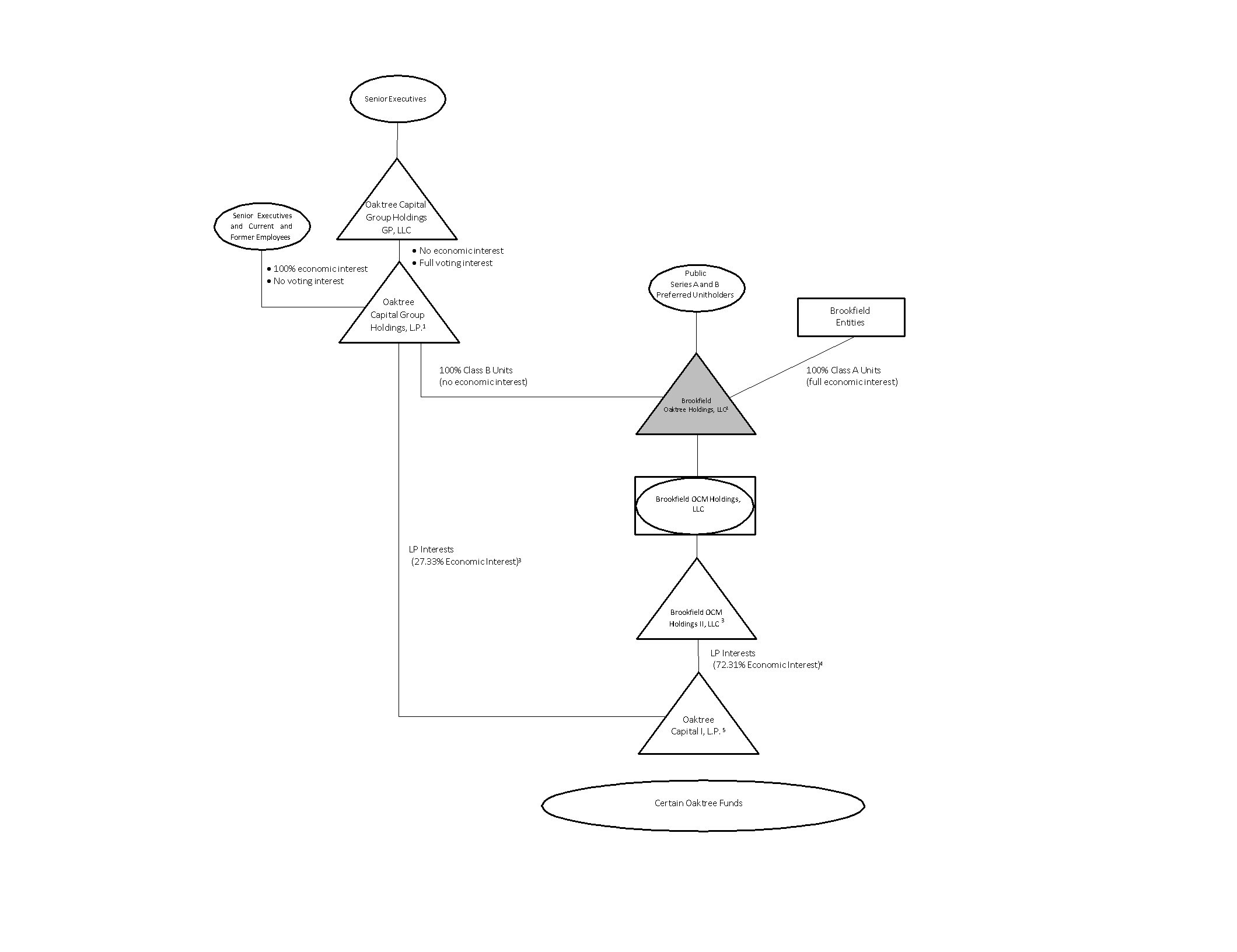
Brookfield Oaktree Holdings, LLC is a Delaware limited liability company that was formed on April 13, 2007 under the name Oaktree Capital Group, LLC. The Company’s issued and outstanding member interests are divided into certain classes and series of units. The Company’s outstanding units are held by (i) an affiliate of Brookfield as the sole holder of the Company’s Class A common units, (ii) preferred unitholders as the holders of Series A and Series B preferred units listed on the New York Stock Exchange (“NYSE”), which represent only the right to receive certain distributions from the Company and such other rights as are specified in the relevant preferred unit designations, and (iii) OCGH as the sole holder of the Company’s Class B common units, which units do not represent an economic interest in the Company. OCGH is owned by the OCGH unitholders. Subject to the operating agreement of the Company, to the extent the approval of any matter requires the vote of the Company’s unitholders, the Class A units are entitled to one vote per unit and the Class B units are entitled to ten votes per unit, voting together as a single class.
16
As explained above, Oaktree’s operations are conducted through a group of operating entities collectively referred to as the “Oaktree Operating Group.” Subsequent to the 2024 Restructuring, we have an indirect economic interest in only one of the six Oaktree Operating Group members through the Company’s approximately 72% equity method investment in Oaktree Capital I. Please see “Business—Structure and Operation of our Business” above for more details, including regarding the 2024 Restructuring. OCGH has a direct economic interest in all of the Oaktree Operating Group members. The interests in the Oaktree Operating Group are referred to as the “Oaktree Operating Group units.” An Oaktree Operating Group unit is not a separate legal interest but represents one limited partnership interest in each of the Oaktree Operating Group entities.
The diagram below depicts our organizational structure in simplified form as of December 31, 2024.
____________________
(1)Holds 100% of the Class B units, which represent approximately 79% of the total combined voting power of our outstanding Class A and Class B units. The Class B units have no economic interest in us. The general partner of Oaktree Capital Group Holdings, L.P. is Oaktree Capital Group Holdings GP, LLC, which is controlled by senior executives of Oaktree.
(2)Brookfield Oaktree Holdings, LLC is the public registrant and the issuer of the Series A and Series B preferred units listed on the NYSE. It also indirectly holds the preferred mirror units issued by Oaktree Capital I, L.P.
(3)Three additional entities, which are not subsidiaries of ours and are not reflected in this diagram, own interests in Brookfield OCM Holdings II, LLC which entitle them to receive (i) two-thirds of carried interest distributions from new closed-end funds organized in or after 2022 and incentive income from evergreen funds earned subsequent to January 1, 2023 and subsequent years and (ii) income from designated investments and investments having certain tax characteristics.
(4)The percent economic interest in Oaktree Capital I, L.P. represents the aggregate number of Oaktree Capital I, L.P. units (other than mirror preferred units) held, directly or indirectly, as a percentage of the total number of Oaktree Capital I, L.P. units (other than mirror preferred units and Class P common units) outstanding. As of December 31, 2024, there were 160,195,444 Oaktree Capital I, L.P. units outstanding.
(5)OEP and OEP II, which are not subsidiaries of ours and are not reflected in this diagram, own less than 1% interest in Oaktree Capital I, L.P.
17
Regulatory Matters and Compliance
Oaktree’s business, as well as the financial services industry in general, is subject to extensive regulation in the United States and elsewhere. Oaktree’s affiliated entities, Oaktree Capital Management (UK) LLP, Oaktree Capital Management (Europe) LLP and Oaktree Capital Management (International) Limited, are authorized and regulated by the U.K. Financial Conduct Authority (“FCA”) as an investment manager in the United Kingdom. The U.K. Financial Services and Markets Act 2000 (“FSMA”) and rules promulgated thereunder govern all aspects of the U.K. investment business, including sales, research and trading practices, the provision of investment advice, the use and safekeeping of client funds and securities, regulatory capital, recordkeeping, margin practices and procedures, the approval standards for individuals, anti-money laundering, periodic reporting, and settlement procedures. Similarly, we have a number of other affiliated entities outside the United States that are regulated by the applicable regulators in their respective jurisdictions.
Our affiliated entity OCM, which provides certain services to us, is registered as an investment adviser with the SEC. Registered investment advisers are subject to the requirements and regulations of the U.S. Investment Advisers Act of 1940, as amended (the “Advisers Act”). These requirements relate to, among other things, fiduciary duties to clients, maintaining an effective compliance program, solicitation agreements, conflicts of interest, recordkeeping and reporting, disclosure, limitations on agency cross and principal transactions between an adviser and advisory clients and general anti-fraud prohibitions. In addition, OCM is registered as a commodity pool operator and a commodity trading adviser with the U.S. Commodity Futures Trading Commission (“CFTC”). Registered commodity pool operators and commodity trading advisers are each subject to the requirements and regulations of the U.S. Commodity Exchange Act, as amended (the “Commodity Exchange Act”). These requirements relate to, among other things, maintaining an effective compliance program, recordkeeping and reporting, disclosure, business conduct, and general anti-fraud prohibitions. In addition, as a registered commodity pool operator and a commodity trading adviser with the CFTC, OCM is also required to be a member of the National Futures Association (the “NFA”), a self-regulatory organization for the U.S. derivatives industry. The NFA also promulgates and enforces rules governing the conduct of, and examines the activities of, its member firms.
One of OCM’s indirect subsidiaries, OCM Investments, LLC, is registered as a broker-dealer with the SEC and in all 50 states, the District of Columbia and Puerto Rico, and is a member of the U.S. Financial Industry Regulatory Authority (“FINRA”). As a broker-dealer, this entity is subject to regulation and oversight by the SEC and state securities regulators. In addition, FINRA, a self-regulatory organization that is subject to oversight by the SEC, promulgates and enforces rules governing the conduct of, and examines the activities of, its member firms. Due to the limited authority granted to OCM Investments, LLC in its capacity as a broker-dealer, it is not required to comply with certain regulations covering trade practices among broker-dealers and the use and safekeeping of customers’ funds and securities. As a registered broker-dealer and member of a self-regulatory organization, OCM Investments, LLC, however, is subject to the SEC’s uniform net capital rule. Rule 15c3-1 of the Exchange Act specifies the minimum level of net capital a broker-dealer must maintain and also requires that a significant part of a broker-dealer’s assets be kept in relatively liquid form. The SEC and FINRA impose rules that require notification when net capital falls below certain predefined criteria, limit the ratio of subordinated debt to equity in the regulatory capital composition of a broker-dealer and constrain the ability of a broker-dealer to expand its business under certain circumstances. Additionally, the SEC’s uniform net capital rule imposes certain requirements that may have the effect of prohibiting a broker-dealer from distributing or withdrawing capital and requiring prior notice to the SEC for certain withdrawals of capital.
Certain of Oaktree’s activities are subject to compliance with laws and regulations of U.S. federal, state and municipal governments, non-U.S. governments, their respective agencies and/or various self-regulatory organizations or exchanges relating to, among other things, antitrust laws, anti-money laundering laws, anti-bribery laws relating to foreign officials, and privacy laws with respect to client information, and some of Oaktree’s funds invest in businesses that operate in highly regulated industries. Any failure to comply with these rules and regulations could expose Oaktree to liability and/or reputational damage, which could adversely affect us. Oaktree’s business has operated for many years within a legal framework that requires Oaktree being able to monitor and comply with a broad range of legal and regulatory developments that affect Oaktree’s activities. However, additional legislation, changes in rules or changes in the interpretation or enforcement of existing laws and rules, either in the United States or elsewhere, may directly affect Oaktree’s and our mode of operation and profitability. Please see “Risk Factors—Risks Relating to Our Business—Regulatory changes in the United States, regulatory compliance failures and the effects of negative publicity surrounding the financial industry in general could adversely affect our reputation, business and operations.”
18
Financial and Other Information
Financial and other information for the years ended December 31, 2024, 2023 and 2022 are discussed in “Management’s Discussion and Analysis of Financial Condition and Results of Operations—Operating Metrics” included elsewhere in this annual report.
Available Information
Oaktree’s website address is www.oaktreecapital.com (the “Oaktree website”). Information on this website is not a part of this annual report and is not incorporated by reference herein. BOH makes available free of charge on this website or provides a link on this website to our Annual Report on Form 10-K, Quarterly Reports on Form 10-Q and Current Reports on Form 8-K and any amendments to those reports filed or furnished pursuant to Section 13(a) or 15(d) of the Exchange Act, as soon as reasonably practicable after those reports are electronically filed with, or furnished to, the SEC. To access these filings, go to the “Unitholders—Investor Relations” section of the Oaktree website and then click on “SEC Filings.” In addition, these reports and the other documents we file with the SEC are available at a website maintained by the SEC at www.sec.gov.
Investors and others should note that BOH uses www.brookfieldoaktreeholdings.com (the “BOH website”) to announce material information to investors and the marketplace. While not all of the information that we post on the BOH website is of a material nature, some information could be deemed to be material. Accordingly, we encourage investors, the media, and others interested in BOH to review the information that is shared on the BOH website. Information contained on, or available through, the BOH website is not a part of this annual report and is not incorporated by reference into this document.
Item 1A. Risk Factors
We are subject to a number of material risks inherent in our business. You should carefully consider the risks and uncertainties described below and other information included in this annual report. If any of the events described below occur, our business and financial results could be seriously harmed. The trading price of our preferred units could decline as a result of any of these risks, and you could lose all or part of your investment.
Risks Relating to Our Business
Given Oaktree’s focus on achieving superior investment performance with less-than-commensurate risk, and the priority afforded to its clients’ interests, Oaktree may reduce AUM, restrain its growth, reduce fees or otherwise alter the terms under which Oaktree or we do business when Oaktree or we deem it appropriate—even in circumstances where others might deem such actions unnecessary. This approach could adversely affect our results of operations.
One of the means by which Oaktree seeks to achieve superior investment performance is by limiting the AUM in its strategies to an amount that it believes can be invested appropriately in accordance with Oaktree’s investment philosophy and current or anticipated economic and market conditions. In the past Oaktree has taken, and may continue to take, affirmative steps to limit the growth of AUM, including the AUM of the funds that produce revenues for Oaktree. These steps include:
•from time to time, Oaktree has suspended marketing certain open-end funds, sometimes for long periods, and has declined to participate in searches aggregating billions of dollars;
•from time to time, Oaktree has returned capital from certain closed-end funds prior to the end of such funds’ respective investment periods or declined to call all of the capital committed to certain closed-end funds during those funds’ respective investment periods;
•Oaktree intentionally sized certain closed-ended funds to be smaller than their predecessors even though additional capital could have been raised; and
•since Oaktree’s founding it has turned away substantial amounts of capital offered to Oaktree for management.
From time to time, Oaktree has, and may continue to, afford certain investors in Oaktree’s funds or separate account clients more favorable economic terms than other investors in the same fund or separate account clients within the same or similar investment strategy, including with respect to management fees and performance-based fees. The availability of such terms is generally based on the aggregate size of commitments of such investor or client to one or more funds or accounts managed by Oaktree.
19
Oaktree’s practice of putting clients’ interests first and forsaking short-term advantage by, for example, reducing assets under management or management fee or carried interest rates may reduce the profits Oaktree could otherwise realize in the short term and adversely affect our business and financial condition. Our unitholders should understand that in instances in which Oaktree’s clients’ interests diverge from the short-term interests of our unitholders, Oaktree intends to act in the interests of its clients. However, it is Oaktree’s fundamental belief that prioritizing its clients’ interests will maximize the long-term value of its business, which, in turn, will benefit our unitholders.
Our business is materially affected by conditions in the global financial markets and economies, and any disruption or deterioration in these conditions could materially reduce our revenues, earnings and cash flow and adversely affect our overall performance, ability to raise or deploy capital, financial prospects and condition and liquidity position.
Our business and the businesses in which Oaktree’s funds invest are materially affected by conditions in the global financial markets and economic conditions throughout the world that are outside our control, such as interest rates, the availability and cost of credit, inflation rates, general economic uncertainty, political uncertainty, changes in laws (including laws relating to taxation), trade barriers, commodity prices, currency exchange rates and controls, volatility in financial markets, the impacts of public health issues, such as pandemics and epidemics, and national and international political circumstances (including economic and political events in or affecting the world’s major economies, such as the ongoing war between Russia and Ukraine and conflicts in the Middle East). These and other uncertain conditions in the global financial markets and economy have resulted in, and may continue to result in, adverse consequences for many of Oaktree’s funds, including restricting such funds’ investment activities and impeding such funds’ ability to effectively achieve their investment objectives. Sanctions imposed by the U.S. and other countries in connection with hostilities between Russia and Ukraine and the tensions between China and Taiwan have caused additional financial market volatility and affected the global economy. In addition, concerns over future increases in inflation, economic recession, as well as interest rate volatility and fluctuations in oil and gas prices resulting from global production and demand levels, as well as geopolitical tension, have exacerbated market volatility.
Market uncertainty and volatility have also been magnified as a result of the 2024 U.S. presidential and congressional elections and resulting uncertainties regarding actual and potential shifts in U.S. and foreign trade, economic and other policies, including with respect to treaties and tariffs. The U.S. has recently enacted and proposed to enact significant new tariffs or other trade barriers. In that connection, certain countries subject to such
trade barriers have imposed or expressed an intent to impose similar measures in return. Additionally, President Trump has directed various federal agencies to further evaluate key aspects of U.S. trade policy and there has been ongoing discussion and commentary regarding potential significant changes to U.S. trade policies, treaties and tariffs. There continues to exist significant uncertainty about the future relationship between the U.S. and other countries with respect to such trade policies, treaties and tariffs. These developments, or the perception that any of them could occur, may have a material adverse effect on global economic conditions and the stability of global financial markets, and may significantly reduce global trade and, in particular, trade between the impacted nations and the U.S. There can be no assurance that future economic conditions in the U.S. or elsewhere around the world will be favorable to our business.
The economic environment in the past has resulted in, and may in the future result in, decreases in the market value of certain publicly-traded securities held by some of Oaktree’s funds. Illiquidity in certain portions of the financial markets could adversely affect the pace of realization of Oaktree’s funds’ investments or otherwise restrict the ability of Oaktree’s funds to realize value from their investments, thereby adversely affecting our ability to generate investment income. There can be no assurance that conditions in the global financial markets will not deteriorate and/or adversely affect our investments and overall performance. These market and economic conditions are not in our control and are often difficult, if not impossible, to predict, manage, mitigate, hedge or foresee.
Our profitability may also be adversely affected by our fixed costs, such as service fees paid to OCM under the Services Agreement, and the possibility that we or Oaktree would be unable to scale back other costs and otherwise redeploy resources within a time frame sufficient to match changes in market and economic conditions to take advantage of the opportunities that may be presented by these changes. As a result, we or Oaktree may not be able to adjust resources to take advantage of new investment opportunities that may be created as a result of specific dislocations in the market.
Inflation has adversely affected and may continue to adversely affect Oaktree’s business, results of operations and financial condition of Oaktree’s funds and their portfolio companies.
Certain of Oaktree’s funds and their portfolio companies are in industries that have been impacted by inflation. Recent inflationary pressures have increased the costs of labor, energy and raw materials and have adversely
20
affected consumer spending, economic growth and Oaktree’s funds’ portfolio companies’ operations. While inflation decelerated over 2024, profit margins may be pressured if inflation re-accelerates, particularly for companies that lack pricing power. If such portfolio companies are unable to pass any increases in their costs of operations along to their customers, it could adversely affect their operating results. In addition, any projected future decreases in the operating results of Oaktree’s funds’ portfolio companies due to inflation could adversely impact the fair value of those investments. Any decreases in the fair value of Oaktree’s fund investments could result in future realized or unrealized losses.
Our business depends in large part on Oaktree’s ability to raise capital from investors. If Oaktree were unable to raise such capital, Oaktree would be unable to collect incentive fees or deploy such capital into investments, which would materially reduce our revenues and cash flow and adversely affect our financial condition.
Oaktree’s ability to raise capital from investors depends on a number of factors, including many that are outside its control. These include the general economic environment and the number of other investment funds being raised at the same time by Oaktree’s competitors that are focused on the same or similar investment strategies as Oaktree’s funds. Additionally, investors may reduce (or even eliminate) their investment allocations to alternative investments, including closed-ended private funds and hedge funds. During periods of high interest rates, investors may favor investments that are generally viewed as producing a risk-free return, such as treasury bonds, over investments in Oaktree’s funds. Poor performance of Oaktree’s funds could also make it more difficult for Oaktree to raise new capital. Investors in Oaktree’s funds may decline to invest in future funds Oaktree raises, and investors in open-end and evergreen funds may withdraw their investments in the funds (on specified withdrawal dates) as a result of poor performance. Oaktree’s investors and potential investors continually assess Oaktree’s funds’ performance, both on a standalone basis and relative to market benchmarks and Oaktree’s competitors, and Oaktree’s ability to raise capital for existing and future funds and avoid excessive redemptions depends on Oaktree’s funds’ relative and absolute performance. To the extent economic and market conditions deteriorate, Oaktree may be unable to raise sufficient amounts of capital to support the investment activities of future funds.
In addition, certain institutional investors, including sovereign wealth funds and public pension funds, have demonstrated an increased preference for alternatives to the traditional investment fund structure, such as managed accounts, funds-of-one and co-investment vehicles. There can be no assurance that such alternatives will be as profitable for Oaktree as the traditional investment fund structure, or as to the impact such a trend could have on the cost of our operations or profitability. Moreover, certain institutional investors are demonstrating a preference to make direct investments in alternative assets without the assistance of private asset managers like Oaktree. Such institutional investors may become Oaktree’s competitors and could cease to be Oaktree clients. As some existing investors cease or significantly curtail making commitments to alternative investment funds, Oaktree may need to identify and attract new investors in order to maintain or increase the size of Oaktree’s investment funds. There are no assurances that Oaktree can find or secure capital commitments from new investors. If economic conditions were to deteriorate or if Oaktree is unable to find new investors, Oaktree might raise less than its desired amount for a given fund.
If Oaktree were unable to successfully raise capital, it could materially reduce our revenue, earnings and cash flow and adversely affect our financial prospects and condition.
We depend on OCM as the primary investment adviser to Oaktree’s funds to support Oaktree’s funds’ investment activities and a Services Agreement with OCM to support Oaktree’s operations; if the terms of the services provided by OCM were significantly altered or if the arrangements to provide such services were terminated, our ability to achieve our investment objective or operate as a public reporting company could be significantly harmed.
Oaktree’s funds depend on the diligence, skill, judgment, reputation and business contacts of key personnel of OCM provided to them through investment management agreements with OCM and we depend on key personnel of OCM under the Services Agreement between OCM and us. Our future success will depend upon OCM’s ability to retain these key personnel and to recruit additional qualified personnel. These key personnel possess substantial experience and expertise in investing, are responsible for locating and executing Oaktree’s funds’ investments, have significant relationships with the institutions that are the source of many of Oaktree’s funds’ investment opportunities and in certain cases have strong relationships with Oaktree’s investors. Therefore, if these key personnel join competitors or form competing companies, it could result in the loss of significant investment opportunities and certain existing investors. OCM is not obligated to dedicate any specific personnel exclusively to its funds or to us, nor is OCM or its personnel obligated to dedicate any specific portion of their time to the management of our business. Consequently, we may not receive the level of support and assistance that we otherwise might receive if OCM personnel were employed directly by us and we have no ability to determine the level of support that OCM
21
provides to the Oaktree funds in which we directly and indirectly invest. We are also subject to conflicts of interest arising out of our relationship with OCM, Brookfield and their respective affiliates. For example, Mr. Howard Marks, our Co-Chairman and one of our board members, is also the Co-Chairman of OCM and a board member of Brookfield. As mentioned above (under “Business—Overview”), Brookfield and its affiliates acquired a majority interest in Oaktree upon the completion of the Mergers. Accordingly, Mr. Marks owes duties to OCM and Brookfield, which duties may from time-to-time conflict with the interests of us and our preferred unitholders. Additionally, if our Services Agreement with OCM was significantly altered or terminated, it could result in the loss of significant key personnel of OCM that we depend on to operate as a public reporting company and could have a material adverse effect on our financial condition and results of operation. Also, the services of our Chief Executive Officer, Mr. Nicholas H. Goodman, are made available by Brookfield. If Brookfield ceased to do so, we would have to identify another person to serve as our chief executive officer, which could be disruptive and/or have a material adverse effect on our financial condition and results of operation.
As the appointed investment adviser to Oaktree’s funds, OCM provides Oaktree’s funds services to evaluate, negotiate, structure, execute, monitor and service the funds’ investments. Key personnel of OCM have departed in the past and current key personnel could depart at any time. The termination of the Services Agreement or the departure of key personnel or of a significant number of the investment professionals or partners of OCM could have a material adverse effect on our ability to maintain our operations or Oaktree’s ability to achieve its funds’ investment objectives. OCM may need to hire, train, supervise and manage new professionals to service our business and may not be able to find qualified professionals in a timely manner or at all.
Our revenues are volatile due to the nature and structure of our business, and if we experience a substantial decline in our investment income, we may not be able to pay distributions on our preferred units.
Our revenues and cash flow are more volatile and limited following the 2019 Restructuring, the 2022 Restructuring and the 2024 Restructuring. As a result of the 2024 Restructuring, the Company no longer consolidates the operations of Oaktree Capital I, but rather accounts for the Company’s approximately 72% interest in Oaktree Capital I under the equity method of accounting. As such, subsequent to the 2024 Restructuring, the Company’s revenue is primarily the investment income earned from (i) limited partner investments in certain of Oaktree’s flagship opportunistic funds, (ii) an equity method investment in Oaktree Capital I, and (iii) an indirect ownership in Brookfield REIT. If we were to experience a significant reduction in investment income, we may not be able to pay future distributions on our preferred units.
Oaktree’s failure to deal appropriately with conflicts of interest or inter-fund governance matters could damage our reputation and adversely affect our business.
As Oaktree has expanded the number and scope of its strategies and distribution channels, including Oaktree’s advising registered mutual funds and business development companies, Oaktree increasingly confronts potential conflicts of interest that it needs to manage and resolve. In our view, conflicts of interest may describe two types of potential situations: (i) where the interests of the funds Oaktree manages (or the investors in such funds) may conflict with one another; and (ii) where Oaktree’s interests, as manager or adviser, may conflict with the interests of Oaktree’s funds or clients.
Examples of potential inter-fund conflicts include: (i) the allocation of investment opportunities in situations where the investment focus of one or more of Oaktree’s funds overlaps (including certain instances in which funds registered under the Investment Company Act may be precluded from participating in certain opportunities as a result of regulatory restrictions applicable to companies with multiple types of funds with overlapping investment focuses); (ii) opportunities to co-invest directly alongside a fund that are offered to certain fund investors rather than to other Oaktree funds or other fund investors; (iii) investments by different funds at different levels of the capital structure of the same issuer; (iv) receipt of material, non-public information regarding an issuer by one strategy where another strategy does not wish to be restricted in trading the securities of that issuer; and (v) investments by a fund into a portfolio company held or controlled by another fund. Over time Oaktree has developed general guidelines or a course of conduct to manage these potential inter-fund governance matters, including establishing an inter-fund governance work group and standing committee composed of senior officers from Oaktree’s non-investment groups, including Oaktree’s legal and compliance departments. Oaktree seeks to resolve such governance issues in good faith and with a view to the best interests of all of its clients, but there can be no assurance that Oaktree will make the correct judgment or that its judgment will not be questioned or challenged.
In addition to the potential for conflict among Oaktree’s funds, we and Oaktree face the potential for conflict between us and Oaktree, on the one hand, and Oaktree’s funds or Oaktree’s clients, on the other hand. These conflicts may include: (i) personal trading by Oaktree personnel in the securities of issuers held by one or more of Oaktree’s funds; (ii) the allocation of investment opportunities among funds with different incentive fee structures, or where Oaktree personnel have invested more heavily in one fund than another; (iii) the use of subscription lines by
22
Oaktree’s funds, which, among other things, may cause fund investors to indirectly bear interest expense when such investors would prefer to contribute capital and avoid the interest expense; and (iv) the determination of what constitutes fund-related expenses and the allocation of such expenses between Oaktree’s funds and us or Oaktree. Through Oaktree, we maintain internal controls and various policies and procedures, including oversight, codes of ethics and conduct, compliance systems and communication tools, to identify, prevent, mitigate or resolve conflicts of interest that may arise. Notwithstanding these efforts, it is possible that perceived or actual conflicts could give rise to investor dissatisfaction or litigation or regulatory enforcement actions. Appropriately dealing with conflicts of interest is complex and difficult, and any mistake could potentially create liability or damage our reputation. Regulatory scrutiny of, or litigation in connection with, conflicts of interest could have a material adverse effect on our reputation, which in turn could materially adversely affect our business in a number of ways, such as causing investors to redeem their capital (to the degree they have that right), making it harder for Oaktree to raise new funds and discouraging others from doing business with Oaktree.
The investment management business is intensely competitive.
The investment management business is intensely competitive, with competition based on a variety of factors, including investment performance, the quality of client service, brand recognition and business reputation. Oaktree’s investment management business competes for clients, personnel and investment opportunities with a large number of private equity funds, specialized investment funds, hedge funds, corporate buyers, traditional investment managers, commercial banks, investment banks, other investment managers and other financial institutions, and we expect that competition will increase. Numerous factors serve to increase Oaktree’s competitive risks, some of which are outside of our control:
•a number of Oaktree’s competitors have more personnel and greater financial, technical, marketing and other resources than Oaktree does, and, in the case of some competitors, longer operating histories, more established relationships and/or greater experience;
•some of Oaktree’s funds may not perform as well as competitors’ funds or other available investment products;
•many of Oaktree’s competitors have raised, or are expected to raise, significant amounts of capital, and many of them have investment objectives similar to Oaktree’s, which may create additional competition for investment opportunities and reduce the size and duration of pricing inefficiencies that Oaktree seeks to exploit;
•some of Oaktree’s competitors (including strategic competitors) may have a lower cost of capital and access to funding sources that are not available to us, which may create competitive disadvantages for Oaktree with respect to Oaktree’s funds, particularly Oaktree’s funds that directly use leverage or rely on debt financing of their portfolio companies to generate superior investment returns;
•some of Oaktree’s competitors have higher risk tolerances, different risk assessments or lower return thresholds, which could allow them to consider a wider variety of investments and to bid more aggressively than Oaktree for investments;
•Oaktree’s competitors may be able to achieve synergistic cost savings in respect of an investment that Oaktree cannot, which may provide them with a competitive advantage in bidding for an investment;
•there are relatively few barriers to entry impeding new investment funds, and the successful efforts of new entrants into Oaktree’s various lines of business, including major commercial and investment banks and other financial institutions, have resulted in increased competition;
•some of Oaktree’s competitors may have better expertise or be regarded by investors as having better expertise in a specific asset class or geographic region than Oaktree does;
•some investors may prefer to pursue investments directly instead of investing through one of Oaktree’s funds; and
•other industry participants will from time to time seek to recruit Oaktree’s investment professionals and other employees away from Oaktree.
Oaktree may find it harder to raise funds, and may lose investment opportunities in the future, if Oaktree does not match or improve on the fees, structures, products and terms offered by competitors to their fund clients. Alternatively, Oaktree may experience decreased profitability, rates of return and increased risk of loss if Oaktree matches or improves on the prices, structures, products and terms offered by competitors. This competitive pressure could adversely affect Oaktree’s ability to make successful investments and limit Oaktree’s ability to raise future funds, either of which would adversely impact our business, revenues, results of operations and cash flow.
23
Additionally, technological innovation, including the use of artificial intelligence and data science, has the potential to disrupt the financial industry and change the way financial institutions, including asset managers, do business. Some of Oaktree’s competitors may be more successful than Oaktree in the development and implementation of new technologies, including services and platforms based on artificial intelligence, to address investor demand or improve operations. If Oaktree is unable to adequately advance Oaktree’s capabilities in these areas, or does so at a slower pace than others in Oaktree’s industry, Oaktree may be at a competitive disadvantage.
Poor performance of Oaktree funds could adversely affect Oaktree’s ability to raise capital for future funds and poor performance of funds in which we are directly or indirectly invested would cause a decline in our revenues, net income and cash flow.
When any of Oaktree’s funds performs poorly, either by incurring losses or underperforming benchmarks or Oaktree’s competitors, Oaktree’s investment record suffers. Poor investment performance by Oaktree funds in which we are directly or indirectly invested also adversely affects our investment income and, all else being equal, may lead to a decline in Oaktree’s AUM. In such circumstances, we may experience losses on our investments of our own capital or losses through our equity method investment in Oaktree Capital I. Poor performance of Oaktree’s funds could also make it more difficult for Oaktree to raise new capital for Oaktree. Investors in Oaktree’s closed-end funds may decline to invest in future closed-end funds Oaktree raises, and investors in open-end and evergreen funds may withdraw their investments in the funds (on specified withdrawal dates) as a result of poor performance. Oaktree’s investors and potential investors continually assess Oaktree’s funds’ performance, both on a standalone basis and relative to market benchmarks, Oaktree’s competitors, and other investment products, and Oaktree’s ability to raise capital for Oaktree’s existing and future funds and avoid excessive redemption levels depends on Oaktree’s funds’ performance.
Oaktree may not be able to maintain its current incentive fee structure as a result of industry pressure from clients to reduce fees, which could have an adverse effect on our profit margins and results of operations.
Oaktree may not be able to maintain its current incentive fee structure as a result of industry pressure from clients to reduce fees. Although Oaktree’s incentive fee rates may vary among and within asset classes, historically Oaktree has competed primarily on the basis of its performance and not on the level of Oaktree’s fees relative to those of Oaktree’s competitors. In recent years, however, there has been a general trend toward lower fees in the investment management industry, and Oaktree has in certain cases lowered the fees Oaktree charges in order to remain competitive. Additionally, Oaktree has afforded, and reserved the right in Oaktree’s sole discretion to continue to afford, certain clients more favorable economic terms, including with respect to incentive fee rates, in cases where such clients have committed capital to Oaktree’s funds or strategies that in the aggregate exceeds certain threshold amounts. In order to maintain Oaktree’s fee structure in a competitive environment, Oaktree must be able to continue to provide clients with investment returns and service that incentivize Oaktree’s investors to pay its current fee rates. We cannot provide any assurance that Oaktree will succeed in providing investment returns and service that will allow Oaktree to maintain its current fee structure. Fee reductions on existing or new business could have an adverse effect on Oaktree’s profit margins and results of operations. For more information about Oaktree’s fees please see “Management’s Discussion and Analysis of Financial Condition and Results of Operations.”
Oaktree often pursues investment opportunities that involve business, regulatory, legal or other complexities.
Oaktree often pursues unusually complex investment opportunities involving substantial business, regulatory or legal complexity that would deter other investment managers. Oaktree’s tolerance for complexity presents risks, as such transactions can be more difficult, expensive and time-consuming to finance and execute; it can be more difficult to manage or realize value from the assets acquired in such transactions; and such transactions sometimes entail a higher level of regulatory scrutiny or a greater risk of contingent liabilities. Any of these risks could harm the performance of Oaktree’s funds.
Technological developments in artificial intelligence could disrupt the markets in which Oaktree operates and subject Oaktree and us to increased competition, legal and regulatory risks and compliance costs.
Technological developments in artificial intelligence, including machine learning technology and generative artificial intelligence (collectively, “AI Technologies”) and their current and potential future applications, including in the private investment and financial sectors, as well as the legal and regulatory frameworks within which they operate, are rapidly evolving. The full extent of current or future risks related thereto is not possible to predict. AI Technologies could significantly disrupt the markets in which Oaktree operates and subject Oaktree and us to increased competition, legal and regulatory risks and compliance costs, which could have a material adverse effect on Oaktree’s business or our business, financial condition and results of operations. Oaktree intends to seek to avail
24
itself of the potential benefits, insights and efficiencies that are available through the use of AI Technologies, which presents a number of potential risks that cannot be fully mitigated. Data in models that AI Technologies utilize are likely to contain a degree of inaccuracy and error, which could result in flawed algorithms. This could reduce the effectiveness of AI Technologies and adversely impact us and our operations to the extent we rely on the work product of such AI Technologies in such operations. There is also a risk that AI Technologies may be misused or misappropriated by Oaktree’s employees and/or third parties engaged by us or Oaktree. For example, a user may input confidential information, including material non-public information or personal information, into AI Technology applications, resulting in such information becoming part of a dataset that is accessible by third-party AI Technology applications and users, including Oaktree’s competitors. Such actions could subject Oaktree and/or us to legal and regulatory investigations and/or actions. Further, Oaktree or we may not be able to control how third-party AI Technologies that Oaktree or we choose to use are developed or maintained, or how data Oaktree or we input is used or disclosed, even where Oaktree has sought contractual protections with respect to these matters. The misuse or misappropriation of Oaktree’s or our data could have an adverse impact on our reputation and could subject Oaktree and/or us to legal and regulatory investigations and/or actions. In addition, Oaktree or we may communicate externally regarding AI Technology-related initiatives, including Oaktree’s development and use of AI Technologies, which subjects Oaktree and us to the risk of being accused of making inaccurate or misleading statements regarding Oaktree’s and our ability to avail ourselves of the potential benefits of AI Technology.
Regulations related to AI Technologies continue to evolve and may also impose on Oaktree and us certain obligations and costs related to monitoring and compliance. For example, in April 2023, the Federal Trade Commission, U.S. Department of Justice, Consumer Financial Protection Bureau, and U.S. Equal Employment Opportunity Commission released a joint statement on artificial intelligence demonstrating interest in monitoring the development and use of automated systems and enforcement of their respective laws and regulations. In October 2023, the former Presidential Administration signed an executive order (the “October 2023 Executive Order”) that established new standards for AI safety and security. However, in January 2025, the current Presidential Administration signed an executive order that rescinded the October 2023 Executive Order and requires the development of an AI action plan that is consistent with the current Presidential Administration’s policy within 180 days. In the EU, a regulation applicable to certain AI Technologies and the data used to train, test and deploy them (the “EU AI Act”) entered into force in August 2024, with most of its obligations applying in phases from 6 to 36 months thereafter. The EU AI Act imposes significant requirements on both the providers and deployers of AI Technologies, and significant sanctions for breaches. Moreover, claims for damages in respect of AI Technologies may also be possible (and in certain jurisdictions, facilitated by revisions to regulations on liability). The costs of preparing for, monitoring and complying with laws and regulations related to AI Technologies, and any claims or penalties as the result of any use of or reliance on AI Technologies, could, if applicable, adversely affect Oaktree, us and/or third parties connected to Oaktree or us (whether directly or indirectly), which could adversely affect our business and results of operations.
Extensive regulation in the United States and abroad affects Oaktree’s activities and creates the potential for significant liabilities and penalties that could adversely affect our business and results of operations.
Potential regulatory action poses a significant risk to our reputation and our business. Oaktree’s business, and by extension our business, is subject to extensive regulation in the United States and in the other countries in which Oaktree’s investment activities occur, including periodic examinations, inquiries and investigations by governmental and self-regulatory organizations in the jurisdictions in which Oaktree operates around the world. Many of these regulators, including U.S. federal and state and foreign government agencies and self-regulatory organizations, are empowered to impose fines, suspensions of personnel or other sanctions, including censure, the issuance of cease-and-desist orders or the suspension or expulsion of applicable licenses and memberships. Even if an investigation did not result in a sanction, or the sanction imposed against us, Oaktree or Oaktree’s personnel were small in monetary amount, adverse publicity relating to the investigation could harm our or Oaktree’s reputation and cause Oaktree to lose existing investors or fail to gain new investors.
Each of the regulatory bodies with jurisdiction over Oaktree or us has regulatory powers dealing with many aspects of financial services, including the authority to grant, and in specific circumstances to cancel, permissions to carry on particular activities. A failure to comply with the applicable obligations imposed by the Advisers Act and the Investment Company Act, including recordkeeping, custody, advertising and operating requirements, disclosure obligations and prohibitions on fraudulent activities, could result in investigations, sanctions and reputational damage. Similarly, a failure to comply with the obligations imposed by the Commodity Exchange Act, including recordkeeping, reporting requirements, disclosure obligations and prohibitions on fraudulent activities, could also result in investigations, sanctions and reputational damage. Oaktree’s funds are involved regularly in trading activities that implicate a broad number of U.S. securities law regimes, including laws governing trading on inside information, market manipulation and a broad number of technical trading requirements that implicate fundamental
25
market regulation policies. Violation of these laws could result in severe restrictions on Oaktree’s activities and damage to Oaktree’s reputation and our reputation.
Oaktree’s or our failure to comply with applicable laws or regulations could result in litigation, fines, censure, suspensions of personnel or other sanctions, including revocation of the registration of relevant affiliated entities as an investment adviser, CPO, CTA or registered broker-dealer. The regulations to which Oaktree’s business is subject are designed primarily to protect investors in Oaktree’s funds and to ensure the integrity of the financial markets. They are not designed to protect our preferred unitholders. Even if a sanction imposed against Oaktree or us, one of Oaktree’s or our subsidiaries or Oaktree personnel by a regulator is for a small monetary amount, the adverse publicity related to the sanction could harm our reputation, which in turn could materially adversely affect our or Oaktree’s business in a number of ways, such as causing Oaktree’s investors to redeem their capital (to the extent they have that right), making it harder for Oaktree to raise new funds and discouraging others from doing business with Oaktree.
Some of Oaktree’s funds from time to time invest in businesses that operate in highly-regulated industries, including businesses that are regulated by the U.S. Federal Communications Commission, the U.S. Federal Energy Regulatory Commission, U.S. federal and state banking authorities and U.S. state gaming authorities, as well as equivalent foreign regulatory bodies. The regulatory regimes to which such businesses are subject may, among other things, condition Oaktree’s funds’ ability to invest in those businesses upon the satisfaction of applicable ownership restrictions or qualification requirements or, absent any applicable exemption, require Oaktree or its subsidiaries to comply with registration, reporting or other requirements. Moreover, Oaktree’s failure to obtain or maintain any regulatory approvals necessary for Oaktree’s funds to invest in such industries may disqualify Oaktree’s funds from participating in certain investments or require Oaktree’s funds to divest themselves of certain assets.
Regulatory changes in the United States, regulatory compliance failures and the effects of negative publicity surrounding the financial industry in general could adversely affect our reputation, business and operations.
The business in which we and Oaktree operate both in and outside the United States may be subject to new or additional regulations from time to time. We and Oaktree may be adversely affected as a result of new or revised legislation or regulations imposed by the SEC, the CFTC or other U.S. governmental regulatory authorities or self-regulatory organizations that supervise the financial markets and businesses such as Oaktree’s and ours. The financial services industry in recent years has been the subject of heightened scrutiny and the SEC has specifically focused on private equity and the private funds industry. In that connection, in recent years the SEC’s stated examination priorities and published observations from examinations have included, among other things, private equity firms’ collection of fees and allocation of expenses, their marketing and valuation practices, allocation of investment opportunities, investor side letter terms, consistency of firms’ practices with disclosures, handling of material non-public information and insider trading, disclosures of investment risk, conflicts of interest, adherence to notice, consent and other contractual requirements regarding limited partnership advisory committees, fiduciary standards of conduct, financial technologies, and compliance with the SEC’s recently adopted rules, including those referenced herein. In recent years, the SEC has proposed, and in some instances, adopted, a number of new rules and amendments to existing rules that impact our or Oaktree’s business and operations.
For example, the SEC (in May 2023) and the SEC and CFTC jointly (in February 2024) adopted changes to Form PF, a confidential form relating to reporting by private fund advisers and intended to be used by the Financial Stability Oversight Counsel (“FSOC”) for systemic risk oversight purposes, that expand existing reporting obligations. Such increased obligations may increase Oaktree’s costs, including if it is required to spend more time, hire additional personnel, or buy new technology to comply effectively.
The SEC has also proposed several other rules that may impact our or Oaktree’s operations. For example, an October 2022 SEC proposal would, if adopted, impose substantial obligations on registered investment advisers to conduct initial due diligence and ongoing monitoring of a broad universe of service providers that we or Oaktree may use. If adopted, these new rules could significantly increase compliance burdens and associated regulatory costs and complexity for us and Oaktree and enhance the risk of regulatory action, which could adversely impact our reputation and Oaktree’s fundraising efforts, including as a result of regulatory sanctions. Moreover, in February 2023, the SEC proposed extensive amendments to the custody rule for SEC-registered investment advisers which would apply to all assets of an advisory client, including real estate and other assets that generally are not considered securities under the federal securities laws. If adopted, the amendments would require, among other things, that qualified custodians maintain possession of and control of assets of advisory clients and participate in or effectuate any changes of such assets’ beneficial ownership. There is a lack of clarity as to whether all assets held by advisory clients can be custodied in a manner that satisfies the proposed rule or whether existing qualified
26
custodians will provide custodial services for such assets at a reasonable cost or at all. If adopted, these amendments could expose Oaktree’s registered investment advisers to additional regulatory liability, increase compliance costs and impose limitations on Oaktree’s investing activities. Whether such proposed rules will ultimately be adopted, or, if adopted, what the full extent of their impact would be is unclear. The general anticipation is that, if adopted, these proposed rules will increase regulatory and compliance costs, place burdens on Oaktree’s resources, including the time and attention of Oaktree’s personnel, and heighten the risk of regulatory action.
We and Oaktree also may be adversely affected by changes in the interpretation or enforcement of existing laws and rules by these governmental authorities and self-regulatory organizations. For example, in recent years, senior officials at the SEC have shown a willingness to pursue violations that could be viewed as minor on the theory that publicly pursuing minor violations could reduce the prevalence of more significant violations.
In June 2024, the U.S. Supreme Court reversed its longstanding approach under the Chevron doctrine, which provided for judicial deference to regulatory agencies. As a result of this decision, we cannot be sure whether there will be increased challenges to existing agency regulations or how lower courts will apply the decision in the context of other regulatory schemes without more specific guidance from the U.S. Supreme Court. For example, the decision could significantly impact consumer protection, advertising, privacy, artificial intelligence, anti-corruption and anti-money laundering practices and other regulatory regimes with which we, Oaktree and Oaktree’s portfolio companies are or may be required to comply. Any such regulatory developments could result in uncertainty about and changes in the ways such regulations apply to us, Oaktree and Oaktree’s portfolio companies, and may require additional resources to ensure continued compliance. We cannot predict which, if any, of these actions will be taken or, if taken, their effect. Such actions could have a significant adverse effect on our business, financial condition and results of operations.
It is difficult to determine the full extent of the impact on us or Oaktree of any new laws, regulations or initiatives that may be proposed or whether any of the proposals will become law. Any changes in the regulatory framework applicable to our or Oaktree’s business, including the changes described above, may impose additional costs on us, require the attention of Oaktree’s senior management or result in limitations on the manner in which Oaktree and we conduct our businesses. Moreover, as calls for additional regulation have increased, there may be a related increase in regulatory investigations of the trading and other investment activities of alternative asset management funds, including Oaktree’s funds. In addition, Oaktree and we may be adversely affected by changes in the interpretation or enforcement of existing laws and rules by these governmental authorities and self-regulatory organizations. Compliance with any new laws or regulations could make our overall compliance activities more difficult and expensive, affect the manner in which Oaktree and we conduct our businesses and adversely affect our profitability.
Changes in law and government regulations may adversely affect our business, financial condition and results of operations.
The current regulatory environment in the United States may be impacted by future legislative developments, such as amendments to key provisions of the Dodd-Frank Act. Any changes in the regulatory framework applicable to our business, Oaktree’s business or the businesses of the portfolio companies of Oaktree’s funds may impose additional costs or result in limitations on the manner in which business is conducted, or may ultimately have an adverse impact on the competitiveness of certain nonbank financial service providers vis-à-vis traditional banking organizations.
Regulatory changes in jurisdictions outside the United States could adversely affect Oaktree’s business.
Certain of Oaktree’s subsidiaries operate outside the United States. A number of these subsidiaries are regulated by governmental authorities in foreign jurisdictions where they operate. In addition, Oaktree regularly relies on exemptions from various requirements of the regulations of certain foreign countries in conducting its asset management and fundraising activities.
Each of the regulatory bodies with jurisdiction over Oaktree has regulatory powers dealing with many aspects of Oaktree’s business generally and financial services specifically, including the authority to grant, and in specific circumstances to cancel, permissions to carry on particular activities. Oaktree is involved regularly in trading activities that implicate a broad number of foreign (as well as U.S.) securities law regimes, including laws governing trading on inside information and market manipulation and a broad number of technical trading requirements that implicate fundamental market regulation policies. Additionally, Oaktree must comply with foreign laws governing the sale of interests in Oaktree’s funds and laws that govern other business activities. Violation of these laws could result in severe penalties, restrictions or prohibitions on Oaktree’s activities and damage to Oaktree’s reputation and our reputation, which in turn could materially adversely affect Oaktree’s or our business in a number of ways, such
27
as causing investors to redeem their capital (to the degree they have that right) from Oaktree’s funds, making it harder for Oaktree to raise new funds and discouraging others from doing business with Oaktree.
SEC rules barring so-called “bad actors” from relying on Rule 506 of Regulation D in private placements could materially adversely affect Oaktree’s business, financial condition and results of operations.
Rules 501 and 506 of Regulation D under the Securities Act prohibit issuers deemed to be “bad actors” from relying on the exemptions available under Rule 506 of Regulation D (“Rule 506”) in connection with private placements (the “disqualification rule”). Specifically, an issuer will be precluded from conducting offerings that rely on the exemption from registration under the Securities Act provided by Rule 506 (“Rule 506 offerings”) if a “covered person” of the issuer has been the subject of a “disqualifying event” (each as defined below). “Covered persons” include, among others, the issuer, affiliated issuers, any investment manager or solicitor of the issuer, any director, executive officer or other officer participating in the offering of the issuer, any general partner or managing member of the foregoing entities, any promoter of the issuer and any beneficial owner of 20% or more of the issuer’s outstanding voting equity securities, calculated on the basis of voting power. A “disqualifying event” includes, among other things, certain (1) criminal convictions and court injunctions and restraining orders issued in connection with the purchase or sale of a security or false filings with the SEC; (2) final orders from the CFTC, federal banking agencies and certain other regulators that bar a person from associating with a regulated entity or engaging in the business of securities, insurance or banking or that are based on certain fraudulent conduct; (3) SEC disciplinary orders relating to investment advisers, brokers, dealers and their associated persons; (4) SEC cease-and-desist orders relating to violations of certain anti-fraud provisions and registration requirements of the federal securities laws; (5) suspensions or expulsions from membership in a self-regulatory organization (“SRO”) or from association with an SRO member; and (6) U.S. Postal Service false representation orders.
If any Oaktree covered person is subject to a disqualifying event, one or more of Oaktree’s funds could lose the ability to raise capital in a Rule 506 offering for a significant period of time. Most of Oaktree’s funds rely on Rule 506 to raise capital from investors during their fundraising periods. If one or more of Oaktree’s funds were to lose the ability to rely on the Rule 506 exemption because an Oaktree covered person has been the subject of a disqualifying event, our business, financial condition and results of operations could be materially and adversely affected.
Oaktree’s failure to comply with “pay to play” regulations implemented by the SEC and certain states, and changes to the “pay to play” regulatory regimes, could adversely affect Oaktree’s business.
In recent years, the SEC and several states have initiated investigations alleging that certain private equity firms and hedge funds or agents acting on their behalf have paid money to current or former government officials or their associates in exchange for improperly soliciting contracts with state pension funds. The SEC has also initiated a similar investigation into contracts awarded by sovereign wealth funds. Rule 206(4)-5 under the Advisers Act addresses “pay to play” practices by investment advisers involving campaign contributions and other payments to government officials able to exert influence on potential U.S. state and local government entity clients. Among other restrictions, the rule prohibits investment advisers from providing advisory services for compensation to a government entity for two years, subject to very limited exceptions, after the investment adviser, its senior executives or its personnel involved in soliciting investments from government entities make contributions to certain candidates and officials in a position to influence the hiring of an investment adviser by such government entity. The rule does not require any showing that a donation was made with intent to exert influence. Any donation that exceeds the limits set forth in Rule 206(4)-5 may lead to an investment adviser being required to forgo compensation from applicable government entities for two years; to the extent such fees have already been paid, the investment adviser may be required to forfeit the already-received compensation. Advisers are required to implement compliance policies designed, among other matters, to track contributions by certain of the adviser’s employees and engagements of third parties that solicit government entities and to keep certain records in order to enable the SEC to determine compliance with the rule. Additionally, California law requires placement agents (including in certain cases employees of investment managers) who solicit funds from California state retirement systems, such as the California Public Employees’ Retirement System and the California State Teachers’ Retirement System, to register as lobbyists, thereby becoming subject to increased reporting requirements and prohibited from receiving contingent compensation for soliciting investments from California state retirement systems. New York has adopted similar rules. In July 2018, OCM reached a settlement with the SEC related to its “pay to play” rules pursuant to which OCM paid a monetary settlement to the SEC and agreed not to violate the rule in the future. Any failure by OCM or another of Oaktree’s affiliated entities or their respective personnel involved in soliciting investment from government entities to comply with these rules could expose Oaktree or us to reputational damage since we are affiliated with OCM. Additionally, the SEC’s amended rules for investment adviser marketing
28
that went into effect in 2022 impose more prescriptive requirements and will impact the marketing of Oaktree’s funds as well as placement agent arrangements globally. Compliance with the new rule may result in higher compliance and operational costs and less overall flexibility in Oaktree’s marketing.
Oaktree’s failure to maintain the security of its information and technology networks, including personal data and client information, intellectual property and proprietary business information could have a material adverse effect on us.
Security breaches and other disruptions of or incidents affecting Oaktree’s information and technology networks could result in compromising our or Oaktree’s information and intellectual property and expose us or Oaktree to significant liability, reputational harm, regulatory investigation and remediation costs, which could cause material harm to our business and financial results. In the ordinary course of our and Oaktree’s business, Oaktree collects, processes and stores sensitive data, including proprietary business information and intellectual property, and personal data of Oaktree employees and its clients, in Oaktree’s data centers and on Oaktree’s networks (including data stored on systems maintained by third parties). The secure processing, maintenance and transmission of this information are critical to our operations. In many cases, this information is provided or made available to third-party vendors who agree to protect it, which has in the past and may in the future become compromised through a cyber-attack or data breach, misappropriation, misuse, leakage, falsification or accidental release or loss of information by Oaktree or a third-party vendor. Although Oaktree and its third-party vendors take various measures and have made, and will continue to make, significant investments in an attempt to ensure the integrity of their respective systems and to safeguard against such failures or security breaches, there can be no assurance that these measures and investments will provide adequate protection. Despite security measures, Oaktree’s and its third-party vendor’s information technology and infrastructure are vulnerable to different types of attacks by third parties or breaches due to employee error, malfeasance or other disruptions. Certain of Oaktree’s funds invest in strategic assets having a national or regional profile or in infrastructure assets, the nature of which could expose them to a greater risk of being subject to a cyberattack or security breach. In addition, we, Oaktree, Oaktree’s employees and Oaktree’s third-party vendors have been and may continue to be the target of fraudulent emails or other targeted attempts to gain unauthorized access to proprietary or sensitive information, including personal data.
There has been an increase in the frequency and sophistication of the data security threats Oaktree faces, with attacks ranging from those common to businesses generally to those that are more advanced and persistent, which may target us or Oaktree because, as an investment management firm, Oaktree holds confidential and other price-sensitive information about the portfolio companies of Oaktree’s funds and their potential investments. As a result, through Oaktree we face a heightened risk of a security breach or disruption with respect to sensitive information resulting from an attack by computer hackers, foreign governments, cyber-terrorists or other bad actors. If successful, these types of attacks on Oaktree’s network or other systems could have a material adverse effect on our business and results of operations, due to, among other things, the loss, unauthorized access to or other misuse of personal, regulated, investor or proprietary data, interruptions or delays in our business and damage to our reputation. We are not currently aware of any current or past cyberattacks or other incidents that, individually or in the aggregate, have materially affected, or would reasonably be expected to materially affect, our or Oaktree’s business strategy operations or financial condition. There can be no assurance that the various procedures and controls Oaktree utilizes to mitigate these threats will be sufficient to prevent or detect disruptions to its systems. Because cyberattacks can originate from a wide variety of sources and the techniques used change frequently and are not recognized until launched, Oaktree may not learn about an attack until well after the attack occurs, and the full scope of a cyberattack may not be realized until an investigation has been performed. The costs related to data security threats or disruptions may not be fully insured or indemnified by other means. In addition, privacy and data security have become a top priority for regulators around the world and a cybersecurity incident impacting our business could result in regulatory scrutiny, investigations or actions.
A significant actual or potential theft, loss, corruption, exposure, fraudulent use or misuse of client, employee or other personal data, regulated or proprietary business data, whether by third parties or as a result of Oaktree’s employee malfeasance or otherwise, non-compliance with our contractual or other legal obligations regarding such data or intellectual property or a violation of Oaktree’s privacy and security policies with respect to such data could result in significant remediation and other costs, fines, litigation or regulatory actions against Oaktree or us. Such an event could additionally disrupt Oaktree’s or our operations and the services Oaktree provides to clients, damage Oaktree’s reputation and our reputation, result in a loss of a competitive advantage, impact our ability to provide timely and accurate financial data, and cause a loss of confidence in Oaktree’s services and our financial reporting, which could adversely affect our business, revenues, competitive position and investor confidence.
Additionally, the General Data Protection Regulation (the “GDPR”) became applicable in all European Union (“EU”) member states on May 25, 2018. This regulation added a broad array of requirements for handling personal data of individuals that are residents of the EU and the processing and transfer of that data from the EU and could
29
impose a fine of up to 4% of global annual revenue or 20 million euros, whichever is higher, for violations. The GDPR has resulted in and will continue to result in significantly greater compliance burdens and costs for companies like Oaktree. Further, due to Brexit (discussed below), Oaktree is required to comply with the GDPR and also the U.K. equivalent (“U.K. GDPR”). The relationship between the UK and the EU in relation to certain aspects of data protection law remains unclear, and any changes will lead to additional costs and increase our overall risk exposure.
In the U.S., the Gramm-Leach-Bliley Act of 1999 (the “GLBA”) imposes privacy requirements on financial institutions, including obligations to protect and safeguard consumers' nonpublic personal information and records, and limits the ability to share and reuse such information. Under the GLBA, beginning in May 2024, the Federal Trade Commission will require financial institutions to report the unauthorized acquisition of unencrypted customer information involving at least five hundred customers, within thirty days of discovery. In December 2023, an SEC rule went into effect which requires us to report within four days on a Form 8-K any cybersecurity incident determined to be material. Material incidents requiring such disclosure include those involving a third party provider. At the state level, California was the first state to pass a comprehensive privacy law when it enacted the California Consumer Privacy Act of 2018 (the “CCPA”), which went into effect on January 1, 2020. The CCPA imposes sweeping data protection obligations on many companies doing business in California and provides for substantial fines for non-compliance and, in some cases, a private right of action for consumers who are victims of data breaches involving their unencrypted personal information. Further, in November 2020, California voters passed the California Privacy Rights and Enforcement Act of 2020 (“CPRA”), which amended and further expanded the CCPA with additional data privacy compliance requirements that may impact our business, and established a regulatory agency dedicated to enforcing those requirements. In March of 2021, Virginia enacted the Virginia Consumer Data Protection Act, creating the second comprehensive U.S. state privacy law, which took effect on January 1, 2023 (the same day CPRA took effect). Many additional states have since also passed comprehensive state privacy laws with additional obligations and requirements on businesses, with many more states considering passing their own similar laws. In 2023, Delaware, Indiana, Iowa, Florida, Montana, Oregon, Tennessee and Texas adopted laws regulating the permitted use and security of certain personal information, and New Jersey became the first state in 2024 to adopt such a law. Further, the U.S. Congress is considering passing a comprehensive privacy law on the federal level. Many regulators, including the Federal Trade Commission, have indicated an intention to take more aggressive enforcement actions regarding data security and data matters, and related private litigation is increasing and resulting in progressively larger judgments and settlements.
It remains unclear how various provisions of these newer laws will be interpreted and enforced. These and other data privacy laws and regulations and their interpretations continue to develop and may be inconsistent from jurisdiction to jurisdiction. The effects of the GDPR and U.K. GDPR, CCPA, and other U.S. state, U.S. federal, and international data privacy laws and regulations are significant and may require Oaktree to modify its data processing practices and policies and to incur substantial costs and potential liability in an effort to comply with such laws and regulations.
Interruption of certain information technology, communications systems or data services could disrupt our business, result in losses and/or limit our growth.
We rely on Oaktree’s financial, accounting, communications and other information technology systems. If these systems do not operate properly, are disabled or are compromised, we could suffer financial loss, a disruption of our business, regulatory intervention or reputational damage. Oaktree’s information technology and communications systems are vulnerable to damage or disruption from fire, power loss, telecommunications failure, system malfunctions, natural disasters such as hurricanes, earthquakes and floods, acts of war or terrorism, employee errors or malfeasance, computer viruses, cyberattacks, or other events which are beyond our or Oaktree’s control.
We depend on Oaktree’s headquarters in Los Angeles, where a substantial portion of Oaktree’s personnel are located, for the continued operation of our business. An earthquake, fire or other disaster or a disruption in the infrastructure that supports our business, including a disruption involving electronic communications or other services used by Oaktree or third parties with whom we conduct business, or directly affecting Oaktree’s headquarters, could have a material adverse impact on our ability to continue to operate our business without interruption. Insurance and other safeguards might only partially reimburse us for certain losses, if at all.
In addition, we rely on unaffiliated third party service providers for certain other aspects of our business, including software vendors for portfolio management and accounting software, outside financial institutions for back office processing and custody of securities and third party broker dealers for the execution of trades. An interruption or deterioration in the performance of these third parties or failures of their information systems and technology,
30
over which we have no control, could cause system interruption, delays, loss, corruption or exposure of critical data or intellectual property and impair the quality of the funds’ operations, which could impact our reputation and hence adversely affect our business. These risks could increase as vendors increasingly offer cloud-based software services rather than software services that can be operated within our own data centers. Oaktree’s portfolio companies also rely on data processing systems and the secure processing, storage and transmission of information, including payment and health information. A disruption or compromise of these systems could have a material adverse effect on the value of these businesses. Such an event may have adverse consequences on our investments or assets of the same type, or may require Oaktree’s portfolio companies to increase preventative security measures or expand insurance coverage.
Any such interruption or deterioration in Oaktree’s operations could result in substantial recovery and remediation costs and liability to Oaktree’s clients, business partners and other third parties. While Oaktree has implemented disaster recovery plans, business continuity plans and backup systems designed to lessen the risk of any material adverse impact, such disaster recovery planning may not be sufficient to mitigate the harm and cannot account for all eventualities, and a catastrophic event that results in the destruction or disruption of any of Oaktree’s or our data or critical business or information technology systems could severely affect Oaktree’s or our ability to conduct business operations, and as a result, our future operating results could be materially adversely affected.
Oaktree is subject to substantial litigation risks and may face significant liabilities and damage to its professional reputation as a result.
Oaktree makes investment decisions on behalf of its clients that could result in substantial losses. This may subject Oaktree to the risk of legal liabilities or actions alleging negligence, breach of fiduciary duty, breach of contract or other causes of action. Heightened standards of care or additional fiduciary duties may apply in certain of Oaktree’s managed accounts or other advisory contracts. To the extent Oaktree enters into agreements with clients containing such terms or applicable law mandates a heightened standard of care or duties, Oaktree could, for example, be liable to certain clients for acts of simple negligence or breach of such duties.
Further, Oaktree may be subject to litigation arising from investor dissatisfaction with the performance of Oaktree’s funds or from third-party allegations that Oaktree improperly exercised control or influence over portfolio investments or that Oaktree is liable for actions or inactions taken by portfolio companies that such third parties argue Oaktree controls. In addition, Oaktree and its affiliates that are the investment managers and general partners of Oaktree’s funds, Oaktree’s funds themselves and those individuals who are Oaktree’s affiliates’ or the funds’ officers and directors are each exposed to the risks of litigation specific to the funds’ investment activities and portfolio companies and, in cases where Oaktree’s funds own controlling interests in public companies, to the risk of shareholder litigation by the public companies’ other shareholders. Moreover, Oaktree is exposed to risks of litigation or investigation by investors and regulators relating to Oaktree having engaged, or Oaktree’s funds having engaged, in transactions that presented conflicts of interest that were not properly addressed. Please see also “—Extensive regulation in the United States and abroad affects Oaktree’s activities and creates the potential for significant liabilities and penalties that could adversely affect our business and results of operations.”
Substantial legal liability of Oaktree could materially adversely affect our business, financial condition or results of operations or cause significant reputational harm to Oaktree, which could seriously harm our business. The Oaktree funds in which we directly and indirectly invest depend on Oaktree’s business relationships and reputation for integrity and high-caliber professional services. As a result, allegations of improper conduct asserted by private litigants or regulators, regardless of whether the ultimate outcome is favorable or unfavorable to Oaktree, as well as negative publicity and press speculation about Oaktree, its investment activities or the investment industry in general, whether or not valid, may harm Oaktree’s reputation, which may be more damaging to our business than to other types of businesses.
Oaktree employee misconduct, which is difficult to detect and deter, could subject Oaktree to significant regulatory sanctions and reputational harm. Fraud and other deceptive practices or other misconduct at the portfolio companies of Oaktree’s funds could similarly subject Oaktree or us to liability and reputational damage and also harm our performance.
There have been a number of highly publicized cases involving fraud or other misconduct by individuals in the financial services industry, and there is a risk that Oaktree employees could engage in misconduct that adversely affects our business. Oaktree is subject to a number of obligations and standards arising from its investment management business and the authority over the assets Oaktree manages. The violation of any of these obligations or standards by any of Oaktree’s employees or advisors could adversely affect Oaktree clients and us. Oaktree’s business often requires that Oaktree deal with confidential matters of great significance to companies in
31
which Oaktree’s funds may invest or to Oaktree clients. If Oaktree employees improperly use or disclose confidential information, Oaktree could be subject to regulatory sanctions and suffer serious harm to its reputation, financial position and current and future business relationships. It is not always possible to deter employee misconduct, and the precautions Oaktree takes to prevent this activity may not be effective in all cases. If Oaktree employees engage in misconduct, or if they are accused of misconduct, its business and reputation could be adversely affected, which may cause adverse effects on our business.
Any determination that Oaktree personnel have violated the Foreign Corrupt Practices Act (the “FCPA”), UK anti-bribery laws or other applicable anti-corruption laws could subject Oaktree to, among other things, civil and criminal penalties, material fines, profit disgorgement, injunctions on future conduct, securities litigation and a general loss of investor confidence, any one of which could adversely affect our reputation, business, financial condition or results of operations. Although the current U.S. Presidential administration has signed an executive order to pause, subject to certain exceptions, the initiation of new investigations and enforcement actions under the FCPA, such laws have attracted significant regulatory focus in recent years, including outside of the U.S. For example, the SEC will be responsible for examining investment advisers’ compliance with a U.S. Department of Treasury’s Financial Crimes Enforcement Network (“FinCEN”) rule currently scheduled to go into effect January 2026, that requires registered investment adviser and exempt reporting advisers to, among other measures, adopt an anti-money laundering and countering the financing of terrorism (“AML/CFT”) program, file certain reports with FinCEN and to maintain records related to such activities. The application of these rules would impose significant compliance costs on us. The EU and the U.K. are similarly revising their respective anti-money laundering regimes. The EU’s revised anti-money laundering regime is expected to come into effect as early as June 2026 and the U.K. has also significantly expanded the reach of its anti-bribery laws. While Oaktree has policies and procedures designed to ensure compliance by its personnel with the FCPA, such policies and procedures may not be effective in all instances to prevent violations. In addition, in light of the executive order to pause initiation of new FCPA investigations and enforcement actions in the U.S., other asset managers, particularly those who, unlike Oaktree, are not subject to the anti-corruption laws of a jurisdiction outside of the United States, may implement changes to their FCPA or anti-money laundering policies that would provide such managers access to investment opportunities that may not be available to Oaktree because of its current policies and procedures.
In addition, we may also be adversely affected if there is misconduct by personnel of portfolio companies in which Oaktree’s funds invest. For example, financial fraud or other deceptive practices at such portfolio companies, or failures by personnel at such portfolio companies to comply with anti-bribery, trade sanctions or other legal and regulatory requirements could adversely affect our business and reputation. Such misconduct might undermine our due diligence efforts with respect to such companies and could negatively affect the valuation of Oaktree’s funds’ investments. In addition, we may face increased risk of such misconduct to the extent Oaktree’s funds’ investment in markets outside the United States, particularly emerging markets, increases.
Risks Relating to Oaktree’s Funds
Our results of operations are dependent on the performance of Oaktree’s funds. Poor fund performance will result in reduced revenues. Poor performance of Oaktree’s funds will also make it difficult for Oaktree to retain and attract investors to Oaktree’s funds, to retain and attract qualified professionals and to grow Oaktree’s business. The performance of each fund Oaktree manages is subject to some or all of the following risks.
The historical returns attributable to Oaktree’s funds should not be considered indicative of the future results of Oaktree’s funds or of our future results or of any returns expected on an investment in our preferred units.
The historical returns attributable to Oaktree’s funds should not be considered indicative of the future results of Oaktree’s funds. Poor performance of the funds Oaktree manages will cause a decline in our revenues and would therefore have a negative effect on our operating results.
Moreover, with respect to the historical returns of Oaktree’s funds:
•we may create new funds in the future that reflect a different asset mix and different investment strategies, as well as a varied geographic and industry exposure as compared to Oaktree’s present funds, and any such new funds could have different returns from Oaktree’s existing or previous funds;
•Oaktree’s funds’ returns have previously benefited from investment opportunities and general market conditions that may not repeat themselves, and there can be no assurance that Oaktree’s current or future funds will be able to avail themselves of profitable investment opportunities;
32
•many of Oaktree’s funds’ historical investments were made over a long period of time and over the course of various market and macroeconomic cycles, and the circumstances under which Oaktree’s current or future funds may make future investments may differ significantly from those conditions prevailing in the past;
•newly established funds may generate lower returns during the period in which they initially deploy their capital;
•Oaktree’s funds may not be able to successfully identify, make and realize upon any particular investment or generate returns for their investors; and
•any material increase or decrease in the size of Oaktree’s funds could result in materially different rates of returns.
The future internal rate of return for any current or future fund may vary considerably from the historical internal rate of return generated by any particular fund, or for Oaktree’s funds as a whole. In addition, future returns will be affected by the applicable risks described elsewhere in this annual report, including risks of the industries and businesses in which a particular fund invests. Moreover, the Company’s investment income earned from Brookfield’s equity method investment in Oaktree Capital I generally reflects only one-third of the incentive income attributable to Oaktree Capital I in respect of Oaktree’s closed-end funds established in 2022 or later and in respect of incentive income from Oaktree’s evergreen funds earned subsequent to January 1, 2023.
Certain of Oaktree’s funds make investments in distressed businesses that involve significant risks and potential additional liabilities.
Certain of Oaktree’s funds invest in obligors and issuers with weak financial conditions, poor operating results, substantial financing needs, negative net worth or significant competitive issues and/or securities that are illiquid, distressed or have other high-risk features. These funds also invest in obligors and issuers that are involved in bankruptcy or reorganization proceedings. In these situations, it may be difficult to obtain full information as to the exact financial and operating conditions of these obligors and issuers. Furthermore, some of Oaktree’s funds’ distressed debt investments may not be widely traded or may have no recognized market. Depending on the specific fund’s investment profile, a fund’s exposure to the investments may be substantial in relation to the market for those investments, and the acquired assets are likely to be illiquid and difficult to transfer. As a result, it may take a number of years for the market value of the investments to ultimately reflect their intrinsic value as Oaktree perceives it.
A central strategy of Oaktree’s opportunistic credit funds, for example, is to anticipate the occurrence of certain corporate events, such as debt or equity offerings, restructurings, reorganizations, mergers, takeover offers and other transactions. If the relevant corporate event that Oaktree anticipates is delayed, changed or never completed, the market price and value of the applicable fund’s investment could decline sharply.
In addition, these investments could subject a fund to certain potential additional liabilities that may exceed the value of its original investment. Under certain circumstances, payments or distributions on certain investments may be reclaimed if any such payment or distribution is later determined to have been a fraudulent conveyance, a preferential payment or similar transaction under applicable bankruptcy and insolvency laws. In addition, under certain circumstances, a lender that has inappropriately exercised control of the management and policies of a debtor may have its claims subordinated or disallowed or may be found liable for damages suffered by parties as a result of such actions. In the case where the investment in securities of troubled companies is made in connection with an attempt to influence a restructuring proposal or plan of reorganization in bankruptcy, the fund may become involved in substantial litigation.
Certain of Oaktree’s funds may be subject to risks arising from potential control group liability.
Certain of Oaktree’s investment funds could potentially be liable under U.S. Employee Retirement Income Security Act of 1974 ("ERISA") for the pension obligations of one or more of Oaktree’s portfolio companies if the investment fund were determined to be a "trade or business" under ERISA and deemed part of the same "controlled group" as the portfolio company under ERISA’s controlled group rules. While a number of cases have held that managing investments is not a “trade or business” for tax purposes, at least one federal Circuit Court has determined that a private equity fund could be a “trade or business” for ERISA controlled group liability purposes based on a number of factors, including the fund’s level of involvement in the management of its portfolio companies and the nature of its management fee arrangements. Litigation related to the Circuit Court’s decision suggests that additional factors may be relevant, including the structure of the investment and the nature of the fund’s relationship with other affiliated investors and co-investors in the portfolio company.
33
If any of Oaktree’s funds were determined to be a trade or business for purposes of ERISA controlled group liability, it is possible that pension liabilities incurred by a portfolio company could result in liability being incurred by the fund, with a resulting need for additional capital contributions, the appropriation of such fund’s assets to satisfy such pension liabilities and/or the imposition of a lien by the PBGC on certain fund assets. Moreover, regardless of whether any of Oaktree’s funds were determined to be a trade or business for purposes of ERISA controlled group liability, a court might hold that one of Oaktree’s fund’s portfolio companies is jointly and severally liable for another portfolio company’s unfunded pension liabilities pursuant to the ERISA “controlled group” rules, depending upon the relevant investment structures and ownership interests as noted above.
Poor investment performance during periods of adverse market conditions may result in relatively high levels of investor redemptions, which can exacerbate the liquidity pressures on the affected funds, force the sale of assets at distressed prices or reduce the funds’ returns.
Poor investment performance during periods of adverse market conditions, together with investors’ increased need for liquidity given adverse conditions in the credit markets during such periods, can prompt relatively high levels of investor redemptions at times when many funds may not have sufficient liquidity to satisfy some or all of their investor redemption requests. During times when market conditions are deteriorating, many funds may face additional redemption requests and/or compulsory investor withdrawals or redemptions, which will exacerbate the liquidity pressures on the affected funds. If such funds cannot satisfy their current and future redemption requests, they may be forced to sell assets at distressed prices or cease operations. Various measures taken by funds to improve their liquidity profiles (such as the implementation of “gates” or the suspension of redemptions) that reduce the amounts that would otherwise be paid out in response to redemption requests may have the effect of incentivizing investors to “gross up” or increase the size of the future redemption requests they make, thereby exacerbating the cycle of redemptions.
Valuation methodologies for certain assets in Oaktree’s funds can be subject to significant subjectivity, and the values of assets established pursuant to the methodologies may never be realized.
Oaktree’s funds make investments for which market quotations are not readily available, and thus the process by which Oaktree value such investments involves inherent uncertainties. Oaktree is required by GAAP to make good faith determinations as to the fair value of these investments on a quarterly basis in connection with the preparation of Oaktree’s funds’ financial statements.
There is no single method for determining fair value in good faith. The types of factors that may be considered when determining the fair value of an investment in a particular company include acquisition price of the investment, discounted cash flow valuations, historical and projected operational and financial results for the company, the strengths and weaknesses of the company relative to its comparable companies, industry trends, general economic and market conditions, information with respect to offers for the investment, the size of the investment (and any associated control) and other factors deemed relevant. Because valuations of investments for which market quotations are not readily available are inherently uncertain, may fluctuate over short periods of time and may be based on estimates, determinations of fair value may differ materially from the values that would have resulted if a ready market had existed. Even if market quotations are available for Oaktree’s investments, the quotations may not reflect the value that Oaktree would actually be able to realize because of various factors, including the possible illiquidity associated with a large ownership position, subsequent illiquidity in the market for a company’s securities, future market price volatility or the potential for a future loss in market value based on poor industry conditions or the market’s view of overall company and management performance.
Because there is significant uncertainty in the valuation of, or in the stability of the value of, illiquid investments, the fair values of such investments as reflected in a fund’s NAV do not necessarily reflect the prices that would actually be obtained on behalf of the fund when such investments are sold. Sales at values significantly lower than the values at which investments have previously been reflected in a fund’s NAV may result in losses for the applicable fund and the loss of incentive income that may have been accrued by the applicable fund.
Oaktree’s funds make investments in companies that are based outside the United States, which exposes us to additional risks not typically associated with investing in companies that are based in the United States.
Many of Oaktree’s funds invest a portion of their assets in the equity, debt, loans or other securities of issuers located outside the United States, while certain of Oaktree’s funds invest substantially all of their assets in these types of securities. Investments in securities outside the United States involve certain factors not typically associated with investing in U.S. securities, including risks relating to:
34
•a fund’s ability to exchange local currencies for U.S. dollars and other currency exchange matters, including fluctuations in currency exchange rates and costs associated with conversion of investment principal and income from one currency into another;
•controls on, and changes in controls on, foreign investment and limitations on repatriation of invested capital;
•less developed or less efficient financial markets than exist in the United States, which may lead to price volatility and relative illiquidity;
•the absence of uniform accounting, auditing and financial reporting standards, practices and disclosure requirements and less government supervision and regulation;
•differences in legal and regulatory environments, particularly with respect to bankruptcy and reorganization, less developed corporate laws regarding fiduciary duties and the protection of investors and less reliable judicial systems to enforce contracts and applicable law;
•less publicly available information in respect of companies in non-U.S. markets;
•heightened exposure to corruption risk;
•certain economic and political risks, including potential exchange control regulations and restrictions on investments and repatriation of capital, potential political, economic or social instability, the possibility of nationalization or expropriation or confiscatory taxation and adverse economic and political developments; and
•the possible imposition of non-U.S. taxes or withholding on income and gains recognized with respect to the securities.
There can be no assurance that adverse developments with respect to these risks will not adversely affect Oaktree’s funds that invest in securities of non-U.S. issuers.
We have made and expect to continue to make significant investments in Oaktree’s current and future funds, and we may lose money on some or all of our investments.
We have had a practice of making significant principal investments in Oaktree funds and expect to continue to make significant principal investments in Oaktree’s funds both directly and indirectly through Oaktree Capital I and we or Oaktree Capital I may increase the amount we invest at any time. Further, from time to time Oaktree Capital I makes loans or otherwise extends credit or guarantees to Oaktree’s funds. Contributing capital, making other investments or extending credit to these funds is risky, and we and/or Oaktree Capital I may lose some or all of these investments. Any such loss could have a material adverse impact on our financial condition and results of operations whether directly or through its impact on Oaktree Capital I.
Oaktree’s funds often invest in companies that are highly leveraged, a fact that may increase the risk of loss associated with the investments.
Oaktree’s funds often invest in companies whose capital structures involve significant leverage. These investments are inherently more sensitive to declines in revenues and to increases in expenses and interest rates. The leveraged capital structures of these companies place significant burdens on their cash flows and increases the exposure of Oaktree’s funds to adverse economic factors such as downturns in the economy or deterioration in the condition of the portfolio company or its industry. Additionally, the securities acquired by Oaktree’s funds may be the most junior in what could be a complex capital structure and thus subject the funds to the greatest risk of loss in the event of insolvency, liquidation, dissolution, reorganization or bankruptcy of one of these companies.
The use of leverage by Oaktree’s funds could have a material adverse effect on our financial condition, results of operation and cash flow.
Some of Oaktree’s funds use leverage (including through credit facilities, swaps and other derivatives) as part of their respective investment programs and may borrow a substantial amount of capital. The use of leverage poses a significant degree of risk and can enhance the magnitude of a significant loss in the value of the investment portfolio. To the extent that any fund leverages its capital structure, it is subject to the risks normally associated with debt financing, including the risk that its cash flows will be insufficient to meet principal and interest payments, which could significantly reduce or even eliminate the value of such fund’s investments. In addition, the interest expense and other costs incurred in connection with such leverage may not be recovered by the appreciation in the value of any associated securities or bank debt and will be lost – and the timing and magnitude of such losses may be accelerated or exacerbated – in the event of a decline in the market value of such securities or bank debt. In
35
addition, such funds may be subject to margin calls or acceleration in the event of a decline in the value of the posted collateral. To meet liquidity needs as a result of margin calls or acceleration, Oaktree Capital I may elect to invest additional capital into or loan money to such funds. Any such investment or loan would be subject to the risk of loss. In addition, if Oaktree were to elect to enforce its rights against any fund with respect to a loan to such fund, Oaktree may damage its relationships with its investors and have difficulty raising additional capital. Any of the foregoing circumstances could have a material adverse effect on our financial condition, results of operations and cash flow.
Changes in the debt financing markets and higher interest rates may negatively impact the ability of Oaktree’s funds and their portfolio companies to obtain attractive financing for their investments or refinance existing debt and may increase the cost of such financing if it is obtained, leading to lower-yielding investments and potentially decreasing our investment income.
The markets for debt financing are subject to retrenchment, resulting in more restrictive covenants or other more onerous terms (including posting additional collateral) in order to obtain financing, and in some cases lenders may refuse to provide any financing that would have been readily obtained under different credit conditions. In addition, higher interest rates generally impact the investment management industry by making it harder to obtain financing for new investments, refinance existing investments or liquidate debt investments, which can lead to reduced investment returns and missed investment opportunities.
If Oaktree’s funds are unable to obtain committed debt financing or can only obtain debt at an increased interest rate or on other less advantageous terms, such funds’ investment activities may be restricted and their profits may be lower than they would otherwise have achieved, either of which could lead to a decrease in the investment income earned by us. Similarly, the portfolio companies owned by Oaktree’s funds regularly utilize the corporate debt markets to obtain financing for their operations. To the extent that credit markets render such financing difficult or more expensive to obtain, the operating performance of those portfolio companies and therefore the investment returns on Oaktree’s funds may be negatively impacted. In addition, to the extent that the then-current markets make it difficult or impossible to refinance debt or extend maturities on outstanding debt, a portfolio company may be unable to repay such debt at maturity and may be forced to sell assets, undergo a recapitalization or seek bankruptcy protection. Any of the foregoing circumstances could impair the value of Oaktree’s funds’ investments in those portfolio companies and have a material adverse effect on our financial condition, results of operations and cash flow.
Oaktree’s funds are subject to risks in using prime brokers, custodians, counterparties, administrators, other agents and third-party service providers.
Many of Oaktree’s funds depend on the services of prime brokers, custodians, counterparties, administrators and other agents and third-party service providers to carry out certain securities and derivatives transactions and other business functions. The terms of these contracts are often customized and complex, and many of these arrangements occur in markets or relate to products that are subject to limited or no regulatory oversight. In particular, some of Oaktree’s funds utilize prime brokerage arrangements with a relatively limited number of counterparties, which has the effect of concentrating the transaction volume (and related counterparty default risk) of such funds with these counterparties.
Oaktree’s funds are subject to the risk that the counterparty to one or more of these contracts defaults, either voluntarily or involuntarily, on its performance under the contract. Any such default may occur suddenly and without notice to us. Moreover, if a counterparty defaults, Oaktree’s funds may be unable to take action to cover their exposure, either because they lack contractual recourse or because market conditions make it difficult to take effective action. This inability could occur in times of market stress, which is when defaults are most likely to occur.
In addition, risk-management models that Oaktree may employ from time to time may not accurately anticipate the impact of market stress or counterparty financial condition, and as a result, Oaktree may not have taken sufficient action to reduce risks effectively. Default risk may arise from events or circumstances that are difficult to detect, foresee or evaluate. In addition, concerns about, or a default by, one large participant could lead to significant liquidity problems for other participants, which may in turn expose us to significant losses.
In the event of a counterparty default, particularly a default by a major investment bank, one or more of Oaktree’s funds could incur material losses, and the resulting market impact of a major counterparty default could harm our business, results of operation and financial condition.
36
In the event of the insolvency of a prime broker, custodian, counterparty or any other party that is holding assets of Oaktree’s funds as collateral, Oaktree’s funds might not be able to recover equivalent assets in full as they will rank among the prime broker’s, custodian’s or counterparty’s unsecured creditors in relation to the assets held as collateral. In addition, Oaktree’s funds’ cash held with a prime broker, custodian or counterparty generally will not be segregated from the prime broker’s, custodian’s or counterparty’s own cash, and Oaktree’s funds may therefore rank as unsecured creditors in relation thereto.
Risks Relating to Our Preferred Units
The market price of our preferred units could be adversely affected by various factors.
The market price for the preferred units may fluctuate based on a number of factors, including:
•variations in our quarterly operating results or distributions, which may be substantial;
•the incurrence of additional indebtedness or additional issuances of other series or classes of preferred units;
•whether we declare or fail to declare distributions on the preferred units from time to time and our ability to make distributions under the terms of our indebtedness;
•the credit ratings of the preferred units;
•a lack of liquidity in the trading of our preferred units (including, if the preferred units are voluntarily or involuntarily delisted from the NYSE);
•the prevailing interest rates or rates of return being paid by other companies similar to us and the market for similar securities; and
•general market, political and economic conditions.
Our performance, market conditions and prevailing interest rates have fluctuated in the past and can be expected to fluctuate in the future. Fluctuations in these factors could have an adverse effect on the price and liquidity of the preferred units. In general, as market interest rates rise, securities with fixed interest rates or fixed distribution rates, such as the preferred units, decline in value. Consequently, if you purchase the preferred units and market interest rates increase, the market price of the preferred units may decline. We cannot predict the future level of market interest rates.
Our ability to pay quarterly distributions on the preferred units will be subject to, among other things, general business conditions, our financial results, restrictions under the terms of any indebtedness we may incur or senior units we may issue, Oaktree Capital I’s existing and future indebtedness or senior equity securities, and our and Oaktree Capital I’s liquidity needs. Any reduction or discontinuation of quarterly distributions could cause the market price of the preferred units to decline significantly. Accordingly, the preferred units may trade at a discount to their purchase price.
If we, including any service organizations that we use, fail to maintain effective internal controls over our financial reporting in the future, the accuracy and timing of our financial reporting may be adversely affected.
The Sarbanes-Oxley Act requires, among other things, that as a public company we maintain effective internal control over financial reporting and disclosure controls and procedures. We are required under Section 404 to provide an annual management assessment of the effectiveness of our internal controls over financial reporting. Following the 2019 Restructuring, we are no longer required to include in our annual reports an opinion from our independent registered public accounting firm addressing its assessment of such controls. To maintain and improve the effectiveness of our disclosure controls and procedures, significant resources and management oversight are required. We have implemented and continue to implement procedures and processes to address the standards and requirements applicable to public companies.
If it is determined that we are not in compliance with Section 404 in the future, we would be required to implement remedial procedures and re-evaluate our internal controls over financial reporting and our operations, financial reporting or financial results could be adversely affected. Matters impacting our internal controls may cause us to be unable to report our financial information on a timely basis and thereby subject us to adverse regulatory consequences, including sanctions by the SEC, or violations of applicable stock exchange listing rules. Moreover, if a material misstatement occurs, we may need to restate our financial results and there could be a
37
negative reaction in the financial markets due to a loss of investor confidence in us and the reliability of our financial statements. This could materially adversely affect us and lead to a decline in the market price of our preferred units.
Preparing our consolidated financial statements involves a number of complex manual and automated processes, which are dependent on individual data input or review and require significant management judgment. One or more of these elements may result in errors that may not be detected and could result in a material misstatement of our consolidated financial statements.
Distributions on the preferred units are discretionary and non-cumulative.
Distributions on each of the Series A preferred units and Series B preferred units are discretionary and non-cumulative. Holders of each series of our preferred units will only receive distributions when, as and if declared by our board of directors. Consequently, if the board of directors does not authorize and declare a distribution for a distribution period, holders of each of our preferred units would not be entitled to receive any distribution for such distribution period, and such unpaid distribution will not be payable in such distribution period or in later distribution periods. We will have no obligation to pay distributions for a distribution period if our board of directors does not declare such distribution before the scheduled record date for such period, whether or not distributions are declared or paid for any subsequent distribution period with respect to our outstanding preferred units or any other preferred units we may issue in the future. This may result in holders of our preferred units not receiving the full amount of distributions that they expect to receive, or any distributions, and may make it more difficult to resell our preferred units, or to do so at a price that the holder finds attractive. Our board of directors may, in its sole discretion, determine to suspend distributions on our outstanding preferred units, which may have a material adverse effect on the market price of those units. There can be no assurances that our operations will generate sufficient cash flows to enable us to pay distributions on our preferred units. Our financial and operating performance is subject to prevailing economic and industry conditions and to financial, business and other factors, many of which are beyond our control.
Risks Relating to Our Organization and Structure
We have an indirect economic interest in only a portion of the Oaktree Operating Group, which may negatively impact our ability to pay distributions on our preferred units.
Following the 2022 Restructuring, the only entity within the Oaktree Operating Group in which we have an indirect economic interest is Oaktree Capital I. As a result of the 2024 Restructuring, the Company no longer consolidates the operations of Oaktree Capital I, but rather accounts for the Company’s approximately 72% interest in Oaktree Capital I under the equity method of accounting. As such, subsequent to the 2024 Restructuring, the Company’s revenue is primarily the investment income earned from (i) limited partner investments in certain of Oaktree’s flagship opportunistic funds, (ii) an equity method investment in Oaktree Capital I, and (iii) an indirect ownership in Brookfield REIT. Please see “Item 1. Business—Structure and Operation of our Business.”
We hold a limited partner interest in, and made a capital commitment of, $750.0 million to Oaktree Opportunities Fund XI, L.P., a parallel investment vehicle thereof or a feeder fund in respect of one of the foregoing (such limited partner interest, the “Opps XI Investment” and such fund entities collectively, “Opps XI”). In order to fund the Opps XI Investment, our sole Class A unitholder, or one of its affiliates, contributes cash as a capital contribution (the “Opps XI Investment Cash”) as and to the extent required to satisfy our obligations to Opps XI. We will use the Opps XI Investment Cash solely to fund the Opps XI Investment and satisfy our obligations in respect of Opps XI. Distributions from the Opps XI Investment are intended for the benefit of the Class A unitholder, subject to applicable law. Our preferred unitholders should not rely on distributions received by us in respect of our Opps XI Investment for payment of distributions on or redemption of the preferred units. As of December 31, 2024, the Company has funded in the aggregate $637.5 million of the $750.0 million capital commitment. $379.0 million of the investment interest was pledged as collateral for two non-recourse credit facilities of an affiliate. The potential exposure is limited to the pledged interests.
In addition, we hold a limited partner interest in, and made a capital commitment of, $750.0 million to Oaktree Opportunities Fund XII, L.P., a parallel investment vehicle thereof or a feeder fund in respect of one of the foregoing (such limited partner interest, the “Opps XII Investment” and such fund entities collectively, “Opps XII”). In order to fund the Opps XII Investment, our sole Class A unitholder, or one of its affiliates, contributes cash as a capital contribution (the “Opps XII Investment Cash”) as and to the extent required to satisfy our obligations to Opps XII. We will use the Opps XII Investment Cash solely to fund the Opps XII Investment and satisfy our obligations in respect of Opps XII. Distributions from the Opps XII Investment are intended for the benefit of the Class A unitholder, subject to applicable law. Our preferred unitholders should not rely on distributions received by us in
38
respect of our Opps XII Investment for payment of distributions on or redemption of the preferred units. As of December 31, 2024, the Company has funded in the aggregate $53.3 million of the $750.0 million capital commitment.
The distributions to holders of the Series A and Series B preferred units have been, and are expected to continue to be, generally serviced by distributions we receive from Oaktree Capital I. There can be no assurances that the distributions we receive from Oaktree Capital I will generate sufficient cash flows to enable us to pay distributions on our preferred units.
If we or any of Oaktree’s private funds were deemed an investment company under the Investment Company Act, applicable restrictions could make it impractical for us to continue our business or for Oaktree to continue such funds as contemplated and could have a material adverse effect on our business.
A person will generally be deemed to be an “investment company” for purposes of the Investment Company Act if:
•it is or holds itself out as being engaged primarily, or proposes to engage primarily, in the business of investing, reinvesting or trading in securities; or
•absent an applicable exemption, it owns or proposes to acquire investment securities having a value exceeding 40% of the value of its total assets (exclusive of U.S. government securities and cash items) on an unconsolidated basis.
We believe that we are engaged primarily in the business of providing asset management services and not primarily in the business of investing, reinvesting or trading in securities. We also believe that the primary source of income from our business is properly characterized as income earned in exchange for the provision of services. We hold ourselves out as an asset management firm and do not propose to engage primarily in the business of investing, reinvesting or trading in securities. Accordingly, we do not believe that we are an investment company under the Investment Company Act.
The Investment Company Act and the rules thereunder contain detailed parameters for the organization and operation of investment companies. Among other things, the Investment Company Act and the rules thereunder limit or prohibit transactions with affiliates, impose limitations on the issuance of debt and equity securities, generally prohibit the issuance of options and impose certain governance requirements. Oaktree and we intend to conduct our respective operations so that Oaktree and we will not be deemed to be an investment company under the Investment Company Act. While Oaktree does advise or sub-advise funds that are registered under the Investment Company Act, Oaktree operates its private funds so that they are not deemed to be investment companies that are required to be registered under the Investment Company Act. If anything were to happen that would cause us to be deemed to be an investment company under the Investment Company Act or that would require us to register its private funds under the Investment Company Act, requirements imposed by the Investment Company Act, including limitations on capital structure, ability to transact business with affiliates and ability to compensate senior employees, could make it impractical for us to continue our business as currently conducted or Oaktree to continue management of its private funds as currently conducted, impair the agreements and arrangements between and among OCGH, us, Oaktree’s private funds and Oaktree’s senior management, or any combination thereof, and materially adversely affect our business, financial condition and results of operations. In addition, we may be required to limit the amount of investments that we make as a principal or otherwise conduct our business in a manner that does not subject us to the registration and other requirements of the Investment Company Act.
Our operating agreement contains provisions that substantially limit remedies available to our preferred unitholders for actions that might otherwise result in liability for our officers and/or directors.
While our operating agreement provides that our officers and directors have fiduciary duties equivalent to those applicable to officers and directors of a Delaware corporation under the Delaware General Corporation Law, the agreement also provides that our officers and directors are liable to us or our unitholders for an act or omission only if such act or omission constitutes a breach of the duties owed to us or our unitholders, as applicable, by any such officer or director and such breach is the result of willful malfeasance, gross negligence, the commission of a felony or a material violation of law, in each case, that has, or could reasonably be expected to have, a material adverse effect on us or fraud. Moreover, we have agreed to indemnify each of our directors and officers, to the fullest extent permitted by law, against all expenses and liabilities (including judgments, fines, penalties, interest, amounts paid in settlement with our approval and counsel fees and disbursements) arising from the performance of any of their obligations or duties in connection with their service to us, including in connection with any civil, criminal, administrative, investigative or other action, suit or proceeding to which any such person may be made party by
39
reason of being or having been one of our directors or officers, except for any expenses or liabilities that have been finally judicially determined to have arisen primarily from acts or omissions that violated the standard set forth in the preceding sentence. Furthermore, our operating agreement provides that OCGH does not have any liability to us or our other unitholders for any act or omission and is indemnified in connection therewith.
Under our operating agreement, each of our directors and us is entitled, subject to certain consent rights, to take actions or make decisions in its “sole discretion” or “discretion” or that it deems “necessary or appropriate” or “necessary or advisable.” In those circumstances, each of our directors or us is entitled to consider only such interests and factors as it desires, including our own or our directors’ interests, and neither it nor our board of directors has any duty or obligation (fiduciary or otherwise) to give any consideration to any interest of or factors affecting us or any unitholders, and neither we nor our board of directors is subject to any different standards imposed by our operating agreement, the Act or under any other law, rule or regulation or in equity, except that we must act in good faith at all times. These modifications of fiduciary duties are expressly permitted by Delaware law. These modifications are detrimental to our unitholders because they restrict the remedies available to them for actions that without those limitations might constitute breaches of duty (including fiduciary duty).
Our ability to make distributions to holders of any series of preferred units may be limited by our holding company structure, applicable provisions of Delaware law, contractual restrictions and the terms of any senior securities we may issue in the future.
We are a limited liability holding company and have no independent means of generating revenues. In connection with the issuance of our preferred units, Oaktree Capital I issued ”mirror” preferred units to a holding company in which we indirectly own an interest to correspond with each series of our preferred units. The terms of the mirror preferred units state that, subject to certain exceptions, no distributions may be declared or paid with respect to the common units of Oaktree Capital I until distributions have been declared and paid or declared and set aside with respect to each series of mirror preferred units and the series of our preferred units to which they correspond. Accordingly, our ability to receive distributions from Oaktree Capital I may be impaired to the extent Oaktree Capital I has not declared and paid or declared and set aside distributions on each series of mirror preferred units.
Under the Act, we may not make a distribution to a member if, after the distribution, all our liabilities, other than liabilities to members on account of their limited liability company interests and liabilities for which the recourse of creditors is limited to specific property of the limited liability company, would exceed the fair value of our assets. If we were to make such an impermissible distribution, any member who received a distribution and knew at the time of the distribution that the distribution was in violation of the Act would be liable to us for three years for the amount of the distribution. In addition, Oaktree Capital I’s cash flow may be insufficient to enable it to make required minimum tax distributions to holders of its units, in which case it may have to borrow funds or sell assets and thus our liquidity and financial condition could be materially adversely affected. Our operating agreement contains provisions authorizing the issuance of preferred units in us by our board of directors at any time without unitholder approval.
Risks Relating to United States Taxation
If the amount of distributions on the preferred units is greater than our gross ordinary income, then the amount that a holder of preferred units would receive upon liquidation may be less than the preferred unit liquidation value.
In general, to the extent of our gross ordinary income in any taxable year, we will specially allocate to the preferred units items of our gross ordinary income in an amount equal to the distributions paid in respect of the preferred units during the taxable year. Similar allocations will be made with respect to any equity securities we issue in the future that rank equally with the preferred units. Allocations of gross ordinary income will increase the capital account balances of the holders of the preferred units. Distributions will correspondingly reduce the capital account balances of the holders of the preferred units. So long as our gross ordinary income equals or exceeds the distributions paid to the holders of the preferred units, the capital account balances of the holders of the preferred units with respect to the preferred units will equal the aggregate preferred unit liquidation value at the end of each taxable year. If the distributions paid in respect of the preferred units in a taxable year exceed our gross ordinary income, items of our gross ordinary income will be allocated to the preferred units pro-rata based on the amount of distributions paid in respect of the preferred units in such taxable year. If the distributions paid in respect of the preferred units in a taxable year exceed the proportionate share of our gross ordinary income allocated in respect of the preferred units for such year, the capital account balances of the holders of the preferred units with respect to
40
the preferred units will be reduced below the aggregate preferred unit liquidation value by the amount of such excess. In that event, we will allocate additional gross ordinary income, to the extent available in any taxable year, in subsequent years until such excess is eliminated. If we were to have insufficient gross ordinary income to eliminate such excess, holders of preferred units would be entitled, upon our liquidation, dissolution or winding up, to less than the aggregate preferred unit liquidation value. In addition, to the extent that we make additional allocations of gross ordinary income in a taxable year to eliminate such excess from prior years, the gross ordinary income allocated to holders of the preferred units in such taxable year would exceed the distributions paid to the preferred units during such taxable year. In such taxable year, holders of preferred units may recognize taxable income in respect of their investments in the preferred units in excess of our cash distributions, thus giving rise to an out-of-pocket tax liability for such holders. Future issuances of equity securities that rank equally with the preferred units could increase the likelihood that the capital account balances of holders of the preferred units decrease below the aggregate preferred unit liquidation value and holders of preferred units bear an out-of-pocket tax liability in future taxable years.
Holders of preferred units who are U.S. taxpayers should anticipate the need to file annually a request for an extension of the due date of their income tax return. In addition, it is possible that holders of preferred units may be required to file amended income tax returns.
Holders of preferred units are required to take into account items of gross ordinary income that are allocated to them for our taxable year ending within or with their taxable year. It may require a substantial period of time after the end of our fiscal year to obtain the requisite information from all lower-tier entities so that tax information (including IRS Schedules K-1) may be prepared by us. For this reason, holders of preferred units who are U.S. taxpayers should anticipate the need to file annually with the IRS (and certain states) a request for an extension past the applicable due date of their income tax return for the taxable year. Because holders of our preferred units will be required to report the items of gross income that are allocated to them, tax reporting for such holders will generally be more complicated than for shareholders of a corporation. In addition, it is possible that a holder of preferred units will be required to file amended income tax returns as a result of adjustments to items on the corresponding income tax returns of the Company. Any obligation for a holder of preferred units to file amended income tax returns for that or any other reason, including any costs incurred in the preparation or filing of such returns, is the responsibility of each holder of preferred units.
An investment in preferred units will give rise to UBTI to certain tax-exempt holders.
We will make investments through entities classified as partnerships or disregarded entities for U.S. federal income tax purposes in “debt-financed” property and, thus, an investment in preferred units will give rise to unrelated business taxable income (“UBTI”) to tax-exempt holders of preferred units. Moreover, if the IRS successfully asserts that we are engaged in a trade or business, then additional amounts of income could be treated as UBTI. Tax-exempt holders of our preferred units are strongly urged to consult their tax advisors regarding the tax consequences of owning our preferred units. Because we are under no obligation to minimize UBTI, tax-exempt U.S. holders of preferred units should consult their own tax advisers regarding all aspects of UBTI.
Non-U.S. holders face unique U.S. tax issues from owning preferred units that may result in adverse tax consequences to them.
In light of our investment activities, we may be, or may become, engaged in a U.S. trade or business for U.S. federal income tax purposes, in which case some portion of our income would be treated as effectively connected income, or “ECI,” with respect to non-U.S. holders of our preferred units. Moreover, dividends paid by real estate investment trust, or “REIT,” investments that are attributable to gains from the sale of U.S. real property interests may be treated as ECI with respect to non-U.S. holders of our preferred units. In addition, certain income of non-U.S. holders from U.S. sources not connected to any U.S. trade or business conducted by us could be treated as ECI. We may earn ECI and/or income treated as ECI. To the extent our income is treated as ECI, each non-U.S. holder generally would be subject to withholding tax on distributions attributable to such income, would be required to file a U.S. federal income tax return for such year reporting such income effectively connected with such trade or business and any other income treated as ECI, and would be subject to U.S. federal income tax at regular U.S. tax rates on any such income (state and local income taxes and filings may also apply in that event). Non-U.S. holders that are corporations may also be subject to a 30% branch profits tax (potentially reduced under an applicable tax treaty) on their allocable share of such income. In addition, if we are treated as being engaged in a U.S. trade or business, a portion of any gain recognized by non-U.S. holders on the sale or exchange of preferred units may be treated for U.S. federal income tax purposes as ECI. Consequently, such non-U.S. holders could be subject to U.S. federal income tax and branch profits tax on the sale or exchange of preferred units. In certain circumstances, for
41
transfers on or after January 1, 2022, the transferee of such preferred units (or a broker through which the transfer is effected) may be required to deduct and withhold a tax equal to 10% of the amount realized (or deemed realized) on the sale or exchange of such preferred units, or such other amount as is specified in the Treasury Regulations. Because this guidance is recent, it is unclear how this provision may impact transfers of preferred units in the future. In addition, certain income from U.S. sources that is not ECI allocable to non-U.S. holders may be subject to withholding taxes imposed at the highest effective applicable tax rate. Non-U.S. holders of our preferred units are strongly urged to consult their tax advisors regarding the tax consequences of owning our preferred units.
Holders of preferred units may be subject to state and local taxes and return filing requirements as a result of investing in our preferred units.
In addition to U.S. federal income taxes, holders of our preferred units may be subject to other taxes, including state and local taxes, unincorporated business taxes and estate, inheritance or intangible taxes that are imposed by the various jurisdictions in which we do business or own property now or in the future, even if the holders of our preferred units do not reside in any of those jurisdictions. Holders of our preferred units may also be required to file state and local income tax returns and pay state and local income taxes in some or all of these jurisdictions. Further, holders of our preferred units may be subject to penalties for failure to comply with those requirements. It is the responsibility of each unitholder to file all U.S. federal, state and local tax returns that may be required of such unitholder.
Amounts distributed in respect of the preferred units could be treated as “guaranteed payments” for U.S. federal income tax purposes.
The treatment of interests in a partnership such as the preferred units and the payments received in respect of such interests is uncertain. The IRS may contend that payments on the preferred units represent “guaranteed payments,” which would generally be treated as ordinary income and may not have the same character when received by a holder as our gross ordinary income had when earned by us. If distributions on the preferred units are treated as “guaranteed payments,” a holder’s taxable income would be equal to the guaranteed payment accrued or received, regardless of the amount of our gross ordinary income. Our limited liability company agreement provides that we and all holders agree to treat payments made in respect of the preferred units as other than guaranteed payments. Potential holders of preferred units are encouraged to consult their own tax advisors regarding the treatment of payments on the preferred units as “guaranteed payments.”
Holders of preferred units who do not hold the units through the record date for a distribution may be allocated gross ordinary income even though no distribution is received.
While distributions (if any) with respect to preferred units will be made on a quarterly basis, under the allocation methodology we have adopted we will prorate the total amount of gross ordinary income allocated to preferred units for a taxable year among holders of the preferred units on a monthly basis. As a result, a holder of a preferred unit who does not hold the preferred unit through the record date for a distribution may be allocated gross ordinary income even though no distribution is received. Holders of preferred units will remain liable for any income taxes associated with allocations of gross ordinary income even if they do not receive a distribution with respect to their preferred units or if the amount of such allocations exceed the amount of distributions they receive with respect to their preferred units. Any such gross ordinary income allocation will increase the holder’s adjusted basis in its preferred units.
42
Item 1B. Unresolved Staff Comments
None.
Item 1C. Cybersecurity
Oaktree maintains a cyber risk management program designed to identify, assess, manage, mitigate, and respond to cybersecurity threats. This program is integrated into Oaktree’s overall risk management processes and focuses on the corporate information technology environment.
The underlying controls of the cyber risk management program are designed to meet Oaktree’s business requirements, security risks and organization profile, and leverages many elements of the National Institute of Standards and Technology (“NIST”) Cybersecurity Framework (“CSF”) and the International Organization Standardization (“ISO”) 27001 Information Security Management System Requirements. The Internal Audit team conducts an annual internal audit of the Company’s cyber risk management program utilizing the services of a third-party provider. Additionally, Oaktree hires a third party provider to conduct an annual penetration test of Oaktree's systems. Oaktree has developed and implemented controls and processes to oversee and manage its engagements with third-party vendors. These procedures encompass pre-engagement due diligence efforts and the ongoing monitoring of the third-party vendors that are considered to be high-risk. Although these controls and processes are designed to mitigate risks associated with third-party engagements, they do not guarantee the elimination of all potential risks. The effectiveness of these controls and processes is dependent on a variety of factors, some of which are outside our control.
The head of Oaktree’s cybersecurity team has substantial information technology and cybersecurity experience, with a career spanning over 30 years in managing global IT operations in a wide range of areas, including, but not limited to, cybersecurity, IT governance, controls, compliance, data center operations, network engineering and cloud computing.
Oaktree faces risks from cybersecurity threats that could have a material adverse effect on its business, financial condition, results of operations, cash flows or reputation. Oaktree has experienced, and will continue to experience, cyber incidents in the normal course of its business. However, we are not currently aware of any current or past cyberattacks or other incidents that, individually or in the aggregate, have materially affected, or are reasonably likely to materially affect, Oaktree’s business, business strategy, financial condition, results of operations, or cash flows. See “Risk Factors – Risks Relating to Our Business – Oaktree’s failure to maintain the security of its information and technology networks, including personal data and client information, intellectual property and proprietary business information could have a material adverse effect on us.”
43
Item 2. Properties
We do not directly own or lease any real property. Our principal executive offices are located in office space leased by OCM at 333 South Grand Avenue, 28th Floor, Los Angeles, California 90071. OCM also leases office space elsewhere in the United States. OCM Cayman leases office space in Europe, the Middle East, Asia and Australia. Certain affiliates of Oaktree’s managed funds lease office space in Europe and Asia. We consider our facilities to be suitable and adequate for the management and operation of our business.
Item 3. Legal Proceedings
For a discussion of legal proceedings, please see the section entitled “Legal Actions” in note 17 to our consolidated financial statements included elsewhere in this annual report, which section is incorporated herein by reference.
Item 4. Mine Safety Disclosures
None.
44
Part II.
Item 5. Market for Registrant’s Common Equity, Related Stockholder Matters and Issuer Purchases of Equity Securities
Market Information
Our Class A units are not listed on a securities exchange. The number of holders of record of our Class A units as of March 20, 2025 was one.
Equity Compensation Plan Information
The following table sets forth information concerning the awards that may be issued under the Amended and Restated 2011 Equity Incentive Plan (the “2011 Plan”) as of December 31, 2024.
| Plan Category | Number of Securities to be Issued Upon Exercise of Outstanding Options, Warrants and Rights (1) | Weighted-Average Exercise Price of Outstanding Options, Warrants and Rights | Number of Securities Remaining Available for Future Issuance Under Equity Compensation Plans (excluding securities reflected in column (a)) (2) | ||||||||||||||
| (a) | (b) | (c) | |||||||||||||||
| Equity compensation plans approved by security holders | 21,878,516 | — | 2,138,697 | ||||||||||||||
Total (3) | 21,878,516 | — | 2,138,697 | ||||||||||||||
(1) Reflects the aggregate number of OCGH units, Class A units, OEP units, OEP II units, and phantom units granted under the 2011 Plan as of December 31, 2024.
(2) The 2011 Plan provides that the maximum number of Units that may be delivered pursuant to awards under the 2011 Plan is 22,300,000, as increased on January 1 of each year beginning in 2012 by a number of Units equal to the excess of (a) 15% of the number of outstanding Oaktree Operating Group units on December 31 of the immediately preceding year over (b) the number of Oaktree Operating Group units that have been issued or are issuable under the 2011 Plan as of such date, except that our board of directors may, in its discretion, increase the number of Units covered by the 2011 Plan by a lesser amount. The issuance of Units or the payment of cash upon the exercise of an award or in consideration of the cancellation or termination of an award will reduce the total number of Units available under the 2011 Plan, as applicable. Units underlying awards under the 2011 Plan that are forfeited, cancelled, expire unexercised or are settled in cash will be available again to be used as awards under the 2011 Plan. However, Units used to pay the required exercise price or tax obligations, or Units not issued in connection with the settlement of an award or that are used or withheld to satisfy tax obligations of a participant, will not be available again for other awards under the 2011 Plan.
(3) As of December 31, 2024, 4,929,054 OCGH units have been granted under the 2007 Plan. However, such amounts are not reflected in this table because our board of directors has resolved that the administrator of the 2007 Plan will no longer grant awards under the 2007 Plan.
Unregistered Sales of Equity Securities and Purchases of Equity Securities in the Fourth Quarter of 2024
None.
Item 6. Reserved
45
Item 7. Management’s Discussion and Analysis of Financial Condition and Results of Operations
The following discussion and analysis should be read in conjunction with the consolidated financial statements of Brookfield Oaktree Holdings, LLC and the related notes included within this annual report. For a discussion and analysis of historical periods ended before January 1, 2023, please refer to “Management’s Discussion and Analysis of Financial Condition and Results of Operations” in our annual report on Form 10-K for the year ended December 31, 2023. This discussion contains forward-looking statements that are subject to risks and uncertainties and assumptions relating to our operations, financial results, financial condition, business prospects, growth strategy and liquidity. The factors listed under “Risk Factors” and “Forward-Looking Statements” in this annual report provide examples of risks, uncertainties and events that may cause our actual results to differ materially from the expectations described in any forward-looking statements.
Business Overview
Brookfield Oaktree Holdings, LLC holds Credit, Real Estate and Equity investments managed by leading alternative asset management firms Oaktree Capital Management, L.P. and Brookfield Asset Management Ltd. The Company both directly invests in funds and has indirect exposure through its approximately 72% economic interest in Oaktree Capital I, L.P. (“Oaktree Capital I”), which holds a majority of Oaktree’s investments in its funds.
Brookfield Oaktree Holdings, LLC is a Delaware limited liability company that was formed on April 13, 2007 under the name Oaktree Capital Group, LLC. The Company’s ownership and operational structure through December 31, 2024 are the result of certain mergers and restructurings. The Company’s holdings and operations currently primarily represent (i) limited partner investments in certain of Oaktree’s flagship opportunistic credit funds, (ii) an approximately 72% economic interest in Oaktree Capital I, which holds a majority of Oaktree’s investments in its funds, and (iii) an indirect ownership interest in Brookfield Real Estate Income Trust Inc. (“Brookfield REIT”). The Company is the issuer of the Series A and Series B preferred units listed on the NYSE.
See Part I, Item I included in the Company’s Annual Report on Form 10-K for the year ended December 31, 2019 filed with the SEC on March 2, 2020 for more information regarding the Mergers and the 2019 Restructuring. See Item 1.01 of the Company’s Current Report on Form 8-K filed with the SEC on December 6, 2022 and Part I, Item I included in the Company’s Annual Report on Form 10-K for the year ended December 31, 2022 filed with the SEC on March 21, 2023 for more information about the 2022 Restructuring. See Item 8.01 of the Company’s Current Report on Form 8-K filed with the SEC on July 1, 2024 for more information about the 2024 Restructuring.
The results of the Company are largely driven by the performance of certain funds and other investments held directly or indirectly by Oaktree Capital I, which is one of the key operating entities of Oaktree, and managed by Oaktree. The distributions to holders of the Series A and Series B preferred units listed on the NYSE are generally serviced by the distributions from Oaktree Capital I, and payments to the preferred unitholders must be satisfied prior to declaration of any distributions to Class A or Class B unitholders, subject to the terms of the Series A and Series B preferred units and certain limitations and exceptions set forth therein.
OCM provides certain administrative and other services relating to the operations of the Company’s business pursuant to the Services Agreement between the Company and OCM.
Business Environment and Developments
The Company and Oaktree are affected by a wide range of factors, including the condition of the global economy and financial markets; the relative attractiveness of Oaktree’s investment strategies and investors’ demand for them; and regulatory or other governmental policies or actions. Global economic conditions can significantly impact the values of fund investments and the ability to make new investments or sell existing investments for these funds. Historically, however, Oaktree’s diversified nature, of both investment strategies and revenue mix, has generally allowed it to benefit from both strong and weak economic environments. Weak economies and the declining financial markets that typically accompany them tend to dampen revenues from asset-based management fees, investment realizations or price appreciation, but their prospect can present opportunities to raise relatively larger amounts of capital for certain strategies, especially opportunistic credit. Additionally, weak financial markets may also present more opportunities for funds to make investments at reduced prices. Conversely, strong financial markets generally increase the value of fund investments, which typically create favorable exit opportunities that enhance the prospect for incentive income and fund-related realized investment income proceeds for Oaktree and enhance the prospect for investment income for us.
The ongoing Russia-Ukraine conflict, including global sanctions imposed on Russia, and conflict in the Middle East, create continued uncertainty and volatility in the global financial markets and economy and, as a result, may adversely impact Oaktree’s businesses and its funds’ and their respective portfolio companies’ business. As of
46
the date of this filing, we are not aware of any material risk to the stability of our consolidated financial statements caused by the Russia-Ukraine conflict or the conflict in the Middle East or the materiality of any effect such uncertainties may have on our business and operations.
There has been significant recent progress and developments in the area of generative artificial intelligence, such as ChatGPT, but the impact to our business of such evolving technology cannot be fully determined at this time.
Understanding Our Results—Consolidation of Oaktree Funds
Generally accepted accounting principles in the United States (“GAAP”) requires us to consolidate entities in which we have a direct or indirect controlling financial interest based on either a variable interest model or voting interest model. A limited partnership or similar entity is a variable interest entity (“VIE”) if the unaffiliated limited partners do not have substantive kick-out or participating rights. Most of the Oaktree funds are VIEs because they have not granted unaffiliated limited partners substantive kick-out or participating rights. The Company consolidates those VIEs in which we are the primary beneficiary. For entities that are not VIEs, consolidation is evaluated through a majority voting interest model. Please see note 2 to our consolidated financial statements included elsewhere in this annual report for more information.
As a result of the 2024 Restructuring, effected to facilitate the change of the general partner of Oaktree Capital I, the Company no longer indirectly controls Oaktree Capital I. Therefore, Oaktree Capital I was deconsolidated as of July 1, 2024. As such, certain Oaktree funds and CLOs which were consolidated by Oaktree Capital I are no longer consolidated by the Company. The Company continues to consolidate the respective vehicles through which interests are held in Oaktree Opportunities Fund XI, L.P. and Oaktree Opportunities Fund XII, L.P. as the Company remains the primary beneficiary.
Revenues
We earn interest and dividend income which is primarily earned by our consolidated funds from their investment holdings.
Historically, we had the potential to earn incentive income from many of the closed-end funds and certain evergreen funds managed by Oaktree in Oaktree Capital I’s capacity as the general partner of those funds. These closed-end funds generally provided that we received incentive income only after we had returned to Oaktree’s investors all of their contributed capital plus an annual preferred return, typically 8%. Once this occurred, we generally received as incentive income 80% of all distributions otherwise attributable to Oaktree’s investors, and those investors received the remaining 20% until we had received, as incentive income, 20% of all such distributions in excess of the contributed capital from the inception of the fund. Thereafter, all such future distributions attributable to Oaktree’s investors were distributed 80% to those investors and 20% to us as incentive income. As a result of the 2022 Restructuring, we were generally only entitled to earn one-third of the incentive income attributable to Oaktree Capital I in respect of Oaktree’s closed-end funds established in 2022 or later and in respect of incentive income from Oaktree’s evergreen funds earned subsequent to January 1, 2023. We were generally earning 100% of the incentive income attributable to Oaktree Capital I in respect of Oaktree’s closed-end funds established prior to 2022. Subsequent to the 2024 Restructuring, the Company no longer earns incentive income as a result of the deconsolidation of Oaktree Capital I. Rather the economics resulting from Oaktree Capital I’s right to earn incentive income are reflected in the Company’s results through investment income earned from the Company’s approximately 72% equity method investment in Oaktree Capital I.
We earn revenue from investment income, which represents our pro-rata share of income or loss from our investments. Historically, investment income was generally from Oaktree Capital I’s capacity as general partner in Oaktree funds and as an investor in Oaktree’s CLOs and third-party managed funds and companies. Subsequent to the 2024 Restructuring, we no longer earn investment income from the direct fund-related holdings of Oaktree Capital I. Rather the economics resulting from Oaktree Capital I’s investments are reflected in the Company’s investment income earned from the Company’s approximately 72% equity method investment in Oaktree Capital I.
Our consolidated revenues reflect the elimination of all revenues, if any, related to funds that are consolidated by the Company.
Please see “Business—Structure and Operation of Our Business—Structure of Funds” in this annual report for a detailed discussion of the structure of Oaktree funds.
47
Expenses
Compensation, General and Administrative Expenses
Compensation has historically primarily reflected compensation expense directly related to incentive income, which generally consists of percentage interests (sometimes referred to as “points” or an allocation of shares received upon the completion of a successful SPAC merger) that are granted to Oaktree investment professionals associated with the particular fund or SPAC that generated the incentive income, and secondarily, compensation directly related to investment income. There was no fixed percentage for the incentive income-related portion of this compensation, either by fund, SPAC or strategy. The percentage that consolidated incentive compensation expense represented of the particular period’s consolidated incentive income may not have been meaningful because incentive income from consolidated funds or SPACs was eliminated in consolidation, whereas no incentive income compensation expense was eliminated in consolidation.
Subsequent to the 2024 Restructuring, the Company no longer earns incentive income as a result of the deconsolidation of Oaktree Capital I, and therefore will no longer record incentive compensation expense. Compensation and benefits following the 2024 Restructuring primarily reflects compensation to the Company’s board of directors.
Subsequent to the 2022 Restructuring, general and administrative expenses generally included costs related to outside auditors, tax professionals, derivative and hedging activity, and other general items related directly to the Company’s operations. Subsequent to the 2024 Restructuring and deconsolidation of Oaktree Capital I, the Company no longer directly incurs costs related to derivative and hedging activity.
Consolidated Fund Expenses
Consolidated fund expenses consist primarily of costs, expenses and fees that are incurred by, or arise out of the operation and activities of or otherwise are related to, our consolidated funds, including, without limitation, travel expenses, professional fees, research and software expenses, insurance, and other costs associated with administering and supporting those funds. Inasmuch as most of these fund expenses are borne by third-party investors, they reduce the investors’ interests in the consolidated funds and have no impact on net income or loss attributable to the Company.
As a result of the 2024 Restructuring, the Company deconsolidated Oaktree Capital I as of July 1, 2024. As such, certain Oaktree funds and CLOs which were consolidated by Oaktree Capital I are no longer consolidated by the Company. The Company continues to consolidate the respective vehicles through which interests are held in Oaktree Opportunities Fund XI, L.P. and Oaktree Opportunities Fund XII, L.P. as the Company remains the primary beneficiary.
Interest Expense
Interest expense has historically primarily reflected the interest expense of the consolidated funds, as well as the interest expense of Oaktree and its operating subsidiaries. Subsequent to the 2022 Restructuring, our financial statements reflected debt obligations, interest expense or related liabilities associated with our operating subsidiary when Oaktree Capital I directly borrowed under Oaktree’s credit agreements, issued private placement notes or entered into another debt arrangement. Subsequent to the 2024 Restructuring, as a result of the deconsolidation of Oaktree Capital I, the Company no longer records interest expense for debt obligations of Oaktree Capital I or funds that were consolidated due to interests held by Oaktree Capital I.
Other Income (Loss)
Net Realized Gain (Loss) on Consolidated Funds’ Investments
Net realized gain (loss) on consolidated funds’ investments consists of realized gains and losses arising from dispositions of investments held by Oaktree’s consolidated funds.
Net Change in Unrealized Appreciation (Depreciation) on Consolidated Funds’ Investments
Net change in unrealized appreciation (depreciation) on consolidated funds’ investments reflects both unrealized gains and losses on investments held by Oaktree’s consolidated funds and the reversal upon disposition of investments of unrealized gains and losses previously recognized for those investments.
48
Income Taxes
The Company is a publicly traded partnership. Because it satisfies the qualifying income test, it is not required to be treated as a corporation for U.S. federal and state income tax purposes; rather it is taxed as a partnership.
The Company analyzes its tax filing positions for all open tax years in all of the U.S. federal, state and local tax jurisdictions where it is required to file income tax returns. If the Company determines that uncertainties in tax positions exist, a reserve is established. The Company recognizes accrued interest and penalties related to uncertain tax positions within income tax expense in the consolidated statements of operations.
Tax laws are complex and subject to different interpretations by the taxpayer and respective governmental taxing authorities. Significant judgment is required in determining tax expense and in evaluating tax positions, including evaluating uncertainties. The Company reviews its tax positions quarterly and adjusts its tax balances as new information becomes available.
The Oaktree funds are generally not subject to U.S. federal and state income taxes and, consequently, no income tax provision has been made in the accompanying consolidated financial statements because individual partners are responsible for their proportionate share of the taxable income.
Net Income Attributable to Non-controlling Interests
Net income attributable to non-controlling interests represents the ownership interests that third parties hold in entities that are consolidated in our financial statements. These interests fall into two categories:
•Net Income Attributable to Non-controlling Interests in Consolidated Funds. This category represents the economic interests of the unaffiliated investors in the consolidated funds. The net income of these interests is primarily driven by the investment performance of the consolidated funds. In comparison to net income, this measure excludes our operating results and other items solely attributable to the Company. Following the 2024 Restructuring, with the deconsolidation of Oaktree Capital I, we no longer reflect the economic interest owned by other investors in the funds consolidated by Oaktree Capital I as noncontrolling interests; and,
•Net Income Attributable to Non-controlling Interests in Consolidated Subsidiaries. This category primarily represents the economic interest in the Oaktree Operating Group owned by OCGH and OEP (“OCGH and other non-controlling interest”), as well as the economic interest in certain consolidated subsidiaries held by third parties. Subsequent to the 2022 Restructuring, this category included only the OCGH and other non-controlling interest in Oaktree Capital I. The OCGH and other non-controlling interest was determined at the Oaktree Operating Group level based on the weighted average proportionate share of Oaktree Operating Group units held by OCGH and other unitholders. Inasmuch as the number of outstanding Oaktree Operating Group units corresponded with the total number of outstanding Class A, OCGH and OEP units, changes in the economic interest held by the OCGH and other unitholders were driven by additional issuances of our Class A units and driven by additional issuances of OCGH, OEP and OEP II units, as well as repurchases and forfeitures of, and exchanges between, Class A, OCGH, OEP and OEP II units. Certain of our expenses, such as income tax and related administrative expenses of Brookfield Oaktree Holdings, LLC and the holding companies through which we hold interests in Oaktree Capital I, were solely attributable to the Class A unitholders. Please see note 11 to our consolidated financial statements included elsewhere in this annual report for additional information on the economic interest in the Oaktree Operating Group owned by OCGH. Subsequent to the 2024 Restructuring, we no longer reflect the economic interest owned by OCGH and OEP as noncontrolling interests.
Net Income Attributable to Preferred Unitholders
This category represents distributions declared, if any, on our preferred units. Please see note 11 to our consolidated financial statements for more information.
49
GAAP Consolidated Results of Operations
The following table sets forth our audited consolidated statements of operations:
| Year Ended December 31, | |||||||||||||||||
| 2024 | 2023 | 2022 | |||||||||||||||
| (in thousands, except per unit data) | |||||||||||||||||
| Revenues: | |||||||||||||||||
| Management fees | $ | — | $ | — | $ | 224,141 | |||||||||||
| Interest and dividend income | 490,389 | 348,801 | 557,844 | ||||||||||||||
| Incentive income | 117,529 | 267,325 | 268,452 | ||||||||||||||
Investment income | 170,032 | 72,664 | 51,265 | ||||||||||||||
| Total revenues | 777,950 | 688,790 | 1,101,702 | ||||||||||||||
| Expenses: | |||||||||||||||||
| Compensation and benefits | (1,009) | (675) | (142,079) | ||||||||||||||
| Equity-based compensation | — | — | (6,566) | ||||||||||||||
| Incentive income compensation | (22,168) | (134,837) | (94,427) | ||||||||||||||
| General and administrative | (3,182) | (5,556) | (24,512) | ||||||||||||||
| Depreciation and amortization | — | — | (1,581) | ||||||||||||||
| Consolidated fund expenses | (81,066) | (65,768) | (77,978) | ||||||||||||||
| Interest expense | (99,773) | (50,272) | (248,401) | ||||||||||||||
| Total expenses | (207,198) | (257,108) | (595,544) | ||||||||||||||
| Other income (loss): | |||||||||||||||||
| Net realized gain (loss) on consolidated funds’ investments | 65,644 | 79,420 | (13,114) | ||||||||||||||
Net change in unrealized appreciation (depreciation) on consolidated funds’ investments | 150,666 | 29,064 | (15,023) | ||||||||||||||
| Total other income (loss) | 216,310 | 108,484 | (28,137) | ||||||||||||||
| Income before income taxes | 787,062 | 540,166 | 478,021 | ||||||||||||||
| Income taxes | — | — | (14,931) | ||||||||||||||
| Net income | 787,062 | 540,166 | 463,090 | ||||||||||||||
| Less: | |||||||||||||||||
Net income loss attributable to non-controlling interests in consolidated funds | (417,901) | (245,928) | (190,905) | ||||||||||||||
Net income loss attributable to non-controlling interests in consolidated subsidiaries | (61,637) | (73,061) | (68,539) | ||||||||||||||
Net income attributable to Brookfield Oaktree Holdings, LLC | 307,524 | 221,177 | 203,646 | ||||||||||||||
| Net income attributable to preferred unitholders | (27,316) | (27,316) | (27,316) | ||||||||||||||
Net income attributable to Brookfield Oaktree Holdings, LLC Class A unitholders | $ | 280,208 | $ | 193,861 | $ | 176,330 | |||||||||||
| Distributions declared per Class A unit | $ | 2.84 | $ | 1.00 | $ | 1.86 | |||||||||||
Net income per Class A unit (basic and diluted): | |||||||||||||||||
Net income per Class A unit | $ | 2.45 | $ | 1.80 | $ | 1.73 | |||||||||||
| Weighted average number of Class A units outstanding | 114,452 | 107,590 | 102,043 | ||||||||||||||
Year Ended December 31, 2024 Compared to Year Ended December 31, 2023
Revenues
Interest and Dividend Income
Interest and dividend income increased $141.6 million, or 40.6%, to $490.4 million for the year ended December 31, 2024, from $348.8 million for the year ended December 31, 2023. The increase was primarily
50
attributable to increases in income from our investments in Opps XI and Opps XII, partially offset by the decrease in income due to deconsolidation of Oaktree Capital I as a result of the 2024 Restructuring.
Incentive Income
Incentive income decreased $149.8 million, or 56.0%, to $117.5 million for the year ended December 31, 2024, from $267.3 million for the year ended December 31, 2023. The decrease was primarily due to the 2024 Restructuring, whereby we no longer earn incentive income due to the deconsolidation of Oaktree Capital I.
Investment Income
A summary of investment income is set forth below:
| Year Ended December 31, | |||||||||||
| 2024 | 2023 | ||||||||||
| Income (loss) from investments in funds: | (in thousands) | ||||||||||
| Oaktree funds: | |||||||||||
| Credit | $ | 149,504 | $ | 175,692 | |||||||
Equity | 4,105 | (10,906) | |||||||||
Real Estate | (15,420) | (16,300) | |||||||||
| Non-Oaktree | 9,911 | 23,644 | |||||||||
Total investment income - Before equity-method investment in Oaktree Capital I | 148,100 | 172,130 | |||||||||
Equity-method investment in Oaktree Capital I | 127,872 | — | |||||||||
Total investment income - Oaktree and operating subsidiaries | 275,972 | 172,130 | |||||||||
| Eliminations | (105,940) | (99,466) | |||||||||
| Total investment income | $ | 170,032 | $ | 72,664 | |||||||
Investment income increased $97.3 million, or 133.9%, to $170.0 million for the year ended December 31, 2024, from $72.7 million for the year ended December 31, 2023 primarily due to increases in the values of our Credit investments that we hold directly and through our equity method investment in Oaktree Capital I.
Expenses
Incentive Income Compensation
Incentive income compensation expense decreased $112.6 million, or 83.5%, to $22.2 million for the year ended December 31, 2024, from $134.8 million for the year ended December 31, 2023. The decrease was primarily due to the 2024 Restructuring, whereby we no longer incur incentive income compensation expense due to the deconsolidation of Oaktree Capital I.
General and Administrative
General and administrative expense decreased $2.4 million, or 42.9%, to $3.2 million for the year ended December 31, 2024, from $5.6 million for the year ended December 31, 2023, primarily reflecting the deconsolidation of Oaktree Capital I subsequent to the 2024 Restructuring.
Consolidated Fund Expenses
Consolidated fund expenses increased $15.3 million, or 23.3%, to $81.1 million for the year ended December 31, 2024, from $65.8 million for the year ended December 31, 2023. The increase is primarily due to the general costs incurred by Opps XII, which was consolidated beginning the fourth quarter of 2023, partially offset by the decrease due to deconsolidation of Oaktree Capital I consolidated funds as a result of the 2024 Restructuring.
Interest Expense
Interest expense increased $49.5 million, or 98.5%, to $99.8 million for the year ended December 31, 2024, from $50.3 million for the year ended December 31, 2023. The increase is primarily due to interest on debt outstanding at Opps XII which was consolidated in the fourth quarter of 2023, partially offset by a decrease in interest incurred by Opps XI due to a lower debt balance.
51
Other Income (Loss)
Net Realized Gain (Loss) on Consolidated Funds’ Investments
Net realized gain on consolidated funds’ investments decreased $13.8 million, to a net gain of $65.6 million for the year ended December 31, 2024, from $79.4 million for the year ended December 31, 2023. The net realized gain during the year ended December 31, 2024 reflects our consolidated funds’ performance on investments sold and the decline is primarily due to Opps XI and Opps XII.
Net Change in Unrealized Appreciation (Depreciation) on Consolidated Funds’ Investments
The net change in unrealized appreciation (depreciation) on consolidated funds’ investments increased $121.6 million, to net appreciation of $150.7 million for the year ended December 31, 2024, from $29.1 million for the year ended December 31, 2023. Excluding the impact of the reversal of net realized gain (loss) on consolidated funds’ investments, the net change in unrealized appreciation (depreciation) on consolidated funds’ investments increased $107.8 million to a net gain of $216.3 million for the year ended December 31, 2024, from $108.5 million for the year ended December 31, 2023, primarily resulting from our investments in Opps XI and Opps XII.
Net (Income) Loss Attributable to Non-controlling Interests in Consolidated Funds
Net (income) loss attributable to non-controlling interests in consolidated funds increased $172.0 million, or 69.9% to net income of $417.9 million for the year ended December 31, 2024, from net income of $245.9 million for the year ended December 31, 2023. The increase reflected our consolidated funds’ performance attributable to third-party investors in each period. These effects are described in more detail under “—Other Income (Loss)” above.
Net Income (Loss) Attributable to Brookfield Oaktree Holdings, LLC Class A Unitholders
Net income (loss) attributable to Brookfield Oaktree Holdings, LLC Class A unitholders increased $86.3 million, or 44.5%, to $280.2 million for the year ended December 31, 2024, from $193.9 million for the year ended December 31, 2023, primarily reflecting higher interest and dividend income and better realized and unrealized performance of our consolidated funds’ investments. These effects are described in more detail under “—Net Change in Unrealized Appreciation (Depreciation) on Consolidated Funds’ Investments ” and “—Interest and Dividend Income”.
52
GAAP Statement of Financial Condition
We manage our financial condition without the consolidation of Oaktree funds. Since Oaktree’s founding, Oaktree and, by extension, we have managed our financial condition in a way that builds our capital base and maintains sufficient liquidity for known and anticipated uses of cash.
The following table presents our GAAP consolidating statement of financial condition:
| As of December 31, 2024 | |||||||||||||||||||||||
| Oaktree and Operating Subsidiaries | Consolidated Funds | Eliminations | Consolidated | ||||||||||||||||||||
| (in thousands) | |||||||||||||||||||||||
| Assets: | |||||||||||||||||||||||
| Cash and cash-equivalents | $ | 22,303 | $ | — | $ | — | $ | 22,303 | |||||||||||||||
| Corporate investments | 2,363,254 | — | (842,994) | 1,520,260 | |||||||||||||||||||
| Receivables and other assets | 16,955 | — | — | 16,955 | |||||||||||||||||||
| Assets of consolidated funds | — | 5,513,914 | — | 5,513,914 | |||||||||||||||||||
| Total assets | $ | 2,402,512 | $ | 5,513,914 | $ | (842,994) | $ | 7,073,432 | |||||||||||||||
| Liabilities and Capital: | |||||||||||||||||||||||
| Liabilities: | |||||||||||||||||||||||
| Accounts payable and accrued expenses | $ | 948 | $ | — | $ | — | $ | 948 | |||||||||||||||
| Due to affiliates | 200 | — | — | 200 | |||||||||||||||||||
| Liabilities of consolidated funds | — | 1,601,836 | — | 1,601,836 | |||||||||||||||||||
| Total liabilities | 1,148 | 1,601,836 | — | 1,602,984 | |||||||||||||||||||
| Non-controlling redeemable interests in consolidated funds | — | — | 3,069,084 | 3,069,084 | |||||||||||||||||||
| Capital: | |||||||||||||||||||||||
Capital attributable to BOH preferred unitholders | 400,584 | — | — | 400,584 | |||||||||||||||||||
Capital attributable to BOH Class A unitholders | 1,993,015 | 612,351 | (612,351) | 1,993,015 | |||||||||||||||||||
| Non-controlling interest in consolidated subsidiaries | 7,765 | 230,643 | (230,643) | 7,765 | |||||||||||||||||||
| Non-controlling interest in consolidated funds | — | 3,069,084 | (3,069,084) | — | |||||||||||||||||||
| Total capital | 2,401,364 | 3,912,078 | (3,912,078) | 2,401,364 | |||||||||||||||||||
| Total liabilities and capital | $ | 2,402,512 | $ | 5,513,914 | $ | (842,994) | $ | 7,073,432 | |||||||||||||||
Corporate Investments
| As of December 31, | |||||||||||
| 2024 | 2023 | ||||||||||
| (in thousands) | |||||||||||
| Oaktree funds: | |||||||||||
| Credit | $ | 852,425 | $ | 1,984,819 | |||||||
Equity | — | 263,542 | |||||||||
Real Estate | 307,824 | 395,806 | |||||||||
| Non-Oaktree | — | 38,216 | |||||||||
| Total corporate investments – Before equity-method Investment in Oaktree Capital I | 1,160,249 | 2,682,383 | |||||||||
| Equity-method Investment in Oaktree Capital I | 1,203,005 | — | |||||||||
| Total corporate investments – Oaktree and operating subsidiaries | 2,363,254 | 2,682,383 | |||||||||
Eliminations | (842,994) | (1,150,175) | |||||||||
| Total corporate investments – Consolidated | $ | 1,520,260 | $ | 1,532,208 | |||||||
Liquidity and Capital Resources
We manage our liquidity and capital requirements by focusing on our cash flows before the consolidation of Oaktree funds and the effect of normal changes in short-term assets and liabilities. Prior to the 2024 Restructuring, our primary cash flow activities on an unconsolidated basis involved (a) generating cash flow from operations, (b) generating realized income and return of principal from investment activities, including strategic investments in
53
certain third parties, (c) funding capital commitments that we have made to Oaktree funds, (d) funding our growth initiatives, (e) distributing cash flow to our Class A unitholders and to OCGH and OEP, (f) borrowings, interest payments and repayments under credit agreements, our senior notes and other borrowing arrangements, and (g) issuances of, and distributions made on, our preferred units. Subsequent to the 2024 Restructuring, our primary cash flow activities on an unconsolidated basis involve (a) generating realized income and return of principal from investment activities, (b) funding capital commitments that we have made to Oaktree funds, (c) distributing cash flow to our Class A unitholders, (d) issuances of, and distributions made on, our preferred units, and (e) equity contribution from the investors of the Company to fulfill certain contractual capital commitments to its subsidiaries. As of December 31, 2024, the Company on an unconsolidated basis had $22.3 million of cash and cash equivalents.
Ongoing sources of cash include distributions from our equity method corporate investments. We primarily use distributions from our corporate investments to pay compensation and related expenses, service fees under the Services Agreement with OCM and distributions. Subject to applicable law and certain consent rights contained in our operating agreement, pursuant to a covenant in our operating agreement Oaktree plans to cause its operating group entities to distribute, on a quarterly basis, at least 85% of its adjusted distributable earnings, as defined in our operating agreement, and we plan to distribute amounts we receive in respect of such distributions, less any tax and tax receivable obligations, to holders of our Class A units. Distributions from each Oaktree Operating Group entity may not be proportionate to its share of adjusted distributable earnings.
Distributions on the preferred units are discretionary and non-cumulative. We may redeem, at our option, out of funds legally available, at any time, in whole or in part, the Series A preferred units or the Series B preferred units, at a price of $25.00 per preferred unit plus declared and unpaid distributions to, but excluding, the redemption date, without payment of any undeclared distributions. Holders of the preferred units have no right to require the redemption of the preferred units.
We have subscribed for a limited partner interest in, and made a capital commitment of, $750.0 million to Oaktree Opportunities Fund XI, L.P., a parallel investment vehicle thereof or a feeder fund in respect of one of the foregoing (such limited partner interest, the “Opps XI Investment” and such fund entities collectively, “Opps XI”). In order to fund the Opps XI Investment, our sole Class A unitholder, or one of its affiliates, will contribute cash as a capital contribution (the “Opps XI Investment Cash”) as and to the extent required to satisfy our obligations to Opps XI. We will use the Opps XI Investment Cash solely to fund the Opps XI Investment and satisfy our obligations in respect of Opps XI. Distributions from the Opps XI Investment are intended for the benefit of the Class A unitholder, subject to applicable law. Our preferred unitholders should not rely on distributions received by us in respect of the Company’s Opps XI Investment for payment of distributions on or redemption of the preferred units. As of December 31, 2024, $637.5 million of the $750.0 million capital commitment was funded. $379.0 million of the investment interest was pledged as collateral for two non-recourse credit facilities of an affiliate. The potential exposure is limited to the pledged interests.
We have subscribed for a limited partner interest in, and made a capital commitment of, $750.0 million to Oaktree Opportunities Fund XII, L.P., a parallel investment vehicle thereof or a feeder fund in respect of one of the foregoing (such limited partner interest, the “Opps XII Investment” and such fund entities collectively, “Opps XII”). In order to fund the Opps XII Investment, our sole Class A unitholder, or one of its affiliates, will contribute cash as a capital contribution (the “Opps XII Investment Cash”) as and to the extent required to satisfy our obligations to Opps XII. We will use the Opps XII Investment Cash solely to fund the Opps XII Investment and satisfy our obligations in respect of Opps XII. Distributions from the Opps XII Investment are intended for the benefit of the Class A unitholder, subject to applicable law. Our preferred unitholders should not rely on distributions received by us in respect of the Company’s Opps XII Investment for payment of distributions on or redemption of the preferred units. As of December 31, 2024, the Company has funded in the aggregate $53.3 million of the $750.0 million capital commitment.
On June 27, 2023, the Company entered into a contribution agreement (the “Treasury Contribution Agreement”) with Brookfield Corporate Treasury Ltd. (“Treasury”). Treasury holds all of the outstanding Class A units of the Company. Pursuant to the Treasury Contribution Agreement, Treasury agreed to contribute to the Company an amount (the “Contributed Amount”) equal to the value of BUSI II GP-C LLC, BUSI II-C L.P., BUSI II SLP-GP LLC and Brookfield REIT OP Special Limited Partner L.P. (collectively, and together with any additional entities that may become direct or indirect subsidiaries of NTR (as defined below) and that beneficially own shares of Brookfield REIT (as defined below), the “REIT Entities”), including their indirect ownership in Brookfield Real Estate Income Trust Inc., a Maryland corporation (“Brookfield REIT”), as of June 30, 2023, and the Company agreed to contribute the Contributed Amount to OCG NTR Holdings, LLC, a wholly owned subsidiary of the Company (“NTR”), in connection with the Company’s indirect acquisition (the “Acquisition”) of 100% of the interests in the REIT Entities. An amount of $307.0 million in respect of the Contributed Amount was contributed to the Company on June 27, 2023 (the “Purchase Price”) and a true-up contribution of $13.9 million was made on July 31, 2023 (the “True-Up Payment”).
54
Also on June 27, 2023, the Company entered into a contribution agreement (the “NTR Contribution Agreement”) with NTR whereby the Company contributed the Purchase Price to NTR and agreed to make a contribution in an amount equal to the True-Up Payment to NTR, and NTR agreed to use the Contributed Amount in connection with the Acquisition. On June 29, 2023, NTR entered into an agreement of purchase and sale (the “Agreement of Purchase and Sale”) to effect the Acquisition, whereby NTR acquired 100% of the interests in the REIT Entities from BUSI II NTR Sub LLC in exchange for cash. The Acquisition was completed on June 30, 2023.
As of December 31, 2024, the carrying value of the REIT Entities included in corporate investments was $307.8 million.
In connection with the Acquisition, on June 29, 2023, the Company entered into a letter agreement (the “Restructuring Letter Agreement”) with Treasury whereby, among other things, the Company agreed that, notwithstanding any provision of the operating agreement of the Company to the contrary, Treasury will have the right, in its sole and absolute discretion, to make up to $200.0 million of additional capital contributions to the Company to be utilized in connection with the Company’s indirect ownership of Brookfield REIT or any other matters with respect to the operations of NTR and the REIT Entities, and no vote, approval or other authorization will be required in connection with such additional capital contributions. Also on June 29, 2023, the Company entered into a letter agreement (the “Indemnification Letter Agreement”) with BP US REIT LLC (“BP US”) whereby, among other things, BP US agrees to defend, indemnify and hold harmless the Company, its members and the Company’s and such members’ respective officers, directors, employees, agents, successors, and assigns from any third-party claims brought against any of them related to the ownership, management or ongoing operating of the REIT Entities, and any subsidiaries thereof.
Consolidated Cash Flows
The accompanying consolidated statements of cash flows include our consolidated funds, despite the fact that we typically have only a minority economic interest in those funds. The assets of consolidated funds, on a gross basis, are larger than the assets of our business and, accordingly, have a substantial effect on the cash flows reflected in our consolidated statements of cash flows. The primary cash flow activities of our consolidated funds involve:
•raising capital from third-party investors;
•using the capital provided by us and third-party investors to fund investments and operating expenses;
•financing certain investments with indebtedness;
•generating cash flows through the realization of investments, as well as the collection of interest and dividend income; and
•distributing net cash flows to fund investors and to us.
Because our consolidated funds are either treated as investment companies for accounting purposes or represent CLOs whose primary operations are investing activities, their investing cash flow amounts are included in our cash flows from operations. We believe that we and each of the consolidated funds has sufficient access to cash to fund our and their respective operations in the near term. Subsequent to the 2022 Restructuring, the Company no longer consolidates CLOs whose direct ownership interests are held by OCM Cayman. As a result of the 2024 Restructuring, the Company no longer consolidates Oaktree Capital I, and the cash inflows and outflows related to Oaktree Capital I are now presented under the investing activities of the Company’s cash flow.
Significant amounts from our consolidated statements of cash flows for the years ended December 31, 2024, 2023 and 2022 are discussed below.
Operating Activities
Operating activities used $0.5 billion, $0.7 billion and $1.9 billion of cash in 2024, 2023 and 2022, respectively. These amounts principally reflected net income, purchases of securities, net of non-cash adjustments, and net realized and unrealized (gain) loss from consolidated fund investments in each of the respective periods as well as net purchases of securities of the consolidated funds.
55
Investing Activities
Investing activities used $1.1 million and $366.6 million of cash in 2024 and 2023, respectively and used $228.7 million of cash in 2022. Corporate investments in funds and companies of $34.9 million, $488.3 million and $308.4 million in 2024, 2023 and 2022, respectively, consisted of the following:
| Year Ended December 31, | ||||||||||||||||||||
| 2024 | 2023 | 2022 | ||||||||||||||||||
| (in millions) | ||||||||||||||||||||
| Funds | $ | 177.8 | $ | 757.0 | $ | 678.2 | ||||||||||||||
Eliminated in consolidation | (142.9) | (268.7) | (369.8) | |||||||||||||||||
Total investments | $ | 34.9 | $ | 488.3 | $ | 308.4 | ||||||||||||||
Distributions and proceeds from corporate investments in funds and companies of $203.8 million, $121.6 million and $84.6 million in 2024, 2023 and 2022, respectively, consisted of the following:
| Year Ended December 31, | ||||||||||||||||||||
| 2024 | 2023 | 2022 | ||||||||||||||||||
| (in millions) | ||||||||||||||||||||
| Funds | $ | 398.7 | $ | 158.1 | $ | 254.8 | ||||||||||||||
Eliminated in consolidation | (194.9) | (36.5) | (170.2) | |||||||||||||||||
| Total proceeds | $ | 203.8 | $ | 121.6 | $ | 84.6 | ||||||||||||||
Financing Activities
Financing activities provided $0.8 billion, $1.3 billion and $2.0 billion of cash in 2024, 2023 and 2022, respectively. Financing activities included: (a) net distributions from non-controlling interests in consolidated funds of $184.3 million in 2024, and net contributions of $907.1 million and $520.0 million in 2023 and 2022, respectively; (b) net borrowing from credit facilities of the consolidated funds of $1.3 billion in 2024, and repayment of $48.9 million and $81.1 million in 2023 and 2022, respectively; (c) distributions to unitholders of $423.1 million, $177.7 million and $329.2 million in 2024, 2023 and 2022, respectively; (d) net capital contributions of $99.3 million, $581.5 million and $146.9 million in 2024, 2023 and 2022, respectively; (e) payments of debt issuance costs of $3.4 million, $0.1 million and $8.9 million in 2024, 2023 and 2022, respectively.
Future Sources and Uses of Liquidity
We expect to continue to make distributions to our preferred unitholders in accordance with their contractual terms and our Class A unitholders pursuant to our distribution policy for our common units as described in our operating agreement. In the future, subject to our operating agreement we may also issue additional units or debt and other equity securities with the objective of increasing our available capital. In addition, we may, from time to time, repurchase our preferred units in open market or privately negotiated purchases or otherwise, redeem our preferred units pursuant to the terms of their respective governing documents, or repurchase OCGH, OEP or OEP II units. The distributions from our corporate investments, including the distributions from the equity investment in Oaktree Capital I, also provide the Company with ongoing cash inflow.
We believe that the sources of liquidity described above will be sufficient to fund our working capital requirements for at least the next twelve months.
Preferred Unit Issuances
On May 17, 2018, we issued 7,200,000 of our 6.625% Series A preferred units representing limited liability company interests with a liquidation preference of $25.00 per unit. The issuance resulted in $173.7 million in net proceeds to us. Distributions on the Series A preferred units, when and if declared by the board of directors of Oaktree, will be paid quarterly on March 15, June 15, September 15 and December 15 of each year. Distributions on the Series A preferred units are non-cumulative.
On August 9, 2018, we issued 9,400,000 of our 6.550% Series B preferred units representing limited liability company interests with a liquidation preference of $25.00 per unit. The issuance resulted in $226.9 million in net
56
proceeds to us. Distributions on the Series B preferred units, when and if declared by the board of directors of Oaktree, will be paid quarterly on March 15, June 15, September 15 and December 15 of each year. Distributions on the Series B preferred units are non-cumulative.
Unless distributions have been declared and paid or declared and set apart for payment on the preferred units for a quarterly distribution period, during the remainder of that distribution period we may not repurchase any common units or any other units that are junior in rank, as to the payment of distributions, to the preferred units and we may not declare or pay or set apart payment for distributions on any common units or junior units for the remainder of that distribution period, other than certain Permitted Distributions (as defined in the unit designation related to the applicable preferred units (each, the “Preferred Unit Designation”)).
We may redeem, at our option, out of funds legally available, at any time, in whole or in part, the Series A preferred units or the Series B preferred units, at a price of $25.00 per preferred unit plus declared and unpaid distributions to, but excluding, the redemption date, without payment of any undeclared distributions. Holders of the preferred units have no right to require the redemption of the preferred units.
The preferred units are not convertible into Class A units or any other class or series of our interests or any other security. Holders of the preferred units do not have any of the voting rights given to holders of our Class A units, except that holders of the preferred units are entitled to certain voting rights under certain conditions.
Contractual Obligations, Commitments and Contingencies
In the ordinary course of business, we and our consolidated funds enter into contractual arrangements that may require future cash payments. The following table sets forth information related to anticipated future cash payments as of December 31, 2024:
| 2025 | 2026-2027 | 2028-2029 | Thereafter | Total | |||||||||||||||||||||||||
| (in thousands) | |||||||||||||||||||||||||||||
| Oaktree and Operating Subsidiaries: | |||||||||||||||||||||||||||||
BOH limited partner commitments to Oaktree funds (1) | 809,190 | — | — | — | $ | 809,190 | |||||||||||||||||||||||
| Subtotal | 809,190 | — | — | — | 809,190 | ||||||||||||||||||||||||
| Consolidated Funds: | |||||||||||||||||||||||||||||
| Debt obligations payable | 1,472,795 | — | — | — | 1,472,795 | ||||||||||||||||||||||||
Interest obligations on debt (2) | 47,693 | — | — | — | 47,693 | ||||||||||||||||||||||||
| Total | $ | 2,329,678 | $ | — | $ | — | $ | — | $ | 2,329,678 | |||||||||||||||||||
(1) These obligations represent commitments by us to provide limited and general partner capital funding to our funds and limited partner capital funding to funds managed by unaffiliated third parties. These amounts are generally due on demand and are therefore presented in the 2025 column. Capital commitments are generally expected to be called over a period of several years.
(2) Interest obligations include accrued interest on outstanding indebtedness. Where applicable, current interest rates are applied to estimate future interest obligations on variable-rate debt.
In some of Oaktree’s service contracts or management agreements, Oaktree has agreed to indemnify third-party service providers or separate account clients under certain circumstances. The terms of the indemnities vary from contract to contract and the amount of indemnification liability, if any, cannot be determined and has neither been included in the above table nor recorded in our consolidated financial statements as of December 31, 2024.
Off-Balance Sheet Arrangements
Please see note 14 to our consolidated financial statements included elsewhere in this annual report for information on our commitments and contingencies and notes 9 and 15 for information on our joint and several liability as co-obligors on certain debt obligations with affiliates of the Company prior to the 2024 Restructuring.
57
Critical Accounting Estimates
We prepare our consolidated financial statements in accordance with GAAP. In applying many of these accounting principles, we need to make assumptions, estimates or judgments that affect the reported amounts of assets, liabilities, revenues and expenses in our consolidated financial statements. We base our estimates and judgments on historical experience and other assumptions that we believe are reasonable under the circumstances. These assumptions, estimates or judgments, however, are both subjective and subject to change, and actual results may differ from our assumptions and estimates. If actual amounts are ultimately different from our estimates, the revisions are included in our results of operations for the period in which the actual amounts become known. We believe our critical accounting policies could potentially produce materially different results if we were to change underlying assumptions, estimates or judgments. Our most significant assumptions and estimates are related to the valuation of our corporate investments and the investments of our consolidated funds. For a summary of our significant accounting policies and estimates, please see the notes to our consolidated financial statements included elsewhere in this annual report.
Recent Accounting Developments
Please see note 2 to our consolidated financial statements included elsewhere in this annual report for information regarding recent accounting developments.
Item 7A. Quantitative and Qualitative Disclosures About Market Risk
In the normal course of business, we are exposed, directly or indirectly through our investments, to a broad range of risks inherent in the financial markets in which we participate, including price risk, interest-rate risk, access to and cost of financing risk, liquidity risk, counterparty risk and foreign exchange-rate risk. Potentially negative effects of these risks may be mitigated to a certain extent by those aspects of Oaktree’s investment approach, investment strategies, fundraising practices or other business activities that are designed to benefit, either in relative or absolute terms, from periods of economic weakness, tighter credit or financial market dislocations.
Our predominant exposure to market risk is related to our investments in Oaktree and Brookfield funds and our economic interest in Oaktree Capital I, which holds a general partner interest in certain Oaktree funds. The fair value of the financial assets and liabilities held by the funds, in which we are invested may fluctuate in response to changes in, among many factors, the fair value of securities, foreign-exchange rates, commodities prices and interest rates.
Price Risk
Impact on Net Change in Unrealized Appreciation (Depreciation) on Consolidated Funds’ Investments
As of December 31, 2024, we had investments at fair value of $4.9 billion related to our consolidated funds. We estimate that a 10% decline in market values would result in a decrease in unrealized appreciation (depreciation) on the consolidated funds’ investments of $494.7 million. Of this decline, approximately $75.4 million would impact net income attributable to BOH Class A unitholders, with the remainder attributable to non-controlling interests. The magnitude of the impact on net income is largely affected by the percentage of our equity ownership interest. Following the 2024 Restructuring, the Company no longer consolidates Oaktree Capital I. Oaktree Capital I was deconsolidated as of July 1, 2024. As such, the consolidated funds consolidated by Oaktree Capital I are no longer consolidated by the Company.
Impact on Investment Income
Investment income or loss arises from our pro-rata share of income or loss from our investments. This income is directly affected by changes in market risk factors. Based on investments held by our equity method investments as of December 31, 2024, a 10% decline in fair values of the investments held by Oaktree Capital I and Brookfield REIT would result in a $150.7 million decrease in the amount of investment income. These estimated effects are without regard to a number of factors that would be expected to increase or decrease the magnitude of the change to degrees that are not readily quantifiable, such as the timing of fund flows or the timing of new investments or realizations.
Exchange-rate Risk
Subsequent to the 2022 Restructuring and the deconsolidation of OCM Cayman, we no longer have foreign subsidiaries and the associated exchange rate risk related to those operations. At any point in time, some of the investments held by the funds we are directly and indirectly invested in may be denominated in non-U.S. dollar currencies on an unhedged basis. Changes in currency rates could affect our revenues with respect to such fund
58
investments; however, the degree of impact is not readily determinable because of the many indirect effects that currency movements may have on individual investments.
Credit Risk
We are party to agreements providing for various financial services and transactions that contain an element of risk in the event that the counterparties are unable to meet the terms of such agreements. In such agreements, we depend on the respective counterparty to make payment or otherwise perform. We generally endeavor to minimize our risk of exposure by limiting to reputable financial institutions the counterparties with which we enter into financial transactions. In other circumstances, availability of financing from financial institutions may be uncertain due to market events, and we may not be able to access these financing markets.
Interest-rate Risk
As of December 31, 2024, the Company prior to consolidation of funds had no debt obligations outstanding.
Our consolidated funds have debt obligations, most of which accrue interest at variable rates. Changes in these rates would affect the amount of interest payments that our funds would have to make, impacting future earnings and cash flows. As of December 31, 2024, the consolidated funds had $1.5 billion of principal or par value, as applicable, outstanding under these debt obligations. We estimate that interest expense relating to variable-rate debt would increase on an annualized basis by $14.7 million in the event interest rates were to increase by 100 basis points.
We are also subject to interest-rate risk through the securities we hold in our consolidated funds. A 100-basis point increase in interest rates would be expected to negatively affect prices of securities that accrue interest income at fixed rates and therefore negatively impact the net change in unrealized appreciation (depreciation) on consolidated funds’ investments. The actual impact is dependent on the average duration of such holdings. Conversely, securities that accrue interest at variable rates would be expected to benefit from a 100-basis point increase in interest rates because these securities would generate higher levels of current income and therefore positively impact interest and dividend income.
59
Item 8. Financial Statements and Supplementary Data
INDEX TO FINANCIAL STATEMENTS
| Audited Consolidated Financial Statements: | Page | ||||
Report of Independent Registered Public Accounting Firm (PCAOB ID: | |||||
60
Report of Independent Registered Public Accounting Firm
To the Unitholders and the Board of Directors of Brookfield Oaktree Holdings, LLC
Opinion on the Financial Statements
We have audited the accompanying consolidated statements of financial condition of Brookfield Oaktree Holdings, LLC (the Company) as of December 31, 2024 and 2023, and the related consolidated statements of operations, comprehensive income (loss), cash flows and changes in unitholders’ capital for each of the three years in the period ended December 31, 2024, and the related notes (collectively referred to as the “consolidated financial statements”). In our opinion, the consolidated financial statements present fairly, in all material respects, the financial position of the Company at December 31, 2024 and 2023, and the results of its operations and its cash flows for each of the three years in the period ended December 31, 2024, in conformity with U.S. generally accepted accounting principles.
Basis for Opinion
These financial statements are the responsibility of the Company's management. Our responsibility is to express an opinion on the Company’s financial statements based on our audits. We are a public accounting firm registered with the Public Company Accounting Oversight Board (United States) (PCAOB) and are required to be independent with respect to the Company in accordance with the U.S. federal securities laws and the applicable rules and regulations of the Securities and Exchange Commission and the PCAOB.
We conducted our audits in accordance with the standards of the PCAOB. Those standards require that we plan and perform the audit to obtain reasonable assurance about whether the financial statements are free of material misstatement, whether due to error or fraud. The Company is not required to have, nor were we engaged to perform, an audit of its internal control over financial reporting. As part of our audits, we are required to obtain an understanding of internal control over financial reporting but not for the purpose of expressing an opinion on the effectiveness of the Company's internal control over financial reporting. Accordingly, we express no such opinion.
Our audits included performing procedures to assess the risks of material misstatement of the financial statements, whether due to error or fraud, and performing procedures that respond to those risks. Such procedures included examining, on a test basis, evidence regarding the amounts and disclosures in the financial statements. Our audits also included evaluating the accounting principles used and significant estimates made by management, as well as evaluating the overall presentation of the financial statements. We believe that our audits provide a reasonable basis for our opinion.
Critical Audit Matter
The critical audit matter communicated below is a matter arising from the current period audit of the financial statements that was communicated or required to be communicated to the audit committee and that: (1) relates to accounts or disclosures that are material to the financial statements and (2) involved our especially challenging, subjective or complex judgments. The communication of the critical audit matter does not alter in any way our opinion on the consolidated financial statements, taken as a whole, and we are not, by communicating the critical audit matter below, providing a separate opinion on the critical audit matter or on the accounts or disclosures to which it relates.
61
Valuation of investments which utilize significant unobservable inputs | ||||||||
| Description of the Matter | At December 31, 2024, the Company’s investments included $4.1 billion of investments of consolidated funds, at fair value, categorized as Level III within the fair value hierarchy. The fair value of these fund investments is determined by management using the valuation techniques and significant unobservable inputs described in Notes 2 and 6 to the consolidated financial statements. Auditing the fair value of the Company’s fund investments categorized as Level III within the fair value hierarchy was complex and involved a high degree of subjectivity due to estimation uncertainty resulting from the unobservable nature of the inputs used in the valuations and the limited number of comparable market transactions for the same or similar investments. | |||||||
| How We Addressed the Matter in Our Audit | We obtained an understanding, evaluated the design and tested the operating effectiveness of controls over the Company’s investment valuation process, including management's assessment of the significant inputs and estimates used in the fair value measurements. We performed the following procedures, among others, for a sample of the Company’s fund investments categorized as Level III: We tested the mathematical accuracy of the Company’s valuation models and agreed the values in the models to the Company’s books and records. We evaluated the valuation techniques used by the Company and considered the consistency in application of the valuation techniques to each subject investment and investment class. We evaluated the reasonableness of significant unobservable inputs by comparing the inputs used by the Company against third-party sources such as recent trades, market indexes or other market data, evaluated the consistency of forecasted cash flows with historical operating results and trends and assessed the appropriateness of management’s determination of comparable companies. Where applicable, we utilized our internal valuation specialists to assist with these procedures, including developing an independent range of inputs that we compared to the inputs selected by management or an independent fair value estimate that we compared to the Company’s fair value estimate. We considered other information obtained through the audit that corroborated or contradicted the Company’s inputs or fair value measurements. We also reviewed subsequent events and transactions, including sales of investments subsequent to the balance sheet date, and considered whether they corroborated or contradicted the Company’s year-end valuations. | |||||||
/s/ Ernst & Young LLP
We have served as the Company’s auditor since 2016.
March 20, 2025
62
Brookfield Oaktree Holdings, LLC
Consolidated Statements of Financial Condition
($ in thousands)
| As of December 31, | |||||||||||
| 2024 | 2023 | ||||||||||
| Assets | |||||||||||
| Cash and cash-equivalents | $ | $ | |||||||||
Corporate investments (includes $ | |||||||||||
| Due from affiliates | |||||||||||
| Other assets | |||||||||||
Assets of consolidated funds: | |||||||||||
| Cash and cash-equivalents | |||||||||||
| Investments, at fair value | |||||||||||
| Dividends and interest receivable | |||||||||||
| Receivable for securities sold | |||||||||||
| Derivative assets, at fair value | |||||||||||
| Other assets, net | |||||||||||
Total assets | $ | $ | |||||||||
| Liabilities and Unitholders’ Capital | |||||||||||
| Liabilities: | |||||||||||
Accrued compensation expense | $ | $ | |||||||||
Accounts payable, accrued expenses and other liabilities | |||||||||||
Due to affiliates | |||||||||||
| Debt obligations (Note 9) | |||||||||||
Liabilities of consolidated funds: | |||||||||||
Accounts payable, accrued expenses and other liabilities | |||||||||||
Payables for securities purchased | |||||||||||
Derivative liabilities, at fair value | |||||||||||
Distributions payable | |||||||||||
| Debt obligations of the consolidated funds | |||||||||||
Total liabilities | |||||||||||
| Commitments and contingencies (Note 14) | |||||||||||
| Non-controlling redeemable interests in consolidated funds | |||||||||||
| Unitholders’ capital: | |||||||||||
Series A preferred units, | |||||||||||
Series B preferred units, | |||||||||||
Class A units, | |||||||||||
Class B units, | |||||||||||
| Paid-in capital | |||||||||||
| Retained earnings | |||||||||||
| Accumulated other comprehensive loss | ( | ||||||||||
Unitholders’ capital attributable to Brookfield Oaktree Holdings, LLC | |||||||||||
| Non-controlling interests in consolidated subsidiaries | |||||||||||
Total unitholders’ capital | |||||||||||
Total liabilities and unitholders’ capital | $ | $ | |||||||||
63
Brookfield Oaktree Holdings, LLC
Consolidated Statements of Operations
(in thousands, except per unit amounts)
| Year Ended December 31, | |||||||||||||||||
| 2024 | 2023 | 2022 | |||||||||||||||
| Revenues: | |||||||||||||||||
| Management fees | $ | $ | $ | ||||||||||||||
| Interest and dividend income | |||||||||||||||||
| Incentive income | |||||||||||||||||
Investment income | |||||||||||||||||
| Total revenues | |||||||||||||||||
| Expenses: | |||||||||||||||||
| Compensation and benefits | ( | ( | ( | ||||||||||||||
| Equity-based compensation | ( | ||||||||||||||||
| Incentive income compensation | ( | ( | ( | ||||||||||||||
| General and administrative | ( | ( | ( | ||||||||||||||
| Depreciation and amortization | ( | ||||||||||||||||
| Consolidated fund expenses | ( | ( | ( | ||||||||||||||
| Interest expense | ( | ( | ( | ||||||||||||||
| Total expenses | ( | ( | ( | ||||||||||||||
| Other income (loss): | |||||||||||||||||
| Net realized gain (loss) on consolidated funds’ investments | ( | ||||||||||||||||
Net change in unrealized appreciation (depreciation) on consolidated funds’ investments | ( | ||||||||||||||||
| Total other income (loss) | ( | ||||||||||||||||
| Income before income taxes | |||||||||||||||||
| Income taxes | ( | ||||||||||||||||
| Net income | |||||||||||||||||
| Less: | |||||||||||||||||
Net (income) loss attributable to non-controlling interests in consolidated funds | ( | ( | ( | ||||||||||||||
| Net (income) loss attributable to non-controlling interests in consolidated subsidiaries | ( | ( | ( | ||||||||||||||
Net income attributable to Brookfield Oaktree Holdings, LLC | |||||||||||||||||
| Net income attributable to preferred unitholders | ( | ( | ( | ||||||||||||||
| Net income (loss) attributable to Brookfield Oaktree Holdings, LLC Class A unitholders | $ | $ | $ | ||||||||||||||
| Distributions declared per Class A unit | $ | $ | $ | ||||||||||||||
| Net income (loss) per Class A unit (basic and diluted): | |||||||||||||||||
| Net income (loss) per Class A unit | $ | $ | $ | ||||||||||||||
| Weighted average number of Class A units outstanding | |||||||||||||||||
Please see accompanying notes to consolidated financial statements.
64
Brookfield Oaktree Holdings, LLC
Consolidated Statements of Comprehensive Income (Loss)
(in thousands)
| Year Ended December 31, | |||||||||||||||||
| 2024 | 2023 | 2022 | |||||||||||||||
Net income | $ | $ | $ | ||||||||||||||
Other comprehensive income, net of tax: | |||||||||||||||||
| Foreign currency translation adjustments | ( | ( | ( | ||||||||||||||
Other comprehensive loss, net of tax | ( | ( | ( | ||||||||||||||
Total comprehensive income | |||||||||||||||||
| Less: | |||||||||||||||||
Comprehensive income attributable to non-controlling interests in consolidated funds | ( | ( | ( | ||||||||||||||
Comprehensive income loss attributable to non-controlling interests in consolidated subsidiaries | ( | ( | ( | ||||||||||||||
Comprehensive income attributable to BOH | |||||||||||||||||
| Comprehensive income attributable to preferred unitholders | ( | ( | ( | ||||||||||||||
Comprehensive income attributable to BOH Class A unitholders | $ | $ | $ | ||||||||||||||
Please see accompanying notes to consolidated financial statements.
65
Brookfield Oaktree Holdings, LLC
Consolidated Statements of Cash Flows
(in thousands)
| Year Ended December 31, | |||||||||||||||||
| 2024 | 2023 | 2022 | |||||||||||||||
| Cash flows from operating activities: | |||||||||||||||||
| Net income | $ | $ | $ | ||||||||||||||
| Adjustments to reconcile net income (loss) to net cash used in operating activities: | |||||||||||||||||
| Investment income | ( | ( | ( | ||||||||||||||
| Depreciation and amortization | |||||||||||||||||
| Equity-based compensation | |||||||||||||||||
| Net realized and unrealized (gain) loss from consolidated funds’ investments | ( | ( | |||||||||||||||
| Accretion of original issue and market discount of consolidated funds’ investments, net | ( | ( | ( | ||||||||||||||
Income distributions from corporate investments in funds and companies | |||||||||||||||||
| SPAC deconsolidation gain and other non-cash items | ( | ( | |||||||||||||||
| Cash flows due to changes in operating assets and liabilities: | |||||||||||||||||
Decrease in deferred tax assets | |||||||||||||||||
| (Increase)/ Decrease in other assets | ( | ( | |||||||||||||||
| Decrease in net due from affiliates | |||||||||||||||||
Increase (decrease) in accrued compensation expense | ( | ( | |||||||||||||||
Increase (decrease) in accounts payable, accrued expenses and other liabilities | ( | ( | |||||||||||||||
Cash flows due to changes in operating assets and liabilities of consolidated funds: | |||||||||||||||||
| Increase in dividends and interest receivable | ( | ( | ( | ||||||||||||||
Increase in due from brokers | ( | ||||||||||||||||
(Increase) decrease in receivables for securities sold | ( | ||||||||||||||||
| (Increase) decrease in other assets | ( | ||||||||||||||||
| Increase (decrease) in accounts payable, accrued expenses and other liabilities | ( | ||||||||||||||||
| Increase (decrease) in payables for securities purchased | ( | ( | |||||||||||||||
| Purchases of securities | ( | ( | ( | ||||||||||||||
| Proceeds from maturities and sales of securities | |||||||||||||||||
| Net cash used in operating activities | ( | ( | ( | ||||||||||||||
| Cash flows from investing activities: | |||||||||||||||||
| Purchases of U.S. Treasury and other securities | ( | ( | |||||||||||||||
Proceeds from maturities and sales of U.S. Treasury and other securities | |||||||||||||||||
| Corporate investments in funds and companies | ( | ( | ( | ||||||||||||||
Distributions and proceeds from corporate investments in funds and companies | |||||||||||||||||
| Purchases of fixed assets | ( | ||||||||||||||||
Net cash used in investing activities | ( | ( | ( | ||||||||||||||
(continued)
Please see accompanying notes to consolidated financial statements.
66
Brookfield Oaktree Holdings, LLC
Consolidated Statements of Cash Flows – (Continued)
(in thousands)
| Year Ended December 31, | |||||||||||||||||
| 2024 | 2023 | 2022 | |||||||||||||||
| Cash flows from financing activities: | |||||||||||||||||
| Capital contributions | $ | $ | $ | ||||||||||||||
| Capital distributions | ( | ||||||||||||||||
| Distributions to Class A unitholders | ( | ( | ( | ||||||||||||||
| Distributions to OCGH unitholders | ( | ( | ( | ||||||||||||||
| Distributions to preferred unitholders | ( | ( | ( | ||||||||||||||
| Proceeds from issuance of debt obligations | |||||||||||||||||
| Payment of debt issuance costs | ( | ( | |||||||||||||||
Cash flows from financing activities of consolidated funds: | |||||||||||||||||
| Contributions from non-controlling interests | |||||||||||||||||
| Distributions to non-controlling interests | ( | ( | ( | ||||||||||||||
Proceeds from debt obligations issued by CLOs | |||||||||||||||||
Payment of debt issuance costs | ( | ( | |||||||||||||||
Repayment on debt obligations issued by CLOs | ( | ||||||||||||||||
| Borrowings on credit facilities | |||||||||||||||||
| Repayments on credit facilities | ( | ( | ( | ||||||||||||||
| Net cash provided by financing activities | |||||||||||||||||
| Effect of exchange rate changes on cash | ( | ( | |||||||||||||||
Net increase (decrease) in cash and cash-equivalents | ( | ||||||||||||||||
| Deconsolidation due to restructuring | ( | ( | |||||||||||||||
| Deconsolidation of funds | ( | ( | ( | ||||||||||||||
| Cash and cash-equivalents, beginning balance | |||||||||||||||||
| Cash and cash-equivalents, ending balance | $ | $ | $ | ||||||||||||||
| * * * | |||||||||||||||||
| Supplemental cash flow disclosures: | |||||||||||||||||
| Cash paid for interest | $ | $ | $ | ||||||||||||||
| Cash paid for income taxes | |||||||||||||||||
| Supplemental disclosure of non-cash activities: | |||||||||||||||||
| Net assets related to the deconsolidation of funds | $ | $ | $ | ||||||||||||||
Net assets related to the deconsolidation due to 2024 and 2022 Restructuring | |||||||||||||||||
| Reconciliation of cash and cash-equivalents | |||||||||||||||||
| Cash and cash-equivalents – Oaktree | $ | $ | $ | ||||||||||||||
| Cash and cash-equivalents – consolidated funds | |||||||||||||||||
| Total cash and cash-equivalents | $ | $ | $ | ||||||||||||||
Please see accompanying notes to consolidated financial statements.
67
Brookfield Oaktree Holdings, LLC
Consolidated Statements of Changes in Unitholders’ Capital
(in thousands)
Brookfield Oaktree Holdings, LLC | Non-controlling Interests in Consolidated Subsidiaries | Total Unitholders’ Capital | |||||||||||||||||||||||||||||||||||||||||||||||||||
| Class A Units | Class B Units | Series A Preferred Units | Series B Preferred Units | Paid-in Capital | Retained Earnings (Accumulated Deficit) | Accumulated Other Comprehensive Income (Loss) | |||||||||||||||||||||||||||||||||||||||||||||||
Unitholders' capital as of December 31, 2021 | $ | $ | $ | $ | $ | ( | $ | $ | |||||||||||||||||||||||||||||||||||||||||||||
Activity for the year ended December 31, 2022: | |||||||||||||||||||||||||||||||||||||||||||||||||||||
| Issuance of units | — | — | — | — | — | — | — | — | |||||||||||||||||||||||||||||||||||||||||||||
| Unit Exchange | ( | — | — | — | — | — | — | — | |||||||||||||||||||||||||||||||||||||||||||||
| Cancellation of units associated with forfeitures | — | ( | — | — | — | — | — | — | — | ||||||||||||||||||||||||||||||||||||||||||||
| Capital contributions | — | — | — | — | — | — | |||||||||||||||||||||||||||||||||||||||||||||||
Restructuring equity distribution of entities | — | — | — | — | ( | — | — | ( | ( | ||||||||||||||||||||||||||||||||||||||||||||
| Equity reallocation between controlling and non-controlling interests | — | — | — | — | — | — | ( | ( | |||||||||||||||||||||||||||||||||||||||||||||
| Capital increase related to equity-based compensation | — | — | — | — | — | — | |||||||||||||||||||||||||||||||||||||||||||||||
| Distributions declared | — | — | ( | ( | — | ( | — | ( | ( | ||||||||||||||||||||||||||||||||||||||||||||
| Net income | — | — | — | — | |||||||||||||||||||||||||||||||||||||||||||||||||
| Foreign currency translation adjustment, net of tax | — | — | — | — | — | — | ( | ( | ( | ||||||||||||||||||||||||||||||||||||||||||||
| Unrealized gain on interest-rate swap designated as cash-flow hedge, net of tax | — | — | — | — | — | — | |||||||||||||||||||||||||||||||||||||||||||||||
Unitholders' capital as of December 31, 2022 | ( | ||||||||||||||||||||||||||||||||||||||||||||||||||||
Activity for the year ended December 31, 2023: | |||||||||||||||||||||||||||||||||||||||||||||||||||||
| Issuance of units | — | — | — | — | — | — | — | — | |||||||||||||||||||||||||||||||||||||||||||||
| Unit Exchange | ( | — | — | — | — | — | — | — | |||||||||||||||||||||||||||||||||||||||||||||
| Cancellation of units associated with forfeitures | — | ( | — | — | — | — | — | — | — | ||||||||||||||||||||||||||||||||||||||||||||
| Capital contributions | — | — | — | — | — | — | |||||||||||||||||||||||||||||||||||||||||||||||
| Equity reallocation between controlling and non-controlling interests | — | — | — | — | — | — | ( | ( | |||||||||||||||||||||||||||||||||||||||||||||
| Distributions declared | — | — | ( | ( | — | ( | — | ( | ( | ||||||||||||||||||||||||||||||||||||||||||||
| Net income | — | — | — | — | |||||||||||||||||||||||||||||||||||||||||||||||||
| Foreign currency translation adjustment, net of tax | — | — | — | — | — | — | ( | ( | ( | ||||||||||||||||||||||||||||||||||||||||||||
Unitholders’ capital as of December 31, 2023 | ( | ||||||||||||||||||||||||||||||||||||||||||||||||||||
Activity for the year ended December 31, 2024: | |||||||||||||||||||||||||||||||||||||||||||||||||||||
| Issuance of units | — | — | — | — | — | — | — | — | |||||||||||||||||||||||||||||||||||||||||||||
| Unit exchange | ( | — | — | — | — | — | — | — | |||||||||||||||||||||||||||||||||||||||||||||
| Capital contributions | — | — | — | — | — | — | |||||||||||||||||||||||||||||||||||||||||||||||
| Deconsolidation of Oaktree Capital I | — | — | — | — | — | — | ( | ( | |||||||||||||||||||||||||||||||||||||||||||||
| Equity reallocation between controlling and non-controlling interests | — | — | — | — | — | — | ( | ( | |||||||||||||||||||||||||||||||||||||||||||||
| Distributions declared | — | — | ( | ( | — | ( | — | ( | ( | ||||||||||||||||||||||||||||||||||||||||||||
| Net income | — | — | — | — | |||||||||||||||||||||||||||||||||||||||||||||||||
| Foreign currency translation adjustment, net of tax | — | — | — | — | — | — | ( | ( | ( | ||||||||||||||||||||||||||||||||||||||||||||
Unitholders’ capital as of December 31, 2024 | $ | $ | $ | $ | $ | $ | $ | ||||||||||||||||||||||||||||||||||||||||||||||
Please see accompanying notes to consolidated financial statements.
68
Brookfield Oaktree Holdings, LLC
Notes to Consolidated Financial Statements
December 31, 2024
($ in thousands, except where noted)
1. ORGANIZATION AND BASIS OF PRESENTATION
As used in these consolidated financial statements:
“Oaktree” refers to the Oaktree Operating Group members and, where applicable, their respective subsidiaries and affiliates; and
the “Company” refers to Brookfield Oaktree Holdings, LLC and, where applicable, its subsidiaries and affiliates.
The Company holds Credit, Real Estate and Equity investments managed by leading alternative asset management firms Oaktree Capital Management, L.P. and Brookfield Asset Management Ltd. The Company both directly invests in funds and has indirect exposure through its approximately 72 % economic interest in Oaktree Capital I, L.P. (“Oaktree Capital I”), which acts as or controls the general partner of certain Oaktree funds and which holds a majority of Oaktree’s investments in its funds.
The Company is a Delaware limited liability company that was formed on April 13, 2007 under the name Oaktree Capital Group, LLC. The Company’s issued and outstanding member interests are divided into certain classes and series of units. The Company’s outstanding units are held by (i) an affiliate of Brookfield Corporation (formerly known as Brookfield Asset Management, Inc.) (“Brookfield”) as the sole holder of the Company’s Class A common units, (ii) preferred unitholders as the holders of Series A and Series B preferred units listed on the NYSE, which represent only the right to receive certain distributions from the Company and such other rights as are specified in the relevant preferred unit designations, and (iii) Oaktree Capital Group Holdings, L.P. (“OCGH”) as the sole holder of the Company’s Class B common units, which units do not represent an economic interest in the Company. OCGH is owned by Oaktree’s senior executives, current and former Oaktree employees, and their respective transferees (collectively, the “OCGH unitholders”). Subject to the operating agreement of the Company, to the extent the approval of any matter requires the vote of the Company’s unitholders, the Class A units are entitled to one vote per unit and the Class B units are entitled to ten votes per unit, voting together as a single class.
The Company’s ownership and operational structure through December 31, 2024 were the result of (i) certain mergers with affiliates of Brookfield completed on September 30, 2019 (the “Mergers”) and the subsequent restructuring completed on October 1, 2019 in connection with the Mergers (the “2019 Restructuring”), (ii) the restructuring completed on November 30, 2022 in connection with an internal Oaktree reorganization to facilitate the separation of Brookfield’s capital business and asset management business (the “2022 Restructuring”) and (iii) the restructuring completed on July 1, 2024 in connection with an internal Oaktree reorganization which resulted in the change of the general partner of Oaktree Capital I, L.P. (“Oaktree Capital I”) from Brookfield OCM Holdings II, LLC, a subsidiary of the Company, to Oaktree Capital I GP, LLC, a newly formed subsidiary of Oaktree Capital Holdings, LLC (“OCH”) (the “2024 Restructuring”). See Part I, Item I included in the Company’s Annual Report on Form 10-K for the year ended December 31, 2019 filed with the SEC on March 2, 2020 for more information regarding the Mergers and the 2019 Restructuring. See Item 1.01 of the Company’s Current Report on Form 8-K filed with the SEC on December 6, 2022 for more information about the 2022 Restructuring. See Item 8.01 of the Company’s Current Report on Form 8-K filed with the SEC on July 1, 2024 for more information about the 2024 Restructuring.
Following the above restructurings, the Company’s holdings and operations primarily represent (i) limited partner investments in certain of Oaktree’s flagship opportunistic funds, (ii) an approximately 72 % economic interest in Oaktree Capital I, which holds a majority of Oaktree’s investments in its funds, and (iii) an indirect ownership in Brookfield Real Estate Income Trust Inc. (“Brookfield REIT”).
Oaktree is a leader among global investment managers specializing in alternative investments.
Oaktree emphasizes an opportunistic, value-oriented and risk-controlled approach to investments in credit, equity, and real estate. Funds managed by Oaktree (the “Oaktree funds”) include commingled funds,
separate accounts, collateralized loan obligation vehicles (“CLOs”) and business development companies (“BDCs”).
Following the 2022 Restructuring and prior to the 2024 Restructuring, the Company’s operations were conducted through an indirect economic interest in Oaktree Capital I, and the Company’s revenue included the incentive income generated by certain funds that OCM manages for which the Company, via Oaktree Capital I, acted as general partner and the investment income earned from the investments the Company makes in Oaktree funds, third-party funds and other companies. Investment income during such period generally reflected the
69
Brookfield Oaktree Holdings, LLC
Notes to Consolidated Financial Statements — (Continued)
December 31, 2024
($ in thousands, except where noted)
investment return on a mark-to-market basis and the Company’s equity participation on the amounts that it invested in Oaktree and third-party funds.
As a result of the 2024 Restructuring, the Company no longer consolidates the operations of Oaktree Capital I, but rather accounts for an approximately 72 % interest in Oaktree Capital I under the equity method of accounting. The Company’s revenue is primarily the investment income earned from (i) limited partner investments in certain of Oaktree’s flagship opportunistic funds, (ii) an equity method investment in Oaktree Capital I, and (iii) an indirect ownership in Brookfield REIT.
Payments to the preferred unitholders must be satisfied prior to declaration of any distributions to Class A or Class B unitholders, subject to the terms of the Series A and Series B preferred units and certain limitations and exceptions set forth therein.
OCM, an affiliate of the Company, has since the 2019 Restructuring provided certain administrative and other services relating to the operations of the Company’s business. These services are provided pursuant to a Services Agreement between the Company and OCM (as amended from time to time, the “Services Agreement”).
Basis of Presentation
Use of Estimates
70
Brookfield Oaktree Holdings, LLC
Notes to Consolidated Financial Statements — (Continued)
December 31, 2024
($ in thousands, except where noted)
2. SUMMARY OF SIGNIFICANT ACCOUNTING POLICIES
Accounting Policies of the Company
Consolidation
The Company consolidates entities in which it has a direct or indirect controlling financial interest based on either a variable interest model or voting interest model. A limited partnership or similar entity is a variable interest entity (“VIE”) if the unaffiliated limited partners do not have substantive kick-out or participating rights. Most of the Oaktree funds are VIEs because they have not granted unaffiliated limited partners substantive kick-out or participating rights. The Company consolidates those VIEs in which it is the primary beneficiary. An entity is deemed to be the primary beneficiary if it holds a controlling financial interest. A controlling financial interest is defined as (a) the power to direct the activities of a VIE that most significantly impact the entity’s economic performance and (b) the obligation to absorb losses of the entity or the right to receive benefits from the entity that could potentially be significant to the VIE. The consolidation guidance requires an analysis to determine (a) whether an entity in which the Company holds a variable interest is a VIE and (b) whether the Company’s involvement, through holding interests directly or indirectly in the entity or contractually through other variable interests (e.g., management and performance-based fees), would give it a controlling financial interest. A decision maker’s fee arrangement is not considered a variable interest if (a) it is compensation for services provided, commensurate with the level of effort required to provide those services, and part of a compensation arrangement that includes only terms, conditions or amounts that are customarily present in arrangements for similar services negotiated at arm’s length (“at-market”), and (b) the decision maker does not hold any other variable interests that absorb more than an insignificant amount of the potential VIE’s expected residual returns.
The Company determines whether it is the primary beneficiary of a VIE at the time it becomes involved with a VIE and reconsiders that conclusion at each reporting date. In evaluating whether the Company is the primary beneficiary, the Company evaluates its economic interests in the entity held either directly by the Company or indirectly through related parties. In situations where power over an entity’s most significant activities is shared among related parties, a qualitative analysis is required to determine which party within the related party group is most closely associated with the VIE. The party within the related party group that is most closely associated with the VIE is the primary beneficiary and is required to consolidate and disclose the impact of the VIE. The consolidation analysis can generally be performed qualitatively; however, if it is not readily apparent that the Company is not the primary beneficiary, a quantitative analysis may also be performed. Investments and redemptions (either by the Company, affiliates of the Company or third parties) or amendments to the governing documents of the respective Oaktree funds could affect an entity’s status as a VIE or the determination of the primary beneficiary. The Company does not consolidate most of the Oaktree funds because it is not the primary beneficiary of those funds due to the fact that its fee arrangements are considered at-market and thus not deemed to be variable interests, and it does not hold any other interests in those funds that are considered to be more than insignificant. Please see note 4 for more information regarding both consolidated and unconsolidated VIEs. For entities that are not VIEs, consolidation is evaluated through a majority voting interest model.
“Consolidated funds” historically refers to Oaktree-managed funds and CLOs that the Company is required to consolidate. When funds or CLOs are consolidated, the Company reflects the assets, liabilities, revenues, expenses and cash flows of the funds or CLOs on a gross basis, and the majority of the economic interests in those funds or CLOs, which are held by third-party investors, are reflected as non-controlling interests in consolidated funds or debt obligations of CLOs in the consolidated financial statements. All of the revenues earned by the Company as investment manager of the consolidated funds are eliminated in consolidation. However, because the eliminated amounts are earned from and funded by third-party investors, the consolidation of a fund does not impact net income or loss attributable to the Company.
As a result of the 2024 Restructuring, the Company no longer controls Oaktree Capital I. Therefore, Oaktree Capital I was deconsolidated as of July 1, 2024. As such, certain Oaktree funds and CLOs which were consolidated by Oaktree Capital I are no longer consolidated by the Company. The Company continues to consolidate the respective vehicles through which interests are held in Oaktree Opportunities Fund XI, L.P. and Oaktree Opportunities Fund XII, L.P. as the Company remains the primary beneficiary.
Certain entities in which the Company is deemed to have significant influence, including Oaktree Capital I, are accounted for under the equity method of accounting.
71
Brookfield Oaktree Holdings, LLC
Notes to Consolidated Financial Statements — (Continued)
December 31, 2024
($ in thousands, except where noted)
Non-controlling Redeemable Interests in Consolidated Funds
The Company records non-controlling interests to reflect the economic interests of the unaffiliated limited partners in Oaktree-managed funds and the class A ordinary shareholders in Oaktree sponsored SPACs. These interests are presented as non-controlling redeemable interests in consolidated funds within the consolidated statements of financial condition, outside of the permanent capital section. Limited partners in open-end and evergreen funds generally have the right to withdraw their capital, subject to the terms of the respective limited partnership agreements, over periods ranging from one month to three years . While limited partners in consolidated closed-end funds generally have not been granted redemption rights, these limited partners do have withdrawal or redemption rights in certain limited circumstances that are beyond the control of the Company, such as instances in which retaining the limited partnership interest could cause the limited partner to violate a law, regulation or rule. For Oaktree sponsored SPACs, the class A ordinary shareholders have redemption rights that are considered to be outside of the Company’s control. These shares are presented as non-controlling redeemable interests on the Company’s consolidated statements of financial condition.
The allocation of net income or loss to non-controlling redeemable interests in consolidated funds and Oaktree sponsored SPACs is based on the relative ownership interests of the unaffiliated limited partners after the consideration of contractual arrangements that govern allocations of income or loss. At the consolidated level, potential incentives are allocated to non-controlling redeemable interests in consolidated funds until such incentives become allocable to the Company under the substantive contractual terms of the limited partnership agreements of the funds.
As a result of the 2024 Restructuring, Oaktree Capital I was deconsolidated as of July 1, 2024. As such, the funds consolidated by Oaktree Capital I are no longer consolidated by the Company.
Non-controlling Interests in Consolidated Subsidiaries
Non-controlling interests in consolidated subsidiaries reflect the portion of unitholders’ capital attributable to OCGH unitholders (“OCGH non-controlling interest”) and third parties. All non-controlling interests in consolidated subsidiaries are attributed a share of income or loss in the respective consolidated subsidiary based on the relative economic interests of the OCGH unitholders or third parties after consideration of contractual arrangements that govern allocations of income or loss.
As a result of the 2024 Restructuring, Oaktree Capital I was deconsolidated as of July 1, 2024. BOH no longer reports OCGH non-controlling interests in Oaktree Capital I.
Fair Value of Financial Instruments
GAAP establishes a hierarchical disclosure framework that prioritizes the inputs used in measuring financial instruments at fair value into three levels based on their market observability. Market price observability is affected by a number of factors, such as the type of instrument and the characteristics specific to the instrument. Financial instruments with readily available quoted prices from an active market or for which fair value can be measured based on actively quoted prices generally will have a higher degree of market price observability and a lesser degree of judgment inherent in measuring fair value.
Financial assets and liabilities measured and reported at fair value are classified as follows:
•Level I - Quoted unadjusted prices for identical instruments in active markets to which the Company has access at the date of measurement. The types of investments in Level I include exchange-traded equities, debt and derivatives with quoted prices.
•Level II - Quoted prices for similar instruments in active markets; quoted prices for identical or similar instruments in markets that are not active; and model-derived valuations in which all significant inputs are directly or indirectly observable. Level II inputs include interest rates, yield curves, volatilities, prepayment risks, loss severities, credit risks and default rates. The types of investments in Level II generally include corporate bonds and loans, government and agency securities, less liquid and restricted equity investments, over-the-counter traded derivatives, and other investments where the fair value is based on observable inputs.
72
Brookfield Oaktree Holdings, LLC
Notes to Consolidated Financial Statements — (Continued)
December 31, 2024
($ in thousands, except where noted)
•Level III - Valuations for which one or more significant inputs are unobservable. These inputs reflect the Company’s assessment of the assumptions that market participants use to value the investment based on the best available information. Level III inputs include prices of quoted securities in markets for which there are few transactions, less public information exists or prices vary among brokered market makers. The types of investments in Level III include non-publicly traded equity, debt, real estate and derivatives.
In some instances, the inputs used to value an instrument may fall into multiple levels of the fair-value hierarchy. In such instances, the instrument’s level within the fair-value hierarchy is based on the lowest of the three levels (with Level III being the lowest) that is significant to the fair-value measurement. The Company’s assessment of the significance of an input requires judgment and considers factors specific to the instrument. Transfers of assets into or out of each fair value hierarchy level as a result of changes in the observability of the inputs used in measuring fair value are accounted for as of the beginning of the reporting period. Transfers resulting from a specific event, such as a reorganization or restructuring, are accounted for as of the date of the event that caused the transfer.
In the absence of observable market prices, the Company values Level III investments inclusive of the Company’s investments in unconsolidated Oaktree funds using valuation methodologies applied on a consistent basis. The quarterly valuation process for Level III investments begins with each portfolio company, property or security being valued by the investment and/or valuation teams. With the exception of open-end funds, all unquoted Level III investment values are reviewed and approved by (i) the Company’s valuation officer, who is independent of the investment teams, (ii) a designated investment professional of each strategy and (iii) for a substantial majority of unquoted Level III holdings as measured by market value, a valuation committee of the respective strategy. For open-end funds, unquoted Level III investment values are reviewed and approved by the Company’s valuation officer. For certain investments, the valuation process also includes a review by independent valuation parties, at least annually, to determine whether the fair values determined by management are reasonable. Results of the valuation process are evaluated each quarter, including an assessment of whether the underlying calculations should be adjusted or recalibrated. In connection with this process, the Company periodically evaluates changes in fair-value measurements for reasonableness, considering items such as industry trends, general economic and market conditions, and factors specific to the investment.
Certain assets are valued using prices obtained from pricing vendors or brokers. The Company seeks to obtain prices from at least two pricing vendors for the subject or similar securities. In cases where vendor pricing is not reflective of fair value, a secondary vendor is unavailable, or no vendor pricing is available, a comparison value made up of quotes for the subject or similar securities received from broker dealers may be used. These investments may be classified as Level III because the quoted prices may be indicative in nature for securities that are in an inactive market, may be for similar securities, or may require adjustment for investment-specific factors or restrictions. The Company evaluates the prices obtained from brokers or pricing vendors based on available market information, including trading activity of the subject or similar securities, or by performing a comparable security analysis to ensure that fair values are reasonably estimated. The Company also performs back-testing of valuation information obtained from pricing vendors and brokers against actual prices received in transactions. In addition to ongoing monitoring and back-testing, the Company performs due diligence procedures surrounding pricing vendors to understand their methodology and controls to support their use in the valuation process.
Fair Value Option
The Company has elected the fair value option for the financial assets and financial liabilities of its consolidated CLOs. The assets and liabilities of CLOs are primarily reflected within the investments, at fair value and within the debt obligations of CLOs line items in the condensed consolidated statements of financial condition. The Company’s accounting for CLO assets is similar to its accounting for its funds with respect to both carrying investments held by CLOs at fair value and the valuation methods used to determine the fair value of those investments. The fair value of CLO liabilities are measured as the fair value of CLO assets less the sum of (a) the fair value of any beneficial interests held by the Company and (b) the carrying value of any beneficial interests that represent compensation for services. Realized gains or losses and changes in the fair value of CLO assets, respectively, are included in net realized gain on consolidated funds’ investments and net change in unrealized appreciation (depreciation) on consolidated funds’ investments in the condensed consolidated statements of operations. Interest income of CLOs is included in interest and dividend income, and interest expense and other
73
Brookfield Oaktree Holdings, LLC
Notes to Consolidated Financial Statements — (Continued)
December 31, 2024
($ in thousands, except where noted)
expenses, respectively, are included in interest expense and consolidated fund expenses in the condensed consolidated statements of operations. Changes in the fair value of a CLO’s financial liabilities in accordance with the CLO measurement guidance are included in net change in unrealized appreciation (depreciation) on consolidated funds’ investments in the condensed consolidated statements of operations. Please see notes 6 and 9 for more information. Subsequent to the 2024 Restructuring, the Company no longer consolidates the CLOs due to the deconsolidation of Oaktree Capital I. Changes in the fair value of the CLOs’ financial liabilities will no longer be included in the condensed consolidated statements of operations for periods subsequent to July 1, 2024.
Derivatives and Hedging
A derivative is a financial instrument whose value is derived from an underlying financial instrument or index, such as interest rates, equity securities, currencies, commodities or credit spreads. Derivatives include futures, forwards, swaps or option contracts, and other financial instruments with similar characteristics. Derivative contracts often involve future commitments to exchange interest payment streams or currencies based on a notional or contractual amount (e.g., interest-rate swaps, foreign-currency forwards or cross-currency swaps).
The Company enters into derivatives as part of its overall risk management strategy or to facilitate its investment management activities. The Company manages its exposure to interest rate and foreign exchange market risks, when deemed appropriate, through the use of derivatives, including foreign currency forward and option contracts, interest-rate and cross currency swaps with financial counterparties. Risks associated with fluctuations in interest rates and foreign-currency exchange rates in the normal course of business are addressed as part of the Company’s overall risk management strategy that may result in the use of derivatives to economically hedge or reduce these exposures. From time to time, the Company may enter into (a) foreign-currency option and forward contracts to reduce earnings and cash-flow volatility associated with changes in foreign-currency exchange rates, and (b) interest-rate swaps to manage all or a portion of the interest-rate risk associated with its variable-rate borrowings. As a result of the use of these or other derivative contracts, the Company is exposed to the risk that counterparties will fail to fulfill their contractual obligations. The Company attempts to mitigate this counterparty risk by entering into derivative contracts only with major financial institutions that have investment-grade credit ratings. Counterparty credit risk is evaluated in determining the fair value of derivatives.
The Company recognizes all derivatives as assets or liabilities in its consolidated statements of financial condition at fair value. In connection with its derivative activities, the Company generally enters into agreements subject to enforceable master netting arrangements that allow the Company to offset derivative assets and liabilities in the same currency by specific derivative type or, in the event of default by the counterparty, to offset derivative assets and liabilities with the same counterparty. While these derivatives are eligible to be offset in accordance with applicable accounting guidance, the Company has elected to present derivative assets and liabilities based on gross fair value in its consolidated statements of financial condition.
When the Company enters into a derivative contract, it may or may not elect to designate the derivative as a hedging instrument and apply hedge accounting as part of its overall risk management strategy. In other situations, when a derivative does not qualify for hedge accounting or when the derivative and the hedged item are both recorded in current-period earnings and thus deemed to be economic hedges, hedge accounting is not applied. Freestanding derivatives are financial instruments that we enter into as part of our overall risk management strategy but do not utilize hedge accounting. These financial instruments may include foreign-currency exchange contracts, interest-rate swaps and other derivative contracts.
Subsequent to the 2024 Restructuring and deconsolidation of Oaktree Capital I, the Company no longer
records activity related to derivative and hedging activity.
Cash and Cash-equivalents
At December 31, 2024 and 2023, the Company had cash balances with financial institutions in excess of Federal Deposit Insurance Corporation insured limits. The Company monitors the credit standing of these financial institutions.
74
Brookfield Oaktree Holdings, LLC
Notes to Consolidated Financial Statements — (Continued)
December 31, 2024
($ in thousands, except where noted)
U.S. Treasury and Other Securities
U.S. Treasury and other securities include holdings of U.S. Treasury bills, time deposit securities, notes and bonds, commercial paper, and investment grade debt securities that are issued or guaranteed by U.S. government-sponsored entities, sovereign debt, domestic and international corporate fixed and floating rate debt, and structured credit with maturities greater than three months from the date of acquisition. These securities are classified as trading and are recorded at fair value with changes in fair value included in investment income. The interest income earned on the deposit is included in the interest and dividend income.
Subsequent to the 2024 Restructuring, due to the deconsolidation of Oaktree Capital I, the Company no longer consolidates the U.S. Treasury and other securities held by Oaktree Capital I.
Corporate Investments
Corporate investments have historically consisted of investments in funds, companies in which the Company does not have a controlling financial interest, equities received as part of our sponsorship of SPACs, and non-investment grade debt securities. Prior to the 2024 Restructuring, these investments largely represented
investments held by Oaktree Capital I. As a result of the 2024 Restructuring, the Company no longer consolidates Oaktree Capital I and instead, it accounts for its interest in Oaktree Capital I under the equity method of accounting. The carrying value of BOH’s investment in Oaktree Capital I is reflected in Corporate investments. Additionally, Corporate investments also includes Brookfield’s indirect ownership in Brookfield REIT.
Investments for which the Company is deemed to have significant influence are accounted for under the equity method of accounting and have historically reflected the Company’s ownership interest in each fund or company. In the case of investments for which the Company is not deemed to have significant influence or control, the fair value option of accounting has been elected. Oaktree Capital I’s underlying general partnership interests are substantially illiquid. While Oaktree Capital I’s investments in funds reflect each respective fund’s holdings at fair value, equity-method investments in companies are not adjusted to reflect the fair value of the underlying company. The fair value of the underlying investments in Oaktree funds is based on the Company’s assessment, which takes into account expected cash flows, earnings multiples and/or comparisons to similar market transactions, among other factors. Valuation adjustments reflecting consideration of credit quality, concentration risk, sales restrictions and other liquidity factors are integral to valuing these instruments.
Non-investment grade debt securities include domestic and international corporate fixed and floating rate debt and structured credit investments. These securities are classified as trading and are recorded at fair value with changes in fair value included in investment income.
Revenue Recognition
Incentive Income
Prior to the 2024 Restructuring, the Company earned incentive income from the investment advisory services provided to its customers by Oaktree Capital I. Revenue was recognized when control of the promised services was transferred to customers in an amount that reflects the consideration the Company expects to receive in exchange for those services. These services are generally capable of being distinct and each is accounted for as separate performance obligations comprised of distinct service periods because the services are performed over time.
Incentive income generally represents 20 % of each closed-end fund’s profits, subject to the return of contributed capital and a preferred return of typically 8 % per annum, and up to 20 % of certain evergreen fund’s annual profits, subject to high-water marks or hurdle rates. Incentive income is recognized when it is probable that a significant reversal will not occur. Revenue recognition is typically met (a) for closed-end funds, only after all contributed capital and the preferred return on that capital have been distributed to the fund’s investors, and (b) for certain evergreen funds, at the conclusion of each annual measurement period. Potential incentive income is highly susceptible to market volatility, the judgment and actions of third parties, and other factors outside of the Company’s control. The Company’s experience has demonstrated little predictive value in the amount of potential incentive income ultimately earned due to the highly uncertain nature of returns inherent in the markets and contingencies associated with many realization events. As a result, the amount of incentive income recognized in any given period is generally determined after giving consideration to a number of factors, including whether the fund is in its investment or liquidation period, and the nature and level of risk associated with changes in fair value of the
75
Brookfield Oaktree Holdings, LLC
Notes to Consolidated Financial Statements — (Continued)
December 31, 2024
($ in thousands, except where noted)
remaining assets in the fund. In general, it would be unlikely that any amount of potential incentive income would be recognized until (a) the uncertainty is resolved or (b) the fund is near final liquidation, assets are under contract for sale or are at low risk of significant fluctuation in fair value, and the assets are significantly in excess of the threshold at which incentive income would be earned.
Incentives received by Oaktree Capital I before the revenue recognition criteria have been met are deferred and recorded as a deferred incentive income liability within accounts payable, accrued expenses and other liabilities in the consolidated statements of financial condition. Oaktree Capital I may have received tax distributions related to taxable income allocated by funds, which are treated as an advance of incentive income and subject to the same recognition criteria. Tax distributions are contractually not subject to clawback.
Oaktree Capital I may have earned incentive income upon deconsolidation of a SPAC arising from the completion of a merger with an identified target. Upon deconsolidation, Oaktree Capital I derecognizes the net assets of the entity and records any gain or loss related to the remeasurement of its investments to fair value as incentive income in its consolidated statements of operations. Subsequent fair value changes in Oaktree Capital I’s investments held in the entity were recorded in investment income in its consolidated statements of operations.
Subsequent to the 2024 Restructuring, the Company no longer earns incentive income as a result of the deconsolidation of Oaktree Capital I. Rather the economics resulting from Oaktree Capital I’s right to earn incentive income are reflected in the Company’s results through investment income earned from its equity method investment in Oaktree Capital I.
Investment Income
The Company records investment income (loss) from its equity method investments which
represents the Company’s pro-rata share of income or loss from these investments, or the change in fair value of
the investment, as applicable, and consists of both unrealized and realized gains and losses. Investment income
(loss) is realized when the Company sells all or a portion of its investments or when the Company receives or is due
cash income. Unrealized investment income (loss) results from the proportionate share of the investments’
unrealized earnings, including changes in the fair value of the underlying investments. The cash distributions from the Company’s equity investments are classified based the nature of the underlying transaction which resulted in the distribution. Cash distributions that are determined to be realized gains (losses) are included in Cash Flows from Operating Activities and distributions that are returns of capital are included in the Cash Flows from Investing Activities section of the Consolidated Statements of Cash Flows.
Compensation and Benefits
Compensation and benefits has historically reflected incentive income compensation expense, which primarily reflected compensation directly related to incentive income, which generally consists of percentage interests (sometimes referred to as “points” or an allocation of shares received upon the completion of a successful SPAC merger) that the Company grants to its investment professionals associated with the particular fund or SPAC that generated the incentive income, and secondarily, compensation directly related to investment income. The Company has an obligation to pay a fixed percentage of the incentive income earned from a particular fund or SPAC, including income from consolidated funds that is eliminated in consolidation, to specified investment professionals responsible for the management of the fund or SPAC. Amounts payable pursuant to these arrangements are recorded as compensation expense when they have become probable and reasonably estimable. The Company’s determination of the point at which it becomes probable and reasonably estimable that incentive income compensation expense should be recorded is based on its assessment of numerous factors, particularly those related to the profitability, realizations, distribution status, investment profile and commitments or contingencies of the individual funds that may give rise to incentive income or the completion of a merger by an Oaktree sponsored SPAC. Incentive income compensation is generally expensed in the period in which the underlying income is recognized. Payment of incentive income compensation generally occurs in the same period the related income is received or in the next period. Participation in incentive income generated by the funds or SPACs is subject to forfeiture upon departure and to vesting provisions (generally over a period of five years ), in each case, under certain circumstances set forth in the applicable governing documents. These provisions are generally only applicable to incentive income compensation that has not yet been recognized as an expense by the Company or paid to the participant.
76
Brookfield Oaktree Holdings, LLC
Notes to Consolidated Financial Statements — (Continued)
December 31, 2024
($ in thousands, except where noted)
Subsequent to the 2024 Restructuring, the Company no longer earns incentive income as a result of the deconsolidation of Oaktree Capital I, and therefore will no longer record incentive compensation expense. Compensation and benefits following the 2024 Restructuring primarily reflects compensation to the Company’s board of directors.
Income Taxes
The Company is a publicly traded partnership. Because it satisfies the qualifying income test, it is not required to be treated as a corporation for U.S. federal and state income tax purposes; rather it is taxed as a partnership.
The Company analyzes its tax filing positions for all open tax years in all of the U.S. federal, state and local tax jurisdictions where it is required to file income tax returns. If the Company determines that uncertainties in tax positions exist, a reserve is established. The Company recognizes accrued interest and penalties related to uncertain tax positions within income tax expense in the consolidated statements of operations.
Tax laws are complex and subject to different interpretations by the taxpayer and respective governmental taxing authorities. Significant judgment is required in determining tax expense and in evaluating tax positions, including evaluating uncertainties. The Company reviews its tax positions quarterly and adjusts its tax balances as new information becomes available.
Comprehensive Income (Loss)
Comprehensive income (loss) consists of net income (loss) and other gains and losses affecting unitholders’ capital that are excluded from net income (loss). Other gains and losses result from foreign-currency translation adjustments, net of tax.
Following the 2024 Restructuring and the deconsolidation of Oaktree Capital I, the Company is generally not subject to direct foreign-currency translation adjustments.
Accounting Policies of Consolidated Funds
Investment Transactions and Income Recognition
Income Taxes
Foreign Currency
Investments denominated in non-U.S. currencies are recorded in the consolidated financial statements after translation into U.S. dollars utilizing rates of exchange on the last business day of the period. Interest and dividend
77
Brookfield Oaktree Holdings, LLC
Notes to Consolidated Financial Statements — (Continued)
December 31, 2024
($ in thousands, except where noted)
Cash and Cash-equivalents
Receivable for Investments Sold
Receivables for investments sold by the consolidated funds are recorded at net realizable value. Changes in net realizable value are reflected within net change in unrealized appreciation (depreciation) on consolidated funds’ investments and realizations are reflected within net realized gain on consolidated funds’ investments in the consolidated statements of operations.
Investments, at Fair Value
The consolidated funds include investment limited partnerships and CLOs that reflect their investments, including majority-owned and controlled investments, at fair value. The Company has retained the specialized investment company accounting guidance for investment limited partnerships with respect to consolidated investments and has elected the fair value option for the financial assets of CLOs. Thus, the consolidated investments are reflected in the consolidated statements of financial condition at fair value, with unrealized gains and losses resulting from changes in fair value reflected as a component of net change in unrealized appreciation (depreciation) on consolidated funds’ investments in the consolidated statements of operations. Fair value is the amount that would be received to sell an asset or paid to transfer a liability in an orderly transaction between market participants at the measurement date (i.e., the exit price).
Non-publicly traded debt and equity securities and other securities or instruments for which reliable market quotations are not available are valued by management using valuation methodologies applied on a consistent basis. These securities may initially be valued at the acquisition price as the best indicator of fair value. The Company reviews the significant unobservable inputs, valuations of comparable investments and other similar transactions for investments valued at acquisition price to determine whether another valuation methodology should be utilized. Subsequent valuations will depend on the facts and circumstances known as of the valuation date and the application of valuation methodologies as further described below under “—Non-publicly Traded Equity and Real Estate Investments.” The fair value may also be based on a pending transaction expected to close after the valuation date.
Exchange-traded Investments
Securities listed on one or more national securities exchanges are valued at their last reported sales price on the date of valuation. If no sale occurred on the valuation date, the security is valued at the mean of the last “bid” and “ask” prices on the valuation date. Securities that are not readily marketable due to legal restrictions that may limit or restrict transferability are generally valued at a discount from quoted market prices. The discount would reflect the amount market participants would require due to the risk relating to the inability to access a public market for the security for the specified period and would vary depending on the nature and duration of the restriction and the perceived risk and volatility of the underlying securities. Securities with longer duration restrictions or higher volatility are generally valued at a higher discount. Such discounts are generally estimated based on put option models or an analysis of market studies. Instances where the Company has applied discounts to quoted prices of restricted listed securities have been infrequent. The impact of such discounts is not material to the Company’s consolidated statements of financial condition and results of operations for all periods presented.
78
Brookfield Oaktree Holdings, LLC
Notes to Consolidated Financial Statements — (Continued)
December 31, 2024
($ in thousands, except where noted)
Credit-oriented Investments (including Real Estate Loan Portfolios)
Investments in corporate and government debt which are not listed or admitted to trading on any securities exchange are valued at the mean of the last bid and ask prices on the valuation date based on quotations supplied by recognized quotation services or by reputable broker-dealers.
The market-yield approach is considered in the valuation of non-publicly traded debt securities, utilizing expected future cash flows and discounted using estimated current market rates. Discounted cash-flow calculations may be adjusted to reflect current market conditions and/or the perceived credit risk of the borrower. Consideration is also given to a borrower’s ability to meet principal and interest obligations; this may include an evaluation of collateral and/or the underlying value of the borrower utilizing techniques described below under “—Non-publicly Traded Equity and Real Estate Investments.”
Non-publicly Traded Equity and Real Estate Investments
The fair value of equity and real estate investments is determined using a cost, market or income approach. The cost approach is based on the current cost of reproducing a real estate investment less deterioration and functional and economic obsolescence. The market approach utilizes valuations of comparable public companies and transactions, and generally seeks to establish the enterprise value of the portfolio company or investment property using a market-multiple methodology. This approach takes into account the financial measure (such as EBITDA, adjusted EBITDA, free cash flow, net operating income, net income, book value or net asset value) believed to be most relevant for the given company or investment property. Consideration also may be given to factors such as acquisition price of the security or investment property, historical and projected operational and financial results for the portfolio company, the strengths and weaknesses of the portfolio company or investment property relative to its comparable companies or properties, industry trends, general economic and market conditions, and others deemed relevant. The income approach is typically a discounted cash-flow method that incorporates expected timing and level of cash flows. It incorporates assumptions in determining growth rates, income and expense projections, discount and capitalization rates, capital structure, terminal values, and other factors. The applicability and weight assigned to market and income approaches are determined based on the availability of reliable projections and comparable companies and transactions.
The valuation of securities may be impacted by expectations of investors’ receptiveness to a public offering of the securities, the size of the holding of the securities and any associated control, information with respect to transactions or offers for the securities (including the transaction pursuant to which the investment was made and the elapsed time from the date of the investment to the valuation date), and applicable restrictions on the transferability of the securities.
Securities Sold Short
Securities sold short represent obligations of the consolidated funds to make a future delivery of a specific security and, correspondingly, create an obligation to purchase the security at prevailing market prices (or deliver the security, if owned by the consolidated funds) as of the delivery date. As a result, these short sales create the risk that the funds’ obligations to satisfy the delivery requirement may exceed the amount recorded in the accompanying consolidated statements of financial condition.
79
Brookfield Oaktree Holdings, LLC
Notes to Consolidated Financial Statements — (Continued)
December 31, 2024
($ in thousands, except where noted)
Options
The purchase price of a call option or a put option is recorded as an investment, which is carried at fair value. If a purchased option expires, a loss in the amount of the cost of the option is realized. When there is a closing sale transaction, a gain or loss is realized if the proceeds are greater or less than, respectively, the cost of the option. When a call option is exercised, the cost of the security purchased upon exercise is increased by the premium originally paid.
Total-return Swaps
Due From Brokers
Risks and Uncertainties
Certain consolidated funds invest primarily in the securities of entities that are undergoing, or are considered likely to undergo, reorganization, debt restructuring, liquidation or other extraordinary transactions. Investments in such entities are considered speculative and involve substantial risk of principal loss. Certain of the consolidated funds’ investments may also consist of securities that are thinly traded, securities and other assets for which no market exists, and securities which are restricted as to their transferability. Additionally, investments are subject to concentration and industry risks, reflecting numerous factors, including political, regulatory or economic issues that could cause the investments and their markets to be relatively illiquid and their prices relatively volatile. Investments denominated in non-U.S. currencies or involving non-U.S. domiciled entities are subject to risks and special considerations not typically associated with U.S. investments. Such risks may include, but are not limited to, investment and repatriation restrictions; currency exchange-rate fluctuations; adverse political, social and economic developments; less liquidity; smaller capital markets; and certain local tax law considerations.
Credit risk is the potential loss that may be incurred from the failure of a counterparty or an issuer to make payments according to the terms of a contract. Some consolidated funds are subject to additional credit risk due to strategies of investing in debt of financially distressed issuers or derivatives, as well as involvement in privately-negotiated structured notes and structured-credit transactions. Counterparties include custodian banks, major brokerage houses and their affiliates. The Company monitors the creditworthiness of the financial institutions with which it conducts business.
Bank debt has exposure to certain types of risk, including interest rate, market, and the potential non-payment of principal and interest as a result of default or bankruptcy of the issuer. Loans are generally subject to prepayment risk, which will affect the maturity of such loans. The consolidated funds may enter into bank debt
80
Brookfield Oaktree Holdings, LLC
Notes to Consolidated Financial Statements — (Continued)
December 31, 2024
($ in thousands, except where noted)
participation agreements through contractual relationships with a third-party intermediary, causing the consolidated funds to assume the credit risk of both the borrower and the intermediary.
Certain consolidated funds may invest in real property and real estate-related investments, including commercial mortgage-backed securities (“CMBS”) and real estate loans, that entail substantial inherent risks. There can be no assurance that such investments will increase in value or that significant losses will not be incurred. CMBS are subject to a number of risks, including credit, interest rate, prepayment and market. These risks can be affected by a number of factors, including general economic conditions, particularly those in the area where the related mortgaged properties are located, the level of the borrowers’ equity in the mortgaged properties, and the relative timing and rate of delinquencies and prepayments of mortgage loans bearing a higher rate of interest. Real estate loans include residential or commercial loans that are non-performing at the time of their acquisition or that become non-performing following their acquisition. Non-performing real estate loans may require a substantial amount of workout negotiations or restructuring, which may entail, among other things, a substantial reduction in the interest rate and/or write-down of the principal balance. Moreover, foreclosure on collateral securing one or more real estate loans held by the consolidated funds may be necessary, which may be lengthy and expensive. Residential loans are typically subject to risks associated with the value of the underlying properties, which may be affected by a number of factors including general economic conditions, mortgage qualification standards, local market conditions such as employment levels, the supply of homes, and the safety, convenience and attractiveness of the properties and neighborhoods. Commercial loans are typically subject to risks associated with the ability of the borrower to repay, which may be impacted by general economic conditions, as well as borrower specific factors including the quality of management, the ability to generate sufficient income to make scheduled principal and interest payments, or the ability to obtain alternative financing to repay the loan.
Effects of 2024 Restructuring
As a result of the 2024 Restructuring and the deconsolidation of Oaktree Capital I, certain accounts related to Oaktree Capital I are no longer included in the Company’s consolidated financial statements. The effects of the 2024 Restructuring are summarized as follows:
•The Company’s economic interest in Oaktree Capital I is accounted for as an equity method investment, and the Company records its pro-rata share of Oaktree Capital I’s net income as investment income.
•The Company’s incentive income consisted primarily of fees earned from funds managed by Oaktree Capital I. Subsequent to the 2024 Restructuring, the Company no longer earns incentive income. The Company’s proportionate share of incentive income earned by Oaktree Capital I is included as a component of investment income.
•Incentive compensation expense primarily reflected compensation directly related to incentive income. Subsequent to the 2024 Restructuring, the Company no longer recognizes incentive compensation expense, as it no longer earns the corresponding incentive income.
•Certain funds and CLOs that were previously consolidated by Oaktree Capital I are no longer consolidated by the Company.
Reclassifications
Beginning in the third quarter of 2024, investment income (loss) and interest and dividend income have been recorded within revenues and interest expense has been recorded within expenses on the consolidated statements of operations. The Company has reclassified prior period amounts to conform to the current year presentation.
81
Brookfield Oaktree Holdings, LLC
Notes to Consolidated Financial Statements — (Continued)
December 31, 2024
($ in thousands, except where noted)
Recent Accounting Developments
In March 2020, the Financial Accounting Standards Board (“FASB”) issued guidance which provides temporary optional expedients and exceptions to the U.S. GAAP guidance on contract modifications and hedge accounting to ease the financial reporting burdens of the expected market transition from LIBOR and other interbank offered rates to alternative reference rates. The guidance is effective upon issuance and generally may be applied on a prospective basis to contract modifications and hedging relationships through December 31, 2024. The Company did not adopt any of the optional expedients or exceptions.
In November 2023, the FASB issued ASU 2023-07, Segment Reporting – Improvements to Reportable Segment Disclosures, which requires, among other things, disclosure of significant segment expense categories and other segment items on an interim and annual basis. Public entities with a single reportable segment are required to provide the new disclosures and all the disclosures required under ASC 280, Segment Reporting. The guidance is effective for fiscal years beginning after December 15, 2023, and interim periods in fiscal years beginning after December 15, 2024, with early adoption permitted. ASU 2023-07 is to be adopted retrospectively to all prior periods presented. As of December 31, 2024, we have adopted ASU 2023-07, which did not impact our financial statements, but has resulted in incremental disclosures. Please see “Item 16. Segment Reporting” for the impact of adoption.
In December 2023, the FASB issued ASU 2023-09, Improvements to Income Tax Disclosures, which enhances existing annual income tax disclosures, primarily disaggregation of: (i) effective tax rate reconciliation using both percentages and amounts into specific categories, with further disaggregation by nature and/or jurisdiction of certain categories that meet the threshold of 5% of expected tax; and (ii) income taxes paid (net of refunds received) between federal, state/local and foreign, with further disaggregation by jurisdiction if 5% or more of total income taxes paid (net of refunds received). The ASU also eliminates existing disclosures related to: (a) reasonably possible significant changes in total amount of unrecognized tax benefits within 12 months of reporting date; and (b) cumulative amount of each type of temporary difference for which deferred tax liability has not been recognized (due to exception to recognizing deferred taxes related to subsidiaries and corporate joint ventures). This ASU is effective January 1, 2025, with early adoption permitted in the interim or annual periods. Transition is prospective with the option to apply retrospective application. The Company will adopt the ASU on its prospective basis and does not expect this new guidance to have a material impact on its annual income tax disclosures.
In November 2024, the FASB issued ASU 2024-03, Income Statement - Reporting Comprehensive Income - Expense Disaggregation Disclosures (subtopic 220-40), which requires disclosure of disaggregation of certain relevant expenses included in the statements of operations on an annual and interim basis. ASU 2024-03 will be effective for our annual periods beginning January 1, 2027 and interim periods beginning January 1, 2028. The amendments must be applied retrospectively, and early adoption is permitted. We are currently evaluating the effects of adoption on our consolidated financial statements.
82
Brookfield Oaktree Holdings, LLC
Notes to Consolidated Financial Statements — (Continued)
December 31, 2024
($ in thousands, except where noted)
3. REVENUES
Prior to the 2024 Restructuring, the Company earned incentive income generated by the funds, for which Oaktree Capital I served as general partner. These revenues were affected by economic factors related to the asset class composition of the holdings and the contractual terms such as the basis for calculating the incentive income and investors’ ability to redeem. As a result of the 2024 Restructuring, incentive income is no longer recognized by the Company due to the deconsolidation of Oaktree Capital I. The Company’s proportionate share of incentive income earned by Oaktree Capital I is included as a component of investment income. The economics resulting from Oaktree Capital I’s right to earn incentive income are reflected in the Company’s results through investment income earned from its equity method investment in Oaktree Capital I.
Incentive income revenues by fund structure are set forth below.
| Year Ended December 31, | |||||||||||||||||
| 2024 | 2023 | 2022 | |||||||||||||||
| Management Fees | |||||||||||||||||
| Closed-end | $ | $ | $ | ||||||||||||||
| Open-end | |||||||||||||||||
| Sub-advisory fees | |||||||||||||||||
Total | $ | $ | $ | ||||||||||||||
| Incentive Income | |||||||||||||||||
| Closed-end | $ | $ | $ | ||||||||||||||
| Evergreen | |||||||||||||||||
Total | $ | $ | $ | ||||||||||||||
Additionally, the Company earns investment income from the investments the Company makes in its investment in Oaktree Capital I, Oaktree funds, third-party funds and other companies. Revenues by investment types are set forth below.
| Year Ended December 31, | |||||||||||||||||
| Investment Income (Loss) | 2024 | 2023 | 2022 | ||||||||||||||
| Equity-method investments: | |||||||||||||||||
Funds | $ | $ | $ | ||||||||||||||
Companies | ( | ||||||||||||||||
| Other investments, at fair value | |||||||||||||||||
| Total investment income (loss) | $ | $ | $ | ||||||||||||||
Contract Balances
Prior to the 2024 Restructuring, the Company received incentive income in accordance with its contracts with customers. Incentive income is received generally after all contributed capital and the preferred return on that capital have been distributed to the fund’s investors. Contract assets relate to the Company’s conditional right to receive payment for its performance completed under the contract. Receivables are recorded when the right to consideration becomes unconditional (i.e., only requires the passage of time). Contract liabilities (i.e., deferred revenues) relate to payments received in advance of performance under the contract. Contract liabilities are recognized as revenues when the Company provides investment management services. Subsequent to the 2024
Restructuring, the Company no longer recognizes contract assets, as it no longer earns the corresponding incentive
income due to the deconsolidation of Oaktree Capital I.
83
Brookfield Oaktree Holdings, LLC
Notes to Consolidated Financial Statements — (Continued)
December 31, 2024
($ in thousands, except where noted)
The table below sets forth contract balances for the periods indicated:
| As of December 31, | |||||||||||
| 2024 | 2023 | ||||||||||
| Receivables | $ | $ | |||||||||
Contract assets (1) | |||||||||||
(1) The changes in the balances primarily relate to accruals, net of payments received.
4. VARIABLE INTEREST ENTITIES
The Company consolidates VIEs for which Oaktree is the primary beneficiary. VIEs include funds managed by Oaktree and CLOs for which Oaktree acts as collateral manager. The purpose of these VIEs is to provide investment opportunities for investors in exchange for management fees and, in certain cases, performance-based fees. While the investment strategies of the funds and CLOs differ by product, in general the fundamental risks of the funds and CLOs have similar characteristics, including loss of invested capital and reduction or absence of management and performance-based fees. As general partner or collateral manager, respectively, Oaktree generally considers itself the sponsor of the applicable fund or CLO. The Company does not provide performance guarantees and, other than capital commitments, has no financial obligation to provide funding to VIEs.
Consolidated VIEs
As of December 31, 2024, the Company consolidated 2 VIEs through which interests are held in Oaktree Opportunities Fund XI, LP and Oaktree Opportunities Fund XII, L.P. as the Company was the primary beneficiary. As of December 31, 2023, the Company consolidated 9 VIEs.
As of December 31, 2024, the assets and liabilities of the 2 consolidated VIEs amounted to $5.5 billion and $1.6 billion, respectively. The assets of these consolidated VIEs primarily consisted of investments in debt and equity securities. The assets of these VIEs may be used only to settle obligations of the same VIE. In addition, there is no recourse to the Company for the VIEs’ liabilities. As of December 31, 2024, the Company’s investments in consolidated VIEs had a carrying value of $0.8 billion, which represented its maximum risk of loss as of that date.
84
Brookfield Oaktree Holdings, LLC
Notes to Consolidated Financial Statements — (Continued)
December 31, 2024
($ in thousands, except where noted)
Unconsolidated VIEs
The Company held variable interests in certain VIEs in the form of direct equity interests that are not consolidated because it is not the primary beneficiary, inasmuch as its fee arrangements are considered at-market and it does not hold interests in those entities that are considered more than insignificant.
The carrying value of the Company’s investments in VIEs that were not consolidated are shown below.
| As of December 31, | |||||||||||
| 2024 | 2023 | ||||||||||
| Corporate investments | $ | $ | |||||||||
| Due from affiliates | |||||||||||
| Maximum exposure to loss | $ | $ | |||||||||
The Company continues to consolidate the respective vehicles through which interests are held in Oaktree Opportunities Fund XI, L.P. and Oaktree Opportunities Fund XII, L.P. as the Company remains the primary beneficiary.
In connection with the 2024 Restructuring, the Company derecognized the assets and liabilities held by Oaktree Capital I at carrying value as the restructuring occurred between entities under common control of OCGH and no gain or loss was recorded.
Impacts of the deconsolidation of Oaktree Capital I due to the 2024 Restructuring are set forth below:
As of July 1, 2024 | |||||
| Assets: | |||||
| Cash and cash-equivalents | $ | ( | |||
| U.S. Treasury and government agency securities | ( | ||||
| Receivables and other assets | ( | ||||
| Due from affiliates | ( | ||||
| Assets of consolidated funds | ( | ||||
| Total assets | ( | ||||
| Liabilities and Capital: | |||||
| Liabilities: | |||||
| Accounts payable and accrued expenses | $ | ( | |||
| Due to affiliates | ( | ||||
| Debt obligations | ( | ||||
| Liabilities of consolidated funds | ( | ||||
| Total liabilities | ( | ||||
| Non-controlling redeemable interests in consolidated funds | ( | ||||
Unitholders’ Capital: | |||||
| Non-controlling interest in consolidated subsidiaries | ( | ||||
Accumulated other comprehensive loss | ( | ||||
Total unitholders’ capital | ( | ||||
| Total liabilities and capital | $ | ( | |||
85
Brookfield Oaktree Holdings, LLC
Notes to Consolidated Financial Statements — (Continued)
December 31, 2024
($ in thousands, except where noted)
5. INVESTMENTS
Corporate Investments
Corporate investments consisted of the following:
| As of December 31, | |||||||||||
| Corporate Investments | 2024 | 2023 | |||||||||
| Equity-method investments: | |||||||||||
Funds | $ | $ | |||||||||
Companies | |||||||||||
| Other investments, at fair value | |||||||||||
| Total corporate investments | $ | $ | |||||||||
Equity-method Investments
The Company’s equity-method investments include its investments in funds and companies that are not consolidated, but for which the Company is deemed to have significant influence. The Company’s share of income or loss generated by these investments is recorded within investment income in the consolidated statements of operations. The Company’s equity-method investments in Oaktree funds principally reflect the Company’s general partner interests in those funds, which typically do not exceed 2.5 % in each fund. The Oaktree funds are investment companies that follow a specialized basis of accounting established by GAAP. In connection with the 2024 Restructuring, the Company determined that it is no longer the primary beneficiary of Oaktree Capital I and deconsolidated the entity, which is accounted for as an equity method investment beginning with the third quarter of 2024.
On June 27, 2023, the Company entered into a contribution agreement with Brookfield Corporate Treasury Ltd. and acquired the equity ownership in certain entities which beneficially own shares in Brookfield Real Estate Income Trust. The Company accounted for the acquired interests as equity method investments with fair value election. The fair value option has been elected to simplify the accounting for the investment in NTR. Changes in the fair value and cash dividends received from the investment in NTR are included in investment income. During the year ended December 31, 2024, the Company recognized an equity investment loss of $9.5 million. Please refer to note 15 for the detailed description of the transaction.
Each reporting period, the Company evaluates each of its equity-method investments to determine if any are considered significant, as defined by the SEC. As of December 31, 2024, or for the six months ended December 31, 2024, the Company determined Oaktree Capital I met the significance criteria. No other individual equity-method investment met the significance criteria. Separate financial statements of Oaktree Capital I are included in Exhibit 99.1.
86
Brookfield Oaktree Holdings, LLC
Notes to Consolidated Financial Statements — (Continued)
December 31, 2024
($ in thousands, except where noted)
Summarized financial information of the Company’s remaining equity-method investments is set forth below.
| As of December 31, | |||||||||||
| Statements of Financial Condition | 2024 | 2023 | |||||||||
| Assets: | |||||||||||
| Cash and cash-equivalents | $ | $ | |||||||||
| Investments, at fair value | |||||||||||
| Other assets | |||||||||||
Total assets | $ | $ | |||||||||
| Liabilities and Capital: | |||||||||||
| Debt obligations | $ | $ | |||||||||
| Other liabilities | |||||||||||
Total liabilities | |||||||||||
Total capital | |||||||||||
Total liabilities and capital | $ | $ | |||||||||
| Year Ended December 31, | |||||||||||||||||
| 2024 | 2023 | 2022 | |||||||||||||||
| Statements of Operations | |||||||||||||||||
| Revenues / investment income | $ | $ | $ | ||||||||||||||
| Interest expense | ( | ( | ( | ||||||||||||||
| Other expenses | ( | ( | ( | ||||||||||||||
| Net realized and unrealized gain on investments | |||||||||||||||||
Net income | $ | $ | $ | ||||||||||||||
Other Investments, at Fair Value
Other investments, at fair value has primarily consisted of (a) investments in certain Oaktree and non-Oaktree funds, (b) noninvestment grade debt securities, (c) equities received as part of our sponsorship of SPACs and (d) derivatives utilized to hedge the Company’s exposure to investment income earned from its funds.
The following table summarizes net gains (losses) attributable to the Company’s other investments at fair value:
| Year Ended December 31, | |||||||||||||||||
| 2024 | 2023 | 2022 | |||||||||||||||
| Realized gain (loss) | $ | $ | $ | ||||||||||||||
| Net change in unrealized gain (loss) | |||||||||||||||||
| Total gain (loss) | $ | $ | $ | ||||||||||||||
87
Brookfield Oaktree Holdings, LLC
Notes to Consolidated Financial Statements — (Continued)
December 31, 2024
($ in thousands, except where noted)
Investments of Consolidated Funds
Investments, at Fair Value
Investments held and securities sold short by the consolidated funds are summarized below:
| Fair Value as of December 31, | Fair Value as a Percentage of Investments of Consolidated Funds as of December 31, | ||||||||||||||||||||||
| Investments | 2024 | 2023 | 2024 | 2023 | |||||||||||||||||||
| United States: | |||||||||||||||||||||||
| Debt securities: | |||||||||||||||||||||||
| Communication services | $ | $ | % | % | |||||||||||||||||||
| Consumer discretionary | |||||||||||||||||||||||
| Consumer staples | |||||||||||||||||||||||
| Energy | |||||||||||||||||||||||
| Financials | |||||||||||||||||||||||
| Health care | |||||||||||||||||||||||
| Industrials | |||||||||||||||||||||||
| Information technology | |||||||||||||||||||||||
| Materials | |||||||||||||||||||||||
| Real estate | |||||||||||||||||||||||
| Utilities | |||||||||||||||||||||||
| Other | |||||||||||||||||||||||
Total debt securities (cost: $ | |||||||||||||||||||||||
| Equity securities: | |||||||||||||||||||||||
| Communication services | |||||||||||||||||||||||
| Consumer discretionary | |||||||||||||||||||||||
| Energy | |||||||||||||||||||||||
| Financials | |||||||||||||||||||||||
| Health care | |||||||||||||||||||||||
| Industrials | |||||||||||||||||||||||
| Information technology | |||||||||||||||||||||||
| Real Estate | |||||||||||||||||||||||
| Utilities | |||||||||||||||||||||||
Total equity securities (cost: $ | |||||||||||||||||||||||
| Real estate: | |||||||||||||||||||||||
| Real estate | |||||||||||||||||||||||
Total real estate securities (cost: $ | |||||||||||||||||||||||
88
Brookfield Oaktree Holdings, LLC
Notes to Consolidated Financial Statements — (Continued)
December 31, 2024
($ in thousands, except where noted)
| Fair Value as of December 31, | Fair Value as a Percentage of Investments of Consolidated Funds as of December 31, | ||||||||||||||||||||||
| Investments | 2024 | 2023 | 2024 | 2023 | |||||||||||||||||||
| Europe: | |||||||||||||||||||||||
| Debt securities: | |||||||||||||||||||||||
| Communication services | $ | $ | % | % | |||||||||||||||||||
| Consumer discretionary | |||||||||||||||||||||||
| Consumer staples | |||||||||||||||||||||||
| Energy | |||||||||||||||||||||||
| Financials | |||||||||||||||||||||||
| Health care | |||||||||||||||||||||||
| Industrials | |||||||||||||||||||||||
| Information technology | |||||||||||||||||||||||
| Materials | |||||||||||||||||||||||
| Real estate | |||||||||||||||||||||||
| Utilities | |||||||||||||||||||||||
| Other | |||||||||||||||||||||||
Total debt securities (cost: $ | |||||||||||||||||||||||
| Equity securities: | |||||||||||||||||||||||
| Communication Services | |||||||||||||||||||||||
| Consumer discretionary | |||||||||||||||||||||||
| Financials | |||||||||||||||||||||||
| Health care | |||||||||||||||||||||||
| Industrials | |||||||||||||||||||||||
| Materials | |||||||||||||||||||||||
| Real estate | |||||||||||||||||||||||
Total equity securities (cost: $ | |||||||||||||||||||||||
| Real estate: | |||||||||||||||||||||||
| Consumer Discretionary | |||||||||||||||||||||||
| Real estate | |||||||||||||||||||||||
Total real estate securities (cost: $ | |||||||||||||||||||||||
| Asia and other: | |||||||||||||||||||||||
| Debt securities: | |||||||||||||||||||||||
| Communication services | |||||||||||||||||||||||
| Consumer discretionary | |||||||||||||||||||||||
| Consumer staples | |||||||||||||||||||||||
| Energy | |||||||||||||||||||||||
| Financials | |||||||||||||||||||||||
| Health care | |||||||||||||||||||||||
| Industrials | |||||||||||||||||||||||
| Information technology | |||||||||||||||||||||||
| Materials | |||||||||||||||||||||||
| Real estate | |||||||||||||||||||||||
| Utilities | |||||||||||||||||||||||
Total debt securities (cost: $ | |||||||||||||||||||||||
89
Brookfield Oaktree Holdings, LLC
Notes to Consolidated Financial Statements — (Continued)
December 31, 2024
($ in thousands, except where noted)
| Fair Value as of December 31, | Fair Value as a Percentage of Investments of Consolidated Funds as of December 31, | ||||||||||||||||||||||
| Investments | 2024 | 2023 | 2024 | 2023 | |||||||||||||||||||
| Asia and other: | |||||||||||||||||||||||
| Equity securities: | |||||||||||||||||||||||
| Industrials | |||||||||||||||||||||||
| Real estate | |||||||||||||||||||||||
| Utilities | |||||||||||||||||||||||
Total equity securities (cost: $ | |||||||||||||||||||||||
| Total debt securities | |||||||||||||||||||||||
| Total equity securities | |||||||||||||||||||||||
| Total real estate | |||||||||||||||||||||||
| Total investments, at fair value | $ | $ | % | % | |||||||||||||||||||
As of December 31, 2024 and 2023, no 5
Net Gains (Losses) From Investment Activities of Consolidated Funds
Net gains (losses) from investment activities in the consolidated statements of operations consist primarily of realized and unrealized gains and losses on the consolidated funds’ investments (including foreign exchange gains and losses attributable to foreign-denominated investments and related activities) and other financial instruments. Unrealized gains or losses result from changes in the fair value of these investments and other financial instruments. Upon disposition of an investment, unrealized gains or losses are reversed and an offsetting realized gain or loss is recognized in the current period.
The following table summarizes net gains (losses) from investment activities:
| Year Ended December 31, | |||||||||||||||||||||||||||||||||||
| 2024 | 2023 | 2022 | |||||||||||||||||||||||||||||||||
| Net Realized Gain (Loss) on Investments | Net Change in Unrealized Appreciation (Depreciation) on Investments | Net Realized Gain (Loss) on Investments | Net Change in Unrealized Appreciation (Depreciation) on Investments | Net Realized Gain (Loss) on Investments | Net Change in Unrealized Appreciation (Depreciation) on Investments | ||||||||||||||||||||||||||||||
Investments and other financial instruments | $ | $ | $ | $ | $ | $ | |||||||||||||||||||||||||||||
CLO liabilities (1) | ( | ( | |||||||||||||||||||||||||||||||||
Foreign-currency forward contracts (2) | ( | ( | |||||||||||||||||||||||||||||||||
Total-return and interest-rate swaps (2) | ( | ( | |||||||||||||||||||||||||||||||||
Options and futures (2) | ( | ( | ( | ||||||||||||||||||||||||||||||||
Commodity swaps (2) | ( | ( | ( | ||||||||||||||||||||||||||||||||
| Total | $ | $ | $ | $ | $ | ( | $ | ( | |||||||||||||||||||||||||||
(1) Represents the net change in the fair value of CLO liabilities based on the more observable fair value of CLO assets, as measured under the CLO measurement guidance. Please see note 2 for more information.
90
Brookfield Oaktree Holdings, LLC
Notes to Consolidated Financial Statements — (Continued)
December 31, 2024
($ in thousands, except where noted)
6. FAIR VALUE
Fair Value of Financial Assets and Liabilities
The short-term nature of cash and cash-equivalents, U.S. Treasury and other securities, receivables and accounts payable causes each of their carrying values to approximate fair value. The fair value of short-term investments included in cash and cash-equivalents and U.S. Treasury and other securities is a Level I valuation. The Company’s other financial assets and financial liabilities by fair-value hierarchy level are set forth below. Please see notes 9 and 15 for the fair value of the Company’s outstanding debt obligations and amounts due from/to affiliates, respectively. Following the 2024 Restructuring, with the deconsolidation of Oaktree Capital I, the Company no longer holds any debt obligations.
| As of December 31, 2024 | As of December 31, 2023 | ||||||||||||||||||||||||||||||||||||||||||||||
| Level I | Level II | Level III | Total | Level I | Level II | Level III | Total | ||||||||||||||||||||||||||||||||||||||||
| Assets | |||||||||||||||||||||||||||||||||||||||||||||||
| Corporate investments | $ | $ | $ | $ | $ | $ | $ | $ | |||||||||||||||||||||||||||||||||||||||
| SPAC common stock and earn-out shares included in other assets | |||||||||||||||||||||||||||||||||||||||||||||||
| Foreign-currency forward contracts included in other assets | |||||||||||||||||||||||||||||||||||||||||||||||
| Total assets | $ | $ | $ | $ | $ | $ | $ | $ | |||||||||||||||||||||||||||||||||||||||
| Liabilities | |||||||||||||||||||||||||||||||||||||||||||||||
| Foreign-currency forward contracts - included in corporate investments | $ | $ | $ | $ | $ | $ | ( | $ | $ | ( | |||||||||||||||||||||||||||||||||||||
| Total liabilities | $ | $ | $ | $ | $ | $ | ( | $ | $ | ( | |||||||||||||||||||||||||||||||||||||
Fair Value of Financial Instruments Held By Consolidated Funds
The short-term nature of cash and cash-equivalents held at the consolidated funds causes their carrying value to approximate fair value. The fair value of cash-equivalents is a Level I valuation. Derivatives may relate to a mix of Level I, II or III investments, and therefore their fair-value hierarchy level may not correspond to the fair
91
Brookfield Oaktree Holdings, LLC
Notes to Consolidated Financial Statements — (Continued)
December 31, 2024
($ in thousands, except where noted)
value hierarchy level of the economically hedged investment. The table below summarizes the investments and other financial instruments of the consolidated funds by fair-value hierarchy level:
| As of December 31, 2024 | As of December 31, 2023 | ||||||||||||||||||||||||||||||||||||||||||||||
| Level I | Level II | Level III | Total | Level I | Level II | Level III | Total | ||||||||||||||||||||||||||||||||||||||||
| Assets | |||||||||||||||||||||||||||||||||||||||||||||||
Investments: | |||||||||||||||||||||||||||||||||||||||||||||||
Corporate debt – bank debt | $ | $ | $ | $ | $ | $ | $ | $ | |||||||||||||||||||||||||||||||||||||||
Corporate debt – all other | |||||||||||||||||||||||||||||||||||||||||||||||
Equities – common stock | |||||||||||||||||||||||||||||||||||||||||||||||
Equities – preferred stock | |||||||||||||||||||||||||||||||||||||||||||||||
Real estate | |||||||||||||||||||||||||||||||||||||||||||||||
Total investments | |||||||||||||||||||||||||||||||||||||||||||||||
Derivatives: | |||||||||||||||||||||||||||||||||||||||||||||||
Foreign-currency forward contracts | |||||||||||||||||||||||||||||||||||||||||||||||
Swaps | |||||||||||||||||||||||||||||||||||||||||||||||
Total derivatives (1) | |||||||||||||||||||||||||||||||||||||||||||||||
| Total assets | $ | $ | $ | $ | $ | $ | $ | $ | |||||||||||||||||||||||||||||||||||||||
| Liabilities | |||||||||||||||||||||||||||||||||||||||||||||||
Derivatives: | |||||||||||||||||||||||||||||||||||||||||||||||
Foreign-currency forward contracts | ( | ( | ( | ( | |||||||||||||||||||||||||||||||||||||||||||
Swaps | ( | ( | |||||||||||||||||||||||||||||||||||||||||||||
| Options and futures | ( | ( | ( | ( | |||||||||||||||||||||||||||||||||||||||||||
Total derivatives (2) | ( | ( | ( | ( | ( | ||||||||||||||||||||||||||||||||||||||||||
Total liabilities | $ | $ | ( | $ | $ | ( | $ | ( | $ | ( | $ | $ | ( | ||||||||||||||||||||||||||||||||||
(1) Amounts are included in derivative assets under “assets of consolidated funds” in the consolidated statements of financial condition.
(2) Amounts are included in derivative liabilities under “liabilities of consolidated funds” in the consolidated statements of financial condition.
92
Brookfield Oaktree Holdings, LLC
Notes to Consolidated Financial Statements — (Continued)
December 31, 2024
($ in thousands, except where noted)
The following tables set forth a summary of changes in the fair value of Level III investments:
| Corporate Debt – Bank Debt | Corporate Debt – All Other | Equities – Common Stock | Equities – Preferred Stock | Real Estate | Swaps | Total | |||||||||||||||||||||||||||||||||||
| 2024 | |||||||||||||||||||||||||||||||||||||||||
| Beginning balance | $ | $ | $ | $ | $ | $ | $ | ||||||||||||||||||||||||||||||||||
Deconsolidation of funds | ( | ( | ( | ( | $ | ( | |||||||||||||||||||||||||||||||||||
Transfers into Level III | $ | ||||||||||||||||||||||||||||||||||||||||
Transfers out of Level III | ( | ( | ( | ( | $ | ( | |||||||||||||||||||||||||||||||||||
| Purchases | $ | ||||||||||||||||||||||||||||||||||||||||
| Sales | ( | ( | ( | ( | $ | ( | |||||||||||||||||||||||||||||||||||
| Realized gain (losses), net | ( | $ | |||||||||||||||||||||||||||||||||||||||
| Unrealized appreciation (depreciation), net | ( | ( | ( | $ | |||||||||||||||||||||||||||||||||||||
| Ending balance | $ | $ | $ | $ | $ | $ | $ | ||||||||||||||||||||||||||||||||||
| $ | ( | $ | ( | $ | $ | $ | ( | $ | $ | ||||||||||||||||||||||||||||||||
| 2023 | |||||||||||||||||||||||||||||||||||||||||
| Beginning balance | $ | $ | $ | $ | $ | $ | $ | ||||||||||||||||||||||||||||||||||
Transfers into Level III | |||||||||||||||||||||||||||||||||||||||||
Transfers out of Level III | ( | ( | ( | ( | |||||||||||||||||||||||||||||||||||||
| Purchases | |||||||||||||||||||||||||||||||||||||||||
| Sales | ( | ( | ( | ( | ( | ||||||||||||||||||||||||||||||||||||
| Realized gain (losses), net | ( | ( | ( | ||||||||||||||||||||||||||||||||||||||
| Unrealized appreciation (depreciation), net | ( | ( | ( | ( | |||||||||||||||||||||||||||||||||||||
| Ending balance | $ | $ | $ | $ | $ | $ | $ | ||||||||||||||||||||||||||||||||||
| $ | $ | $ | ( | $ | ( | $ | ( | $ | $ | ( | |||||||||||||||||||||||||||||||
Total realized and unrealized gains and losses recorded for Level III investments are included in net realized gain on consolidated funds’ investments or net change in unrealized appreciation (depreciation) on consolidated funds’ investments in the consolidated statements of operations.
Transfers out of Level III are generally attributable to certain investments that experienced a more significant level of market trading activity or completed an initial public offering during the respective period and thus were valued using observable inputs. Transfers into Level III typically reflect either investments that experienced a less significant level of market trading activity during the period or portfolio companies that undertook restructurings or bankruptcy proceedings and thus were valued in the absence of observable inputs.
The following table sets forth a summary of the valuation techniques and quantitative information utilized in determining the fair value of the consolidated funds’ Level III investments as of December 31, 2024:
| Investment Type | Fair Value | Valuation Technique | Significant Unobservable Inputs (1)(2) | Range | Weighted Average (3) | |||||||||||||||||||||||||||
Credit-oriented investments: | ||||||||||||||||||||||||||||||||
| Communication services: | $ | Discounted cash flow (6) | Discount rate | |||||||||||||||||||||||||||||
Recent market information (5) | Quoted prices | Not applicable | Not applicable | |||||||||||||||||||||||||||||
| ( | Recent transaction price (4) | Quoted prices | Not applicable | Not applicable | ||||||||||||||||||||||||||||
Energy: | Discounted cash flow (6) | Discount rate | ||||||||||||||||||||||||||||||
Recent market information (5) | Quoted prices | Not applicable | Not applicable | |||||||||||||||||||||||||||||
Market approach (comparable companies) (7) | Revenue multiple (8) | |||||||||||||||||||||||||||||||
93
Brookfield Oaktree Holdings, LLC
Notes to Consolidated Financial Statements — (Continued)
December 31, 2024
($ in thousands, except where noted)
Financials: | Discounted cash flow (6) | Discount rate | ||||||||||||||||||||||||||||||
Recent transaction price (4) | Quoted prices | Not applicable | Not applicable | |||||||||||||||||||||||||||||
Recent market information (5) | Quoted prices | Not applicable | Not applicable | |||||||||||||||||||||||||||||
| Expected Recovery (11) | Quoted prices | Not applicable | Not applicable | |||||||||||||||||||||||||||||
Market approach (comparable companies) (7) | Multiple of underlying assets (9) | |||||||||||||||||||||||||||||||
Market approach (comparable companies) (7) | Earnings multiple (10) | |||||||||||||||||||||||||||||||
| Industrials: | Discounted cash flow (6) | Discount rate | ||||||||||||||||||||||||||||||
Market approach (comparable companies) (7) | Earnings multiple (10) | |||||||||||||||||||||||||||||||
Recent transaction price (4) | Quoted prices | Not applicable | Not applicable | |||||||||||||||||||||||||||||
Recent market information (5) | Quoted prices | Not applicable | Not applicable | |||||||||||||||||||||||||||||
| Materials: | Discounted cash flow (6) | Discount rate | ||||||||||||||||||||||||||||||
Recent transaction price (4) | Quoted prices | Not applicable | Not applicable | |||||||||||||||||||||||||||||
Recent market information (5) | Quoted prices | Not applicable | Not applicable | |||||||||||||||||||||||||||||
| Real estate: | Recent transaction price (4) | Quoted prices | Not applicable | Not applicable | ||||||||||||||||||||||||||||
Discounted cash flow (6) | Discount rate | |||||||||||||||||||||||||||||||
Recent market information (5) | Quoted prices | Not applicable | Not applicable | |||||||||||||||||||||||||||||
Market approach (comparable companies) (7) | Multiple of underlying assets (9) | |||||||||||||||||||||||||||||||
| Other: | Recent market information (5) | Quoted prices | Not applicable | Not applicable | ||||||||||||||||||||||||||||
Market approach (comparable companies) (7) | Earnings multiple (10) | |||||||||||||||||||||||||||||||
Market approach (comparable companies) (7) | Revenue multiple (8) | |||||||||||||||||||||||||||||||
Recent transaction price (4) | Quoted prices | Not applicable | Not applicable | |||||||||||||||||||||||||||||
Discounted cash flow (6) | Discount rate | |||||||||||||||||||||||||||||||
| Market approach (comparable companies) (7) | Multiple of underlying assets (9) | |||||||||||||||||||||||||||||||
| Equity investments: | ||||||||||||||||||||||||||||||||
Recent transaction price (4) | Quoted prices | Not applicable | Not applicable | |||||||||||||||||||||||||||||
Market approach (comparable companies) (7) | Multiple of underlying assets (9) | |||||||||||||||||||||||||||||||
Market approach (comparable companies) (7) | Earnings multiple (10) | |||||||||||||||||||||||||||||||
Discounted cash flow (6) | Discount rate | |||||||||||||||||||||||||||||||
Market approach (comparable companies) (7) | Revenue multiple (8) | |||||||||||||||||||||||||||||||
Discounted cash flow (6) / market approach (comparable companies) (7) | Discount rate | |||||||||||||||||||||||||||||||
Earnings multiple (10) | ||||||||||||||||||||||||||||||||
Recent market information (5) | Quoted prices | Not applicable | Not applicable | |||||||||||||||||||||||||||||
| Expected Recovery (11) | Quoted prices | Not applicable | Not applicable | |||||||||||||||||||||||||||||
| Black Scholes (12) | Quoted prices | Not applicable | Not applicable | |||||||||||||||||||||||||||||
| Real estate-oriented: | ||||||||||||||||||||||||||||||||
| Consumer discretionary: | Discounted cash flow (6) | Discount rate | ||||||||||||||||||||||||||||||
| Real estate: | Discounted cash flow (6) | Discount rate | ||||||||||||||||||||||||||||||
| Total Level III investments | $ | |||||||||||||||||||||||||||||||
94
Brookfield Oaktree Holdings, LLC
Notes to Consolidated Financial Statements — (Continued)
December 31, 2024
($ in thousands, except where noted)
| Investment Type | Fair Value | Valuation Technique | Significant Unobservable Inputs (1)(2) | Range | Weighted Average (3) | |||||||||||||||||||||||||||
| Credit-oriented investments: | ||||||||||||||||||||||||||||||||
| Consumer Discretionary: | $ | Recent transaction price (4) | Quoted prices | Not applicable | Not applicable | |||||||||||||||||||||||||||
Recent market information (5) | Quoted prices | Not applicable | Not applicable | |||||||||||||||||||||||||||||
Discounted cash flow (6) | Discount rate | |||||||||||||||||||||||||||||||
| Energy: | Discounted cash flow (6) | Discount rate | ||||||||||||||||||||||||||||||
Recent transaction price (4) | Quoted prices | Not applicable | Not applicable | |||||||||||||||||||||||||||||
Recent market information (5) | Quoted prices | Not applicable | Not applicable | |||||||||||||||||||||||||||||
| Financials: | Discounted cash flow (6) | Discount rate | ||||||||||||||||||||||||||||||
Recent transaction price (4) | Quoted prices | Not applicable | Not applicable | |||||||||||||||||||||||||||||
Recent market information (5) | Quoted prices | Not applicable | Not applicable | |||||||||||||||||||||||||||||
Market approach (comparable companies) (7) | Multiple of underlying assets (9) | |||||||||||||||||||||||||||||||
| Industrials | Discounted cash flow (6) | Discount rate | ||||||||||||||||||||||||||||||
Market approach (comparable companies) (7) | Earnings multiple (10) | |||||||||||||||||||||||||||||||
Recent transaction price (4) | Quoted prices | Not applicable | Not applicable | |||||||||||||||||||||||||||||
Recent market information (5) | Quoted prices | Not applicable | Not applicable | |||||||||||||||||||||||||||||
| Materials: | Discounted cash flow (6) | Discount rate | ||||||||||||||||||||||||||||||
Recent transaction price (4) | Quoted prices | Not applicable | Not applicable | |||||||||||||||||||||||||||||
| Real estate: | Recent transaction price (4) | Quoted prices | Not applicable | Not applicable | ||||||||||||||||||||||||||||
Discounted cash flow (6) | Discount rate | |||||||||||||||||||||||||||||||
Recent market information (5) | Quoted prices | Not applicable | Not applicable | |||||||||||||||||||||||||||||
Market approach (comparable companies) (7) | Multiple of underlying assets (9) | |||||||||||||||||||||||||||||||
| Other: | Recent market information (5) | Quoted prices | Not applicable | Not applicable | ||||||||||||||||||||||||||||
Market approach (comparable companies) (7) | Earnings multiple (10) | |||||||||||||||||||||||||||||||
Market approach (comparable companies) (7) | Revenue multiple (8) | |||||||||||||||||||||||||||||||
Recent transaction price (4) | Quoted prices | Not applicable | Not applicable | |||||||||||||||||||||||||||||
Discounted cash flow (6) | Discount rate | |||||||||||||||||||||||||||||||
| Equity investments: | ||||||||||||||||||||||||||||||||
Recent transaction price (4) | Quoted prices | Not applicable | Not applicable | |||||||||||||||||||||||||||||
Market approach (comparable companies) (7) | Multiple of underlying assets (9) | |||||||||||||||||||||||||||||||
Market approach (comparable companies) (7) | Earnings multiple (10) | |||||||||||||||||||||||||||||||
Discounted cash flow (6) | Discount rate | |||||||||||||||||||||||||||||||
Discounted cash flow (6) / market approach (comparable companies) (7) | Discount rate | |||||||||||||||||||||||||||||||
Earnings multiple (10) | ||||||||||||||||||||||||||||||||
Market approach (comparable companies) (7) | Revenue multiple (8) | |||||||||||||||||||||||||||||||
Recent market information (5) | Quoted prices | Not applicable | Not applicable | |||||||||||||||||||||||||||||
| Real estate-oriented: | ||||||||||||||||||||||||||||||||
| Consumer discretionary: | Discounted cash flow (6) | Discount rate | ||||||||||||||||||||||||||||||
| Real estate: | Discounted cash flow (6) | Discount rate | ||||||||||||||||||||||||||||||
| Total Level III investments | $ | |||||||||||||||||||||||||||||||
95
Brookfield Oaktree Holdings, LLC
Notes to Consolidated Financial Statements — (Continued)
December 31, 2024
($ in thousands, except where noted)
(1) The discount rate is the significant unobservable input used in the fair-value measurement of performing credit-oriented investments in which the consolidated funds do not have a controlling interest in the underlying issuer, as well as certain equity investments and real estate loan portfolios. An increase (decrease) in the discount rate would result in a lower (higher) fair-value measurement.
(2) Multiple of either earnings or underlying assets is the significant unobservable input used in the market approach for the fair-value measurement of distressed credit-oriented investments, credit-oriented investments in which the consolidated funds have a controlling interest in the underlying issuer, equity investments and certain real estate-oriented investments. An increase (decrease) in the multiple would result in a higher (lower) fair-value measurement.
(3) The weighted average is based on the fair value of the investments included in the range.
(4) Certain investments are valued based on recent transactions, generally defined as investments purchased or sold within six months of the valuation date. The fair value may also be based on a pending transaction expected to close after the valuation date.
(5) Certain investments are valued using vendor prices or broker quotes for the subject or similar securities. Generally, investments valued in this manner are classified as Level III because the quoted prices may be indicative in nature for securities that are in an inactive market, may be for similar securities, or may require adjustment for investment-specific factors or restrictions.
(6) A discounted cash-flow method is generally used to value performing credit-oriented investments in which the consolidated funds do not have a controlling interest in the underlying issuer, as well as certain equity investments, real estate-oriented investments and real estate loan portfolios.
(7) A market approach is generally used to value distressed investments and investments in which the consolidated funds have a controlling interest in the underlying.
(8) Revenue multiples are based on comparable public companies and transactions with comparable companies. The Company typically applies the multiple to trailing twelve-months’ revenue. However, in certain cases other revenue measures, such as pro forma revenue, may be utilized if deemed to be more relevant.
(9) A market approach using the value of underlying assets utilizes a multiple, based on comparable companies, of underlying assets or the net book value of the portfolio company. The Company typically obtains the value of underlying assets from the underlying portfolio company’s financial statements or from pricing vendors. The Company may value the underlying assets by using prices and other relevant information from market transactions involving comparable assets.
(10) Earnings multiples are based on comparable public companies and transactions with comparable companies. The Company typically utilizes multiples of EBITDA; however, in certain cases the Company may use other earnings multiples believed to be most relevant to the investment. The Company typically applies the multiple to trailing twelve-months’ EBITDA. However, in certain cases other earnings measures, such as pro forma EBITDA, may be utilized if deemed to be more relevant.
A significant amount of judgment may be required when using unobservable inputs, including assessing the accuracy of source data and the results of pricing models. The Company assesses the accuracy and reliability of the sources it uses to develop unobservable inputs. These sources may include third-party vendors that the Company believes are reliable and commonly utilized by other marketplace participants. As described in note 2, other factors beyond the unobservable inputs described above may have a significant impact on investment valuations.
During the year ended December 31, 2024, there were no changes in the valuation techniques for Level III securities. During the year ended December 31, 2023, the valuation techniques for two credit-oriented investments were changed from discounted cash flow to market approach (comparable companies), and two equity investments were changed from recent market information to market approach (comparable companies).
As a result of the 2024 Restructuring, the Company deconsolidated Oaktree Capital I and its consolidated subsidiaries, including its consolidated funds, effective July 1, 2024.
96
Brookfield Oaktree Holdings, LLC
Notes to Consolidated Financial Statements — (Continued)
December 31, 2024
($ in thousands, except where noted)
7. DERIVATIVES AND HEDGING
The fair value of freestanding derivatives consisted of the following:
| Assets | Liabilities | ||||||||||||||||||||||
| Notional | Fair Value | Notional | Fair Value | ||||||||||||||||||||
| As of December 31, 2024 | |||||||||||||||||||||||
| Foreign-currency forward contracts | $ | $ | $ | $ | |||||||||||||||||||
| As of December 31, 2023 | |||||||||||||||||||||||
| Foreign-currency forward contracts | $ | $ | $ | ( | $ | ( | |||||||||||||||||
Realized and unrealized gains and losses arising from freestanding derivatives were recorded in the consolidated statements of operations as follows:
| Year Ended December 31, | |||||||||||||||||
| 2024 | 2023 | 2022 | |||||||||||||||
Investment income (loss) | $ | $ | ( | $ | |||||||||||||
General and administrative expense (1) | $ | ||||||||||||||||
Total gain (loss) | $ | $ | ( | $ | |||||||||||||
There were no derivatives outstanding that were designated as hedging instruments for accounting purposes as of December 31, 2024 and 2023.
Derivatives Held By Consolidated Funds
Certain consolidated funds utilize derivatives in their ongoing investment operations. These derivatives primarily consist of foreign-currency forward contracts and options utilized to manage currency risk, interest-rate swaps to hedge interest-rate risk, options and futures used to hedge certain exposures for specific securities, and total-return swaps utilized mainly to obtain exposure to leveraged loans or to participate in foreign markets not readily accessible. The primary risk exposure for options and futures is price, while the primary risk exposure for total-return swaps is credit. None of the derivative instruments are accounted for as a hedging instrument utilizing hedge accounting.
97
Brookfield Oaktree Holdings, LLC
Notes to Consolidated Financial Statements — (Continued)
December 31, 2024
($ in thousands, except where noted)
The fair value of derivatives held by the consolidated funds consisted of the following:
| Assets | Liabilities | ||||||||||||||||||||||
| Notional | Fair Value | Notional | Fair Value | ||||||||||||||||||||
| As of December 31, 2024 | |||||||||||||||||||||||
| Foreign-currency forward contracts | $ | $ | $ | ( | $ | ( | |||||||||||||||||
| Total-return and interest-rate and credit default swaps | ( | ( | |||||||||||||||||||||
| Options and futures | ( | ( | |||||||||||||||||||||
| Total | $ | $ | $ | ( | $ | ( | |||||||||||||||||
| As of December 31, 2023 | |||||||||||||||||||||||
| Foreign-currency forward contracts | $ | $ | $ | ( | $ | ( | |||||||||||||||||
| Total-return and interest-rate and credit default swaps | |||||||||||||||||||||||
| Options and futures | ( | ( | |||||||||||||||||||||
| Total | $ | $ | $ | ( | $ | ( | |||||||||||||||||
The impact of derivatives held by the consolidated funds in the consolidated statements of operations was as follows:
| Year Ended December 31, | |||||||||||||||||||||||||||||||||||
| 2024 | 2023 | 2022 | |||||||||||||||||||||||||||||||||
| Net Realized Gain (Loss) on Investments | Net Change in Unrealized Appreciation (Depreciation) on Investments | Net Realized Gain (Loss) on Investments | Net Change in Unrealized Appreciation (Depreciation) on Investments | Net Realized Gain (Loss) on Investments | Net Change in Unrealized Appreciation (Depreciation) on Investments | ||||||||||||||||||||||||||||||
Foreign-currency forward contracts | $ | $ | $ | $ | ( | $ | $ | ( | |||||||||||||||||||||||||||
| Total-return and interest-rate and credit default swaps | ( | ( | |||||||||||||||||||||||||||||||||
| Options and futures | ( | ( | ( | ||||||||||||||||||||||||||||||||
| Commodity swaps | ( | ( | ( | ||||||||||||||||||||||||||||||||
| Total | $ | $ | $ | $ | $ | $ | ( | ||||||||||||||||||||||||||||
98
Brookfield Oaktree Holdings, LLC
Notes to Consolidated Financial Statements — (Continued)
December 31, 2024
($ in thousands, except where noted)
Balance Sheet Offsetting
The Company recognizes all derivatives as assets or liabilities at fair value in its consolidated statements of financial condition. In connection with its derivative activities, the Company generally enters into agreements subject to enforceable master netting arrangements that allow the Company to offset derivative assets and liabilities in the same currency by specific derivative type or, in the event of default by the counterparty, to offset derivative assets and liabilities with the same counterparty. While these derivatives are eligible to be offset in accordance with applicable accounting guidance, the Company has elected to present derivative assets and liabilities based on gross fair value in its consolidated statements of financial condition. The table below sets forth the setoff rights and related arrangements associated with derivatives held by the Company. The “gross amounts not offset in statements of financial condition” columns represent derivatives that management has elected not to offset in the consolidated statements of financial condition even though they are eligible to be offset in accordance with applicable accounting guidance.
| Gross Amounts of Assets (Liabilities) Presented | Gross Amounts Not Offset in Statements of Financial Condition | Net Amount | |||||||||||||||||||||
| As of December 31, 2024 | Derivative Assets (Liabilities) | Cash Collateral Received (Pledged) | |||||||||||||||||||||
| Derivative Assets: | |||||||||||||||||||||||
Derivative assets of consolidated funds: | |||||||||||||||||||||||
Foreign-currency forward contracts | |||||||||||||||||||||||
| Total-return and interest-rate and credit default swaps | |||||||||||||||||||||||
Subtotal | |||||||||||||||||||||||
| Total | $ | $ | $ | $ | |||||||||||||||||||
| Derivative Liabilities: | |||||||||||||||||||||||
Derivative liabilities of consolidated funds: | |||||||||||||||||||||||
| Foreign-currency forward contracts | ( | ( | |||||||||||||||||||||
| Total-return and interest-rate and credit default swaps | ( | ( | |||||||||||||||||||||
Options and futures | ( | ( | |||||||||||||||||||||
| Subtotal | ( | ( | |||||||||||||||||||||
| Total | $ | ( | $ | $ | $ | ( | |||||||||||||||||
99
Brookfield Oaktree Holdings, LLC
Notes to Consolidated Financial Statements — (Continued)
December 31, 2024
($ in thousands, except where noted)
| Gross Amounts of Assets (Liabilities) Presented | Gross Amounts Not Offset in Statements of Financial Condition | Net Amount | |||||||||||||||||||||
| As of December 31, 2023 | Derivative Assets (Liabilities) | Cash Collateral Received (Pledged) | |||||||||||||||||||||
| Derivative Assets: | |||||||||||||||||||||||
| Foreign-currency forward contracts | $ | $ | $ | $ | |||||||||||||||||||
Derivative assets of consolidated funds: | |||||||||||||||||||||||
Foreign-currency forward contracts | |||||||||||||||||||||||
| Total-return and interest-rate and credit default swaps | |||||||||||||||||||||||
Subtotal | |||||||||||||||||||||||
| Total | $ | $ | $ | $ | |||||||||||||||||||
| Derivative Liabilities: | |||||||||||||||||||||||
| Foreign-currency forward contracts | $ | ( | $ | ( | $ | $ | ( | ||||||||||||||||
Derivative liabilities of consolidated funds: | |||||||||||||||||||||||
| Foreign-currency forward contracts | ( | ( | |||||||||||||||||||||
Options and futures | ( | ( | |||||||||||||||||||||
Subtotal | ( | ( | |||||||||||||||||||||
| Total | $ | ( | $ | ( | $ | $ | ( | ||||||||||||||||
As a result of the deconsolidation of Oaktree Capital I and its consolidated subsidiaries due to the 2024 Restructuring effective July 1, 2024, derivative assets and derivative liabilities decreased by $0.8 million and $0.4 million, respectively, at July 1, 2024.
8. GOODWILL
Goodwill represents the excess of cost over the fair value of identifiable net assets of acquired businesses. Goodwill has an indefinite useful life and is not amortized, but instead is tested for impairment annually in the fourth quarter of each fiscal year, or more frequently if events or circumstances indicate that impairment may have occurred. Goodwill is included in other assets in the consolidated statements of financial position. Following the 2024 Restructuring, with the deconsolidation of Oaktree Capital I, BOH no longer reports goodwill of Oaktree Capital I effective July 1, 2024.
The carrying value of goodwill was $18.4 million as of December 31, 2023, and is included in other assets in the consolidated statements of financial condition.
100
Brookfield Oaktree Holdings, LLC
Notes to Consolidated Financial Statements — (Continued)
December 31, 2024
($ in thousands, except where noted)
9. DEBT OBLIGATIONS AND CREDIT FACILITIES
Oaktree Capital I Debt Obligations
On March 30, 2022, Oaktree Capital I entered into a note and guaranty agreement with certain accredited investors pursuant to which Oaktree Capital I agreed to issue and sell to such investors €50 million of its 2.20 % Senior Notes, Series A, due 2032, €75 million of its 2.40 % Senior Notes, Series B, due 2034, and €75 million of its 2.58 % Senior Notes, Series C, due 2037. These notes are senior unsecured obligations of Oaktree Capital I, a consolidated subsidiary of the Company, and jointly and severally guaranteed by OCM, Oaktree Capital II, L.P. (“Oaktree Capital II”) and Oaktree AIF Investments, L.P. (“Oaktree AIF”). The offering closed on June 8, 2022, and Oaktree Capital I received proceeds of €200 million on the closing date. Subsequent to the 2024 Restructuring, the Company’s financial statements no longer reflect debt obligations or related liabilities associated with Oaktree Capital I.
| As of | |||||||||||
| December 31, 2024 | December 31, 2023 | ||||||||||
| Senior unsecured notes | |||||||||||
€ | $ | $ | |||||||||
€ | |||||||||||
€ | |||||||||||
| Total remaining principal | |||||||||||
| Less: Debt issuance costs | ( | ||||||||||
| Total debt obligations, net | $ | $ | |||||||||
Oaktree Capital I Guaranty Agreements
As of December 31, 2024, OCM, Oaktree Capital I, Oaktree Capital II, Oaktree AIF and Oaktree Capital Management (Cayman), L.P. (“OCM Cayman”) are co-obligors and jointly and severally liable for all debt obligations listed below, while the debt obligations are reflected in the consolidated financial statements based upon the entity that actually made the borrowing and received the related proceeds. Subsequent to the 2024 Restructuring, the Company’s financial statements no longer reflect debt obligations or related liabilities associated with Oaktree Capital I.
On April 7, 2023, OCM, Oaktree Capital I, Oaktree Capital II, Oaktree AIF and OCM Cayman (collectively, the “Obligors”) entered into amendments to each of the note and guaranty agreements listed below for each series of outstanding senior notes issued by OCM and Oaktree Capital I. Pursuant to these amendments, OCM Cayman became a guarantor of each such series of senior notes. These amendments also amended certain provisions in these note and guaranty agreements, including financial definitions, in order to facilitate the joinder of OCM Cayman as an obligor. Additionally, the amendments for the note purchase agreements executed in 2014 and 2020 amended the assets under management covenants to clarify the treatment of entities that the Obligors account for using equity method accounting. On the same date that the note and guaranty agreement amendments took effect, OCM Cayman became a Borrower under the $650.0 million revolving credit facility with OCM, Oaktree Capital I, Oaktree Capital II and Oaktree AIF pursuant to a joinder agreement executed by OCM Cayman as part of the Seventh Amendment to the credit facility.
On May 20, 2020, OCM entered into a note and guaranty agreement with certain accredited investors pursuant to which OCM agreed to issue and sell to such investors $250.0 million of senior unsecured notes that bear a blended 3.68 % fixed rate of interest and a weighted average maturity of 2031. These notes are guaranteed by Oaktree Capital I, a consolidated subsidiary of the Company prior to the 2024 Restructuring, along with Oaktree Capital II, Oaktree AIF and OCM Cayman, as co-obligors. The offering closed on July 22, 2020 and OCM received proceeds of $250.0 million on the closing date. As OCM is the issuer of such senior notes, the outstanding principal and interest payments guaranteed by Oaktree Capital I were not included in the Company’s financial statements as no event of default has occurred.
Oaktree Capital I, along with certain other Oaktree Operating Group members as co-borrowers, are parties to a credit agreement with a subsidiary of Brookfield that provides for a subordinated credit facility. The subordinated credit facility has a revolving loan commitment of $250.0 million and borrowings generally bear interest at a spread to either LIBOR or an alternative base rate. Borrowings on the subordinated credit facility are subordinate to the
101
Brookfield Oaktree Holdings, LLC
Notes to Consolidated Financial Statements — (Continued)
December 31, 2024
($ in thousands, except where noted)
outstanding debt obligations and borrowings on the primary credit facility of Oaktree Capital I and its co-borrowers. Oaktree Capital I is jointly and severally liable, along with its co-obligors for outstanding borrowings on the subordinated credit facility. The Company’s financial statements generally would not reflect debt obligations, interest expense or related liabilities associated with the subordinated credit facility until such time as Oaktree Capital I (while it was still a consolidated subsidiary of the Company) directly borrows from it. In March 2022, this credit facility was amended to extend the revolving credit maturity date from May 19, 2023 to September 14, 2026. On October 6, 2023, an amendment was signed to further extend the maturity date to October 6, 2028 and change the interest rate to the SOFR plus 1.6 % or an alternative base rate plus 0.5 %. The amendment also provided that the maturity date will automatically extend annually in one-year increments until the lenders notify the borrowers of their intention to terminate the subordinated credit facility.
On November 4, 2021, OCM entered into a note and guaranty agreement with certain accredited investors pursuant to which OCM agreed to issue and sell to such investors $200.0 million aggregate principal amount of its 3.06 % Senior Notes due January 12, 2037. These notes are guaranteed by Oaktree Capital I, a consolidated subsidiary of the Company prior to the 2024 Restructuring, along with Oaktree Capital II and Oaktree AIF, as co-obligors. The offering closed on January 12, 2022 and OCM received proceeds of $200.0 million on the closing date. As OCM is the issuer of such notes, the outstanding principal and interest payments guaranteed by Oaktree Capital I were not included in the Company’s financial statements as no event of default has occurred.
Oaktree’s bank credit facility was amended on October 4, 2024 to among other things, extend the maturity date of the Credit Agreement from December 15, 2027 to October 4, 2029 with the potential to extend the maturity for up to additional years, and changed certain lenders who are party to the Credit Agreement. Based on the current credit ratings of OCM, the interest rate on borrowings is the term SOFR reference rate plus 1.10 % per annum and the commitment fee on the unused portions of the revolving credit facility is 0.10 % per annum. The term SOFR reference rate is determined by the tenor of the borrowings and set by the CME Group Benchmark Administration Limited (CBA). The credit agreement contains customary financial covenants and restrictions, including ones regarding a maximum leverage ratio and a minimum required level of assets under management (as defined in the credit agreement, as amended above). As of December 31, 2024, the revolving credit facility was no longer included in the consolidated financial statements of the Company because Oaktree Capital I was deconsolidated as a result of the 2024 Restructuring.
The fair value of the Company’s debt obligations, which are carried at amortized cost, is a Level III valuation that is estimated based on a discounted cash-flow calculation using estimated rates that would be offered to Oaktree for debt of similar terms and maturities. The fair value of these debt obligations, gross of debt issuance costs, was $175.9 million as of December 31, 2023, utilizing average borrowing rates of 4.9 % as of December 31, 2023.
OCM and the Company were in compliance with all financial maintenance covenants associated with its senior notes and bank credit facility as of December 31, 2024 and 2023, respectively. As of December 31, 2024, Oaktree Capital I is jointly and severally liable, along with its co-obligors, for the debt obligations listed below. As of December 31, 2024, Oaktree Capital I is no longer consolidated in the Company’s consolidated financial statements. The Company’s maximum exposure to Oaktree Capital I’s debt obligations is set forth below:
| As of December 31, | |||||||||||
| 2024 | 2023 | ||||||||||
| Senior unsecured notes | |||||||||||
$ | $ | $ | |||||||||
$ | |||||||||||
$ | |||||||||||
$ | |||||||||||
$ | |||||||||||
$ | |||||||||||
$ | |||||||||||
$ | |||||||||||
| Total remaining principal | $ | $ | |||||||||
102
Brookfield Oaktree Holdings, LLC
Notes to Consolidated Financial Statements — (Continued)
December 31, 2024
($ in thousands, except where noted)
Following the 2024 Restructuring, with the deconsolidation of Oaktree Capital I, BOH no longer reports debt obligations and related guarantees of Oaktree Capital I effective July 1, 2024.
Debt Obligations of the Consolidated Funds
Certain consolidated funds may maintain revolving credit facilities that are secured by the assets of the fund or may issue senior variable rate notes to fund investments on a longer-term basis, generally up to ten years . The obligations of the consolidated funds are nonrecourse to the Company.
The consolidated funds had the following debt obligations outstanding:
| Outstanding Amount as of December 31, | Facility Capacity | Weighted Average Interest Rate | Weighted Average Remaining Maturity (years) | Commitment Fee Rate | L/C Fee | ||||||||||||||||||||||||||||||||||||
| Credit Agreement | 2024 | 2023 | |||||||||||||||||||||||||||||||||||||||
Revolving credit facilities (1) | $ | $ | $ | ||||||||||||||||||||||||||||||||||||||
Less: Debt issuance costs (2) | ( | ( | |||||||||||||||||||||||||||||||||||||||
| Total debt obligations, net | $ | $ | |||||||||||||||||||||||||||||||||||||||
(1) The credit facility capacity is calculated on a pro rata basis using fund commitments as of December 31, 2024.
(2) Debt issuance costs are included in other assets as of December 31, 2024 and December 31, 2023.
The carrying value of the revolving credit facilities approximated fair value due to recent issuance. Financial instruments that are valued using quoted prices for the security or similar securities are generally classified as Level III because the quoted prices may be indicative in nature for securities that are in an inactive market, may be for similar securities or may require adjustment for investment-specific factors or restrictions.
Following the 2024 Restructuring, with the deconsolidation of Oaktree Capital I, which acts as or controls the general partner of certain Oaktree funds and which holds a majority of Oaktree’s investments in its funds, the debt obligations of the funds consolidated by Oaktree Capital I are accounted for as part of the equity investment in Oaktree Capital I.
10. NON-CONTROLLING REDEEMABLE INTERESTS IN CONSOLIDATED FUNDS
The following table sets forth a summary of changes in the non-controlling redeemable interests in the consolidated funds. Dividends reinvested and in-kind contributions or distributions are non-cash in nature and have been presented on a gross basis in the table below.
| Year Ended December 31, | |||||||||||||||||
| 2024 | 2023 | 2022 | |||||||||||||||
| Beginning balance | $ | $ | $ | ||||||||||||||
| Deconsolidation of funds | ( | ( | ( | ||||||||||||||
| Contributions | |||||||||||||||||
| Distributions | ( | ( | ( | ||||||||||||||
| Net income | |||||||||||||||||
| Change in distributions payable | ( | ( | |||||||||||||||
| Foreign currency translation and other, net | ( | ( | |||||||||||||||
| Ending balance | $ | $ | $ | ||||||||||||||
As a result of the deconsolidation of Oaktree Capital I and its consolidated subsidiaries due to the 2024 Restructuring effective July 1, 2024, non-controlling redeemable interests in consolidated funds decreased by $339.1 million at July 1, 2024.
103
Brookfield Oaktree Holdings, LLC
Notes to Consolidated Financial Statements — (Continued)
December 31, 2024
($ in thousands, except where noted)
11. UNITHOLDERS’ CAPITAL
Unitholders’ capital reflects the economic interests attributable to Class A unitholders, preferred unitholders, non-controlling interests in consolidated subsidiaries and non-controlling interests in consolidated funds. Non-controlling interests in consolidated subsidiaries represent the portion of unitholders’ capital attributable to the OCGH non-controlling interest and third parties. The OCGH non-controlling interest is determined at the Oaktree Operating Group level, after giving effect to distributions, if any, attributable to the preferred unitholders, based on the proportionate share of Oaktree Operating Group units held by the OCGH unitholders. Certain expenses, such as income taxes and related administrative expenses of Brookfield Oaktree Holdings, LLC and the holding companies through which the Company holds interests in Oaktree Capital I, are solely attributable to the Class A unitholders.
As of December 31, 2024 and 2023, OCGH units represented 43,822,210 of the total 160,195,444 Oaktree Operating Group units and 50,915,764 of the total 160,114,755 Oaktree Operating Group units, respectively.
Based on total allocable capital of $0 and $1,058,126 as of December 31, 2024 and 2023, respectively, the OCGH non-controlling interest was $0 and $333,195 .
Following the 2024 Restructuring, any related equity interests and non-controlling interests in Oaktree
Capital I will no longer be reflected as part of the Company’s unitholders’ capital.
Distributions per Class A unit are set forth below:
| Payment Date | Record Date | Applicable to Period Ended | Distribution Per Unit | |||||||||||||||||
| November 8, 2024 | November 1, 2024 | September 30, 2024 | $ | |||||||||||||||||
| August 9, 2024 | August 5, 2024 | June 30, 2024 | ||||||||||||||||||
| May 15, 2024 | May 13, 2024 | March 31, 2024 | ||||||||||||||||||
| February 23, 2024 | February 15, 2024 | December 31, 2023 | ||||||||||||||||||
| Total 2024 | $ | |||||||||||||||||||
| November 10, 2023 | November 3, 2023 | September 30, 2023 | $ | |||||||||||||||||
| August 10, 2023 | August 2, 2023 | June 30, 2023 | ||||||||||||||||||
| May 10, 2023 | May 1, 2023 | March 31, 2023 | ||||||||||||||||||
| February 24, 2023 | February 15, 2023 | December 31, 2022 | ||||||||||||||||||
| Total 2023 | $ | |||||||||||||||||||
| November 10, 2022 | October 31, 2022 | September 30, 2022 | $ | |||||||||||||||||
| August 10, 2022 | August 3, 2022 | June 30, 2022 | ||||||||||||||||||
| May 10, 2022 | April 30, 2022 | March 31, 2022 | ||||||||||||||||||
| February 25, 2022 | February 15, 2022 | December 31, 2021 | ||||||||||||||||||
| Total 2022 | $ | |||||||||||||||||||
Preferred Unit Issuances
On May 17, 2018, the Company issued 7,200,000 of its 6.625 % Series A preferred units representing limited liability company interests with a liquidation preference of $25.00 per unit. The issuance resulted in $173.7 million in net proceeds to the Company. Distributions on the Series A preferred units, when and if declared by the board of directors of Oaktree, will be paid quarterly on March 15, June 15, September 15 and December 15 of each year. The first distribution was paid on September 17, 2018. Distributions on the Series A preferred units are non-cumulative.
On August 9, 2018, the Company issued 9,400,000 of its 6.550 % Series B preferred units representing limited liability company interests with a liquidation preference of $25.00 per unit. The issuance resulted in $226.9
104
Brookfield Oaktree Holdings, LLC
Notes to Consolidated Financial Statements — (Continued)
December 31, 2024
($ in thousands, except where noted)
million in net proceeds to the Company. Distributions on the Series B preferred units, when and if declared by the board of directors of Oaktree, will be paid quarterly on March 15, June 15, September 15 and December 15 of each year. The first distribution was paid on December 17, 2018. Distributions on the Series B preferred units are non-cumulative.
Unless distributions have been declared and paid or declared and set apart for payment on the preferred units for a quarterly distribution period, during the remainder of that distribution period the Company may not repurchase any common units or any other units that are junior in rank, as to the payment of distributions, to the preferred units and the Company may not declare or pay or set apart payment for distributions on any common units or junior units for the remainder of that distribution period, other than certain Permitted Distributions (as defined in the unit designation related to the applicable preferred units (each, the “Preferred Unit Designation”)).
The Company may redeem, at its option, out of funds legally available, at any time, in whole or in part, the Series A preferred units or the Series B preferred units, at a price of $25.00 per preferred unit plus declared and unpaid distributions to, but excluding, the redemption date, without payment of any undeclared distributions. Holders of the preferred units have no right to require the redemption of the preferred units.
The preferred units are not convertible into Class A units or any other class or series of the Company’s interests or any other security. Holders of the preferred units do not have any of the voting rights given to holders of our Class A units, except that holders of the preferred units are entitled to certain voting rights under certain conditions.
The following table sets forth a summary of net income attributable to the preferred unitholders, the OCGH and other non-controlling interests and the Class A common unitholders:
Year Ended December 31, | |||||||||||||||||
| 2024 | 2023 | 2022 | |||||||||||||||
Weighted average Oaktree Operating Group units outstanding (in thousands): | |||||||||||||||||
| OCGH and other non-controlling interests | |||||||||||||||||
| Class A unitholders | |||||||||||||||||
| Total weighted average units outstanding | |||||||||||||||||
Net income attributable to preferred unitholders, OCGH and other non-controlling interests: | |||||||||||||||||
Net income attributable to preferred unitholders (1) | $ | $ | $ | ||||||||||||||
| Net income (loss) attributable to OCGH and other non-controlling interests | |||||||||||||||||
Net income attributable to preferred unitholders, OCGH and other non-controlling interests | $ | $ | $ | ||||||||||||||
| Net income (loss) attributable to BOH Class A unitholders: | |||||||||||||||||
| Oaktree Capital I net income (loss) attributable to BOH Class A unitholders | $ | $ | $ | ||||||||||||||
| Non-Operating Group income (expense) | |||||||||||||||||
| Net income (loss) attributable to BOH Class A unitholders | $ | $ | $ | ||||||||||||||
(1) Represents distributions declared, if any, on the preferred units.
The change in the Company’s ownership interest in the Oaktree Operating Group is set forth below:
| Year Ended December 31, | |||||||||||||||||
| 2024 | 2023 | 2022 | |||||||||||||||
Net income attributable to BOH Class A unitholders | $ | $ | $ | ||||||||||||||
| Equity reallocation between controlling and non-controlling interests | |||||||||||||||||
Change from net income attributable to BOH Class A unitholders and transfers from non-controlling interests | $ | $ | $ | ||||||||||||||
105
Brookfield Oaktree Holdings, LLC
Notes to Consolidated Financial Statements — (Continued)
December 31, 2024
($ in thousands, except where noted)
12. EARNINGS PER UNIT
The computation of net income per Class A unit is set forth below:
| Year Ended December 31, | |||||||||||||||||
| 2024 | 2023 | 2022 | |||||||||||||||
| Net income per Class A unit (basic and diluted): | (in thousands, except per unit amounts) | ||||||||||||||||
Net income attributable to BOH Class A unitholders | $ | $ | $ | ||||||||||||||
Weighted average number of Class A units outstanding (basic and diluted) | |||||||||||||||||
| Basic and diluted net income (net of tax) per Class A unit | $ | $ | $ | ||||||||||||||
OCGH units are not exchangeable into Class A units. As the restrictions set forth in the then-current exchange agreement were in place for each applicable reporting period, OCGH units were not included in the computation of diluted earnings per unit for the years ended December 31, 2024 and 2023.
As a result of the 2024 Restructuring, earnings attributable to Oaktree Capital I are reflected in
the Company's investment income for periods beginning in the third quarter of 2024.
13. INCOME TAXES AND RELATED PAYMENTS
The Company is a publicly traded partnership and holds interest in Oaktree Capital I (a non-corporate entity that is not subject to U.S. federal corporate income tax). As a result of the 2024 Restructuring, effected to facilitate the change of the general partner of Oaktree Capital I, the Company no longer controls Oaktree Capital I.
Income tax expense from operations consisted of the following:
| Year Ended December 31, | |||||||||||||||||
| 2024 | 2023 | 2022 | |||||||||||||||
| Current: | |||||||||||||||||
| Foreign income tax | $ | $ | $ | ||||||||||||||
| $ | $ | $ | |||||||||||||||
| Deferred: | |||||||||||||||||
| Foreign income tax | $ | $ | $ | ( | |||||||||||||
| $ | $ | $ | ( | ||||||||||||||
| Total: | |||||||||||||||||
| Foreign income tax | $ | $ | $ | ||||||||||||||
| Income tax expense | $ | $ | $ | ||||||||||||||
The Company’s income (loss) before income taxes consisted of the following:
| Year Ended December 31, | |||||||||||||||||
| 2024 | 2023 | 2022 | |||||||||||||||
| Domestic income (loss) before income taxes | $ | $ | $ | ||||||||||||||
| Foreign income (loss) before income taxes | |||||||||||||||||
| Total income (loss) before income taxes | $ | $ | $ | ||||||||||||||
106
Brookfield Oaktree Holdings, LLC
Notes to Consolidated Financial Statements — (Continued)
December 31, 2024
($ in thousands, except where noted)
The Company’s effective tax rate differed from the federal statutory rate for the following reasons:
| Year Ended December 31, | |||||||||||||||||
| 2024 | 2023 | 2022 | |||||||||||||||
| Income tax expense at federal statutory rate | % | % | % | ||||||||||||||
| Income passed through | ( | ||||||||||||||||
| Foreign taxes | |||||||||||||||||
| Total effective rate | % | % | % | ||||||||||||||
When assessing the realizability of deferred tax assets, the Company considers whether it is probable that some or all of the deferred tax assets will not be realized. In determining whether the deferred tax assets are realizable, the Company considers the period of expiration of the tax asset, historical and projected taxable income, and tax liabilities for the tax jurisdiction in which the tax asset is located. The deferred tax asset recognized by the Company, as it relates to the higher tax basis in the carrying value of certain assets compared to the book basis of those assets, will be recognized in future years by these taxable entities. Deferred tax assets are based on the amount of the tax benefit that the Company’s management has determined is more likely than not to be realized in future periods. In determining the realizability of this tax benefit, management considered numerous factors that will give rise to pre-tax income in future periods. Among these are the historical and expected future book and tax basis pre-tax income of the Company and unrealized gains in the Company’s assets at the determination date. All deferred tax assets related to OCM Cayman were deconsolidated as part of the 2022 Restructuring.
The Company recognizes tax benefits related to its tax positions only where the position is “more likely than not” to be sustained in the event of examination by tax authorities. As part of its assessment, the Company analyzes its tax filing positions in all of the federal, state and foreign tax jurisdictions where it is required to file income tax returns, and for all open tax years in these jurisdictions. All income tax reserve balances related to OCM Cayman were deconsolidated as part of the 2022 Restructuring. As of December 31, 2024, 2023 and 2022, the Company had no
The Company recognizes interest and penalties related to unrecognized tax positions in the provision for income taxes in the consolidated statements of operations. As of December 31, 2024 and 2023, there were no no
The Company files its tax returns as prescribed by the tax laws of the jurisdictions in which it operates. In the normal course of business, the Company is subject to examination by the relevant tax authorities. With limited exceptions, the Company is no longer subject to income tax audits by taxing authorities for periods before 2021. The Company believes that it has adequately provided for any reasonably foreseeable outcomes related to its tax examinations and that any settlements related thereto will not have a material adverse effect on the Company’s consolidated financial statements; however, there can be no assurances as to the ultimate outcomes.
14. COMMITMENTS AND CONTINGENCIES
In the normal course of business, Oaktree enters into contracts that contain certain representations, warranties and indemnifications. The Company’s exposure under these arrangements would involve future claims that have not yet been asserted. Inasmuch as no such claims currently exist or are expected to arise, the Company has not accrued any liability in connection with these indemnifications.
Legal Actions
Oaktree, its affiliates, investment professionals, and portfolio companies are routinely involved in litigation and other legal actions in the ordinary course of their business and investing activities. In addition, Oaktree is subject to the authority of a number of U.S. and non-U.S. regulators, including the SEC and the Financial Industry Regulatory Authority, and those authorities periodically conduct examinations of Oaktree and make other inquiries
107
Brookfield Oaktree Holdings, LLC
Notes to Consolidated Financial Statements — (Continued)
December 31, 2024
($ in thousands, except where noted)
that may result in the commencement of regulatory proceedings against Oaktree and its personnel. The Company and Oaktree are currently not subject to any pending actions or regulatory proceedings that either individually or in the aggregate are expected to have a material impact on the Company’s consolidated financial statements.
Incentive Income
In addition to the incentive income recognized by the Company, certain of its funds have amounts recorded as potentially allocable to the Company as its share of potential future incentive income, based on each fund’s net asset value. Inasmuch as this incentive income is contingent upon future investment activity and other factors, it is not recognized by the Company as revenue until it is probable that a significant reversal will not occur.
Subsequent to the 2024 Restructuring, the Company no longer earns incentive income as a result of the
deconsolidation of Oaktree Capital I. The Company’s proportionate share of incentive income earned by Oaktree Capital I is included as a component of investment income.
As of December 31, 2023, the aggregate of such amounts recorded at the fund level in excess of incentive income recognized by the Company was $1.8 billion, for which related direct incentive income compensation expense was estimated to be $739.1 million.
Commitments to Funds
As of December 31, 2024, the Company had undrawn capital commitments of $112.5 million in its capacity as a limited partner in Opps XI and undrawn commitments of $696.7 million in its capacity as a limited partner in Opps XII (Opps XI and Opps XII as defined in note 15).
As of December 31, 2023, the Company, generally in its capacity as general partner through Oaktree Capital I had undrawn capital commitments of $349.9 million including commitments to both unconsolidated and consolidated funds.
Investment Commitments of the Consolidated Funds
Certain of the consolidated funds are parties to credit arrangements that provide for the issuance of letters of credit and/or revolving loans, which may require the particular fund to extend loans to investee companies. The consolidated funds use the same investment criteria in making these commitments as they do for investments that are included in the consolidated statements of financial condition. The unfunded liability associated with these credit arrangements is equal to the amount by which the contractual loan commitment exceeds the sum of funded debt and cash held in escrow, if any. As of December 31, 2024 and 2023, the consolidated funds had no
A consolidated fund may agree to guarantee the repayment obligations of certain investee companies. As of December 31, 2024 and 2023, there were no guaranteed amounts under such arrangements.
Certain consolidated funds are investment companies that are required to disclose financial support provided or contractually required to be provided to any of their portfolio companies. During the years ended December 31, 2024 and 2023, the consolidated funds did not provide any financial support to portfolio companies.
As a result of the 2024 Restructuring, the Company no longer controls Oaktree Capital I. As such, the funds consolidated by Oaktree Capital I are no longer consolidated by the Company.
108
Brookfield Oaktree Holdings, LLC
Notes to Consolidated Financial Statements — (Continued)
December 31, 2024
($ in thousands, except where noted)
15. RELATED-PARTY TRANSACTIONS
The Company considers its executive officers, employees, if any, and unconsolidated Oaktree funds to be affiliates (as defined in the FASB ASC Master Glossary). Amounts due from and to affiliates are set forth below. The fair value of amounts due from and to affiliates is a Level III valuation and was valued based on a discounted cash-flow analysis. The carrying value of amounts due from and to affiliates approximated fair value due to their short-term nature or because their weighted average interest rate approximated the Company’s cost of debt.
| As of December 31, | |||||||||||
| 2024 | 2023 | ||||||||||
| Due from affiliates: | |||||||||||
| Loans to affiliates | $ | $ | |||||||||
| Incentive income due from unconsolidated funds and affiliates | |||||||||||
| Payments made on behalf of unconsolidated entities | |||||||||||
| Total due from affiliates | $ | $ | |||||||||
| Due to affiliates: | |||||||||||
| Loans from affiliates | $ | $ | |||||||||
| Amounts due to unconsolidated entities | |||||||||||
| Total due to affiliates | $ | $ | |||||||||
Loans To/ From Affiliates
Loans primarily consist of interest-bearing loans made to affiliates.
On May 7, 2021, the Company, through its then-consolidated subsidiary Oaktree Capital I, entered into two revolving line of credit notes with OCM, one as a borrower and the other as a lender. Both revolving line of credit notes allowed for outstanding principal amounts not to exceed $250.0 million and matured on May 7, 2024. On February 17, 2023, the revolving line of credit notes were replaced with an intercompany loan agreement with a maturity of February 17, 2026.
As of December 31, 2023, OCM had borrowed $26.0 million from the Company through Oaktree Capital I, which was included in due from affiliates, and generated $810 thousand of interest income for the year ended December 31, 2023. As of December 31, 2023, the Company through Oaktree Capital I has borrowed $48.0 million from OCM, which was included in due to affiliates, and incurred $1.4 million of interest expense for the year ended December 31, 2023.
Subsequent to the 2024 Restructuring, due to the deconsolidation of Oaktree Capital I, the balances on the
intercompany loan and interest income will no longer be reflected as a related party transaction with the Company.
Payments made on behalf of unconsolidated entities
In the normal course of business, the Company advances certain expenses on behalf of Oaktree funds. Amounts advanced on behalf of consolidated funds are eliminated in consolidation.
Revenues Earned From Oaktree Funds
In aggregate, management fees and incentive income earned from unconsolidated funds totaled $117.5 million, $267.3 million and $280.7 million for the years ended December 31, 2024, 2023 and 2022, respectively.
Subsequent to the 2024 Restructuring, incentive income is no longer recognized by the Company due to the deconsolidation of Oaktree Capital I. The Company’s proportionate share of incentive income earned by Oaktree Capital I is included as a component of investment income.
Special Allocations
Certain executive officers of the Company receive special allocations based on a percentage of profits of the Oaktree Operating Group. These special allocations, which are recorded as compensation expense, are made
109
Brookfield Oaktree Holdings, LLC
Notes to Consolidated Financial Statements — (Continued)
December 31, 2024
($ in thousands, except where noted)
on a current basis for so long as the executive officers remain senior executives of the Company, with limited exceptions.
Administrative Services
The Company is party to the Services Agreement with OCM. Pursuant to the Services Agreement, OCM provides administrative services to the Company necessary for the operations of the Company, which include providing office facilities, equipment, clerical, bookkeeping and record keeping services at such facilities and such other services as OCM, subject to review by the Company’s board of directors, shall from time to time deem to be necessary or useful to perform its obligations under the Services Agreement. OCM may, on behalf of the Company, conduct relations and negotiate agreements with custodians, trustees, depositories, attorneys, underwriters, brokers and dealers, corporate fiduciaries, insurers, banks and such other persons in any such other capacity deemed to be necessary or desirable.
OCM is responsible for the financial and other records that the Company is required to maintain and prepares, prints and disseminates reports to the Company’s unitholders and all other materials filed with the SEC. In addition, OCM assists the Company in overseeing the preparation and filing of the Company’s tax returns, and generally overseeing the payment of the Company’s expenses and the performance of administrative and professional services rendered to the Company by others.
On an annual basis the Company reimburses OCM $750,000 of the costs incurred for providing these administrative services. This reimbursement is payable quarterly, in equal installments, and relates to the Company’s allocable portion of overhead and other expenses (facilities and personnel) incurred by OCM in performing its obligations under the Services Agreement. This amount includes the Company’s allocable portion of (i) the rent of the Company’s principal executive offices (which are located in a building owned by a Brookfield affiliate) at market rates and (ii) the costs of compensation and related expenses of various personnel at Oaktree that perform duties for the Company. The Services Agreement may be terminated by either party without penalty upon 90 days’ written notice to the other.
For each of the years ended December 31, 2024 and 2023, the Company incurred administrative services expense of $0.8
Subordinated Credit Facility
Oaktree Capital I, along with certain other Oaktree Operating Group members as co-borrowers, are parties to a credit agreement with a subsidiary of Brookfield that provides for a subordinated credit facility. The subordinated credit facility has a revolving loan commitment of $250.0 million and borrowings generally bear interest at a spread to either LIBOR or an alternative base rate. Borrowings on the subordinated credit facility are subordinate to the outstanding debt obligations and borrowings on the primary credit facility of Oaktree Capital I and its co-borrowers as detailed in note 9. Oaktree Capital I is jointly and severally liable, along with its co-obligors for outstanding borrowings on the subordinated credit facility. As set forth in note 9, the Company’s financial statements have not reflected debt obligations, interest expense or related liabilities associated with Oaktree Capital I as Oaktree Capital I (while it was still a consolidated subsidiary of the Company) has not directly borrowed from the subordinated credit facility. In March 2022, this credit facility was amended to extend the revolving credit maturity date from May 19, 2023 to September 14, 2026. On October 6, 2023, an amendment was signed to further extend the maturity date to October 6, 2028, and change the interest rate to SOFR plus 1.6 % or an alternative base rate plus 0.5 %. The amendment also provided that the maturity date will automatically extend annually in one-year increments until the lenders notify the borrowers of their intention to terminate the subordinated credit facility.
Subsequent to the 2024 Restructuring, due to the deconsolidation of Oaktree Capital I, the subordinated credit facility will no longer be reflected as a related party transaction with the Company.
Investment in Oaktree Opportunities Fund XI
The Company has subscribed for a limited partner interest in, and made a capital commitment of, $750.0 million to Oaktree Opportunities Fund XI, L.P., a parallel investment vehicle thereof or a feeder fund in respect of one of the foregoing (such limited partner interest, the “Opps XI Investment” and such fund entities collectively, “Opps XI”). In order to make the Opps XI Investment, the Company’s sole Class A unitholder, or one of its affiliates, will contribute cash as a capital contribution (the “Opps XI Investment Cash”) as and to the extent
110
Brookfield Oaktree Holdings, LLC
Notes to Consolidated Financial Statements — (Continued)
December 31, 2024
($ in thousands, except where noted)
required to satisfy the Company’s obligations to Opps XI. The Company will use the Opps XI Investment Cash solely to fund the Opps XI Investment and satisfy its obligations in respect of Opps XI and distributions from the Opps XI Investment are intended solely for the benefit of the Class A unitholder, subject to applicable law. The Company’s preferred unitholders should not rely on distributions received by the Company in respect of the Company’s Opps XI Investment for payment of dividends or redemption of the preferred units. For the year ended December 31, 2024, the Company did not fund any of its capital commitment. As of December 31, 2024, the Company has funded in the aggregate $637.5 million of the $750.0 million of its capital commitment.
Investment in Oaktree Opportunities Fund XII
On May 22, 2023, the Company subscribed for a limited partner interest in, and made a capital commitment of, $750.0 million to Oaktree Opportunities Fund XII, L.P., a parallel investment vehicle thereof or a feeder fund in respect of one of the foregoing (such limited partner interest, the “Opps XII Investment” and such fund entities collectively, “Opps XII”). In order to make the Opps XII Investment, the Company’s sole Class A unitholder, or one of its affiliates, will contribute cash as a capital contribution (the “Opps XII Investment Cash”) as and to the extent required to satisfy the Company’s obligations to Opps XII. The Company will use the Opps XII Investment Cash solely to fund the Opps XII Investment and satisfy its obligations in respect of Opps XII and distributions from the Opps XII Investment are intended solely for the benefit of the Class A unitholder, subject to applicable law. The Company’s preferred unitholders should not rely on distributions received by the Company in respect of the Company’s Opps XII Investment for payment of distributions on or redemption of the preferred units. For the year ended December 31, 2024, the Company funded $53.3 million of its capital commitment. As of December 31, 2024, the Company has funded in the aggregate $53.3 million of the $750.0 million of its capital commitment.
Non-Traded REIT
On June 27, 2023, the Company entered into a contribution agreement (the “Treasury Contribution Agreement”) with Brookfield Corporate Treasury Ltd. (“Treasury”). Treasury holds all of the outstanding Class A units of the Company. Pursuant to the Treasury Contribution Agreement, Treasury agreed to contribute to the Company an amount (the “Contributed Amount”) equal to the value of BUSI II GP-C LLC, BUSI II-C L.P., BUSI II SLP-GP LLC and Brookfield REIT OP Special Limited Partner L.P. (collectively, and together with any additional entities that may become direct or indirect subsidiaries of NTR (as defined in Note 5) and that beneficially own shares of Brookfield REIT (as defined below), the “REIT Entities”), including their indirect ownership in Brookfield Real Estate Income Trust Inc., a Maryland corporation (“Brookfield REIT”), as of June 30, 2023, and the Company agreed to contribute the Contributed Amount to NTR, in connection with the Company’s indirect acquisition (the “Acquisition”) of 100 % of the interests in the REIT Entities. An amount of $307.0 million in respect of the Contributed Amount was contributed to the Company on June 27, 2023 (the “Purchase Price”) and a true-up contribution of $13.9 million was made on July 31, 2023 (the “True-Up Payment”). Also on June 27, 2023, the Company entered into a contribution agreement (the “NTR Contribution Agreement”) with NTR whereby the Company contributed the Purchase Price to NTR and agreed to make a contribution in an amount equal to the True-Up Payment to NTR, and NTR agreed to use the Contributed Amount in connection with the Acquisition. On June 29, 2023, NTR entered into an agreement of purchase and sale (the “Agreement of Purchase and Sale”) to effect the Acquisition, whereby NTR acquired 100% of the interests in the REIT Entities from BUSI II NTR Sub LLC in exchange for cash. The Acquisition was completed on June 30, 2023.
As of December 31, 2024, the carrying value of NTR included in corporate investments was $307.8 million.
In connection with the Acquisition, on June 29, 2023, the Company entered into a letter agreement (the “Restructuring Letter Agreement”) with Treasury whereby, among other things, the Company agreed that, notwithstanding any provision of the operating agreement of the Company to the contrary, Treasury will have the right, in its sole and absolute discretion, to make up to $200.0 million of additional capital contributions to the Company to be utilized in connection with the Company’s indirect ownership of Brookfield REIT or any other matters with respect to the operations of NTR and the REIT Entities, and no vote, approval or other authorization will be required in connection with such additional capital contributions. Also on June 29, 2023, the Company entered into a letter agreement (the “Indemnification Letter Agreement”) with BP US REIT LLC (“BP US”) whereby, among other things, BP US agrees to defend, indemnify and hold harmless the Company, its members and the Company’s and such members’ respective officers, directors, employees, agents, successors, and assigns from any third-party claims brought against any of them related to the ownership, management or ongoing operating of the REIT Entities, and any subsidiaries thereof.
111
Brookfield Oaktree Holdings, LLC
Notes to Consolidated Financial Statements — (Continued)
December 31, 2024
($ in thousands, except where noted)
SPV Credit Facility
In March 2024, BOH transferred a portion of its indirect interest in Opps XI to newly formed special purpose subsidiary (“SPV I”) and pledged its ownership interest in SPV I as collateral for a non-recourse credit facility of an affiliate. In June 2024, BOH transferred an additional portion of its indirect interest in Opps XI to a newly formed special purpose subsidiary (“SPV II”) and pledged its ownership interest in SPV II as collateral for a second non-recourse credit facility of the affiliate. While the outstanding borrowings on the facilities are the obligations of the affiliate, the co-borrowers, including SPV I and SPV II, have joint and several liability under the credit facilities in the event of default and are required to comply with certain covenants. As of December 31, 2024, BOH’s potential exposure under these arrangements is limited to the carrying value of its pledged interests in SPV I and SPV II of $139.6 million and $239.4 million, respectively.
Effect of the 2024 Restructuring
As a result of the 2024 Restructuring, the Company no longer consolidates Oaktree Capital I. The Company will continue to disclose the Services Agreement between BOH and OCM, and Brookfield’s investments in Oaktree Opportunities Fund XI, L.P. and Oaktree Opportunities Fund XII, L.P. and investment in Brookfield REIT.
16. SEGMENT REPORTING
We operate as a single operating segment, which is also our sole reportable segment. The Company’s chief operating decision maker (“CODM”) is our Chief Executive Officer, who reviews financial information presented on a consolidated basis, accompanied by information about our revenue, for purposes of making operating decisions, assessing financial performance and allocating resources. Net income is our primary measure of profit, and all costs and expense categories on our consolidated statements of operations are significant, and are regularly reviewed at a consolidated level by the CODM. The assets attributable to this segment are reflected in the consolidated financial statements.
17. SUBSEQUENT EVENTS
Class A Unit Distribution
A distribution of $0.75 per Class A unit was paid on February 25, 2025 to holders of record at the close of business on February 15, 2025.
Preferred Unit Distributions
A distribution of $0.414063 per Series A preferred unit was paid on March 17, 2025 to Series A preferred unitholders of record at the close of business on March 1, 2025.
A distribution of $0.409375 per Series B preferred unit was paid on March 17, 2025 to Series B preferred unitholders of record at the close of business on March 1, 2025.
112
Item 9. Changes in and Disagreements with Accountants on Accounting and Financial Disclosure
None.
Item 9A. Controls and Procedures
Evaluation of Disclosure Controls and Procedures
We maintain disclosure controls and procedures (as such term is defined in Rules 13a-15(e) and 15d-15(e) under the Exchange Act) that are designed to ensure that information required to be disclosed by us in reports that we file or submit under the Exchange Act is recorded, processed, summarized and reported within the time periods specified in SEC rules and forms and that such information is accumulated and communicated to our management, including our Chief Executive Officer and Chief Financial Officer, as appropriate, to allow timely decisions regarding required disclosure. In designing disclosure controls and procedures, our management necessarily was required to apply its judgment in evaluating the cost-benefit relationship of possible disclosure controls and procedures. The design of any disclosure controls and procedures also is based in part upon certain assumptions about the likelihood of future events, and there can be no assurance that any design will succeed in achieving its stated goals under all potential future conditions. Any controls and procedures, no matter how well designed and operated, can provide only reasonable assurance of achieving the desired objectives.
Our management, including our Chief Executive Officer and Chief Financial Officer, evaluated the effectiveness of our disclosure controls and procedures pursuant to Rule 13a-15 under the Exchange Act as of the end of the period covered by this report. Based on that evaluation, our Chief Executive Officer and Chief Financial Officer have concluded that, as of the end of the period covered by this report, our disclosure controls and procedures (as defined in Rule 13a-15(e) under the Exchange Act) are effective at the reasonable assurance level to accomplish their objectives of ensuring that information we are required to disclose in reports that we file or submit under the Exchange Act is recorded, processed, summarized and reported within the time periods specified in SEC rules and forms and that such information is accumulated and communicated to our management, including our Chief Executive Officer and Chief Financial Officer, as appropriate, to allow timely decisions regarding required disclosure.
Changes in Internal Control Over Financial Reporting
No changes in our internal control over financial reporting (as such term is defined in Rules 13a-15(f) and 15d-15(f) under the Exchange Act) occurred during our most recent quarter, that have materially affected, or are reasonably likely to materially affect, our internal control over financial reporting.
Management’s Report on Internal Control Over Financial Reporting
Our management is responsible for establishing and maintaining adequate internal control over financial reporting. Internal control over financial reporting is a process designed under the supervision of management, including our Chief Executive Officer and Chief Financial Officer, to provide reasonable assurance regarding the reliability of financial reporting and the preparation of our consolidated financial statements for external reporting purposes in accordance with accounting principles generally accepted in the United States of America.
Our internal control over financial reporting includes policies and procedures that pertain to the maintenance of records that, in reasonable detail, accurately and fairly reflect transactions and dispositions of assets; provide reasonable assurance that transactions are recorded as necessary to permit preparation of financial statements in accordance with generally accepted accounting principles, and that receipts and expenditures are being made only in accordance with authorizations of management and the directors; and provide reasonable assurance regarding prevention or timely detection of unauthorized acquisition, use or disposition of our assets that could have a material effect on our financial statements.
Our management conducted an assessment of the effectiveness of our internal control over financial reporting as of December 31, 2024 based on criteria established in Internal Control—Integrated Framework 2013 issued by the Committee of Sponsoring Organizations of the Treadway Commission. Based on this assessment, management has determined that our internal control over financial reporting as of December 31, 2024 was effective.
Item 9B. Other Information
113
Item 9C. Disclosure Regarding Foreign Jurisdictions that Prevent Inspections.
Not applicable.
Part III.
Item 10. Directors, Executive Officers and Corporate Governance
Executive Officers and Directors
The following table sets forth information about our executive officers and directors as of March 20, 2025:
| Name | Age | Position | ||||||
| Howard S. Marks | 78 | Director and Co-Chairman | ||||||
| Bruce A. Karsh | 69 | Director and Co-Chairman | ||||||
| John B. Frank | 68 | Director and Vice Chairman | ||||||
| Nicholas H. Goodman | 43 | Chief Executive Officer | ||||||
| Daniel D. Levin | 46 | Chief Financial Officer and Secretary | ||||||
| Sheldon M. Stone | 72 | Director | ||||||
| Justin B. Beber | 55 | Director | ||||||
| Bruce Flatt | 59 | Director | ||||||
| Steven J. Gilbert | 77 | Director | ||||||
| Depelsha T. McGruder | 52 | Director | ||||||
| Mansco Perry | 71 | Director | ||||||
| Marna C. Whittington | 77 | Director | ||||||
Howard S. Marks is our Co-Chairman and one of Oaktree’s co-founders and has been a director since May 2007. Since the formation of Oaktree in 1995, Mr. Marks has been responsible for ensuring Oaktree’s adherence to its core investment philosophy; communicating closely with clients concerning products and strategies; and contributing his experience to big-picture decisions relating to investments and corporate direction. From 1985 until 1995, Mr. Marks led the groups at The TCW Group, Inc. that were responsible for investments in distressed debt, high yield bonds, and convertible securities. He was also Chief Investment Officer for Domestic Fixed Income at TCW. Previously, Mr. Marks was with Citicorp Investment Management for 16 years, where from 1978 to 1985 he was Vice President and senior portfolio manager in charge of convertible and high yield securities. Between 1969 and 1978, he was an equity research analyst and, subsequently, Citicorp’s Director of Research. Mr. Marks holds a B.S.Ec. degree cum laude from the Wharton School of the University of Pennsylvania with a major in finance and an M.B.A. in accounting and marketing from the Booth School of Business of the University of Chicago, where he received the George Hay Brown Prize. He is a CFA® charterholder. Mr. Marks is a Trustee and member of the Investment Committee at the Metropolitan Museum of Art. He is a member of the Investment Committee of the Royal Drawing School (in London). Mr. Marks serves as a director of Brookfield Corporation. He also serves on the Shanghai International Financial Advisory Council and the Advisory Board of Duke Kunshan University and is an Emeritus Trustee of the University of Pennsylvania, where from 2000 to 2010 he chaired the Investment Board. With over 40 years of investment experience, Mr. Marks’s extensive expertise in the investment management industry, his perceptive market insights and his importance to Oaktree’s client development add value to our board of directors.
114
Bruce A. Karsh is our Co-Chairman and one of Oaktree’s co-founders and has been a director since May 2007. He also serves as Chief Investment Officer of OCM and portfolio manager for Oaktree’s Global Opportunities, Value Opportunities and Global Credit strategies. Prior to co-founding Oaktree, Mr. Karsh was a managing director of TCW Asset Management Company, and the portfolio manager of the Special Credits Funds from 1988 until 1995. Prior to joining TCW, Mr. Karsh worked as Assistant to the Chairman of SunAmerica, Inc. Prior to that, he was an attorney with the law firm of O’Melveny & Myers. Before working at O’Melveny & Myers, Mr. Karsh clerked for the Honorable Anthony M. Kennedy, then of the U.S. Court of Appeals for the Ninth Circuit and now retired Associate Justice of the U.S. Supreme Court. Mr. Karsh holds an A.B. degree in economics summa cum laude from Duke University, where he was elected to Phi Beta Kappa. He went on to earn a J.D. from the University of Virginia School of Law, where he served as Notes Editor of the Virginia Law Review and was a member of the Order of the Coif. Mr. Karsh serves on the boards of a number of privately held companies. He is a member of the investment committee of the Broad Foundations. Mr. Karsh is Trustee Emeritus of Duke University, having served as Trustee from 2003 to 2015, and as Chairman of the Board of DUMAC, LLC, the entity that managed Duke’s endowment, from 2005 to 2014. Additionally, Mr. Karsh’s extensive leadership and management skills, his expertise in the investment management industry and his current and past service on boards of other public companies add value to our board of directors.
John B. Frank is our Vice Chairman and has been a director of the Company since May 2007. Mr. Frank joined in 2001 as General Counsel and was named Oaktree’s Managing Principal in early 2006, a position which he held for about nine years. As Managing Principal, Mr. Frank was Oaktree’s principal executive officer and responsible for all aspects of the Oaktree’s management. Prior to joining Oaktree, Mr. Frank was a partner of the Los Angeles law firm of Munger, Tolles & Olson LLP, where he managed a number of notable merger and acquisition transactions and was responsible for the firm’s financial affairs. While at that firm, he served as primary outside counsel to public- and privately-held corporations, and as special counsel to various boards of directors and special board committees. Prior to joining Munger Tolles in 1984, Mr. Frank served as a law clerk to the Honorable Frank M. Coffin of the United States Court of Appeals for the First Circuit. Prior to attending law school, Mr. Frank served as a Legislative Assistant to the Honorable Robert F. Drinan, Member of Congress. Mr. Frank holds a B.A. degree with honors in history from Wesleyan University and a J.D. magna cum laude from the University of Michigan Law School, where he was Managing Editor of the Michigan Law Review and a member of the Order of the Coif. He is a member of the State Bar of California and, while in private practice, was listed in Woodward & White’s Best Lawyers in America. Mr. Frank is the Chair of Oaktree Specialty Lending and a member of various of its board committees. Mr. Frank is a member of the Board of Directors of Chevron Corporation, Daily Journal Corporation and Chair of the Board of Duration Capital Partners, an investment firm specializing in transportation infrastructure that “spun-out” from Oaktree in 2024. Mr. Frank is also a Trustee of The James Irvine Foundation, the XPRIZE Foundation and the John Randolph Haynes and Dora Haynes Foundation. Mr. Frank was formerly a long-time trustee of Good Samaritan Hospital, Polytechnic School and Wesleyan University (where he served as Chair of the Board). Mr. Frank’s legal background and investment management industry knowledge add value to our board of directors.
Nicholas H. Goodman is our Chief Executive Officer and has been in such role since March 2024. Mr. Goodman is also President and Chief Financial Officer of Brookfield. In Mr. Goodman’s current role at Brookfield, he is responsible for allocating Brookfield’s capital across its various businesses and new business initiatives. He also has overall responsibility for global finance, tax, treasury and capital markets. Prior to becoming President in 2022 and Chief Financial Officer in 2020, Mr. Goodman served as Managing Partner and Treasurer of Brookfield. Mr. Goodman joined Brookfield in 2010 and since then has held several roles, including Chief Financial Officer of Brookfield Renewable Partners. Prior to Brookfield, Mr. Goodman worked for large financial institutions in London and New York. Mr. Goodman holds a Bachelor of Arts (Hons) from the University of Strathclyde in Glasgow, Scotland, and is a member of the Institute of Chartered Accountants of Scotland.
Daniel D. Levin is our Chief Financial Officer and Secretary. He was previously Oaktree’s Head of Corporate Finance and Chief Product Officer and a senior member of the corporate development group. Prior to joining Oaktree in 2011, Mr. Levin was a vice president in the Investment Banking division at Goldman, Sachs & Co., focusing on asset management firms and other financial institutions. His previous experience includes capital raising and mergers and acquisitions roles at Technoserve and Robertson Stephens, Inc. Mr. Levin received an M.B.A. with honors in finance from the Wharton School of the University of Pennsylvania and a B.A. degree with honors in economics and mathematics from Columbia University.
Sheldon M. Stone is a co-founder of Oaktree and has been a director of the Company since May 2007. Mr. Stone is the creator and head of Oaktree’s high yield bond area. In this capacity, he serves as a co-portfolio manager of Oaktree’s U.S. High Yield Bond and Global High Yield Bond strategies. Mr. Stone established TCW’s High Yield Bond department with Mr. Marks in 1985 and ran the department for ten years. Prior to joining TCW, Mr. Stone worked with Mr. Marks for two years at Citibank where he performed credit analysis and managed high yield bond portfolios. From 1978 to 1983, Mr. Stone worked at The Prudential Insurance Company where he was a
115
director of corporate finance, managing a private debt portfolio exceeding $1 billion. Mr. Stone holds a B.A. degree from Bowdoin College and an M.B.A. in accounting and finance from Columbia University. In addition, he is a Trustee of the Colonial Williamsburg Foundation, an Adjunct Professor at the University of Southern California and serves on of the investment committee for Bowdoin College. With over 35 years of experience in the fixed income markets, Mr. Stone brings a wealth of knowledge to the board of directors. As one of Oaktree’s co-founders, he is also closely familiar with Oaktree’s business. His investment background and insights into the fixed income markets add value to our board of directors.
Justin B. Beber is Chief Operating Officer of Brookfield. In this role, he has primary oversight of Brookfield’s corporate operations, including corporate strategy, human resources, risk management, technology, legal, compliance, and internal audit activities. Mr. Beber is a member of Brookfield’s Executive Committee. Mr. Beber joined Brookfield in 2007 and has held a variety of senior roles including Head of Strategic Initiatives for Brookfield’s Infrastructure Group. Prior to joining Brookfield in 2007, Mr. Beber was a partner with a leading Toronto-based law firm, where his practice focused on corporate finance, mergers and acquisitions and private equity. Mr. Beber earned his combined MBA/LLB from the Schulich School of Business and Osgoode Hall Law School at York University in Canada and Bachelor of Economics from McGill University. Mr. Beber has been an Oaktree director since 2019. Mr. Beber’s legal background and expertise in the investment management industry add value to our board of directors.
Bruce Flatt is Chief Executive Officer of Brookfield and Brookfield Asset Management, a leading global alternative asset manager, and has been a director since October 2019. Mr. Flatt joined Brookfield in 1990 and became CEO in 2002. Under his leadership, Brookfield has developed a global operating presence in more than 30 countries. Mr. Flatt ran Brookfield’s real estate and investment operations and has served on numerous public company boards over the past three decades. Mr. Flatt’s extensive leadership and management skills, his expertise in the investment management industry and his current and past service on boards of other public companies add value to our board of directors.
Steven J. Gilbert has been a director since October 2016. He is the founder and Chairman of the Board of Gilbert Global Equity Partners, L.P., an institutional investment firm established in 1997. In addition, Mr. Gilbert also founded Soros Capital, Commonwealth Capital Partners, and Chemical Venture Partners. He currently serves as Vice Chairman of the Executive Board of MidOcean Equity Partners, LP, Chairman of TRI Pointe Homes, Inc. and independent director on the Board of Directors of Empire State Realty Trust, Inc., MBIA Inc. and Fairholme Funds, Inc. Mr. Gilbert had recently served as a director of SDCL Edge Acquisition Corp. and Birch Grove Capital and has served on the boards of more than 25 other companies over the span of his career. Mr. Gilbert received a J.D. degree from Harvard Law School, an M.B.A. from Harvard Business School, and a B.S. in economics from the Wharton School of the University of Pennsylvania. Mr. Gilbert’s investment and finance expertise add value to our board of directors.
Depelsha T. McGruder has been a director since February 2021. Ms. McGruder is the chief operating officer and treasurer for the Ford Foundation, overseeing Finance, Information Technology and Information Management, International Operations, Facilities and Property Management, Grants Management and Event Strategy & Production across 11 offices in the US, Africa, Asia and Latin America. Prior to joining the foundation in 2020, she served as COO of New York Public Radio (NYPR), overseeing internal operations and strategic planning for WNYC, WQXR, Gothamist.com, The Greene Space, and New Jersey Public Radio since 2018. Before her tenure at NYPR, Ms. McGruder spent 17 years at Viacom in senior leadership positions at both MTV and BET Networks, launching and operating multiple new businesses and networks. She started her career as a broadcast journalist, working as an on-air reporter, anchor, and producer for two commercial television stations in Georgia and subsequently spent time as a strategy consultant at Accenture in the media, telecommunications and high technology practice. She holds a B.A. from Howard University and an M.B.A. from Harvard Business School. Ms. McGruder’s finance, strategy and operations expertise adds value to our board of directors.
116
Mansco Perry has been a director since February 2023. Mr. Perry was the Executive Director and Chief Investment Officer of the Minnesota State Board of Investment from October 2013 until his retirement in October 2022. He previously served as the Chief Investment Officer of Macalester College from 2010 to 2013; Chief Investment Officer of the Maryland State Retirement and Pension System from 2008 to 2010; and Assistant Executive Director and Deputy Chief Investment Officer of the Minnesota State Board of Investment from 1998 to 2008. He currently serves on the Investment Committee of Lawrence University. He has also served as a member of various investment committees, including the Investment Advisory Council of the New York State Teachers Retirement System. Additionally, throughout his career, he has served on the board of directors or the board of trustees of a number of private colleges, councils and foundations, including the Council of Institutional Investors where he was Treasurer from 2021 to 2022. In 2017, Mr. Perry received the Richard L. Stoddard Award in Recognition of His Outstanding Contributions to the Investment of Public Funds by the National Association of State Investment Officers. Mr. Perry holds a B.A. from Carleton College, an M.B.A. from the University of Chicago, and a J.D. from the William Mitchell School of Law. He was awarded the Chartered Financial Analyst, the Chartered Alternative Investment Analyst, and the Certificate in Investment Performance Measurement designations. Mr. Perry’s investment and finance expertise add value to our board of directors.
Marna C. Whittington, Ph.D., has been a director since June 2012. Ms. Whittington was the Chief Executive Officer of Allianz Global Investors Capital from 2001 until her retirement in January 2012. From 2002 to 2011, she was Chief Operating Officer of Allianz Global Investors, the parent company of Allianz Global Investors Capital. Prior to that, she was Managing Director and Chief Operating Officer of Morgan Stanley Investment Management. Ms. Whittington started in the investment management industry in 1992, joining Philadelphia-based Miller Anderson & Sherrerd. Previously, she was Executive Vice President and CFO of the University of Pennsylvania, and earlier, Secretary of Finance for the State of Delaware. Ms. Whittington currently serves as a director and chair of the audit committee of Ocugen. She also currently serves as a director and audit committee member of Phillips 66. She holds an M.S. degree and a Ph.D. from the University of Pittsburgh, both in quantitative methods, and a B.A. degree in mathematics from the University of Delaware. Ms. Whittington’s investment and finance expertise and her familiarity with our company add value to our board of directors.
There are no family relationships among any of our executive officers and directors.
117
Board Structure and Governance
Composition of Our Board of Directors
Our operating agreement establishes a board of directors responsible for the oversight of our business and operations. Our operating agreement provides that until the earliest to occur of (a) Messrs. Howard Marks and Bruce Karsh, collectively, ceasing to beneficially own at least 42% of the equity in the Oaktree Operating Group they owned as of September 30, 2019, (b) Messrs. Howard Marks and Bruce Karsh both ceasing to be actively and substantially involved in the oversight of the affairs of the Oaktree Operating Group business, (c) the incapacitation of both Messrs. Howard Marks and Bruce Karsh, (d) either Messrs. Howard Marks or Bruce Karsh becoming incapacitated, and the other ceasing to be actively and substantially involved in the oversight of the affairs of the Oaktree Operating Group business for a period of at least 90 consecutive days or an aggregate of 180 calendar days in any 360-day period, except as a result of incapacitation, or (e) September 30, 2026, the board of directors will be comprised of no less than five individuals and, without Brookfield’s consent, no more than 10 individuals, with two selected by OCGH and two selected by Brookfield. The remaining directors will be nominated by OCGH and be subject to joint written appointment by each of OCGH and Brookfield. As of March 20, 2025, there are 10 directors on the board of directors. Upon the occurrence of any events described in clauses (a) through (e) above, for so long as the holders of OCGH units as of September 30, 2019 and certain related parties and certain permitted transferees (the “Permitted OCGH Holders”) continue to beneficially own at least 15% of the equity in the Oaktree Operating Group beneficially owned by them immediately after the closing of the mergers on September 30, 2019, OCGH will be entitled to appoint a number of directors equal to the greater of (i) a number of directors proportionate to such equity ownership and (ii) two directors. Otherwise, for so long as the Permitted OCGH Holders continue to beneficially own at least 5% (but less than 15%) of the equity of the Oaktree Operating Group beneficially owned by them immediately after the closing of the mergers on September 30, 2019, OCGH will be entitled to appoint one director. Brookfield will appoint the remaining directors to the board of directors. Our board of directors consists of Messrs. Marks, Karsh, Frank, Stone, Beber, Flatt, Gilbert, Perry and Mss. McGruder and Whittington (for a total of 10 directors). Subject to our operating agreement, actions by our board of directors must be taken with the approval of at least a majority of its members.
Audit Committee
Because our preferred equity, but not our common equity, is listed on the NYSE, the corporate governance standards of the NYSE do not generally apply to us, other than the requirement to maintain an audit committee that satisfies the requirements of Rule 10A-3 under the Exchange Act, and related certification requirements.
The purpose of the audit committee is to assist our board of directors in overseeing and monitoring the quality and integrity of our financial statements, our compliance with legal and regulatory requirements, the performance of our internal audit function and our independent registered public accounting firm’s qualifications, independence and performance. Our audit committee is comprised of Messrs. Gilbert and Perry and Mss. McGruder and Whittington. Our board of directors has determined that Messrs. Gilbert and Perry and Mss. McGruder and Whittington meet the independence standards and financial literacy requirements for service on an audit committee of a board of directors under Rule 10A-3 promulgated under the Exchange Act and the NYSE rules. In addition, our board of directors has determined that each of Messrs. Gilbert and Perry and Mss. McGruder and Whittington is an “audit committee financial expert” within the meaning of Item 407(d)(5) of Regulation S-K and has “accounting or related financial management expertise” under applicable NYSE rules. The audit committee has a charter that is available on Oaktree’s website at www.oaktreecapital.com under the “Unitholders – Investor Relations” section.
Code of Ethics
We have a Code of Ethics, which applies to our principal executive officer, principal financial officer and principal accounting officer and is available on our website at https://www.brookfieldoaktreeholdings.com/ under the “Corporate Governance” section. We intend to disclose any amendment to or waiver of the Code of Ethics on behalf of a principal executive officer, principal financial officer or principal accounting officer, either on our website or in a Current Report on Form 8-K filing.
Securities Trading Policies and Procedures
118
Communications to the Board of Directors
The non-management members of our board of directors meet quarterly. The non-management directors have selected Mr. Gilbert, one of our non-management directors, to lead these meetings for 2025. All interested parties, including any employee or unitholder, may send communications to the non-management members of our board of directors by writing to: Brookfield Oaktree Holdings, LLC, Attn: Chief Financial Officer and Secretary, 333 South Grand Avenue, 28th Floor, Los Angeles, CA 90071.
Section 16(a) Beneficial Ownership Reporting Compliance
Section 16(a) of the Exchange Act requires our executive officers and directors and persons who beneficially own more than ten percent of a registered class of our equity securities to file initial reports of ownership and reports of changes in ownership with the SEC and furnish us with copies of all Section 16(a) forms they file. To our knowledge, based solely on our review of the copies of such reports furnished to us or written representations from such persons that they were not required to file a Form 5 to report previously unreported ownership or changes in ownership, we believe that, with respect to the year ended December 31, 2024, such persons complied with all such filing requirements.
119
Item 11. Executive Compensation
Compensation Discussion and Analysis
Overview of Compensation Philosophy and Program
Except with respect to carried interest and profit sharing arrangements that certain of our Named Executive Officers (“NEOs”) receive from Oaktree Capital I and its consolidated subsidiaries, or, prior to November 30, 2022, received from Oaktree Capital I, OCM Cayman and their respective consolidated subsidiaries, our NEOs do not receive compensation from us for their services. Rather, we pay a service fee to OCM pursuant to the Services Agreement, as described under “Certain Relationships and Related Transactions, and Director Independence—BOH Services Agreement with OCM,” and OCM compensates its officers and other employees that perform duties for us. Their compensation is set by OCM.
Oaktree’s fundamental philosophy in compensating its key personnel under its carried interest and profit sharing arrangements has always been to align their interests with the interests of Oaktree’s clients and unitholders and to motivate and reward long-term performance. The alignment of interests is a defining characteristic of Oaktree’s business and one that Oaktree believes best optimizes long-term sustainable value.
The following individuals were our NEOs for 2024: (a) Bruce A. Karsh, our Co-Chairman; (b) Nicholas H. Goodman, who became our Chief Executive Officer on March 1, 2024; (c) Daniel D. Levin, our Chief Financial Officer; (d) John B. Frank, our Vice Chairman, and (e) Jay S. Wintrob, our former Chief Executive Officer who ceased serving in this role on March 1, 2024. We only have four NEOs who were actively engaged with us at the end of 2024 because none of our other executive officers receive compensation from us or our subsidiaries.
Profit Sharing Arrangements
We paid Mr. Wintrob and Mr. Frank a certain percentage of our profits comprised of fee-related earnings, net investment income and net incentive income, with certain adjustments, attributable to Oaktree Capital I and its consolidated subsidiaries or, prior to November 30, 2022, to Oaktree Capital I, OCM Cayman and their respective consolidated subsidiaries. More details regarding these arrangements, are described below.
Carried Interest or Incentive Income
Mr. Karsh and Mr. Frank have a right to receive a portion of the incentive income generated by certain of Oaktree’s funds through their participation interests in the carry pools generated by the general partners of these funds. The carry pools (and our NEOs’ participation therein) are referred to as Oaktree’s “Carry Plans.” Under the terms of the closed-end funds, we (and officers and employees who share in carried interest) are generally not entitled to carried interest distributions (other than tax distributions) until the investors in the funds have received a return of all contributed capital plus a preferred return, which is typically 8%. Because the aggregate amount of carried interest payable through the Carry Plans is directly tied to the realized performance of the funds, Oaktree believes this fosters a strong alignment of interests among the investors in those funds and these NEOs, and therefore benefits both those investors and our unitholders.
For purposes of our financial statements, we treat the income allocated to Oaktree’s personnel who have participation interests in the incentive income generated by Oaktree’s funds as compensation, and the allocations of incentive income earned by our NEOs in respect of 2024 are accordingly set forth under “All Other Compensation” in the Summary Compensation Table below, even though they may not have received such amounts in cash.
The Carry Plans largely consist of the participation interests in certain of Oaktree’s investment funds paid to the general partners of those funds, which in turn have granted a portion of such interests to Oaktree’s investment professionals. Certain investment funds and separate accounts that Oaktree manages pay incentive fees directly to certain members of the Oaktree Operating Group. Our NEOs with profit sharing arrangements will also receive a portion of incentive fees through those profit sharing arrangements.
Compensation of the Individual NEOs
Bruce A. Karsh
All of the compensation earned by Mr. Karsh from us in 2024 consisted of carried interest we received from certain of Oaktree’s Opportunistic Credit funds, Oaktree’s largest closed-end strategy. Mr. Karsh received such carried interest as the portfolio manager of these funds.
120
Nicholas H. Goodman
Mr. Goodman does not receive compensation from us for his services. Rather, Brookfield compensates Mr. Goodman, including for the duties that he performs for us. As Mr. Goodman’s compensation is set and paid by Brookfield, the Summary Compensation Table includes only the amount of the compensation that is allocated to us for accounting purposes in connection with the services that Mr. Goodman provides as our Chief Executive Officer.
Daniel D. Levin
Mr. Levin does not receive compensation from us for his services. Rather, we pay a service fee to OCM pursuant to the Services Agreement, as described under “Certain Relationships and Related Transactions, and Director Independence—BOH Services Agreement with OCM,” and OCM compensates Mr. Levin, including for the duties that he performs for us. Mr. Levin’s compensation is set by OCM.
John B. Frank
Mr. Frank received a share of the carried interest from Oaktree’s largest closed-end strategy, Opportunistic Credit, both in recognition of his historical contributions to the management of some of the strategy’s investments and in lieu of other compensation, such as a greater profit sharing percentage or additional OCGH units.
For 2024 Mr. Frank also received (a) 1.3% of the net incentive income of the Oaktree Operating Group from certain funds that existed as of December 31, 2014 (b) 1.0% of the net incentive income of Oaktree Operating Group from certain funds that started during 2015 or had substantial or final closings during 2015, and (c) 0.5% of the net incentive income of the Oaktree Operating Group from certain funds that started after December 31, 2015 or whose final or more substantial closing occurred after December 31, 2015.
Additionally, for 2024 Mr. Frank was entitled to receive profit sharing payments that reflect 0.5% of the net investment income and fee-related earnings of the Oaktree Operating Group subject to certain adjustments. Mr. Frank’s profit sharing of net incentive income, net investment income and fee-related earnings was subject to a cap of $3,000,000 in 2024.
Mr. Frank’s remuneration for 2024 was determined based on his responsibilities as Vice Chairman.
Jay S. Wintrob
Pursuant to his employment agreement, Mr. Wintrob was entitled to profit sharing payments equal to a fixed percentage of Oaktree’s operating profit and income during the employment term (which ended on April 1, 2024). The fixed percentage is 1.5% in each of 2015 through 2024, up to the level of profit and income in 2014 and 1.75% of profit and income that exceeds the 2014 level, if any. Beginning in 2017, these profit sharing payments were calculated by including a portion of the net incentive income on pre-employment funds. For 2020 and later, the payments were calculated taking into account 50% of the net incentive income earned by Oaktree that is derived from such funds. In all cases, Mr. Wintrob’s profit sharing payments have a floor of $5,000,000 per year, pro-rated for a partial year. Payments are made, in arrears, in a combination of cash and awards under a long-term incentive plan administered by OCM, but at least the first $3,000,000 in each year is paid in cash.
No Perquisites
We do not provide our executive officers with perquisites.
121
Summary Compensation Table for 2024
The following table provides summary information concerning the compensation of Nicholas H. Goodman, who became our principal executive officer on March 1, 2024, Daniel D. Levin, our chief financial officer, and our two other most highly compensated executive officers as of December 31, 2024, and Jay S. Wintrob, our former principal executive officer who ceased serving in this role on March 1, 2024, for services rendered to us during 2024. As explained above, we only have four NEOs who were actively engaged with us at the end of 2024 because none of our other executive officers receive compensation from us or our subsidiaries.
The figures in this table reflect carried interest and profit sharing arrangements that certain of our NEOs received from Oaktree Capital I and its consolidated subsidiaries, or, prior to November 30, 2022, received from Oaktree Capital I, OCM Cayman and their respective consolidated subsidiaries. Except with respect to carried interest and profit sharing arrangements that certain of our NEOs received from Oaktree Capital I and its consolidated subsidiaries, or, prior to November 30, 2022, received from Oaktree Capital I, OCM Cayman and their respective consolidated subsidiaries, our executive officers do not receive compensation or perquisites from us for their services. Rather, we pay a service fee to OCM pursuant to the Services Agreement, as described under “Certain Relationships and Related Transactions, and Director Independence— BOH Services Agreement with OCM,” and OCM compensates its officers and other employees that perform duties for us. Their compensation is set by OCM.
| Name and Principal Position | Year | Salary ($) | Bonus ($) | Stock Awards ($) | All Other Compensation ($) (1) | Total ($) | |||||||||||||||||||||||||||||||||||
Bruce A. Karsh, Co-Chairman | 2024 | $ | — | $ | — | $ | — | $ | 276,619 | $ | 276,619 | ||||||||||||||||||||||||||||||
| 2023 | $ | — | $ | — | $ | — | $ | 15,257 | $ | 15,257 | |||||||||||||||||||||||||||||||
| 2022 | $ | — | $ | — | $ | — | $ | 173,423 | $ | 173,423 | |||||||||||||||||||||||||||||||
Nicolas H. Goodman Chief Executive Officer (2) | 2024 | $ | — | $ | — | $ | — | $ | 75,000 | $ | 75,000 | ||||||||||||||||||||||||||||||
| Daniel D. Levin, Chief Financial Officer | 2024 | $ | — | $ | — | $ | — | $ | — | $ | — | ||||||||||||||||||||||||||||||
| 2023 | $ | — | $ | — | $ | — | $ | — | $ | — | |||||||||||||||||||||||||||||||
| 2022 | $ | — | $ | — | $ | — | $ | — | $ | — | |||||||||||||||||||||||||||||||
John B. Frank, Vice Chairman | 2024 | $ | — | $ | — | $ | — | $ | 619,328 | $ | 619,328 | ||||||||||||||||||||||||||||||
| 2023 | $ | — | $ | — | $ | — | $ | 401,476 | $ | 401,476 | |||||||||||||||||||||||||||||||
| 2022 | $ | — | $ | — | $ | — | $ | 671,560 | $ | 671,560 | |||||||||||||||||||||||||||||||
| Jay S. Wintrob, Former Chief Executive Officer | 2024 | $ | — | $ | — | $ | — | $ | 691,415 | $ | 691,415 | ||||||||||||||||||||||||||||||
| 2023 | $ | — | $ | — | $ | — | $ | 1,381,451 | $ | 1,381,451 | |||||||||||||||||||||||||||||||
| 2022 | $ | — | $ | — | $ | — | $ | 2,158,711 | $ | 2,158,711 | |||||||||||||||||||||||||||||||
(1) Please see the “All Other Compensation Supplemental Table” below.
(2) Amount represents a portion of his compensation paid by Brookfield (in his capacity as President and CFO of that entity) allocated for his services as CEO of BOH.
122
All Other Compensation Supplemental Table
The following table provides additional information regarding each component of the All Other Compensation column in the Summary Compensation Table:
| Name | Year | Payments in Respect of Carried Interest (1) | Profits Participation (2) | Allocated from Brookfield Corporation | Total | |||||||||||||||||||||||||||
| Bruce A. Karsh | 2024 | $ | 276,619 | $ | — | $ | — | $ | 276,619 | |||||||||||||||||||||||
| 2023 | $ | 15,257 | $ | — | $ | — | $ | 15,257 | ||||||||||||||||||||||||
| 2022 | $ | 173,423 | $ | — | $ | — | $ | 173,423 | ||||||||||||||||||||||||
| Nicholas H. Goodman | 2024 (3) | $ | — | $ | — | $ | 75,000 | $ | 75,000 | |||||||||||||||||||||||
| Daniel D. Levin | 2024 | $ | — | $ | — | $ | — | $ | — | |||||||||||||||||||||||
| 2023 | $ | — | $ | — | $ | — | $ | — | ||||||||||||||||||||||||
| 2022 | $ | — | $ | — | $ | — | $ | — | ||||||||||||||||||||||||
| John B. Frank | 2024 | $ | 55,507 | $ | 563,821 | $ | — | $ | 619,328 | |||||||||||||||||||||||
| 2023 | $ | 3,704 | $ | 397,772 | $ | — | $ | 401,476 | ||||||||||||||||||||||||
| 2022 | $ | 47,314 | $ | 624,246 | $ | — | $ | 671,560 | ||||||||||||||||||||||||
| Jay S. Wintrob | 2024 | $ | — | $ | 691,415 | $ | — | $ | 691,415 | |||||||||||||||||||||||
| 2023 | $ | — | $ | 1,381,451 | $ | — | $ | 1,381,451 | ||||||||||||||||||||||||
| 2022 | $ | — | $ | 2,158,711 | $ | — | $ | 2,158,711 | ||||||||||||||||||||||||
(1) Amounts included for 2024 represent amounts earned on an accrual basis in respect of participation interests in incentive income generated by Oaktree’s funds with respect to the year ended December 31, 2024. To the extent that timing differences may exist between when amounts are earned on an accrual basis and paid in cash, these amounts do not reflect actual cash carried interest distributions to the NEOs during such periods. Timing differences typically arise when cash is distributed in the quarter immediately following the one in which the related income was earned.
(2) Amounts included for 2024 represent the amounts earned on an accrual basis in a given year in respect of the NEO’s annual profits participation interest.
(3) Amount represents a portion of his compensation paid by Brookfield (in his capacity as President and CFO of that entity) allocated for his services as CEO of BOH.
Non-competition, Non-solicitation and Confidentiality Restrictions
Pursuant to the terms of OCGH’s partnership agreement or applicable equity grant agreements, our executive officers (other than Mr. Goodman, who is subject to separate obligations to Brookfield) are subject to customary provisions regarding non-solicitation of Oaktree’s clients and employees, confidentiality, assignment of intellectual property and non-disparagement obligations. In addition, during their term of employment with Oaktree and for a period up to one year immediately following the resignation or termination of employment (other than a termination by us without cause), unless they, their family members and related entities have not held any OCGH units, OEP units or OEP II units in the twelve-month period immediately preceding the last day of their employment, our executive officers other than Mr. Goodman (who is subject to separate obligations to Brookfield) may not, directly or indirectly:
•engage in any business activity in which Oaktree operates, including any Competitive Business (as defined below);
•render any services to any Competitive Business; or
•acquire a financial interest in or become actively involved with any Competitive Business (other than as a passive investor holding a minimal percentage of the stock of a public company).
Under the terms of OCGH’s partnership agreement or applicable equity grant agreements, and during the term of employment and for the two-year period immediately following the earlier of (a) resignation or termination of employment for any reason or (b) the executive officer, their family members and related entities ceasing to hold any OCGH units, OEP units or OEP II units, our executive officers may not solicit Oaktree’s customers or clients for a Competitive Business or induce any employee to leave Oaktree’s employ. Mr. Wintrob is also subject to restrictions on solicitation of customers, clients and employees under his employment agreement.
123
“Competitive Business” means any business which is competitive with the business of any member of the Oaktree Operating Group or any of its affiliates (including raising, organizing, managing or advising any fund having an investment strategy in any way competitive with any of the funds managed by any member of the Oaktree Operating Group or any of its affiliates) anywhere in the United States or any other country where a member of the Oaktree Operating Group or any of its affiliates conducts business.
Incentive Income
Participation in incentive income generated by Oaktree’s funds through the Carry Plans is typically subject to a five-year vesting schedule, under which a participating NEO’s interest will vest in increments of 22% on each of the first through fourth anniversaries of the closing date of the applicable fund, with the remaining 12% of the interest vesting on or after the fifth anniversary of such closing date, subject to certain limitations as set forth in the applicable governing documents. Under the terms of the applicable governing documents, participating NEOs are subject to various covenants addressing confidentiality, intellectual property, non-solicitation and non-disparagement. Pursuant to the terms of the Carry Plans, a participating NEO’s incentive income interest is subject to clawback if the general partner of the applicable fund is required to return any distributions (other than tax distributions) received in respect of such NEO’s interest in the applicable fund.
Grants of Plan-Based Awards in 2024
No grants of equity-based awards or long-term incentive awards were made to our NEOs during 2024.
Potential Payments upon Termination of Employment or Change in Control at 2025 Year End
We do not have any formal cash-based severance or change of control plans or agreements in place for any of our NEOs.
In all cases, neither Mr. Karsh nor Mr. Frank is entitled to any additional vesting of their participation rights in the incentive income generated by Oaktree’s funds as a result of a change in control of Oaktree or us or any of our affiliates. The impact of a termination of employment on the incentive income participation rights held by each of Messrs. Karsh and Frank is described below.
Incentive Income (Messrs. Karsh and Frank)
Generally, upon the earliest to occur of a participating NEO’s death, “disability” (as defined in the applicable governing documents), termination without “cause” (as defined in the applicable governing documents) or resignation (each, a “termination event”), such NEO’s incentive income interest will be converted into the right to receive a residual percentage (which cannot exceed the NEO’s interest prior to such termination event) of the distributions the NEO otherwise would have received absent such termination event, as described below.
In the case of a termination event other than resignation, the residual percentage will be the participating NEO’s interest prior to such event.
If a participating NEO resigns, the residual percentage generally will equal the product of:
•the participating NEO’s interest prior to such resignation; and
•the participating NEO’s vested percentage as of the resignation date (as discussed above under “—Carried Interest or Incentive Income”).
If a participating NEO resigns and engages in competitive activity within two years following his resignation, the NEO’s residual percentage will be reduced further (by as much as 50%).
If a participating NEO is terminated for cause, he immediately forfeits all rights to further distributions of incentive income.
The following table sets forth the estimated value of the incentive income distributions that would be made in respect of the participating NEO’s unvested incentive income interests under the Carry Plans attributable to BOH, assuming those interests became fully vested on December 31, 2024 upon a termination of employment without cause or termination due to death, disability or resignation. No amount is payable or accelerated in respect of an interest in the incentive income upon an individual’s termination, regardless of the reason for the termination. Rather, an individual who is terminated will receive amounts payable as and when Oaktree receives the associated incentive income (which is expected to occur over a number of years) in accordance with the same payment schedule as would have been in effect in the absence of termination.
The values disclosed below in respect of the rights of participating NEOs to continue to participate in distributions of incentive income, whether at the same level as before termination or at a reduced level as described
124
above under “—Potential Payments Upon Termination of Employment or Change in Control at 2025 Year End,” have been determined assuming that each of the funds in respect of which the participating NEOs would have a right to incentive income had been liquidated on December 31, 2024 and all of the funds’ assets distributed in accordance with their respective distribution provisions at a value equal to their book value as of December 31, 2024. We have calculated the amounts set forth below using these assumptions because distributions made on a liquidation basis would yield the maximum amounts potentially payable to each of the participating NEOs, had a termination of employment actually occurred on December 31, 2024. We note, however, that the values set forth below were computed based on assumptions that may not be accurate or applicable to a given circumstance of termination. The actual amounts to be paid upon a particular termination of employment cannot be directly determined since such payments would be based on several factors, including when termination of employment occurs, the circumstances of termination, the time period for fund liquidation, the investment performance of the fund and the value at which such liquidations actually occur, when Oaktree determines to make distributions from such funds, when income is realized from such funds and the actual amounts so realized.
Estimated Distributions in Respect of Acceleration of Unvested Incentive Income Interests
| Name | Liquidation Value of Interests Subject to Vesting Acceleration | |||||||
| Bruce A. Karsh | $ | 38,830,067 | ||||||
| John B. Frank | $ | 8,198,518 | ||||||
Impact of the Expiration of Mr. Wintrob’s Employment Agreement on March 31, 2024 on His Profit Sharing Payments
In accordance with the terms of his employment agreement, upon ceasing to serve as Chief Executive Officer on March 1, 2024, Mr. Wintrob became entitled to: (i) the profit sharing payments through March 31, 2024, a portion of which are attributable to equity interests in Oaktree Capital I, OCM Cayman or their respective consolidated subsidiaries, and (ii) immediate vesting of all unvested Converted OCGH Units delivered in respect of prior profit sharing payments.
CEO Median Employee Pay Ratio
In August 2015, the SEC issued final rules implementing the provision of the Dodd-Frank Wall Street Reform and Consumer Protection Act that require U.S. publicly-traded companies to disclose the ratio of their Chief Executive Officer’s compensation to that of their median employee. Disclosure pursuant to such rules is not included herein because we do not have any employees.
Director Compensation Table for 2024
The following table sets forth the cash and long-term incentive compensation paid to our outside directors listed below for the year ended December 31, 2024:
| Name | Fees Earned or Paid in Cash (1) | Other Compensation (2) | Total | |||||||||||||||||
| Steven J. Gilbert | $ | 225,000 | $ | 100,000 | $ | 325,000 | ||||||||||||||
| Depelsha T. McGruder | $ | 125,000 | $ | 100,000 | $ | 225,000 | ||||||||||||||
| Mansco Perry | $ | 125,000 | $ | 100,000 | $ | 225,000 | ||||||||||||||
| Marna C. Whittington | $ | 140,000 | $ | 100,000 | $ | 240,000 | ||||||||||||||
(1) Annual cash retainer and fees for serving on our board of directors and for serving on the Audit Committee of our Board. Mr. Gilbert also receives an annual cash retainer of $100,000 for serving as our lead outside director. The members of our board of directors also serve on the board of Oaktree Capital Holdings, LLC (formerly known as Atlas OCM Holdings, LLC) for no additional compensation.
(2) Initial value of long-term incentive awards granted in 2024 under the Brookfield Oaktree Holdings, LLC Amended and Restated Long-Term Incentive Plan, subject to four-year vesting.
During 2024, we compensated our outside directors named above through an annual cash retainer of $100,000 and the grant of long-term incentive awards. Directors who were also employees of Oaktree or Brookfield during any portion of 2024 do not receive any additional compensation for serving on our board of directors.
125
Members of our audit committee received an additional annual retainer of $25,000, and the chair of the audit committee received an additional annual retainer of $15,000. The lead outside director received an additional annual retainer of $100,000. All members of the board of directors are reimbursed for their reasonable out-of-pocket expenses incurred in attending board meetings.
The long-term incentive awards granted in 2024 for Messrs. Gilbert and Perry, and Mss. McGruder and Whittington under the Brookfield Oaktree Holdings, LLC Amended and Restated Long-Term Incentive Plan had an initial value equal to $100,000.
Compensation Committee Interlocks and Insider Participation
As described under “Directors, Executive Officers and Corporate Governance—Board Structure and Governance—Controlled Company Exemption,” we are a “controlled company” within the meaning of the NYSE corporate governance standards and do not have a compensation committee. For a description of certain transactions involving us and our directors and executive officers, please see “Certain Relationships and Related Transactions, and Director Independence.”
126
Compensation Committee Report
As described above, our board of directors does not have a compensation committee. The directors listed below have reviewed and discussed with management the foregoing Compensation Discussion and Analysis and, based on such review and discussion have determined that the Compensation Discussion and Analysis should be included in this annual report.
Howard S. Marks
Bruce A. Karsh
John B. Frank
Sheldon M. Stone
Bruce Flatt
Justin B. Beber
Steven J. Gilbert
Marna C. Whittington
Depelsha T. McGruder
Mansco Perry
127
Item 12. Security Ownership of Certain Beneficial Owners and Management and Related Stockholder Matters
The following table sets forth information regarding the current beneficial ownership of our Class A units, Class B units, Series A preferred units, Series B preferred units and of OCGH units, OEP units and OEP II units by:
•each person known to us to beneficially own more than 5% of any class of the outstanding voting securities of Brookfield Oaktree Holdings, LLC;
•each of our directors;
•each of our named executive officers; and
•all directors and executive officers as a group.
In the following table, the applicable percentage ownership with respect to the Class A units and the Class B units beneficially owned represents the applicable unitholder’s holdings of Class A units and Class B units, respectively, as a percentage of 116,373,234 Class A units outstanding and 43,837,045 Class B units outstanding, respectively, as of March 20, 2025. The applicable percentage ownership with respect to the OCGH or OEP units beneficially owned represents the applicable unitholder’s holdings of OCGH or OEP units as a percentage of the 160,210,279 Oaktree Operating Group units outstanding as of March 20, 2025. The applicable unitholder’s aggregate holdings of Class A units, OCGH units and OEP units represents such unitholder’s aggregate economic interest in the Oaktree Operating Group.
Beneficial ownership is determined in accordance with the rules of the SEC. Under these rules, more than one person may be deemed a beneficial owner of the same securities, and a person may be deemed a beneficial owner of securities as to which he has no economic interest. To our knowledge, except as otherwise set forth in the notes to the following table, each person named in the table has sole voting and investment power with respect to all of the interests shown as beneficially owned by such person, subject to applicable community property laws. Unless otherwise specified, the address of each person named in the table is c/o Brookfield Oaktree Holdings, LLC, 333 South Grand Avenue, 28th Floor, Los Angeles, CA 90071.
128
| Class A Units Beneficially Owned | Class B Units Beneficially Owned | OCGH/ OEP/ OEP II Units Beneficially Owned (1) | Series A Preferred Units Beneficially Owned | Series B Preferred Units Beneficially Owned | ||||||||||||||||||||||||||||||||||||||||||||||||||||||||||
| Named Executive Officers and Directors | Number | Percent | Number | Percent | Number | Percent | Number | Percent | Number | Percent | ||||||||||||||||||||||||||||||||||||||||||||||||||||
| Howard S. Marks | — | — | — | (2) | — | 10,549,454 | 6.6 | % | — | — | — | — | ||||||||||||||||||||||||||||||||||||||||||||||||||
| Bruce A. Karsh | — | — | — | (2) | — | 6,755,178 | 4.2 | — | — | — | — | |||||||||||||||||||||||||||||||||||||||||||||||||||
| Jay S. Wintrob | — | — | — | — | 124,410 | * | — | — | — | — | ||||||||||||||||||||||||||||||||||||||||||||||||||||
| John B. Frank | — | — | — | — | 1,360,549 | * | — | — | — | — | ||||||||||||||||||||||||||||||||||||||||||||||||||||
Nicholas H. Goodman | — | — | — | — | — | — | — | — | — | — | ||||||||||||||||||||||||||||||||||||||||||||||||||||
| Daniel D. Levin | — | — | — | — | 100,418 | * | — | — | — | — | ||||||||||||||||||||||||||||||||||||||||||||||||||||
| Sheldon M. Stone | — | — | — | — | 6,493,406 | 4.1 | — | — | — | — | ||||||||||||||||||||||||||||||||||||||||||||||||||||
| Justin B. Beber | — | — | — | — | — | — | — | — | — | — | ||||||||||||||||||||||||||||||||||||||||||||||||||||
| Bruce Flatt | — | — | — | — | — | — | — | — | — | — | ||||||||||||||||||||||||||||||||||||||||||||||||||||
| Steven J. Gilbert | — | — | — | — | — | * | 19,211 | * | 30,000 | * | ||||||||||||||||||||||||||||||||||||||||||||||||||||
| Depelsha T. McGruder | — | — | — | — | — | — | — | — | — | — | ||||||||||||||||||||||||||||||||||||||||||||||||||||
| Mansco Perry | — | — | — | — | — | — | — | — | — | * | ||||||||||||||||||||||||||||||||||||||||||||||||||||
| Marna C. Whittington | — | — | — | — | 1,770 | * | — | — | — | — | ||||||||||||||||||||||||||||||||||||||||||||||||||||
All executive officers and directors as a group (12 persons) | — | — | — | — | 25,385,185 | 15.8 | 19,211 | * | 30,000 | * | ||||||||||||||||||||||||||||||||||||||||||||||||||||
| 5% Unitholders | ||||||||||||||||||||||||||||||||||||||||||||||||||||||||||||||
| Oaktree Capital Group Holdings, L.P. | — | — | 43,837,045 | 100 | % | — | — | — | — | — | — | |||||||||||||||||||||||||||||||||||||||||||||||||||
Brookfield Oaktree Holdings Canada Inc. | 116,373,234 | 100 | % | — | — | — | — | — | — | — | — | |||||||||||||||||||||||||||||||||||||||||||||||||||
* Represents less than 1%.
(1) Subject to certain restrictions, each OCGH unitholder, OEP unitholder and OEP II unitholder has the right to exchange his or her vested units for cash and/or Brookfield Class A shares. Exchange consideration for OCGH units may also include notes issued by a Brookfield subsidiary and/or equity interests in a subsidiary of OCGH that will entitle such unitholder to the proceeds from a note. The form of the consideration in an exchange is generally in the discretion of Brookfield, subject to certain limitations.
(2) Excludes 43,837,045 Class B units held by OCGH. The general partner of OCGH is Oaktree Capital Group Holdings GP, LLC. In their capacities as members of the executive committee of Oaktree Capital Group Holdings GP, LLC holding more than 50% of the aggregate number of OCGH units held by all of the members of the executive committee as a group, Mr. Marks and Mr. Karsh may be deemed to be beneficial owners of the securities held by OCGH. Each of Mr. Marks and Mr. Karsh disclaims beneficial ownership of such securities.
129
Item 13. Certain Relationships and Related Transactions, and Director Independence
Exchange Agreement
The Fifth Amended and Restated Exchange Agreement allows, among other things, limited partners of OCGH to exchange their OCGH units that have vested for cash, Brookfield Class A Shares, Brookfield Asset Management Ltd. Class A Shares, notes issued by a Brookfield subsidiary or equity interests in a subsidiary of OCGH that will entitle such limited partners to the proceeds from a note. Either of such notes will have a three-year maturity and will accrue interest at the then-current 5-year treasury note rate plus 3%. Only Converted OCGH Units (each “Converted OCGH Unit” being an OCGH Unit that was converted from one unvested Class A Unit held by a current, or in certain cases former, employee, officer or director of Oaktree or its subsidiaries at the closing of the Mergers), OCGH Units issued and outstanding at the time of the closing of the Mergers, OCGH Units issued after the closing of the Mergers pursuant to agreements in effect on March 13, 2019, OCGH Units issuable upon vesting of certain phantom equity awards (“Phantom Units”) and other OCGH Units consented to by Brookfield will, when vested, be eligible to participate in an exchange. The form of the consideration in an exchange is generally in the discretion of Brookfield, subject to certain limitations. On May 14, 2024, Oaktree entered into the Fifth Amended and Restated Exchange Agreement to, among other things, add Brookfield Asset Management Ltd. (“BAM”), a subsidiary of Brookfield, to the agreement, and allow Brookfield to elect and deliver the BAM Class A Shares as consideration for a portion of the exchange completed therein.
In general, OCGH limited partners are entitled to provide an election notice to participate in an exchange with respect to eligible vested OCGH Units during the first 60 calendar days of each year. Each exchange will be consummated within the first 155 days of such calendar year, subject to extension in certain circumstances.
2022 Restructuring
On November 30, 2022, in connection with an internal Oaktree reorganization to facilitate the separation of Brookfield’s capital business and asset management business, we and certain other entities entered into a restructuring agreement related to the 2022 Restructuring. As a result of the 2022 Restructuring, we (i) distributed all of our interests in the economic shares of Oaktree Holdings, Ltd., the parent entity of OCM Cayman, to our sole Class A unitholder and (ii) transferred all of our interests in the voting shares of Oaktree Holdings, Ltd. to Oaktree Capital Holdings, LLC (formerly known as Atlas OCM Holdings, LLC), which is a non-subsidiary affiliate of ours. Accordingly, subsequent to the 2022 Restructuring, the Company’s operations were conducted through an indirect economic interest in only one of the Oaktree Operating Group entities, specifically Oaktree Capital I, and because we no longer hold an economic interest in OCM Cayman or a voting interest in its general partner, OCM Cayman was deconsolidated as of the effective date of the 2022 Restructuring. Further, we concluded that we were no longer the primary beneficiary for CLOs as their direct ownership interests were held by OCM Cayman. Additionally, subsequent to the 2022 Restructuring, we no longer earned management fees or subadvisory fees from Oaktree’s funds or their affiliates, and we were generally only entitled to earn one-third of the incentive income attributable to Oaktree Capital I in respect of Oaktree’s closed-end funds established in 2022 or later and in respect of incentive income from Oaktree’s evergreen funds earned subsequent to January 1, 2023.
2024 Restructuring
On July 1, 2024, an internal Oaktree reorganization was effected whereby, among other things, the General Partner of Oaktree Capital I was changed from Brookfield OCM Holdings II, LLC (formerly known as OCM Holdings I, LLC) to Oaktree Capital I GP, LLC, a newly formed subsidiary of Oaktree Capital Holdings, LLC (formerly known as Atlas OCM Holdings, LLC). Brookfield OCM Holdings II, LLC remained a limited partner of Oaktree Capital I and retained its economic interest therein (the “2024 Restructuring”). See Item 8.01 of the Company’s Current Report on Form 8-K filed with the SEC on July 1, 2024 for more information about the 2024 Restructuring.
Letter Agreement with OCH
On March 20, 2024, the Company entered into a letter agreement (the “Letter Agreement”) with OCH whereby OCH agreed that, so long as any (i) of the preferred units or (ii) the Series A Preferred Mirror Units or the Series B Preferred Mirror Units of Oaktree Capital I (collectively, the “Preferred Mirror Units”) are outstanding, for any then-current quarterly distribution period, unless distributions have been declared and paid or declared and set apart for payment on the preferred units or the Preferred Mirror Units, then, in each case for such then-current quarterly distribution period only, OCH (a) shall not cause or permit any of its operating subsidiaries to repurchase such operating subsidiary’s common units or other junior units and (b) shall not cause or permit any of its operating subsidiaries to declare or pay or set apart payment for distributions on any of such operating subsidiary’s common units or other junior units, other than, in the case of each of clauses (a) and (b), certain permitted distributions, or repurchases or distributions the proceeds of which are used, directly or indirectly, to effect any permitted distribution.
130
BOH Services Agreement with OCM
BOH entered into a Services Agreement with OCM effective October 1, 2019 (the “Services Agreement”). OCM was an operating subsidiary of BOH prior to the 2019 Restructuring and provides certain services relating to the management and operation of our business.
Under the Services Agreement, we are required to pay a fee of $750,000 to OCM annually for the services provided, payable in quarterly installments.
The Services Agreement has an indefinite term but may be terminated by us or OCM upon at least 90 days’ written notice to the other party. We incurred service fees of $750,000 for fiscal year 2024 under the Services Agreement.
Oaktree Operating Group Partnership Agreements
The Oaktree business is conducted through the Oaktree Operating Group and its subsidiaries. Pursuant to the partnership agreement of Oaktree Capital I, which is the only Oaktree Operating Group entity that was controlled by us following the 2022 Restructuring and prior to the 2024 Restructuring, our indirect subsidiary that served as the general partner of Oaktree Capital I had the right to determine when distributions would be made to the holders of interests in Oaktree Capital I units and the amounts of any such distributions. As a result of the 2024 Restructuring, effected to facilitate the change of the general partner of Oaktree Capital I, the Company no longer controls Oaktree Capital I.
Each of the Oaktree Operating Group partnerships has an identical number of common units outstanding, and we use the term “Oaktree Operating Group unit” to refer, collectively, to a common unit in each of the Oaktree Operating Group partnerships. As of March 20, 2025, there were 160,210,279 Oaktree Operating Group units outstanding. The holders of Oaktree Operating Group units, including units in Oaktree Capital I and the holding companies through which we indirectly own units in Oaktree Capital I, will incur U.S. federal, state and local income taxes on their proportionate share of any net taxable income of the Oaktree Operating Group. Net profits and net losses of Oaktree Operating Group units generally are allocated to the holders of such units (including the intermediate holding companies) pro rata in accordance with the percentages of their respective interests. The partnership agreement of each Oaktree Operating Group partnership provides for cash distributions, which we refer to as “tax distributions,” to the partners of such partnership if we determine that the allocation of the partnership’s income will give rise to taxable income for its partners. Generally, these tax distributions are computed based on our estimate of the net taxable income of the relevant entity allocable to a partner multiplied by an assumed tax rate equal to the highest effective marginal combined U.S. federal, state and local income tax rate prescribed for an individual or corporate resident in Los Angeles, California or New York, New York (taking into account the nondeductibility of certain expenses and the character of our income). Tax distributions are made only to the extent that all distributions from the Oaktree Operating Group for the relevant year were insufficient to cover such tax liabilities.
The partnership agreements of the Oaktree Operating Group partnerships also provide that substantially all of our expenses will be borne by the Oaktree Operating Group.
In connection with the Mergers and the 2019 Restructuring, the partnership agreements of the Oaktree Operating Group entities were amended in order to (i) align the governance provisions with the provisions of our operating agreement and the operating agreement of Oaktree Capital Holdings, LLC, (ii) provide for cash distributions to be made in a manner consistent with the payment of obligations under any notes that may be issued pursuant to the exchange mechanism in the Exchange Agreement, (iii) provide for non-pro rata distributions to discharge expenses relating to indemnification of directors, officers and other indemnitees under our operating agreement and the operating agreement of Oaktree Capital Holdings, LLC, and (iv) provide for the payment of certain expenses of the Oaktree Operating Group. The amendments also aligned the partnership agreements of the Oaktree Operating Group entities with the cash distribution policy adopted at the closing of the Mergers, which generally provides for the distribution by entities within the Oaktree Operating Group to their equity holders of at least 85% of the cash available for distribution (taking into account the special distributions described in this paragraph).
In connection with the issuance by the Company of each series of preferred units, Oaktree Capital I issued preferred units that have economic terms designed to mirror those of the Company’s preferred units and that are held directly or indirectly by the Company.
Aircraft Use
OCM leases from Mr. Karsh on a non-exclusive basis an aircraft owned personally by him, pursuant to which he may use the plane for both Oaktree-related travel and personal travel. All payments related to the plane are made by OCM and not by us.
131
Investments in Funds
Our directors and executive officers are permitted to invest their own capital (or the capital of family trusts or other estate planning vehicles they control) in Oaktree funds. These investment opportunities are available to all Oaktree professionals who Oaktree has determined have a status that reasonably permits Oaktree to offer them these types of investments in compliance with applicable laws and regulations. These investment opportunities are available on the same terms and conditions as those applicable to third-party investors in Oaktree funds and bear their share of management fees, except that they are not subject to incentive fees. As of December 31, 2024, Oaktree manages approximately $0.9 billion of AUM invested by our directors and executive officers and certain current and former Oaktree employees in Oaktree funds. During the year ended December 31, 2024, the following directors and executive officers made the following contributions of their own capital (and/or the capital of family trusts or other estate planning vehicles they control) to Oaktree funds and are expected to continue to contribute capital in Oaktree funds from time to time: Mr. Marks contributed an aggregate of $7,065,000; Mr. Karsh and entities affiliated with Mr. Karsh contributed an aggregate of $14,359,890; Mr. Frank contributed an aggregate of $5,578,306; Mr. Stone contributed an aggregate of $1,804,461; Mr. Wintrob and entities affiliated with Mr. Wintrob contributed an aggregate of $3,665,901; Mr. Levin contributed an aggregate of $382,711; Todd Molz, our former General Counsel and Chief Administrative Officer, and entities affiliated with Mr. Molz contributed an aggregate of $191,356; and Mr. Gilbert contributed an aggregate of $500,000, respectively. During the year ended December 31, 2024, the following directors and executive officers (and/or family trusts or other estate planning vehicles they control) received the following net distributions from Oaktree funds as a result of their invested capital: Mr. Stone received $6,384,929; Mr. Wintrob and entities affiliated with Mr. Wintrob received $7,220,787; Mr. Frank received $11,728,251; Mr. Karsh and entities affiliated with Mr. Karsh received an aggregate of $73,321,701; Mr. Marks received $9,534,352; Mr. Levin received $499,605; and Mr. Molz and entities affiliated with Mr. Molz received an aggregate of $219,837, respectively.
Limitations on Liability; Indemnification of Directors, Officers and Manager
Our operating agreement provides that our directors and officers will be liable to us or our unitholders for an act or omission only if such act or omission constitutes a breach of the duties owed to us or our unitholders, as applicable, by any such director or officer and such breach is the result of (a) willful malfeasance, gross negligence, the commission of a felony or a material violation of law, in each case, that has or could reasonably be expected to have a material adverse effect on us or (b) fraud.
Moreover, in our operating agreement we have agreed to indemnify our directors and officers, to the fullest extent permitted by law, against all expenses and liabilities (including judgments, fines, penalties, interest, amounts paid in settlement with our approval and counsel fees and disbursements) arising from the performance of any of their obligations or duties in connection with their service to us, including in connection with any civil, criminal, administrative, investigative or other action, suit or proceeding to which any such person may be made a party by reason of being or having been one of our directors or officers or our manager, except for any expenses or liabilities that have been finally judicially determined to have arisen primarily from acts or omissions that violated the standard set forth in the preceding paragraph.
The indemnification rights that we provide to our directors and officers are more expansive than those provided to the directors and officers of a Delaware corporation.
Intercompany Loans
We have from time to time put in place one or more intercompany loans between OCM, OCM Cayman, Oaktree Capital II, Oaktree Investment Holdings or Oaktree AIF, on the one hand, and our former operating company subsidiary Oaktree Capital I, on the other hand, to facilitate short-term cash management. Subsequent to the 2024 Restructuring, due to the deconsolidation of Oaktree Capital I, any such intercompany loans will no longer be reflected as related party transactions with the Company.
132
Statement of Policy Regarding Transactions with Related Persons
Our board of directors has adopted a written statement of policy for our company regarding transactions with related persons. Our related person policy covers any “related person transaction” including, but not limited to, any transaction, arrangement or relationship (including any indebtedness or guarantee of indebtedness) or series of similar transactions, arrangements or relationships that is reportable by us under Item 404(a) of Regulation S-K in which we were or are to be a participant and the amount involved exceeds $120,000 and in which any “related person” (as defined in Item 404(a) of Regulation S-K) had or will have a direct or indirect material interest. With certain limited exceptions, our related person policy requires that each related person transaction, and any material amendment or modification to a related person transaction, be reviewed and approved or ratified by a committee or subcommittee of our board of directors composed solely of disinterested directors, by a majority of the disinterested members of our board of directors, by a majority of disinterested members of the executive committee of our board of directors or as otherwise approved in accordance with our operating agreement. In light of the governance and related consent rights contained in our operating agreement, our related person policy does not separately apply to transactions between us and OCGH or Brookfield.
Director Independence
Because our preferred equity, but not our common equity, is listed on the NYSE, the corporate governance standards of the NYSE do not generally apply to us, other than the requirement to maintain an audit committee that satisfies the requirements of Rule 10A-3 under the Exchange Act, and related certification requirements. Presently, in applying such requirements, the board of directors has determined that the members of its audit committee, Messrs. Gilbert and Perry and Mss. McGruder and Whittington, satisfy the requirements of such rule.
133
Item 14. Principal Accounting Fees and Services
The following table sets forth the aggregate fees for professional services provided by our independent registered public accounting firm, Ernst & Young LLP, for the years ended December 31, 2024 and 2023.
| For the Year Ended December 31, | |||||||||||||||||||||||
| 2024 | 2023 | ||||||||||||||||||||||
Brookfield Oaktree Holdings, LLC | Oaktree Consolidated Funds and Affiliates | Brookfield Oaktree Holdings, LLC | Oaktree Consolidated Funds and Affiliates | ||||||||||||||||||||
| ($ in thousands) | |||||||||||||||||||||||
Audit fees (1) | $ | 812 | $ | 102 | $ | 930 | $ | 400 | |||||||||||||||
Tax fees (2) | 403 | 224 | 409 | 220 | |||||||||||||||||||
(1) Audit fees consist of fees for services related to the annual audit of our consolidated financial statements, reviews of our interim consolidated financial statements on Form 10-Q, statutory audits, and services that only the independent auditors can reasonably provide such as services associated with SEC registration statements or other documents issued in connection with securities offerings (including consents and comfort letters), accounting consultations related to transactions or events affecting the current period audit and services that are normally provided in connection with statutory and regulatory filings and engagements.
(2) Tax fees consist of fees related to tax compliance and tax advisory services. Tax fees in 2024 include $540 for tax compliance services and $87 for tax advisory services. Tax fees in 2023 include $559 for tax compliance services and $70 for tax advisory services.
In accordance with our audit committee charter, the audit committee is required to approve, in advance, all audit and non-audit services to be provided by our independent registered public accounting firm. All services reported in the Audit, Audit-related and Tax categories above were approved by the audit committee. Our audit committee charter is available on our website at https://www.brookfieldoaktreeholdings.com/ under the “Corporate Governance” section.
134
Part IV.
Item 15. Exhibits, Financial Statement Schedules
(a) The following documents are filed as part of this report:
(1)Financial statements: Please see Item 8 above.
(2)Financial statement schedules: Schedules for which provision is made in the applicable accounting regulations of the SEC are not required under the related instructions or are not applicable and therefore have been omitted.
(3)Exhibits: For a list of exhibits filed with this report, refer to the Exhibits Index on the page immediately preceding the exhibits, which Exhibit Index is incorporated herein by reference.
135
Item 16. Form 10-K Summary
None.
136
SIGNATURES
Pursuant to the requirements of Section 13 or 15(d) of the Securities Exchange Act of 1934, as amended, the registrant has duly caused this report to be signed on its behalf by the undersigned, thereunto duly authorized.
Date: March 20, 2025
Brookfield Oaktree Holdings, LLC | ||||||||
| By: | /s/ Daniel D. Levin | |||||||
| Name: | Daniel D. Levin | |||||||
| Title: | Chief Financial Officer and Secretary | |||||||
Pursuant to the requirements of the Securities Exchange Act of 1934, this report has been signed below by the following persons on behalf of the registrant in the capacities indicated on this 20th day of March 2025:
| Signature | Title | |||||||||||||
| /s/ Howard S. Marks | ||||||||||||||
Howard S. Marks | Director and Co-Chairman | |||||||||||||
| /s/ Bruce A. Karsh | ||||||||||||||
Bruce A. Karsh | Director and Co-Chairman | |||||||||||||
| /s/ John B. Frank | ||||||||||||||
John B. Frank | Director and Vice Chairman | |||||||||||||
/s/ Nicholas H. Goodman | ||||||||||||||
Nicholas H. Goodman | Chief Executive Officer (Principal Executive Officer) | |||||||||||||
| /s/ Daniel D. Levin | ||||||||||||||
Daniel D. Levin | Chief Financial Officer and Secretary (Principal Financial Officer and Principal Accounting Officer) | |||||||||||||
| /s/ Sheldon M. Stone | ||||||||||||||
Sheldon M. Stone | Director | |||||||||||||
| /s/ Justin B. Beber | ||||||||||||||
| Justin B. Beber | Director | |||||||||||||
/s/ Bruce Flatt | ||||||||||||||
Bruce Flatt | Director | |||||||||||||
| /s/ Steven J. Gilbert | ||||||||||||||
Steven J. Gilbert | Director | |||||||||||||
| /s/ Depelsha McGruder | ||||||||||||||
Depelsha McGruder | Director | |||||||||||||
| /s/ Mansco Perry | ||||||||||||||
| Mansco Perry | Director | |||||||||||||
| /s/ Marna C. Whittington | ||||||||||||||
Marna C. Whittington | Director | |||||||||||||
137
EXHIBITS INDEX
| Exhibit No. | Description of Exhibit | ||||
138
139
Summaries of compensation for Daniel D. Levin and John B. Frank (incorporated by reference to sections C and D, respectively, under “Executive Compensation-Compensation Discussion and Analysis-Compensation of the Individual NEOs” on pages 120-126 of the Registrant’s Annual Report on Form 10-K for the year ended December 31, 2024, filed with the SEC on March 20, 2025). | |||||
| 101.INS | XBRL Instance Document. | ||||
| 101.SCH | XBRL Taxonomy Extension Schema Document. | ||||
| 101.CAL | XBRL Taxonomy Extension Calculation Linkbase Document. | ||||
| 101.LAB | XBRL Taxonomy Extension Label Linkbase Document. | ||||
| 101.PRE | XBRL Taxonomy Extension Presentation Linkbase Document. | ||||
140
| 101.DEF | XBRL Taxonomy Extension Definition Linkbase Document. | ||||
* Management contract or compensatory plan or arrangement.
† Filed herewith.
141
Exhibit 10.1
Execution Version
SEVENTH AMENDED AND RESTATED LIMITED PARTNERSHIP AGREEMENT
OF
Oaktree Capital I, L.P.
Dated as of December 26, 2024
THE PARTNERSHIP UNITS OF OAKTREE CAPITAL I, L.P. HAVE NOT BEEN REGISTERED UNDER THE U.S. SECURITIES ACT OF 1933, AS AMENDED (THE “SECURITIES ACT”), THE SECURITIES LAWS OF ANY STATE, PROVINCE OR ANY OTHER APPLICABLE SECURITIES LAWS AND ARE BEING SOLD IN RELIANCE UPON EXEMPTIONS FROM THE REGISTRATION REQUIREMENTS OF THE SECURITIES ACT AND SUCH LAWS. SUCH UNITS MUST BE ACQUIRED FOR INVESTMENT ONLY AND MAY NOT BE OFFERED FOR SALE, PLEDGED, HYPOTHECATED, SOLD, ASSIGNED OR TRANSFERRED AT ANY TIME EXCEPT IN COMPLIANCE WITH (I) THE SECURITIES ACT, ANY APPLICABLE SECURITIES LAWS OF ANY STATE OR PROVINCE, AND ANY OTHER APPLICABLE SECURITIES LAWS; AND (II) THE TERMS AND CONDITIONS OF THIS SEVENTH AMENDED AND RESTATED LIMITED PARTNERSHIP AGREEMENT. SUCH UNITS MAY NOT BE TRANSFERRED EXCEPT IN COMPLIANCE WITH SUCH LAWS AND THIS LIMITED PARTNERSHIP AGREEMENT. THEREFORE, PURCHASERS AND OTHER TRANSFEREES OF SUCH UNITS WILL BE REQUIRED TO BEAR THE RISK OF THEIR INVESTMENT OR ACQUISITION FOR AN INDEFINITE PERIOD OF TIME.
Table of Contents
Page
SECTION 1.01 Definitions 2
ARTICLE II
FORMATION, TERM, PURPOSE AND POWERS
FORMATION, TERM, PURPOSE AND POWERS
SECTION 2.01 Formation 15
SECTION 2.02 Name 15
SECTION 2.03 Term 15
SECTION 2.04 Offices 15
SECTION 2.05 Agent for Service of Process 15
SECTION 2.06 Business Purpose 15
SECTION 2.07 Powers of the Partnership 15
SECTION 2.08 Partners; Admission of New Partners 16
SECTION 2.09 Withdrawal 16
ARTICLE III
MANAGEMENT
MANAGEMENT
SECTION 3.01 General Partner 16
SECTION 3.02 Compensation 17
SECTION 3.03 Expenses 17
SECTION 3.04 Officers 17
SECTION 3.05 Authority of Partners 18
SECTION 3.06 Action by Written Consent or Ratification 19
SECTION 3.07 Brookfield-Owned Units 19
ARTICLE IV
DISTRIBUTIONS
DISTRIBUTIONS
SECTION 4.01 Distributions 19
SECTION 4.02 Distributions Relating to Notes 20
SECTION 4.03 Certain Special Distributions 24
SECTION 4.04 Tax Indemnity 25
SECTION 4.05 Liquidation Distribution 25
SECTION 4.06 Limitations on Distribution 26
SECTION 4.07 Oaktree Equity Plan; Oaktree Equity Plan II; Class T Units; Class P Units 26
ARTICLE V
-i-
CAPITAL CONTRIBUTIONS; CAPITAL ACCOUNTS;
TAX ALLOCATIONS; TAX MATTERS
SECTION 5.01 Initial Capital Contributions 29
SECTION 5.02 No Additional Capital Contributions 29
SECTION 5.03 Capital Accounts 29
SECTION 5.04 Allocations of Profits and Losses 30
SECTION 5.05 Special Allocations 30
SECTION 5.06 Tax Allocations 31
SECTION 5.07 Tax Advances 32
SECTION 5.08 Tax Matters 32
SECTION 5.09 Other Allocation Provisions 33
SECTION 5.10 Adjustment to Membership Interests 33
ARTICLE VI
BOOKS AND RECORDS; REPORTS
BOOKS AND RECORDS; REPORTS
SECTION 6.01 Books and Records 33
ARTICLE VII
PARTNERSHIP UNITS
PARTNERSHIP UNITS
SECTION 7.01 Units 35
SECTION 7.02 Register 35
SECTION 7.03 Registered Partners 35
SECTION 7.04 Ownership of Units 36
ARTICLE VIII
VESTED UNITS; CANCELLATION OF UNITS; ADMISSION OF
ADDITIONAL PARTNERS; TRANSFER RESTRICTIONS
VESTED UNITS; CANCELLATION OF UNITS; ADMISSION OF
ADDITIONAL PARTNERS; TRANSFER RESTRICTIONS
SECTION 8.01 Vested Units 37
SECTION 8.02 Cancellation of Units 37
SECTION 8.03 Limited Partnership Transfers 37
SECTION 8.04 [Reserved] 37
SECTION 8.05 Further Restrictions 37
SECTION 8.06 Assignees 38
SECTION 8.07 Admissions, Withdrawals and Removals 38
SECTION 8.08 [Reserved] 39
SECTION 8.09 Withdrawal and Removal of Limited Partners 39
-ii-
ARTICLE IX
DISSOLUTION, LIQUIDATION AND TERMINATION
DISSOLUTION, LIQUIDATION AND TERMINATION
SECTION 9.01 No Dissolution 39
SECTION 9.02 Events Causing Dissolution 39
SECTION 9.03 Distribution upon Dissolution 40
SECTION 9.04 Time for Liquidation 41
SECTION 9.05 Termination 41
SECTION 9.06 Claims of the Partners 41
SECTION 9.07 Survival of Certain Provisions 41
ARTICLE X
EXCULPATION, INDEMNIFICATION, ADVANCES AND INSURANCE
EXCULPATION, INDEMNIFICATION, ADVANCES AND INSURANCE
SECTION 10.01 Exculpation, Indemnification, Advances and Insurance 41
ARTICLE XI
MISCELLANEOUS
MISCELLANEOUS
SECTION 11.01 Addresses and Notices 47
SECTION 11.02 Further Action 49
SECTION 11.03 Binding Effect 49
SECTION 11.04 Integration 49
SECTION 11.05 Interpretation 49
SECTION 11.06 Creditors 49
SECTION 11.07 Waiver 49
SECTION 11.08 Counterparts 49
SECTION 11.09 Invalidity of Provisions 50
SECTION 11.10 Applicable Law 50
SECTION 11.11 Consent of Partners 50
SECTION 11.12 Facsimile Signatures 50
SECTION 11.13 Arbitration of Disputes 50
SECTION 11.14 Cumulative Remedies 51
SECTION 11.15 Expenses 52
SECTION 11.16 Further Assurances 52
SECTION 11.17 Amendments and Waivers 52
SECTION 11.18 No Third Party Beneficiaries 53
SECTION 11.19 Headings 53
SECTION 11.20 Construction 53
SECTION 11.21 Power of Attorney 53
SECTION 11.22 Partnership Status 53
-iii-
Exhibits
Exhibit A: Overriding Principles
Exhibit B: Illustrative Examples – ExchangeCo Notes Distributions
Exhibit C: Illustrative Examples – Class P Common Units and Class P Preferred Units Distributions
Exhibit D: Unit Designation With Respect To The Series A Preferred Mirror Units
Exhibit E: Unit Designation With Respect To The Series B Preferred Mirror Units
Exhibit F: Illustrative Examples – Class T Units Distributions and Income Tax Allocations
-iv-
SEVENTH AMENDED AND RESTATED LIMITED PARTNERSHIP AGREEMENT
OF
OAKTREE CAPITAL I, L.P.
This SEVENTH AMENDED AND RESTATED LIMITED PARTNERSHIP AGREEMENT (this “Agreement”) of Oaktree Capital I, L.P., a Delaware limited partnership (the “Partnership”), is dated as of December 26, 2024 (the “Effective Date”), by and among Oaktree Capital I GP, LLC, a Delaware limited liability company, as the sole general partner of the Partnership (the “General Partner”), and the limited partners of the Partnership (in their capacity as such, the “Limited Partners”).
WHEREAS, the Partnership was formed as a limited partnership pursuant to the Delaware Revised Uniform Limited Partnership Act, 6 Del. C. Section 17-101, et seq., as it may be amended from time to time (the “Act”), by the filing of a Certificate of Limited Partnership (the “Certificate”) with the Office of the Secretary of State of the State of Delaware and the execution of the Limited Partnership Agreement of the Partnership dated as of May 11, 2007 (the “Original Agreement”);
WHEREAS, the Original Agreement was amended and restated in its entirety by an Amended and Restated Limited Partnership Agreement (the “First Amended Agreement”) dated as of May 25, 2007;
WHEREAS, the First Amended Agreement was amended and restated in its entirety by a Second Amended and Restated Limited Partnership Agreement (the “Second Amended Agreement”) dated as of May 17, 2018;
WHEREAS, the Second Amended Agreement was amended and restated in its entirety by a Third Amended and Restated Limited Partnership Agreement (the “Third Amended Agreement”) dated as of September 30, 2019 and effective as of October 1, 2019;
WHEREAS, the Third Amended Agreement was amended and restated in its entirety by a Fourth Amended and Restated Limited Partnership Agreement (the “Fourth Amended Agreement”) dated as of April 7, 2022;
WHEREAS, on November 30, 2022, Brookfield US Holdings Inc., a corporation incorporated under the laws of the Province of Ontario (“BUSHI”), Oaktree Capital Group Holdings, L.P., a Delaware limited partnership (“OCGH”), Oaktree Equity Plan, L.P., a Delaware limited partnership (“OEP”), Brookfield Oaktree Holdings, LLC (f/k/a/ Oaktree Capital Group, LLC), a Delaware limited liability company (“BOH”), Oaktree Capital Holdings, LLC (f/k/a/ Atlas OCM Holdings, LLC), a Delaware limited liability company (“OCH”), and the other entities party thereto, entered into that certain Globe Restructuring Agreement, pursuant to which the parties thereto consummated an internal reorganization;
WHEREAS, the Fourth Amended Agreement was amended and restated in its entirety by a Fifth Amended and Restated Limited Partnership Agreement (the “Fifth Amended Agreement”) dated as of March 20, 2023;
WHEREAS, the Fifth Amended Agreement was amended and restated in its entirety by a Sixth Amended and Restated Limited Partnership Agreement (the “Sixth Amended Agreement”) dated as of July 1, 2024, for the purpose of replacing the previous general partner of the Partnership in accordance with Section 8.07 and Section 11.17 of the Fifth Amended Agreement and making related changes thereto; and
WHEREAS, the undersigned, constituting the General Partner and all of the Limited Partners, desire to enter into this Seventh Amended and Restated Limited Partnership Agreement of the Partnership to amend, restate and replace the Sixth Amended Agreement in its entirety.
NOW, THEREFORE, in consideration of the mutual promises and agreements herein made and intending to be legally bound hereby, the parties hereto agree to amend and restate the Sixth Amended Agreement in its entirety to read as follows:
ARTICLE I
DEFINITIONS
DEFINITIONS
Section 1.01Definitions. Capitalized terms used herein without definition have the following meanings (such meanings being equally applicable to both the singular and plural form of the terms defined):
“Act” has the meaning set forth in the recitals to this Agreement.
“Adjusted Capital Account Balance” means, with respect to each Partner, the balance in such Partner’s Capital Account adjusted (a) by taking into account the adjustments, allocations and distributions described in U.S. Treasury Regulations Sections 1.704-1(b)(2)(ii)(c)(4), (5) and (6); and (b) by adding to such balance such Partner’s share of Partnership Minimum Gain and Partner Nonrecourse Debt Minimum Gain, determined pursuant to Regulations Sections 1.704-2(g) and 1.704-2(i)(5), any amounts such Partner is obligated to restore pursuant to any provision of this Agreement or by applicable law. The foregoing definition of Adjusted Capital Account Balance is intended to comply with the provisions of Regulations Section 1.704-1(b)(2)(ii)(d) and shall be interpreted consistently therewith.
“Affiliate” means, with respect to any Person, any other Person that directly or indirectly through one or more intermediaries Controls, is Controlled by or is under common Control with the Person in question; provided that no Investment Fund or Portfolio Company shall be an “Affiliate” of any of (a) the Partnership or any Subsidiary thereof, (b) any Partner or any Affiliate of such Partner, or (c) Brookfield or any of Brookfield’s Subsidiaries. Notwithstanding anything to the contrary herein, (i) none of OCGH, OEP, OEU (including each series thereof) the Partnership, the Partnership’s
-2-
Subsidiaries nor any Oaktree Operating Group Member shall be deemed to be an Affiliate of the Brookfield Member, Brookfield or any of Brookfield’s Subsidiaries, other than, following the expiration of the Initial Period, each of the Partnership, the Partnership’s Subsidiaries and the Oaktree Operating Group Members shall be deemed to be Affiliates of the Brookfield Member, Brookfield and Brookfield’s Subsidiaries, and (ii) the Parent Fiduciary Entities (as defined in the BOH Operating Agreement) shall not be deemed to be Affiliates of the Brookfield Member, OCGH, OEP, OEU (including each series thereof), the Partnership, any Partnership Subsidiary or any Oaktree Operating Group Member.
“Agreement” has the meaning set forth in the preamble of this Agreement.
“Applicable Charge” has the meaning set forth in Section 4.07.
“Applicable Percentage” has the meaning set forth in Section 4.04.
“Assignee” has the meaning set forth in Section 8.06.
“Assumed Tax Rate” means the highest effective marginal combined U.S. federal, state and local income tax rate for a Fiscal Year prescribed for an individual or corporate resident in Los Angeles, California or New York, New York (taking into account (a) the nondeductibility of expenses subject to the limitation described in Section 67(a) of the Code and (b) the character (e.g., long-term or short-term capital gain or ordinary or exempt income) of the applicable income). For the avoidance of doubt, the Assumed Tax Rate will be the same for all Partners.
“Atlas” means Atlas Top LLC, a Delaware limited liability company, or any successor thereof designated by Brookfield.
“Atlas Note” has the meaning set forth in the Exchange Agreement.
“Atlas Notes Issuer” means Atlas.
“Available Cash” means, with respect to any fiscal period, the portion of Adjusted Distributable Earnings (as defined in the Cash Distribution Policy) that is determined to be attributable to the Partnership, which determination shall, in the event any ExchangeCo Notes are then outstanding, be made in good faith by BOH.
“Base Amount” has the meaning set forth in Section 4.02(a)(i).
“Base Value” means, with respect to the Units held by OEP, an amount equal to the product of (i) a dollar amount to be mutually agreed upon in writing among the Brookfield Member, OEP and the General Partner, multiplied by (ii) the number of Units held by OEP as of the date of determination; provided, that, the aggregate sum of the Base Value and each amount equal to the “Base Value” (or similar term) as set forth in the governing agreement of each Other OpCo shall equal $67.41.
-3-
“Beneficially Own” has the meaning set forth in the BOH Operating Agreement.
“Board of Directors” means the board of directors of BOH, including any committee thereof appointed pursuant to Section 6.13 of the BOH Operating Agreement.
“BOH” has the meaning set forth in the recitals to this Agreement.
“BOH Indemnified Person” has the meaning of “Indemnified Person” in the BOH Operating Agreement.
“BOH Operating Agreement” means that certain Seventh Amended and Restated Operating Agreement of BOH, dated as of March 15, 2024, as the same has been or may be amended, supplemented or restated from time to time.
“Brookfield” means Brookfield Corporation (formerly known as Brookfield Asset Management Inc.), a corporation incorporated under the laws of the Province of Ontario, or Brookfield Asset Management Ltd., a corporation incorporated under the laws of the Province of British Columbia, or both, as the context requires.
“Brookfield LP” means any Limited Partner who holds Brookfield-Owned Units. As of the Effective Date, the sole Brookfield LP is Brookfield OCM Holdings.
“Brookfield Member” means Brookfield Corporate Treasury Ltd., a corporation incorporated under the laws of the Province of Ontario, and any successors thereto.
“Brookfield OCM Holdings” means Brookfield OCM Holdings II, LLC (f/k/a/ OCM Holdings I, LLC), a Delaware limited liability company.
“Brookfield-Owned Other OpCo Units” means the partnership (or equivalent) units of the Other OpCos, that are directly or indirectly owned by Brookfield.
“Brookfield-Owned Units” has the meaning set forth in Section 7.04(b).
“Brookfield Tax/TPE Amounts” has the meaning set forth in Section 4.02(b).
“Capital Account” means the separate capital account maintained for each Partner in accordance with Section 5.03.
“Capital Contribution” means, with respect to any Partner, the aggregate amount of money contributed to the Partnership and the Carrying Value of any property (other than money), net of any liabilities assumed by the Partnership upon contribution or to which such property is subject, contributed to the Partnership pursuant to Article V.
“Carrying Value” means, with respect to any Partnership asset, the asset’s adjusted basis for U.S. federal income tax purposes, except that the initial carrying value of assets contributed to the Partnership shall be their respective gross fair market values on the date of contribution as determined by the General Partner, and the Carrying Values
-4-
of all Partnership assets shall be adjusted to equal their respective fair market values, in accordance with the rules set forth in United States Treasury Regulation Section 1.704-1(b)(2)(iv)(f), except as otherwise provided herein, as of: (a) the date of the acquisition of any additional partnership interest by any new or existing Partner in exchange for more than a de minimis Capital Contribution; (b) the date of the distribution of more than a de minimis amount of Partnership assets to a Partner; (c) the date a partnership interest is relinquished to the Partnership; or (d) any other date specified in the United States Treasury Regulations; provided however that adjustments pursuant to clauses (a), (b), (c) and (d) above shall be made only if such adjustments are deemed necessary or appropriate by the General Partner to reflect the relative economic interests of the Partners. In the case of any asset that has a Carrying Value that differs from its adjusted tax basis, Carrying Value shall be adjusted by the amount of depreciation calculated for purposes of the definition of “Profits” and “Losses” rather than the amount of depreciation determined for U.S. federal income tax purposes, and depreciation shall be calculated by reference to Carrying Value rather than tax basis once Carrying Value differs from tax basis.
“Cash Distribution Policy” has the meaning set forth in the BOH Operating Agreement.
“Certificate” has the meaning set forth in the recitals to this Agreement.
“Class” means the classes of Units into which the interests in the Partnership may be classified or divided from time to time pursuant to the provisions of this Agreement.
“Class A Unit” means a Unit (as defined in the BOH Operating Agreement) of BOH that is a common unit designated as a “Class A Unit” pursuant to the terms of the BOH Operating Agreement.
“Class P Common Unit” means a Unit of the Partnership with an interest in the profits of the Partnership, as more fully described in Section 4.07.
“Class P Preferred Unit” means a Unit of the Partnership with an interest in the Applicable Charge, as more fully described in Section 4.07.
“Class P Preferred Units Liquidation Amount” has the meaning set forth in Section 9.03(a)(ii).
“Class T Per-Unit Distribution Amount” means, as of any date within a Fiscal Year, with respect to any Class T Unit outstanding as of such date, the aggregate amount of distributions paid to such Class T Unit pursuant to Section 4.07(g) (excluding any Class T Tax Distributions) as of such date with respect to such Fiscal Year.
“Class T Tax Distributions” has the meaning set forth in Section 4.07(g)(v).
-5-
“Class T Unit” means a Unit of the Partnership with an interest in the profits of the Partnership, as more fully described in Section 4.07.
“Closing Cash Amount” has the meaning set forth in Section 4.03(c).
“Code” means the Internal Revenue Code of 1986, as amended from time to time.
“Common Unit” means a Unit of the Partnership, other than (i) any Class T Unit, (ii) any Class P Common Unit, (iii) any Class P Preferred Unit and (iv) any other Unit that has been designated as a separate Class from the Common Units.
“Consent Rights” has the meaning set forth in the BOH Operating Agreement.
“Contingencies” has the meaning set forth in Section 9.03(a).
“Control” means the possession, direct or indirect, of the power to direct or cause the direction of the management and policies of a Person, whether through ownership of voting securities, by contract or otherwise.
“Creditable Foreign Tax” means a foreign tax paid or accrued for United States federal income tax purposes by the Partnership, in either case to the extent that such tax is eligible for credit under Section 901(a) of the Code. A foreign tax is a creditable foreign tax for these purposes without regard to whether a partner receiving an allocation of such foreign tax elects to claim a credit for such amount. This definition is intended to be consistent with the definition of “creditable foreign tax” in Temporary Treasury Regulations Section 1.704-1T(b)(4)(xi)(b), and shall be interpreted consistently therewith.
“DGCL” means the General Corporation Law of the State of Delaware, 8 Del. C. Section 101, et seq., as amended, supplemented or restated from time to time, and any successor to such statute.
“Disabling Event” means the General Partner ceasing to be the general partner of the Partnership pursuant to Section 17-402 of the Act.
“Dissolution Event” has the meaning set forth in Section 9.02.
“Effective Date” has the meaning set forth in the preamble of this Agreement.
“ERISA” means the U.S. Employee Retirement Income Security Act of 1974, as amended, supplemented or restated from time to time, and any successor to such statute, and the rules and regulations promulgated thereunder.
“Exchange Agreement” means that certain Fifth Amended and Restated Exchange Agreement, dated as of May 14, 2024, by and among Atlas Top LLC, OCH, BOH, Brookfield OCM Holdings, Oaktree New Holdings, LLC, Oaktree AIF Holdings II, LLC, Oaktree Holdings, Ltd., OCGH, ExchangeCo and the other parties thereto from time to
-6-
time, as the same has been or may be amended, supplemented or restated from time to time.
“ExchangeCo” means OCGH ExchangeCo, L.P., a Delaware limited partnership.
“ExchangeCo Note” has the meaning set forth in the Exchange Agreement.
“ExchangeCo Note Issuer” has the meaning set forth in Section 4.02.
“ExchangeCo Note Purchase Agreement” has the meaning set forth in the Exchange Agreement.
“Exchange Transaction” means (i) any disposition of Units by OCGH or any other holder thereof to any person pursuant to the terms of the Exchange Agreement, (ii) any disposition of Units by OEP or any other holder thereof to any person pursuant to the terms of the OEP Exchange Agreement or (iii) any disposition of Units by any series of OEU or any other holder thereof to any person pursuant to the terms of the OEU Exchange Agreement, as the context requires.
“Fifth Amended Agreement” has the meaning set forth in the recitals to this Agreement.
“First Amended Agreement” has the meaning set forth in the recitals to this Agreement.
“Fiscal Year” means any twelve-month period commencing on January 1 and ending on December 31.
“Fourth Amended Agreement” has the meaning set forth in the recitals to this Agreement.
“GAAP” means accounting principles generally accepted in the United States of America as in effect from time to time.
“General Partner” has the meaning set forth in the preamble to this Agreement and includes any successor general partner admitted to the Partnership in accordance with the terms of this Agreement. As of the Effective Date, the General Partner is Oaktree Capital I GP, LLC.
“Governmental Entity” means any legislature, court, administrative agency, regulatory body, commission or other governmental authority, board, bureau or instrumentality, domestic or foreign and any subdivision thereof.
“Group Expenses” has the meaning set forth in the Cash Distribution Policy.
-7-
“Incapacity” means, with respect to any Person, the bankruptcy, dissolution, termination, entry of an order of incompetence, or the insanity, permanent disability or death of such Person.
“Indemnified Person” means (a) any Person who is or was a Partner, Officer, or Partnership Representative (together with any “designated individual” within the meaning of Treasury Regulations Section 301.6223-1(b)(3) (or any similar or comparable provisions of state or local Law)) of the Partnership, (b) any Person who is or was an officer, director, member, manager, partner, Partnership Representative (together with any “designated individual” within the meaning of Treasury Regulations Section 301.6223-1(b)(3) (or any similar or comparable provisions of state or local Law)), agent, fiduciary or trustee of any Subsidiary of the Partnership or any Affiliate thereof, (c) any Person who is or was serving at the request of the Partnership or an Affiliate as an officer, director, member, manager, partner, Partnership Representative, agent, fiduciary or trustee of another Person (including any Subsidiary); provided that a Person shall not be an Indemnified Person by reason of providing, on a fee-for-services basis, trustee, fiduciary or custodial services, and (d) any Person the Partners mutually designate as an “Indemnified Person” for purposes of this Agreement.
“Indemnitor Member” has the meaning set forth in Section 10.01(u).
“Initial Period” has the meaning set forth in the BOH Operating Agreement.
“Intermediate Subsidiary” means each Subsidiary of Atlas, OCH or BOH that is within the chain of ownership between any of Atlas, OCH or BOH, as applicable, and any Oaktree Operating Group Member. For the avoidance of doubt, Intermediate Subsidiaries exclude the Oaktree Operating Group Members, the Subsidiaries of any Oaktree Operating Group Member, Atlas FinCo Inc. and Atlas SubCo LLC.
“Investment Fund” has the meaning set forth in the BOH Operating Agreement.
“Law” means any federal, state, local, non-U.S. or other law (including common law), statute, code, ordinance, rule or regulation or other requirement enacted, promulgated, issued, entered or put into effect by a Governmental Entity.
“Limited Partner” has the meaning set forth in the preamble to this Agreement and includes any other Person admitted to the Partnership as a Limited Partner in accordance with the terms of this Agreement. As of the Effective Date, the sole Limited Partners are (a) OCGH, (b) OEP, (c) OEU (acting with respect to OEU Tracking Series) and (d) Brookfield OCM Holdings.
“Liquidation Agent” has the meaning set forth in Section 9.03.
“Merger” has the meaning set forth in Section 4.04.
“Merger Agreement” has the meaning set forth Section 4.04.
-8-
“Merger Closing Date” has the meaning assigned to the term “Closing Date” in the Merger Agreement.
“Miscellaneous Amounts” has the meaning set forth in Section 4.02(a)(i).
“Net Class T Non-Cash Taxable Income” has the meaning set forth in Section 4.07(g)(v).
“Net Taxable Income” has the meaning set forth in Section 4.01(b).
“Nonrecourse Deductions” has the meaning set forth in Treasury Regulations Section 1.704-2(b). The amount of Nonrecourse Deductions of the Partnership for a Fiscal Year equals the net increase, if any, in the amount of Partnership Minimum Gain of the Partnership during that fiscal year, determined according to the provisions of Treasury Regulations Section 1.704-2(c).
“Note” has the meaning set forth in Section 4.02(b).
“Notes Issuer” means, as applicable, the Atlas Notes Issuer or an ExchangeCo Notes Issuer.
“Oaktree Business” has the meaning set forth in the BOH Operating Agreement.
“Oaktree Director” has the meaning set forth in the BOH Operating Agreement.
“Oaktree Operating Group” means, collectively, the entities (a) in or over which (i) each of OCGH, OEP, OEU (including any series thereof) and either BOH or Atlas (or any successor thereof) have an economic interest and (ii) OCH or BOH has Control and (b) through which the Oaktree Business is conducted or the Oaktree Strategy is pursued. For the avoidance of doubt, each of the following entities are part of the Oaktree Operating Group as of the Effective Date: the Partnership, Oaktree Capital II, L.P. (including each series thereof), Oaktree Capital Management, L.P., Oaktree Investment Holdings, L.P., Oaktree AIF Investments, L.P., each a Delaware limited partnership, Oaktree Capital Management (Cayman), L.P., a Cayman Islands exempted limited partnership, and any other Subsidiary of BOH, Atlas or OCH (whether now existing or hereafter formed) that is designated part of the Oaktree Operating Group by the Board of Directors (with, prior to the expiration of the Initial Period, the prior written consent of the Brookfield Member and, after the Initial Period and for so long as OCGH has the right to appoint an Oaktree Director, the prior written consent of OCGH, in each case, not to be unreasonably withheld, delayed or conditioned). For the further avoidance of doubt, unless the Board of Directors (with, prior to the expiration of the Initial Period, the prior written consent of the Brookfield Member and, after the Initial Period and for so long as OCGH has the right to appoint an Oaktree Director, the prior written consent of OCGH, in each case, not to be unreasonably withheld, delayed or conditioned) determines otherwise, none of Oaktree Capital II New Fund Splitter L.P., a Delaware limited partnership, Atlas Capital II LLC, a Delaware limited liability company, Oaktree
-9-
New Holdings, LLC, a Delaware limited liability company, OCH, BOH, Brookfield OCM Holdings, Oaktree AIF Holdings II, LLC, a Delaware limited liability company, Atlas Holdings II, LLC, a Delaware limited liability company, Atlas SubCo Holdings LLC, a Delaware limited liability company, Brookfield OCM Holdings, LLC (f/k/a Oaktree Holdings, LLC), a Delaware limited liability company, or Oaktree Holdings, Ltd., a Cayman Islands exempted limited liability company, shall be included in the Oaktree Operating Group.
“Oaktree Operating Group Member” means any partnership or other entity that is a part of the Oaktree Operating Group.
“Oaktree Operating Group Unit” means (i) the aggregate of one common unit in each of the Oaktree Operating Group Members, representing a common equity interest in each such entity and (ii) the aggregate of one Class P Common Unit (and similar unit of the other Oaktree Operating Group Members) in each of the Oaktree Operating Group Members, representing a common equity interest in each such entity, but subject to the Applicable Charge (or similar charge with respect to the other Oaktree Operating Group Members).
“Oaktree Strategy” has the meaning set forth in the BOH Operating Agreement.
“OCGH” has the meaning set forth in the recitals to this Agreement.
“OCGH/OEP/OEU Indemnitee” means (i) the OCGH general partner and any of (a) the current and former direct and indirect members of the general partner of OCGH, (b) the current and former principals, officers, directors, employees and executive committee members of the general partner of OCGH, (c) the current and former officers of OCGH, and (d) the current and former limited partners of OCGH, in each case, solely in their respective capacities as such, (ii) the OEP general partner and any of (a) the current and former direct and indirect members of the general partner of OEP, (b) the current and former principals, officers, directors, employees and executive committee members of the general partner of OEP, (c) the current and former officers of OEP, and (d) the current and former limited partners of OEP, in each case, solely in their respective capacities as such and (iii) the OEU general partner and the general partner of each series of OEU and any of (a) the current and former direct and indirect members of the general partner of OEU (and/or the general partner of each series thereof), (b) the current and former principals, officers, directors, employees and executive committee members of the general partner of OEU (and/or the general partner of each series thereof), (c) the current and former officers of OEU (and/or each series thereof), and (d) the current and former limited partners of OEU (and/or each series thereof), in each case, solely in their respective capacities as such.
“OCGH Units” means the limited partnership units of OCGH.
“OCGH-Owned Units” has the meaning set forth in Section 7.04(a).
-10-
“OCH” has the meaning set forth in the recitals to this Agreement.
“OCH Indemnified Person” has the meaning of “Indemnified Person” in the OCH Operating Agreement.
“OCH Operating Agreement” means that certain Fourth Amended and Restated Operating Agreement of OCH, dated as of March 15, 2024, as the same has been or may be amended, supplemented or restated from time to time.
“OEP” has the meaning set forth in the recitals to this Agreement.
“OEP Exchange Agreement” means the Amended and Restated Exchange Agreement, dated as of March 31, 2023, by and among OEP, BOH and the other parties thereto (as it may be amended, modified, supplemented or restated from time to time).
“OEP Units” means the limited partnership units of OEP.
“OEP-Owned Units” has the meaning set forth in Section 7.04(c).
“OEU” means Oaktree Equity Plan II, L.P., a Delaware series limited partnership consisting of Oaktree Equity Plan II, L.P. (Tracking Series) and Oaktree Equity Plan II, L.P. (Common Series) as of the Effective Date.
“OEU Common Series” means Oaktree Equity Plan II, L.P. (Common Series), a series of OEU.
“OEU Common Series-Owned Units” has the meaning set forth in Section 7.04(e).
“OEU Common Units” means the limited partnership units of OEU associated with OEU Common Series.
“OEU Exchange Agreement” means an exchange agreement governing the exchange of OEU Units to be entered into following the date of this Agreement.
“OEU Tracking Series” means Oaktree Equity Plan II, L.P. (Tracking Series), a series of OEU.
“OEU Tracking Series-Owned Units” has the meaning set forth in Section 7.04(d).
“OEU Tracking Units” means the limited partnership units of OEU associated with OEU Tracking Series.
“OEU Units” means the limited partnership units of OEU. For the avoidance of doubt, as of the Effective Date, there are two series of OEU Units: (i) OEU Tracking Units and (ii) OEU Common Units.
-11-
“OEU-Owned Units” means, collectively, the OEU Tracking Series-Owned Units and the OEU Common Series-Owned Units.
“Officers” has the meaning set forth in Section 3.04(a).
“Original Agreement” has the meaning set forth in the recitals to this Agreement.
“Other OpCo Applicable Charge” means, with respect to an Other OpCo, the “Applicable Charge” (or similar term) as defined in the governing agreement of such Other OpCo.
“Other OpCo Class P Preferred Units Liquidation Amount” means, with respect to an Other OpCo, the “Class P Preferred Units Liquidation Amount” (or similar term) as defined in the governing agreement of such Other OpCo.
“Other OpCo Class T Per-Unit Distribution Amount” means, with respect to an Other OpCo, the “Class T Per-Unit Distribution Amount” (or similar term) as defined in the governing agreement of such Other OpCo.
“Other OpCo Class T Units” means, with respect to an Other OpCo, the “Class T Units” (or similar term) as defined in the governing agreement of such Other OpCo.
“Other OpCo Common Units” means, with respect to an Other OpCo, the “Common Units” (or similar term) as defined in the governing agreement of such Other OpCo.
“Other OpCo Per-Unit Distribution Amount” means, with respect to an Other OpCo, the “Per-Unit Distribution Amount” (or similar term) as defined in the governing agreement of such Other OpCo.
“Other OpCo Special Distribution Rights” means, with respect to any Special Distribution Right, the equivalent special distribution rights carved out from the partnership units of the Other OpCos, pursuant to provisions in the limited partnership agreements of the Other OpCos that are similar to Section 4.02(a), as part of the Notes transactions that created such Special Distribution Right.
“Other OpCos” means all of the entities that are part of the Oaktree Operating Group (other than the Partnership).
“Partner” means, at any time, each person listed as a Partner (including the General Partner) on the books and records of the Partnership, in each case for so long as he, she or it remains a partner of the Partnership as provided hereunder.
“Partner Nonrecourse Debt Minimum Gain” means an amount with respect to each partner nonrecourse debt (as defined in Treasury Regulations Section 1.704-2(b)(4)) equal to the Partnership Minimum Gain that would result if such partner nonrecourse debt
-12-
were treated as a nonrecourse liability (as defined in Treasury Regulations Section 1.752-1(a)(2)) determined in accordance with Treasury Regulations Section 1.704-2(i)(3).
“Partner Nonrecourse Deductions” has the meaning ascribed to the term “partner nonrecourse deductions” set forth in Treasury Regulations Section 1.704-2(i)(2).
“Partnership” has the meaning set forth in the preamble of this Agreement.
“Partnership Minimum Gain” has the meaning set forth in Treasury Regulations Sections 1.704-2(b)(2) and 1.704-2(d).
“Partnership Representative” has the meaning set forth in Section 5.08(a).
“Partnership Tax Audit” has the meaning set forth in Section 5.08(b).
“Per-Unit Distribution Amount” means, as of any date within a Fiscal Year, with respect to any Common Unit outstanding as of such date, the aggregate amount of distributions paid to such Common Unit (excluding any distributions pursuant to Section 4.01(b) and other tax distributions) as of such date with respect to such Fiscal Year.
“Person” means any individual, corporation, firm, partnership, joint venture, limited liability company, estate, trust, business association, organization, Governmental Entity or other entity.
“Periodic Yield” has the meaning set forth in Section 4.02(a)(i).
“Permitted OCGH Issuances” has the meaning set forth in Section 7.04(a).
“Portfolio Company” has the meaning set forth in the BOH Operating Agreement.
“Preferred Units” has the meaning set forth in the BOH Operating Agreement.
“Profits” and “Losses” means, for each Fiscal Year or other period, the taxable income or loss of the Partnership, or particular items thereof, determined in accordance with the accounting method used by the Partnership for U.S. federal income tax purposes with the following adjustments: (a) all items of income, gain, loss or deduction allocated pursuant to Section 5.05 shall not be taken into account in computing such taxable income or loss; (b) any income of the Partnership that is exempt from U.S. federal income taxation and not otherwise taken into account in computing Profits and Losses shall be added to such taxable income or loss; (c) if the Carrying Value of any asset differs from its adjusted tax basis for U.S. federal income tax purposes, any gain or loss resulting from a disposition of such asset shall be calculated with reference to such Carrying Value; (d) upon an adjustment to the Carrying Value (other than an adjustment in respect of depreciation) of any asset, pursuant to the definition of Carrying Value, the amount of the adjustment shall be included as gain or loss in computing such taxable income or loss; (e) if the Carrying Value of any asset differs from its adjusted tax basis for U.S. federal income tax purposes, the amount of depreciation, amortization or cost
-13-
recovery deductions with respect to such asset for purposes of determining Profits and Losses, if any, shall be an amount which bears the same ratio to such Carrying Value as the U.S. federal income tax depreciation, amortization or other cost recovery deductions bears to such adjusted tax basis (provided that if the U.S. federal income tax depreciation, amortization or other cost recovery deduction is zero, the General Partner may use any reasonable method for purposes of determining depreciation, amortization or other cost recovery deductions in calculating Profits and Losses); and (f) except for items in (a) above, any expenditures of the Partnership not deductible in computing taxable income or loss, not properly capitalizable and not otherwise taken into account in computing Profits and Losses pursuant to this definition shall be treated as deductible items.
“Reference Number of Units” has the meaning set forth in the BOH Operating Agreement.
“Second Amended Agreement” has the meaning set forth in the recitals to this Agreement.
“Series A Preferred Mirror Units” has the meaning set forth in Section 7.01.
“Series B Preferred Mirror Units” has the meaning set forth in Section 7.01.
“Similar Law” means any state, local, non-U.S. or other laws or regulations that would cause the underlying assets of the Partnership to be treated as assets of an investing entity by virtue of its investment (or any beneficial interest) in the Partnership and thereby subject the Partnership, the General Partner or, OCGH, OEP, or OEU (including each series thereof) (or other Persons responsible for the investment and operation of the Partnership’s assets) to laws or regulations that are similar to the fiduciary responsibility or prohibited transaction provisions contained in Title 1 of ERISA or Section 4975 of the Code.
“Sixth Amended Agreement” has the meaning set forth in the recitals to this Agreement.
“Special Distribution Right” has the meaning set forth in Section 4.02(a)(i).
“Subsidiary” has the meaning set forth in the BOH Operating Agreement.
“Tax Advances” has the meaning set forth in Section 5.07.
“Tax Amount” has the meaning set forth in Section 4.01(b).
“Tax Distributions” has the meaning set forth in Section 4.01(b).
“Tax Indemnity” has the meaning set forth in Section 4.04.
“Third Amended Agreement” has the meaning set forth in the recitals to this Agreement.
-14-
“Total Percentage Interest” means, with respect to any Partner, the quotient obtained by dividing the number of Units (other than Class P Preferred Units) then owned by such Partner by the number of Units (other than Class P Preferred Units) then owned by all Partners.
“Transfer” means, in respect of any Unit, property or other asset, any sale, assignment, transfer, distribution or other disposition thereof, whether voluntarily or by operation of Law, including the exchange of any Unit for any other security and any transfer that is part of an Exchange Transaction.
“Transferee” means any Person that is a transferee of a Partner’s interest in the Partnership, or part thereof.
“Treasury Regulations” means the income tax regulations, including temporary regulations, promulgated under the Code, as such regulations may be amended from time to time (including corresponding provisions of succeeding regulations).
“Unit” means a unit issued by the Partnership and authorized in accordance with this Agreement, which shall constitute interests in the Partnership as provided in this Agreement and under the Act, entitling the holders thereof to the relative rights, title and interests in the profits, losses, deductions and credits of the Partnership at any particular time as set forth in this Agreement, and any and all other benefits to which a holder thereof may be entitled as a Partner as provided in this Agreement, together with the obligations of such Partner to comply with all terms and provisions of this Agreement.
ARTICLE II
FORMATION, TERM, PURPOSE AND POWERS
FORMATION, TERM, PURPOSE AND POWERS
Section 2.01Formation. The Partnership was formed as a limited partnership under the provisions of the Act by the filing on May 11, 2007 of the Certificate as provided in the recitals of this Agreement and the execution of the Original Agreement. If requested by the General Partner, the Limited Partners shall promptly execute all certificates and other documents consistent with the terms of this Agreement necessary for the General Partner to accomplish all filing, recording, publishing and other acts as may be appropriate to comply with all requirements for (a) the formation and operation of a limited partnership under the laws of the State of Delaware, (b) if the General Partner deems it advisable, the operation of the Partnership as a limited partnership, or partnership in which the Limited Partners have limited liability, in all jurisdictions where the Partnership proposes to operate and (c) all other filings required to be made by the Partnership.
Section 2.02Name. The name of the Partnership shall be, and the business of the Partnership shall be conducted under the name of, Oaktree Capital I, L.P.
Section 2.03Term. The term of the Partnership commenced on the date of the filing of the Certificate, and the term shall continue until the dissolution of the Partnership in accordance with Article IX. The existence of the Partnership shall continue until cancellation of the Certificate in the manner required by the Act.
-15-
Section 2.04Offices. The Partnership may have offices at such places either within or outside the State of Delaware as the General Partner from time to time may select.
Section 2.05Agent for Service of Process. The Partnership’s registered agent for service of process in the State of Delaware shall be as set forth in the Certificate, as the same may be amended by the General Partner from time to time.
Section 2.06Business Purpose. The Partnership was formed for the object and purpose of, and the nature and character of the business to be conducted by the Partnership is, engaging in any lawful act or activity for which limited partnerships may be formed under the Act, subject to the overriding principles set forth on Exhibit A hereto, which the Partnership shall abide by and comply with, and which the Partnership shall cause its Subsidiaries to abide by and comply with, in all respects at all times.
Section 2.07Powers of the Partnership. Subject to the limitations set forth in this Agreement, the Partnership will possess and may exercise all of the powers and privileges granted to it by the Act including the ownership and operation of the assets contributed to the Partnership by the Partners, by any other Law or this Agreement, together with all powers incidental thereto, so far as such powers are necessary or convenient to the conduct, promotion or attainment of the purpose of the Partnership set forth in Section 2.06. Notwithstanding the foregoing, the Partnership shall not, nor shall the Partnership permit any of its Subsidiaries to, take any action that requires the consent of OCGH, Brookfield or the Brookfield Member under the BOH Operating Agreement or under this Agreement, in each case, without such consent of OCGH, Brookfield and the Brookfield Member, as applicable, in accordance with the terms of the foregoing agreements.
Section 2.08Partners; Admission of New Partners. Each of the Persons listed in the books and records of the Partnership, as the same may be amended from time to time in accordance with this Agreement, by virtue of the execution of this Agreement, are admitted as Partners of the Partnership. The rights, duties and liabilities of the Partners shall be as provided in the Act, except as is otherwise expressly provided herein, and the Partners consent to the variation of such rights, duties and liabilities as provided herein. A Person may be admitted from time to time as a new Partner in accordance with Article VIII; provided that each new Partner shall execute and deliver to the General Partner an appropriate supplement to this Agreement pursuant to which the new Partner agrees to be bound by the terms and conditions of the Agreement, as it may be amended from time to time.
Section 2.09Withdrawal. No Partner shall have the right to withdraw as a Partner of the Partnership other than following the Transfer of all Units owned by such Partner in accordance with Article VIII; provided that a new General Partner or substitute General Partner may be admitted to the Partnership in accordance with Section 8.07.
ARTICLE III
MANAGEMENT
MANAGEMENT
Section 3.01General Partner.
(a)Subject to the limitations set forth in this Agreement, including the final sentence of Section 2.07, the business, property and affairs of the Partnership shall be managed under the sole, absolute and exclusive direction of the General Partner, which may from time to time delegate authority to officers or to others to act on behalf of the Partnership.
-16-
(b)Without limiting the foregoing provisions of this Section 3.01, but subject to the limitations set forth in this Agreement (including the final sentence of Section 2.07), the General Partner shall have the general power to manage or cause the management of the Partnership (which may be delegated to Officers of the Partnership), including the following powers:
(i)the making of any expenditures, the lending or borrowing of money, the assumption or guarantee of, or other contracting for, indebtedness and other liabilities, the issuance of evidences of indebtedness and the incurring of any other obligations;
(ii)the making of tax, regulatory and other filings, or rendering of periodic or other reports to governmental or other agencies having jurisdiction over the business or assets of the Partnership;
(iii)to develop and prepare a business plan each year;
(iv)the negotiation, execution and performance of any contracts, deeds, leases, licenses, conveyances, instruments of transfer or other instruments (including instruments that limit the liability of the Partnership under contractual arrangements to all or particular assets of the Partnership), or authorization of the foregoing;
(v)to establish and enforce limits of authority and internal controls with respect to all personnel and functions;
(vi)the employment, retention, selection and dismissal of officers, employees, agents, outside attorneys, accountants, advisors, consultants and contractors of the Partnership and the determination of their compensation and other terms of employment or hiring, and the creation and operation of employee benefit plans, employee programs and employee practices;
(vii)to develop or cause to be developed accounting procedures for the maintenance of the Partnership’s books of account; and
(viii)to do all such other acts as shall be authorized in this Agreement or by the Partners in writing from time to time.
Section 3.02Compensation. The General Partner shall not be entitled to any compensation for services rendered to the Partnership in its capacity as General Partner.
Section 3.03Expenses. The Partnership shall bear or reimburse the General Partner for any expenses incurred by the General Partner in connection with serving as the general partner of the Partnership.
Section 3.04Officers. The General Partner shall have the power and authority to appoint such officers with such titles, authority and duties as determined by the General Partner. Such Persons so designated by the General Partner shall be referred to as “Officers”. The Officers shall have the titles, power, authority and duties as determined by the General Partner. No Officer, in its capacity as such, shall be considered a general partner of the Partnership by agreement, estoppel or as a result of the performance of its duties hereunder or otherwise.
-17-
(a)Each Officer shall hold office until his or her successor is elected and qualified or until his or her earlier death, disability, resignation or removal. Any number of offices may be held by the same Person.
(b)Any Officer may resign at any time upon written notice to the Partnership. Any Officer, agent or employee of the Partnership may be removed by the General Partner with or without cause at any time. The General Partner may delegate the power of removal as to Officers, agents and employees who have not been appointed by the General Partner. Such removal shall be without prejudice to a Person’s contract rights, if any, but the appointment of any Person as an Officer, agent or employee of the Partnership shall not of itself create contract rights.
(c)The General Partner may from time to time delegate the powers or duties of any Officer to any other Officers or agents, notwithstanding any provision hereof.
(d)Unless otherwise directed by the General Partner, subject to the terms of this Agreement, the Chief Executive Officer or any other Officer of the Partnership shall have power to vote and otherwise act on behalf of the Partnership, in person or by proxy, at any meeting of Partners of or with respect to any action of equity holders of any other entity in which the Partnership may hold securities and otherwise to exercise any and all rights and powers which the Partnership may possess by reason of its ownership of securities in such other entities.
(e)Except as otherwise expressly provided in this Agreement or required by the Act, (i) the duties and obligations owed to the Partnership by the Officers and the General Partner shall be the duty of care and duty of loyalty owed to a corporation organized under the DGCL by its officers and directors, respectively, and (ii) the duty of care and duty of loyalty owed to the Partners by the Officers and General Partner shall be the same as the duty of care and duty of loyalty owed to the stockholders of a corporation under the DGCL by its officers and directors, respectively.
(f)The General Partner shall have the right to exercise any of the powers granted to it by this Agreement and perform any of the duties imposed upon it hereunder either directly or by or through the duly authorized Officers.
Section 3.05Authority of Partners. No Limited Partner, in its capacity as such, shall participate in or have any control over the business of the Partnership. Except as expressly provided herein, the Units do not confer any rights upon the Limited Partners to participate in the affairs of the Partnership described in this Agreement. Except as expressly provided herein, the Limited Partners shall have no right to vote on any matter involving the Partnership, including with respect to any merger, consolidation, combination or conversion of the Partnership. The conduct, control and management of the Partnership shall be vested exclusively in the General Partner. In all matters relating to or arising out of the conduct of the operation of the Partnership, the decision of the General Partner shall be the decision of the Partnership. Except as required or permitted by Law, or expressly provided in the ultimate sentence of this Section 3.05 or by separate agreement with the Partnership, no Partner who is not also a General Partner (and acting in such capacity) shall take any part in the management or control of the operation or business of the Partnership in its capacity as a Partner, nor shall any Partner who is not also a General Partner (and acting in such capacity) have any right, authority or power to act for or on behalf of or bind the Partnership in his or its capacity as a Partner in any respect or assume any obligation or responsibility of the Partnership or of any other Partner. Notwithstanding the foregoing, the Partnership may employ one or more Partners from time to time, and such Partners, in their capacity as employees of the Partnership (and not, for clarity, in their capacity as Limited Partners of the Partnership), may take part in the control and management of the business of the Partnership to the extent such authority and power to act for or on behalf of the Partnership has
-18-
been delegated to them by the General Partner. For the avoidance of doubt, nothing in this Section 3.05 shall limit, in any way, the requirement to, at all times, comply with the final sentence of Section 2.07.
Section 3.06Action by Written Consent or Ratification. Any action required or permitted to be taken by the Partners pursuant to this Agreement shall be taken if all Partners whose consent or ratification is required consent thereto or provide a ratification in writing.
Section 3.07Brookfield-Owned Units. No action taken by any Brookfield LP in such holder’s capacity as a Limited Partner with respect to its Brookfield-Owned Units, including any Transfer of, or vote or consent in respect of, such Brookfield-Owned Units by such Brookfield LP, shall be valid unless such action has been previously approved in writing by the Brookfield Member. In addition, all notices, information, requests for consent and similar distributions made to Brookfield LPs in respect of Brookfield-Owned Units shall simultaneously be sent directly to the Brookfield Member by the Partnership, in accordance with the notice provisions in the BOH Operating Agreement. In the event any Person who is the General Partner holds any Brookfield-Owned Units, such Brookfield-Owned Units shall be deemed to be held by such Person solely in its capacity as a Limited Partner (and thus as a Brookfield LP) and not in its capacity as the General Partner.
ARTICLE IV
DISTRIBUTIONS
DISTRIBUTIONS
Section 4.01Distributions.
(a)Subject to Sections 4.02, 4.03, 4.04 and 4.07, distributions of Available Cash shall be made in accordance with the Cash Distribution Policy, pro rata in accordance with the Partners’ respective Total Percentage Interests. For the avoidance of doubt, (i) the portion of any such distributions made in respect of Brookfield-Owned Units shall be further apportioned and distributed pursuant to the priorities set forth in Section 4.02(b), (ii) the General Partner, in its capacity as such, shall not participate in any distributions, (iii) the Class P Preferred Units shall not participate in any distributions, other than with respect to the Applicable Charge and (iv) the right of the Class T Units to participate in distributions shall be limited as set forth in Section 4.07(g).
(b)In addition to the distributions of Available Cash contemplated by Section 4.01(a), but subject to Sections 4.02, 4.03, 4.04 and 4.07, if the General Partner reasonably determines that the taxable income of the Partnership for a Fiscal Year will give rise to taxable income for the Partners (“Net Taxable Income”), and that distributions of Available Cash in accordance with the Cash Distribution Policy for such Fiscal Year and other distributions made by the Partnership for such Fiscal Year would otherwise be insufficient to cover the income tax liabilities of the Partners arising from such taxable income, then the General Partner shall cause the Partnership to distribute additional cash (if any and determined after taking into account all debts, liabilities and obligations of the Partnership then due and amounts which the General Partner reasonably determines to be necessary to expend or retain for working capital or to place into reserves for customary and usual claims with respect to the Partnership’s operations, in each case determined in a manner consistent with the Cash Distribution Policy) in respect of income tax liabilities (the “Tax Distributions”), pro rata in accordance with the Partners’ respective Total Percentage Interests. The Tax Distributions payable with respect to a period shall be computed based upon the General Partner’s estimate of the allocable Net Taxable Income in accordance with Article V for such period, multiplied by the Assumed Tax Rate (the “Tax Amount”). For purposes of computing the Tax Amount, the effect of any benefit to a Partner under Section 743(b) of the Code will be ignored. To the extent required to be made, the
-19-
Partnership shall make Tax Distributions quarterly based on the expected, estimated taxable income of the Partnership for the relevant quarter as reasonably determined by the General Partner, and within 90 days after the end of the Fiscal Year with respect to a Fiscal Year. For the avoidance of doubt, the portion of any Tax Distribution in respect of Brookfield-Owned Units (excluding any Class P Preferred Units, which for the avoidance of doubt are not entitled to Tax Distributions) shall be further apportioned and distributed pursuant to the priorities set forth in Section 4.02(b).
(c)In addition to the distributions contemplated by Sections 4.01(a), 4.01(b) and 4.07, the Partnership may, with the prior written approval of all of the Partners, make additional distributions as mutually agreed by all of the Partners, pro rata in accordance with the Partners’ respective Total Percentage Interests. For the avoidance of doubt, the portion of any such distribution in respect of Brookfield-Owned Units (excluding any Class P Preferred Units, which for the avoidance of doubt are excluded from the calculation of Total Percentage Interests) shall be further apportioned and distributed pursuant to the priorities set forth in Section 4.02(b) and Section 4.07(g), as applicable.
Section 4.02Distributions Relating to Notes.
(a)In connection with the issuance of ExchangeCo Notes by certain wholly-owned subsidiaries of ExchangeCo (each such subsidiary, an “ExchangeCo Note Issuer”) in exchange for the contribution of Units to such ExchangeCo Notes Issuer and in connection with the other transactions contemplated by the ExchangeCo Note Purchase Agreements, the Partnership, the Brookfield Member and each Partner agree as follows, and each shall take all actions necessary to effectuate the same:
(i)For each such ExchangeCo Note, there will be carved out from the rights of the Brookfield-Owned Units to receive distributions from the Partnership, the economic right (the “Special Distribution Right”) to receive solely from amounts otherwise distributable to Brookfield LPs in respect of Brookfield-Owned Units, a cumulative amount (when added to all distributions in respect of Other OpCo Special Distribution Rights related to such Special Distribution Right that are directly or indirectly owned by Brookfield) equal to the sum of (A) a base amount that is equal to the outstanding principal amount of such ExchangeCo Note (the “Base Amount”), which Base Amount will be due no later than the maturity of such ExchangeCo Note, (B) a periodic yield on the outstanding portion of such Base Amount that accrues at the same rate as the interest rate on such ExchangeCo Note (the “Periodic Yield”) and (C) such additional amounts (if any) as are sufficient to satisfy all other obligations under such ExchangeCo Note and the ExchangeCo Note Documents as defined in the applicable ExchangeCo Note Purchase Agreement, such Special Distribution Right, and all related Other OpCo Special Distribution Rights (such additional amounts, the “Miscellaneous Amounts”), including administrative expenses and enforcement costs. For the avoidance of doubt, the Special Distribution Right will not increase or change the amount distributable in respect of any Brookfield-Owned Unit, or decrease or change the amount distributable in respect of any OCGH-Owned Unit or any OEP-Owned Unit, or otherwise change the pari passu, pro rata nature of Units; instead, it will operate to apportion amounts otherwise distributable to Brookfield LPs in respect of Brookfield-Owned Units to the holder of such Special Distribution Right.
(ii)The Special Distribution Right with respect to an ExchangeCo Note will be held by, and exist for the benefit of, the ExchangeCo Note Issuer for such ExchangeCo Note.
-20-
(iii)As a condition to holding the Special Distribution Right for an ExchangeCo Note, the Units received by the ExchangeCo Note Issuer (through ExchangeCo) from OCGH in connection with such ExchangeCo Note Issuer’s issuance of such ExchangeCo Note will be cancelled. Simultaneously, in exchange for the Brookfield LPs bearing the economic burden of such Special Distribution Right, the Partnership will issue to the Brookfield LPs the same number and type of Units as are so cancelled. For the avoidance of doubt, such cancellation and issuance will not result in any net change to the number and type of Units outstanding; instead, they will result in a net increase to Brookfield-Owned Units that exactly offsets the net decrease in OCGH-Owned Units from OCGH’s contribution of Units to ExchangeCo (and ExchangeCo’s subsequent contribution of such Units to the ExchangeCo Note Issuer) in connection with the issuance of the applicable ExchangeCo Note.
(iv)In connection with any distribution in respect of the Units, each ExchangeCo Note Issuer will be entitled to an amount to be distributed in respect of each Special Distribution Right held by such ExchangeCo Note Issuer; provided that such amount (A) will not be less than the sum of (x) all accrued and unpaid Periodic Yield for such Special Distribution Right, (y) all outstanding Miscellaneous Amounts for such Special Distribution Right and (z) any unpaid Base Amount and (B) will not be more than, when added to (x) all previous distributions in respect of such Special Distribution Right and (y) all previous distributions by Other OpCos in respect of Other OpCo Special Distribution Rights that are related to such Special Distribution Right, the cumulative economic entitlement represented by such Special Distribution Right and such related Other OpCo Special Distribution Rights, in each case as determined by the ExchangeCo Note Issuer and notified to the Partnership. Notwithstanding the foregoing, the cumulative distributions by the Partnership to the applicable Notes Issuer prior to the maturity (whether stated or accelerated) of the ExchangeCo Note with respect to its Special Distribution Right shall not exceed all Periodic Yield, all Miscellaneous Amounts and 90% of the Base Amount thereof, in each case, attributable to the Special Distribution Right of the Partnership.
(v)Upon payment in full of an ExchangeCo Note and all other obligations under the “ExchangeCo Note Documents” as defined in the applicable ExchangeCo Note Purchase Agreement, the Special Distribution Right for such ExchangeCo Note will be cancelled.
(b)In the event any ExchangeCo Note or Atlas Note (each, a “Note”) is outstanding, then amounts distributable pursuant to Section 4.01 or 9.03 in respect of Brookfield-Owned Units (including any Special Distribution Rights carved out therefrom) shall be apportioned and distributed as between the Brookfield LPs and the ExchangeCo Note Issuers in the following order of priority:
(i)first, to the Brookfield LPs until the Brookfield LPs have received cumulative distributions pursuant to this Section 4.02(b)(i) equal to its cumulative Brookfield Tax/TPE Amounts;
(ii)second, to the Brookfield LPs, on the one hand, and each ExchangeCo Note Issuer, on the other hand, pro rata in proportion to the respective amounts receivable by them under this Section 4.02(b)(ii), until, (A) in the case of the Brookfield LPs, the Brookfield LPs have received an aggregate amount, when combined with all related distributions by the Other OpCos in respect of the Brookfield-Owned Other OpCo Units (excluding
-21-
distributions in respect of Special Distribution Rights and Other OpCo Special Distribution Rights), equal to all accrued and unpaid interest and other amounts then owing (but excluding outstanding principal) in respect of all outstanding Atlas Notes, and (B) in the case of an ExchangeCo Note Issuer, such ExchangeCo Note Issuer has received an aggregate amount, when combined with all related distributions by the Other OpCos in respect of related Other OpCo Special Distribution Rights, equal to all accrued and unpaid Periodic Yield and all Miscellaneous Amounts then owing in respect of such ExchangeCo Note Issuer’s Special Distribution Rights and related Other OpCo Special Distribution Rights;
(iii) third, in the event any outstanding principal under any Note is then due, (A) in the case such Note is an Atlas Note, to the Brookfield LPs until the Brookfield LPs have received an aggregate amount, when combined with all related distributions by the Other OpCos in respect of the Brookfield-Owned Other OpCo Units (excluding distributions in respect of Special Distribution Rights and Other OpCo Special Distribution Rights), equal to such outstanding principal, and (B) in the case such Note is an ExchangeCo Note, to the ExchangeCo Note Issuer for such ExchangeCo Note until such ExchangeCo Note Issuer has received an aggregate amount, when combined with all related distributions by the Other OpCos in respect of related Other OpCo Special Distribution Rights, equal to the outstanding Base Amount for the Special Distribution Right for such ExchangeCo Note; provided that, (x) in the event the outstanding principal under more than one Note is then due, distributions under this Section 4.02(b)(iii) shall be made in chronological order of the maturity date of such Notes starting with the earliest maturity date, and (y) in the event two or more Notes have the same maturity date, distributions under this Section 4.02(b)(iii) in respect of such Notes with the same maturity date shall be made pro rata in proportion to the respective amounts receivable in respect of such Notes under this Section 4.02(b)(iii); and
(iv)thereafter, in the event of any remaining outstanding principal under any Note (regardless of whether such outstanding principal is then due), (A) in the case such Note is an Atlas Note, to the Brookfield LPs until the Brookfield LPs have received an aggregate amount, when combined with all related distributions by the Other OpCos in respect of the Brookfield-Owned Other OpCo Units (excluding distributions in respect of Other OpCo Special Distribution Rights), equal to such remaining outstanding principal, and (B) in the case such Note is an ExchangeCo Note, to the ExchangeCo Note Issuer for such ExchangeCo Note until such ExchangeCo Note Issuer has received an aggregate amount, when combined with all related distributions by the Other OpCos in respect of related Other OpCo Special Distribution Rights, necessary to reduce the remaining outstanding Base Amount for the Special Distribution Right for such ExchangeCo Note to 10% of its original Base Amount; provided that, (x) in the event there is more than one Note with remaining outstanding principal or remaining outstanding Base Amount, distributions under this Section 4.02(b)(iv) shall be made in chronological order of the maturity date of such Notes starting with the earliest maturity date, and (y) in the event any such Notes have the same maturity date, distributions under this Section 4.02(b)(iv) in respect of such Notes with the same maturity date shall be made pro rata in proportion to the respective amounts receivable in respect of such Notes under this Section 4.02(b)(iv).
-22-
“Brookfield Tax/TPE Amounts” means the aggregate taxes and unaffiliated third-party expenses (i.e., bona fide out-of-pocket expenses directly incurred and paid to Persons who are unaffiliated with the Brookfield Member and its Affiliates) that are payable and actually paid by the Brookfield Member or any of its direct or indirect Affiliates in connection with their ownership or sale or disposition of the Brookfield-Owned Units (but excluding any Class P Preferred Units). The Brookfield Member shall provide the Partnership and OCGH with an officer’s certificate from time to time certifying as to the amount and type of the Brookfield Tax/TPE Amounts with respect to which distributions are to be made pursuant to Section 4.02(b)(i). The Brookfield Member shall provide OCGH with such information about the Brookfield Tax/TPE Amounts as reasonably requested by OCGH for purposes of verifying the amount and nature of Brookfield Tax/TPE Amounts. For purposes of calculating Brookfield Tax/TPE Amounts, any net operating losses and similar tax attributes utilized shall be treated as attributable to the ownership or sale or disposition of the Brookfield-Owned Units, on the one hand, and the Brookfield Member’s or any of its direct or indirect partners’ other activities, on the other hand, in proportion to the gross taxable income attributable to each.
(c)In the event of any direct or indirect sale or other disposition of any Brookfield-Owned Unit other than to an unaffiliated third party, the Brookfield Member shall cause all proceeds from such sale or other disposition to be applied pursuant to Section 4.02(b) (including in the priorities and proportions contemplated thereunder) mutatis mutandis, as if such proceeds were distributions governed by Section 4.02(b), in each case, to the extent such payment would be required to be made pursuant to Section 7.3(a) of the Note Purchase Agreement governing the Atlas Notes or the corresponding section of the ExchangeCo Note Purchase Agreement.
(d)The Brookfield LPs and the Brookfield Member shall cause all amounts apportioned and distributed pursuant to Section 4.02(b) in respect of any Atlas Note to be used by the Atlas Note Issuer solely to satisfy the corresponding Atlas Note obligations with respect to which such amounts were calculated. The Partnership shall take such actions as are, (i) reasonably requested by the Brookfield Member during the Initial Period, and (ii) reasonably requested by OCGH after the Initial Period, to facilitate such satisfaction of such obligations, including by delivering such amounts directly to the Atlas Note Issuer on behalf of the Brookfield LPs or to the holder of any Atlas Note as payment on behalf of such Atlas Note Issuer.
(e)OCGH shall cause all amounts apportioned and distributed pursuant to Section 4.02(b) in respect of the Special Distribution Right for any ExchangeCo Note to be used by the applicable ExchangeCo Note Issuer solely to satisfy the corresponding ExchangeCo Note obligations with respect to which such amounts were calculated. The Partnership shall take such actions as are reasonably requested by OCGH or the Brookfield Member to facilitate such satisfaction of such obligations, including by delivering such amounts directly to the holder of any ExchangeCo Note as payment on behalf of the applicable ExchangeCo Note Issuer.
(f)OCGH shall provide the Brookfield Member with good faith estimates, based upon reasonably available information to OCGH at the time, of current tax basis information with respect to the Special Distribution Rights held indirectly (through the ExchangeCo Note Issuers) by ExchangeCo (with respect to each series thereof) (i) promptly upon the request of the Brookfield Member, (ii) on a quarterly basis, no later than 15 days prior to any quarterly distribution, and (iii) reasonably prior to (A) any contributions or other distributions (including deemed contributions and distributions pursuant to Section 752 of the
-23-
Code) indirectly (through the ExchangeCo Note Issuers) by or to ExchangeCo and (B) the realization of any extraordinary item of income, gain, loss or deduction of the Partnership.
(g)Set forth on Exhibit B hereto are illustrative examples of distributions in accordance with this Section 4.02.
Section 4.03Certain Special Distributions.
(a)[Reserved]
(b)In the event BOH has indemnification and advancement obligations to BOH Indemnified Persons under the BOH Operating Agreement and such obligations are not satisfied by the Partnership, the Other OpCos or Persons other than BOH, the Partnership shall make special distributions as are necessary to the Brookfield LPs, who, in turn, shall make further distributions of the same amount to BOH for use by BOH solely for purposes of satisfying such obligations. In the event BOH subsequently receives funds from other sources (including any reimbursement under insurance policies, recovery against third parties, or otherwise) such that such distribution (or any portion thereof) would have been unnecessary had BOH received such funds prior to the time of such distribution, the Brookfield LPs and the Brookfield Member shall promptly cause BOH to return such distribution (or such portion thereof) to the Partnership.
(c)(c) In the event that OCH, BOH, Atlas, or any Intermediate Subsidiary has expense obligations that constitute Group Expenses (as defined in the Cash Distribution Policy), and such obligations are not satisfied directly by the Partnership or the Other OpCos, the Partnership shall make special distributions as are necessary to the Brookfield LPs, who, in turn, shall make further distributions of the same amount to OCH, BOH, Atlas or such Intermediate Subsidiary for use by OCH, BOH, Atlas or such Intermediate Subsidiary solely for purposes of satisfying such obligations; provided that special distributions pursuant to this Section 4.03(c) shall be made only to the extent the cumulative amount of Group Expenses that are actually paid by OCH, BOH, Atlas and the Intermediate Subsidiaries exceed the Closing Cash Amount (it being understood that such special distributions shall be only for such excess); provided, further, that, for purposes of determining the Group Expenses actually paid, any routine fees, costs or expenses incurred in connection with the existence and operation of the Intermediate Subsidiaries shall be included in the calculation thereof, irrespective of whether such fees, costs or expenses constitute “Group Expenses”. “Closing Cash Amount” means the aggregate value of the unrestricted cash and cash equivalents held by OCH, BOH and the Intermediate Subsidiaries immediately prior to the closing of the Merger. For the avoidance of doubt, the Closing Cash Amount excludes cash and cash equivalents (if any) contributed or paid by Brookfield and its Affiliates. Upon request, OCH, BOH, Atlas, or such Intermediate Subsidiary, as applicable, shall provide OCGH with reasonable supporting materials regarding such Group Expenses, including a certification from an officer of OCH, BOH, Atlas, or such Intermediate Subsidiary, as applicable, that such information is complete and accurate in all material respects.
(d)For the avoidance of doubt, any special distribution made pursuant to Section 4.03(a), 4.03(b) or 4.03(c) shall be in addition to, and shall not count towards determining the amounts distributable to the Brookfield LPs pursuant to Section 4.01, and no corresponding distribution shall be made to OCGH, OEP, OEU Tracking Series, OEU Common Series or the other holders of Oaktree Operating Group Units.
-24-
Section 4.04Tax Indemnity. To the extent not reserved for on the consolidated balance sheet of BOH as of the Merger Closing Date, OCGH shall indemnify Brookfield and its Affiliates for the Applicable Percentage of any taxes (other than payroll taxes and other employee-related taxes), including interest and penalties, of the Oaktree Operating Group Member and their Subsidiaries for taxable periods (or portions thereof) ending on or before the Merger Closing Date (the “Tax Indemnity”). Any damages to which Brookfield and its Affiliates are entitled under the Tax Indemnity shall be solely recoverable by an offset against distributions otherwise payable to OCGH pursuant to this Agreement and the operating agreements of the Other OpCos. For all purposes of this Agreement, OCGH shall be treated as having received a distribution in an amount equal to such recoverable damages. The “Applicable Percentage” shall be equal to the difference between (a) OCGH’s economic percentage interest in the Oaktree Operating Group immediately prior to the closing of the merger of Berlin Merger Sub, LLC, a wholly-owned subsidiary of Brookfield, with and into BOH (the “Merger”) and (b) OCGH’s economic percentage interest in the Oaktree Operating Group immediately after the closing of the Merger (after giving effect to the transactions contemplated by that certain Agreement and Plan of Merger, dated as of March 13, 2019 (the “Merger Agreement”)). The Tax Indemnity shall survive until 60 calendar days after the expiration of the applicable statute of limitations.
Section 4.05Liquidation Distribution. Distributions made upon dissolution of the Partnership shall be made as provided in Section 9.03.
Section 4.06Limitations on Distribution. Notwithstanding any provision to the contrary contained in this Agreement, the General Partner shall not make a Partnership distribution to any Partner (a) if such distribution would violate Section 17-607 of the Act or other applicable Law or (b) if, after giving effect to such distribution, such Partner’s Capital Account would be negative.
Section 4.07Oaktree Equity Plan; Oaktree Equity Plan II; Class T Units; Class P Units. OEP and OEU are entities through which certain employees of Oaktree Operating Group Members or their respective subsidiaries participate in certain equity interests and profits interests of the Oaktree Operating Group. In connection therewith, as of April 22, 2022, (x) OEP owned (i) 384,242 Common Units acquired from OCGH, and (ii) 3,457,947 Class P Common Units and (y) the Brookfield LP owned (among other Units) 3,457,947 Class P Preferred Units. As of the Effective Date, OEU Tracking Series owned 2,000,000 Class T Units. The number of Units held by OEP, OEU Tracking Series, OEU Common Series and the Brookfield LP is expected to change as OEP-Owned Units and OEU Common Series-Owned Units are exchanged pursuant to the OEP Exchange Agreement and the OEU Exchange Agreement, respectively, or OEU Tracking Series-Owned Units are transferred pursuant to the governing agreement of OEU. The number of Class P Common Units outstanding on any date shall always equal the number of Class P Preferred Units outstanding on such date.
(a)(a) The Class P Common Units represent a profits interest in the Partnership, and distributions in respect of the Class P Common Units will be subordinated to a priority payment (the “Applicable Charge”), calculated quarterly as of the end of each fiscal quarter. The Applicable Charge shall be calculated separately with respect to each Class P Common Unit and shall equal the product of (i) 1%, multiplied by (ii) the Base Value of such Class P Common Unit. The Applicable Charge of each Class P Common Unit will be paid to the holders of Class P Preferred Units from the following sources in the following order: (i) first, Available Cash that would otherwise be distributable (other than under Section 4.01(b) and distributions to OEP in an amount sufficient to enable OEP to pay its partnership expenses for such fiscal quarter) or payable to OEP in respect of such Class P Common Unit and (ii) secon
-25-
d, Available Cash that would otherwise be distributable (including under Section 4.01(b) but excluding distributions to OEP in an amount sufficient to enable OEP to pay its partnership expenses for such fiscal quarter) or payable to OEP in respect of its Common Units. If the Applicable Charge with respect to a fiscal quarter remains unsatisfied (i.e., the amount of distributions from the Partnership to the Class P Preferred Units in respect of the Applicable Charge in a fiscal quarter is less than the amount of the Applicable Charge for such fiscal quarter), then such shortfall shall be added to the Applicable Charge in the following fiscal quarter. The Applicable Charge is intended to be treated as a preferred allocation of net income for U.S. federal income tax purposes.
(b)(b) In the event that the distributions to the Class P Preferred Units with respect to a fiscal quarter are less than the amount of the Applicable Charge for such fiscal quarter, then the amounts otherwise distributable or payable to OEP (other than tax distributions and distributions to OEP in an amount sufficient to enable OEP to pay its partnership expenses for such fiscal quarter) from the Other OpCos shall be distributed to the Brookfield LP in order to satisfy the Applicable Charge or the Other OpCo Applicable Charges. In addition, in the event of a shortfall in payment with respect to an Other OpCo Applicable Charge in a fiscal quarter, amounts otherwise distributable (other than under Section 4.01(b) and distributions to OEP in an amount sufficient to enable OEP to pay its partnership expenses for such fiscal quarter) or payable to OEP from the Partnership with respect to such fiscal quarter shall instead be paid to the Brookfield LP up to an amount equal to the shortfall of such Other OpCo Applicable Charge. For the avoidance of doubt, the Brookfield LP shall not, with respect to its Class P Preferred Units and comparable preferred units of the other OpCos, be entitled to receive distributions and payments with respect to a fiscal quarter in an amount greater than the sum of the Applicable Charge and the Other OpCo Applicable Charges for such fiscal quarter.
(c)(c) For the avoidance of doubt, (i) the Class P Common Units shall be entitled to participate in distributions in a manner described in Section 4.01(a), net of the Applicable Charge described in Section 4.07(a), and (ii) the Class P Preferred Units shall be entitled to receive the Applicable Charge described in Section 4.07(a), but shall not be entitled to participate in any other distributions from the Partnership.
(d)(d) In the event that OEP Units are exchanged by the Brookfield LP or an Affiliate thereof in accordance with the terms of the OEP Exchange Agreement, then a corresponding number of OEP-Owned Units (90% of which shall be Class P Common Units and 10% of which shall be Common Units) shall through a number of steps become owned by the Brookfield LP. In connection therewith, (i) the Class P Common Units owned by the Brookfield LP shall each be immediately converted to a Common Unit and (ii) an equal number of Class P Preferred Units held by the Brookfield LP shall be immediately cancelled. In addition and for the avoidance of doubt, if any amount of the Applicable Charge is withheld from proceeds pursuant to an exchange transaction relating to the OEP-Owned Units in accordance with the terms of the OEP Exchange Agreement, the Applicable Charge shall reduce exchange proceeds on a Unit-by-Unit basis. Further, any exchange of OEP-Owned Units by the Brookfield LP shall be made in multiples of ten (10) OEP-Owned Units.
-26-
(e)(e) Notwithstanding anything to the contrary herein, OEP shall not, without the consent of the Brookfield LP, hold more than 9.9% of the Units issued and outstanding.
(f)(f) Set forth on Exhibit C hereto are illustrative examples of distributions in respect of the Class P Common Units and in respect of the Applicable Charge to the Class P Preferred Units described in this Section 4.07.
(g)(g) The Class T Units represent a profits interest in the Partnership, and the right of the Class T Units to participate in distributions attributable to any Fiscal Year, commencing with distributions attributable to Fiscal Year 2025 (which, for the avoidance of doubt, are expected to be distributed initially during the second fiscal quarter of Fiscal Year 2025), will be limited as follows:
(i) The Class T Units shall participate in distributions, if any, until OEU Tracking Series has received, with respect to its Class T Units and Other OpCo Class T Units outstanding as of the date of such distributions, aggregate distributions attributable to such Fiscal Year such that the sum of the Class T Per-Unit Distribution Amount and the Other OpCo Class T Per-Unit Distribution Amounts equals $1.00.
(ii) After OEU Tracking Series has fully received all distributions with respect to its Class T Units and Other OpCo Class T Units as set forth in Section 4.07(g)(i), the Class T Units shall not participate in further distributions, if any, attributable to such Fiscal Year (other than any Class T Tax Distributions) until the sum of the Per-Unit Distribution Amount and Other OpCo Per-Unit Distribution Amount attributable to a Common Unit equals $3.78 (excluding, for the avoidance of doubt, any Class T Tax Distributions and tax distributions pursuant to Section 4.01(b) and other tax distributions). For the avoidance of doubt, the Class T Units shall not be entitled to participate alongside Common Units in any distribution amounts between $1.01 and $3.78 per unit attributable to any Fiscal Year.
(iii) Thereafter, if and to the extent that the Partnership and the Other OpCos make distributions attributable to such Fiscal Year in excess of $3.78, the Class T Units shall again participate in all such additional distribution amounts that are attributable to such Fiscal Year.
(iv) For the avoidance of doubt, the Class T Units shall be entitled to participate in distributions in a manner described in Section 4.01(a), except as set forth in Section 4.07(g)(ii).
(v) Section 4.01(b) shall not apply to the Class T Units, and in lieu thereof, in addition to the distributions of Available Cash contemplated by Section 4.01(a), but subject to Sections 4.02, 4.03, 4.04 and 4.07, if the General Partner reasonably determines that the taxable income of the Partnership for a Fiscal Year will give rise to taxable income for the Partners in excess of distributions of Available Cash to such Partners with respect to such Fiscal Year (“Net Class T Non-Cash Taxable Income”),
-27-
then the General Partner shall cause the Partnership to distribute additional cash (if any and determined after taking into account all debts, liabilities and obligations of the Partnership then due and amounts which the General Partner reasonably determines to be necessary to expend or retain for working capital or to place into reserves for customary and usual claims with respect to the Partnership’s operations, in each case determined in a manner consistent with the Cash Distribution Policy) in respect of income tax liabilities (the “Class T Tax Distributions”), to holders of Class T Units pro rata in accordance with the allocation of Net Class T Non-Cash Taxable Income among the holders of Class T Units. The Class T Tax Distributions payable with respect to a period shall be computed based upon the General Partner’s estimate of the allocable Net Class T Non-Cash Taxable Income in accordance with Article V for such period, multiplied by the Assumed Tax Rate. For purposes of computing the Class T Tax Distributions, the effect of any benefit to a Partner under Section 743(b) of the Code will be ignored. To the extent required to be made, the Partnership shall make Class T Tax Distributions quarterly based on the expected, estimated Net Class T Non-Cash Taxable Income of the Partnership for the relevant quarter as reasonably determined by the General Partner, and within a reasonable time after the end of the Fiscal Year with respect to a Fiscal Year. Any Class T Tax Distributions shall be advances against amounts otherwise distributable upon liquidation of the Partnership with respect to Class T Units under Section 9.03 or shall adjust the number of Common Units into which the Class T Units are convertible pursuant to Section 4.07(h) and the governing agreement of OEU but shall not otherwise reduce distributions by the Partnership.
(h) Pursuant to the governing agreement of OEU, under the circumstances specified therein, (i) holders of OEU Tracking Units have the right to convert such OEU Tracking Units into OEU Common Units and (ii) OEU Tracking Units are subject to automatic conversion into OEU Common Units. In the event that OEU Tracking Units are converted into OEU Common Units in accordance with the governing agreement of OEU, then a number of Class T Units equal to the number of OEU Tracking Units that were subject to such conversion at OEU shall immediately be converted into a number of Common Units equal to the number of OEU Common Units resulting from such conversion at OEU (i.e., on a one for one basis). Immediately thereafter, and notwithstanding anything in this Agreement to the contrary, such converted Common Units shall be transferred from OEU Tracking Series to OEU Common Series in accordance with the governing agreement of OEU. To the extent any distributions are made during the period between the date on which a holder of OEU Tracking Units has elected to convert such OEU Tracking Units into OEU Common Units and the date upon which the Conversion CEV (as defined in the governing agreement of OEU) is established, the General Partner may take such steps as it deems appropriate in its reasonable good faith discretion to implement the intended economic benefits of this Agreement, which may include allocating any distribution among the Units as it deems appropriate or, after the Conversion CEV is established, making a true-up distribution to the Common Units resulting from the corresponding conversion of Class T Units; provided that in no event shall such holder receive any amounts in excess of the value such holder would have received had such OEU Tracking Units been so converted on the date of such election. In addition, in the event that OEU Common Units are exchanged by the Brookfield LP or an Affiliate thereof in accordance with the terms of the OEU Exchange
-28-
Agreement, then a corresponding number of Common Units held by OEU Common Series shall through a number of steps become owned by the Brookfield LP.
(i) Notwithstanding anything to the contrary herein, OEU shall not, without the consent of the Brookfield LP, hold more than 9.9% of the Units issued and outstanding.
(j) Set forth on Exhibit F hereto are illustrative examples of distributions in respect of the Class T Units described in this Section 4.07.
ARTICLE V
CAPITAL CONTRIBUTIONS; CAPITAL ACCOUNTS;
TAX ALLOCATIONS; TAX MATTERS
CAPITAL CONTRIBUTIONS; CAPITAL ACCOUNTS;
TAX ALLOCATIONS; TAX MATTERS
Section 5.01Initial Capital Contributions. The Partners have made, on or prior to the date hereof, Capital Contributions and have acquired the number of Units as specified in the books and records of the Partnership.
Section 5.02No Additional Capital Contributions. Except as otherwise provided in this Article V, no Partner shall be required to make additional Capital Contributions to the Partnership without the consent of such Partner or be permitted to make additional capital contributions to the Partnership without the consent of all Partners.
Section 5.03Capital Accounts. A separate capital account (a “Capital Account”) shall be established and maintained for each Partner in accordance with the provisions of Treasury Regulations Section 1.704-1(b)(2)(iv). The Capital Account of each Partner shall be credited with such Partner’s Capital Contributions, if any, all Profits allocated to such Partner pursuant to Section 5.04 and any items of income or gain which are specially allocated pursuant to Section 5.05; and shall be debited with all Losses allocated to such Partner pursuant to Section 5.04, any items of loss or deduction of the Partnership specially allocated to such Partner pursuant to Section 5.05, and all cash and the Carrying Value of any property (net of liabilities assumed by such Partner and the liabilities to which such property is subject) distributed by the Partnership to such Partner. Any references in any section of this Agreement to the Capital Account of a Partner shall be deemed to refer to such Capital Account as the same may be credited or debited from time to time as set forth above. In the event of any transfer of any interest in the Partnership in accordance with the terms of this Agreement, the transferee shall succeed to the Capital Account of the transferor to the extent it relates to the transferred interest.
Section 5.04Allocations of Profits and Losses. Except as otherwise provided in this Agreement, Profits and Losses (and, to the extent necessary, individual items of income, gain or loss or deduction of the Partnership) shall be allocated in a manner such that the Capital Account of each Partner after giving effect to the Special Allocations set forth in Section 5.05 is, as nearly as possible, equal (proportionately) to (a) the distributions that would be made pursuant to Article IV if the Partnership were dissolved, its affairs wound up and its assets sold for cash equal to their Carrying Value, all Partnership liabilities were satisfied (limited with respect to each non-recourse liability to the Carrying Value of the assets securing such liability) and the net assets of the Partnership were distributed to the Partners pursuant to this Agreement, minus (b) such Partner’s share of Partnership Minimum Gain and Partner Nonrecourse Debt Minimum Gain, computed immediately prior to the hypothetical sale of assets. The General Partner shall make such adjustments to Capital Accounts as it determines in its sole discretion to be appropriate to ensure allocations are made in accordance with a partner’s interest in the Partnership.
-29-
Section 5.05Special Allocations. Notwithstanding any other provision in this Article V:
(a)Minimum Gain Chargeback. If there is a net decrease in Partnership Minimum Gain or Partner Nonrecourse Debt Minimum Gain (determined in accordance with the principles of Treasury Regulations Sections 1.704-2(d) and 1.704-2(i)) during any Partnership taxable year, the Partners shall be specially allocated items of Partnership income and gain for such year (and, if necessary, subsequent years) in an amount equal to their respective shares of such net decrease during such year, determined pursuant to Treasury Regulations Sections 1.704-2(g) and 1.704-2(i)(5). The items to be so allocated shall be determined in accordance with Treasury Regulations Section 1.704-2(f). This Section 5.05(a) is intended to comply with the minimum gain chargeback requirements in such Treasury Regulations Sections and shall be interpreted consistently therewith; including that no chargeback shall be required to the extent of the exceptions provided in Treasury Regulations Sections 1.704-2(f) and 1.704-2(i)(4).
(b)Qualified Income Offset. If any Partner unexpectedly receives any adjustments, allocations, or distributions described in Treasury Regulations Section 1.704-1(b)(2)(ii)(d)(4), (5) or (6), items of Partnership income and gain shall be specially allocated to such Partner in an amount and manner sufficient to eliminate the deficit balance in such Partner’s Adjusted Capital Account Balance created by such adjustments, allocations or distributions as promptly as possible; provided that an allocation pursuant to this Section 5.05(b) shall be made only to the extent that a Partner would have a deficit Adjusted Capital Account Balance in excess of such sum after all other allocations provided for in this Article V have been tentatively made as if this Section 5.05(b) were not in this Agreement. This Section 5.05(b) is intended to comply with the “qualified income offset” requirement of the Code and shall be interpreted consistently therewith.
(c)Gross Income Allocation. If any Partner has a deficit Capital Account at the end of any Fiscal Year which is in excess of the sum of (i) the amount such Partner is obligated to restore, if any, pursuant to any provision of this Agreement, and (ii) the amount such Partner is deemed to be obligated to restore pursuant to the penultimate sentences of Treasury Regulations Section 1.704-2(g)(1) and 1.704-2(i)(5), each such Partner shall be specially allocated items of Partnership income and gain in the amount of such excess as quickly as possible; provided that an allocation pursuant to this Section 5.05(c) shall be made only if and to the extent that a Partner would have a deficit Capital Account in excess of such sum after all other allocations provided for in this Article V have been tentatively made as if Section 5.05(b) and this Section 5.05(c) were not in this Agreement.
(d)Nonrecourse Deductions. Nonrecourse Deductions shall be allocated to the Partners in accordance with their respective Total Percentage Interests.
(e)Partner Nonrecourse Deductions. Partner Nonrecourse Deductions for any taxable period shall be allocated to the Partner who bears the economic risk of loss with respect to the liability to which such Partner Nonrecourse Deductions are attributable in accordance with Treasury Regulations Section 1.704-2(j).
(f)Creditable Foreign Taxes. Creditable Foreign Taxes for any taxable period attributable to the Partnership, or an entity owned directly or indirectly by the Partnership, shall be allocated to the Partners in proportion to the partners’ distributive shares of income (including income allocated pursuant to Section 704(c) of the Code) to which the Creditable Foreign Tax relates (under principles of Treasury Regulations Section 1.904-6). The provisions of this Section 5.05(f) are intended to comply with the provisions of Temporary Treasury Regulations Section 1.704-1T(b)(4)(xi), and shall be interpreted consistently therewith.
-30-
(g)Ameliorative Allocations. Any special allocations of income or gain pursuant to Sections 5.05(b) or 5.05(c) shall be taken into account in computing subsequent allocations pursuant to Section 5.04 and this Section 5.05(g), so that the net amount of any items so allocated and all other items allocated to each Partner shall, to the extent possible, be equal to the net amount that would have been allocated to each Partner if such allocations pursuant to Sections 5.05(b) or 5.05(c) had not occurred.
Section 5.06Tax Allocations. For income tax purposes, each item of income, gain, loss and deduction of the Partnership shall be allocated among the Partners in the same manner as the corresponding items of Profits and Losses and specially allocated items are allocated for Capital Account purposes; provided that in the case of any asset the Carrying Value of which differs from its adjusted tax basis for U.S. federal income tax purposes, income, gain, loss and deduction with respect to such asset shall be allocated solely for income tax purposes in accordance with the principles of Sections 704(b) and (c) of the Code (as determined by the General Partner and permitted by the Code and Treasury Regulations) so as to take account of the difference between Carrying Value and adjusted basis of such asset; provided, further, that the Partnership shall use the traditional method (as such term is defined in Treas. Reg. section 1.704-3(b)(1)) for all Section 704(c) and “reverse Section 704(c)” allocations. The General Partner shall make such adjustments to Capital Accounts as it determines in its sole discretion to be appropriate to ensure allocations are made in accordance with a partner’s interest in the Partnership.
Section 5.07Tax Advances. To the extent the General Partner reasonably believes that the Partnership is required by law to withhold or to make tax payments on behalf of or with respect to any Partner or the Partnership is subjected to tax itself by reason of the status of any Partner (“Tax Advances”), the General Partner may withhold such amounts and make such tax payments as so required. All Tax Advances made on behalf of a Partner shall be repaid by reducing the amount of the current or next succeeding distribution or distributions which would otherwise have been made to such Partner or, if such distributions are not sufficient for that purpose, by so reducing the proceeds of liquidation otherwise payable to such Partner. For all purposes of this Agreement such Partner shall be treated as having received the amount of the distribution that is equal to the Tax Advance.
Section 5.08Tax Matters.
(a)(a) The “partnership representative” of the Partnership, within the meaning of Section 6223 of the Code (the “Partnership Representative”) shall represent the Partnership (at the Partnership’s expense) in connection with all examinations of the Partnership’s affairs by tax authorities, including resulting judicial and administrative proceedings, and shall expend the Partnership funds for professional services and costs associated therewith. The Partnership Representative shall oversee the Partnership tax affairs in the overall best interests of the Partnership. The General Partner is hereby designated as the initial Partnership Representative; provided that the General Partner may designate another Partner (with such Partner’s consent) to be the Partnership Representative.
(b) At all times during the continuance of the Partnership, the Partnership shall prepare and maintain separate books of account for the Partnership in accordance with GAAP. The Partnership shall file as a partnership for federal, state and local income tax purposes, except where otherwise required by Law. All elections required or permitted to be made by the Partnership, and all other tax decisions and determinations relating to federal, state or local tax matters of the Partnership, shall be made by the Partnership Representative in
-31-
consultation (as and to the extent necessary) with the Partnership’s attorneys or accountants; provided that the Partnership Representative shall, to the maximum extent permitted by Law, make a “push-out” election under Section 6226 of the Code (and any similar or comparable provisions of state or local Law) with respect to any tax actions, examinations or proceedings relating to the Partnership (a “Partnership Tax Audit”) and take all actions necessary or appropriate to give effect to such an election and each Partner agrees to (i) fully cooperate with the Partnership and the Partnership Representative in connection with such election and (ii) pay all liabilities attributable to such Partner as the result of such election. The Partnership Representative shall keep the other Partners reasonably informed as to any Partnership Tax Audit and shall submit to the other Partners, for their review and comment, any settlement or compromise offer with respect to any disputed item of income, gain, loss, deduction or credit of the Partnership. As soon as reasonably practicable after the end of each Fiscal Year, the Partnership shall send to each Partner a copy of U.S. Internal Revenue Service Schedule K-1, and any comparable statements required by applicable state or local income tax Law, with respect to such Fiscal Year. The Partnership also shall provide the Partners with such other information as may be reasonably requested for purposes of allowing the Partners (or the direct or indirect owners of the Partners) to prepare and file their own tax returns.
Section 5.09Other Allocation Provisions.
(a)Certain of the foregoing provisions and the other provisions of this Agreement relating to the maintenance of Capital Accounts are intended to comply with Treasury Regulations Section 1.704-1(b) and shall be interpreted and applied in a manner consistent with such regulations. Sections 5.03, 5.04 and 5.05 may be amended at any time by the General Partner if necessary, in the opinion of an independent tax counsel chosen by mutual agreement of the Brookfield Member and OCGH, to comply with such regulations, so long as any such amendment does not materially change the relative economic interests of the Partners.
(b)No income of the Partnership for a Fiscal Year will be allocated for U.S. federal income tax purposes (i) to any Notes Issuer in excess of the sum of the Periodic Yield and Miscellaneous Amounts distributed to such Notes Issuer in such year pursuant to Section 4.02(b) or (ii) in respect of any Class P Preferred Unit in excess of the Applicable Charge amounts actually paid on such Unit in such year.
(c)The debts, liabilities and obligations of the Partnership will be allocated, to the extent permitted under Section 752 of the Code, in a manner that minimizes the gain recognized by any Partner under Section 731 of the Code, as reasonably agreed by OCGH and the Brookfield Member.
Section 5.10Adjustment to Membership Interests. If the Total Percentage Interests of the holders of the Brookfield-Owned Units or OCGH-Owned Units changes during a Fiscal Year for any reason (including as part of an Exchange Transaction), the allocations of taxable income or loss to each Partner shall be adjusted as necessary to reflect the varying interests of the members during such year as of the date of such change using an interim closing of the books method under Section 706 of the Code and the Treasury Regulations promulgated thereunder or any other method mutually agreed by OCGH and the Brookfield Member.
ARTICLE VI
BOOKS AND RECORDS; REPORTS
BOOKS AND RECORDS; REPORTS
-32-
Section 6.01Books and Records.
(a)At all times during the continuance of the Partnership, the Partnership shall prepare and maintain separate books of account for the Partnership in accordance with GAAP.
(b)Each Limited Partner shall have the right to receive, for a purpose reasonably related to such Limited Partner’s interest as a Limited Partner in the Partnership, upon reasonable written demand stating the purpose of such demand and at such Limited Partner’s own expense:
(i)a copy of the Certificate and this Agreement and all amendments thereto, together with a copy of the executed copies of all powers of attorney pursuant to which the Certificate and this Agreement and all amendments thereto have been executed;
(ii)promptly after their becoming available, copies of the Partnership’s federal, state and local income tax returns and reports (other than Schedules K-1), if any, for each year;
(iii)true and full information regarding the status of the Partnership’s business and financial condition of the Partnership;
(iv)a current list of the name and last known business, residence or mailing address of each Limited Partner; and
(v)other information regarding the affairs of the Partnership as is reasonable.
(c)The Partnership shall use its commercially reasonable efforts to mail or make available to each Limited Partner, as of a date selected by the General Partner, within 60 days after the close of each Fiscal Year, an annual report containing the consolidated financial statements of the Oaktree Operating Group for such Fiscal Year, prepared in accordance with GAAP (except for any requirement for the consolidation of investment funds or collateralized loan obligation vehicles advised or managed by the Oaktree Operating Group and other entities that may be required by FASB ASC 810-20 or similar and subsequent authoritative accounting pronouncements), including a balance sheet and statements of operations, equity and cash flows, such statements to be audited by a registered public accounting firm selected by the General Partner, and such other financial information as the General Partner deems appropriate.
(d)The Partnership shall use its commercially reasonable efforts to mail or make available to each Limited Partner, as of a date selected by the General Partner, within 45 days after the close of each fiscal quarter except the last fiscal quarter of each Fiscal Year, a report containing unaudited consolidated financial statements of the Oaktree Operating Group and such other information as may be required by applicable Law, or as the General Partner determines to be necessary or appropriate.
(e)In addition, the Partnership shall use its commercially reasonable efforts to make available to the Brookfield Member such additional information, including in draft form, at such times as the Brookfield Member may reasonably request from time to time in connection with any public reporting or regulatory requirements to which it is subject from time to time, and which information the Brookfield Member will keep confidential in accordance with applicable privacy laws.
-33-
ARTICLE VII
PARTNERSHIP UNITS
PARTNERSHIP UNITS
Section 7.01Units. As of the Effective Date, interests in the Partnership shall be represented by separate Classes of Units as follows: (i) Common Units, (ii) 7,200,000 Series A Preferred Mirror Units (the “Series A Preferred Mirror Units”) established pursuant to that certain Unit Designation, dated May 17, 2018, (iii) 9,400,000 Series B Preferred Mirror Units (the “Series B Preferred Mirror Units”) established pursuant to that certain Unit Designation, dated August 9, 2018, (iv) Class T Units held by OEU Tracking Series in accordance with Section 4.07, (v) Class P Common Units held by OEP in accordance with Section 4.07 and (vi) Class P Preferred Units held by the Brookfield LP in accordance with Section 4.07. The Partners agree that the Class T Units and the Class P Common Units each constitute “profits interests” within the meaning of IRS Revenue Procedure 93-27, and this Agreement shall be interpreted accordingly. The General Partner may, with the prior written consent of all Partners (other than Partners holding OCGH-Owned Units after OCGH no longer has Consent Rights, in each case, with respect to such Units), establish, from time to time in accordance with such procedures as the General Partner shall determine from time to time, other Classes, one or more series of any such Classes, or other Partnership securities with such designations, preferences, rights, powers and duties (which may be senior to existing Classes and series of Units), as shall be determined by the General Partner, including (a) the right to share in Profits and Losses or items thereof; (b) the right to share in Partnership distributions; (c) the rights upon dissolution and liquidation of the Partnership; (d) whether, and the terms and conditions upon which, the Partnership may or shall be required to redeem the Units (including sinking fund provisions); (e) whether such Unit is issued with the privilege of conversion or exchange and, if so, the terms and conditions of such conversion or exchange; (f) the terms and conditions upon which each Unit will be issued, evidenced by certificates and assigned or transferred; (g) the method for determining the Total Percentage Interest as to such Units; and (h) the right, if any, of the holder of each such Unit to vote on Partnership matters, including matters relating to the relative designations, preferences, rights, powers and duties of such Units. Except as expressly provided in this Agreement to the contrary, any reference to “Units” shall include all Classes that may be established in accordance with this Agreement. All Units of a particular Class shall have identical rights in all respects as all other Units of such Class, except in each case as otherwise specified in this Agreement (including, for the avoidance of doubt, as set forth in Section 4.02 and 4.07).
Section 7.02Register. The register of the Partnership shall be the definitive record of ownership of each Unit and all relevant information with respect to each Partner. Unless the General Partner shall determine otherwise, Units shall be uncertificated and recorded in the books and records of the Partnership.
Section 7.03Registered Partners. The Partnership shall be entitled to recognize the exclusive right of a Person registered on its records as the owner of Units for all purposes and shall not be bound to recognize any equitable or other claim to or interest in Units on the part of any other Person, whether or not it shall have express or other notice thereof, except as otherwise provided in Sections 4.02 or 11.13, by the Act or other applicable Law.
Section 7.04Ownership of Units. Except as otherwise determined by the General Partner with the consent of all Partners, and subject to the arrangements set forth in Section 4.02:
(a)the sole Units directly or indirectly owned by OCGH (collectively, the “OCGH-Owned Units”) from and after the Effective Date will be (i) the Common Units owned by OCGH at the Effective Date and (ii) additional Common Units issued after the Effective Date in connection with the issuance of OCGH Units permitted under Section 4.2(a) of the limited
-34-
partnership agreement of OCGH (“Permitted OCGH Issuances”) in accordance with the terms thereof;
(b)the sole Units directly or indirectly owned by Brookfield or any of its Affiliates (collectively, the “Brookfield-Owned Units”) from and after the Effective Date will be (i) the Common Units directly or indirectly acquired from OCGH or in accordance with Section 4.02(a)(iii) from time to time after the Effective Date, (ii) the Common Units owned by Brookfield and its Affiliates at the Effective Date, (iii) the Class P Preferred Units owned by Brookfield and its Affiliates at the Effective Date and (iv) any Units that become owned by Brookfield and its Affiliates in accordance with Sections 4.07(d) and 4.07(h);
(c)the sole Units directly or indirectly owned by OEP (collectively, the “OEP-Owned Units”) from and after the Effective Date will be (i) the Common Units owned by OEP at the Effective Date and (ii) the Class P Common Units owned by OEP at the Effective Date;
(d)the sole Units directly or indirectly owned by OEU Tracking Series (collectively, the “OEU Tracking Series-Owned Units”) from and after the Effective Date will be the Class T Units owned by OEU Tracking Series at the Effective Date;
(e)the sole Units directly or indirectly owned by OEU Common Series (collectively, the “OEU Common Series-Owned Units”) from and after the Effective Date will be any Common Units that become owned by OEU Common Series in accordance with Section 4.07(h);
(f)no new Units will be issued from and after the Effective Date except in connection with (i) Permitted OCGH Issuances, (ii) the arrangements set forth in Section 4.02(a)(iii), (iii) the conversion of Class P Common Units and Class P Preferred Units into Common Units in accordance with Section 4.07(d) and (iv) the conversion of Class T Units into Common Units in accordance with Section 4.07(h);
(g)no Person (other than (i) Brookfield and its Affiliates or their respective transferees in accordance with Section 8.03, (ii) OCGH, (iii) OEP, (iv) OEU Tracking Series and (v) OEU Common Series) will own any Units except for Special Distribution Rights owned by the ExchangeCo Note Issuers in connection with the arrangements set forth in Section 4.02(a)(iii); and
(h)no Units will be redeemed, cancelled or converted, except (i) in the event of any cancellation of any unvested OCGH Unit due to the forfeiture thereof, the underlying Units for such OCGH Unit will be similarly cancelled, (ii) in the event of any cancellation of any unvested OEU Unit due to the forfeiture thereof, the underlying Class T Unit for such OEU Unit will be similarly cancelled and (iii) as provided in Sections 4.02(a)(iii), 4.07(d) and 4.07(h).
ARTICLE VIII
VESTED UNITS; CANCELLATION OF UNITS; ADMISSION OF
ADDITIONAL PARTNERS; TRANSFER RESTRICTIONS
VESTED UNITS; CANCELLATION OF UNITS; ADMISSION OF
ADDITIONAL PARTNERS; TRANSFER RESTRICTIONS
Section 8.01Vested Units. All Units outstanding as of the date hereof are fully vested.
Section 8.02Cancellation of Units.
-35-
(a)Any Unit underlying an unvested OCGH Unit shall be immediately cancelled without any consideration, and the applicable Limited Partner shall cease to own or have any rights with respect to such cancelled Unit, upon any forfeiture of the corresponding OCGH Unit.
(b)Class P Common Units and Class P Preferred Units shall be cancelled or converted in accordance with Section 4.07(d).
(c)Class T Units shall be converted in accordance with Section 4.07(h). Any Class T Unit underlying an unvested OEU Unit shall be immediately cancelled without any consideration, and the applicable Limited Partner shall cease to own or have any rights with respect to such cancelled Class T Unit, upon any forfeiture of the corresponding OEU Unit.
(d)Upon the cancellation or conversion of any Units in accordance with this Section 8.02, the General Partner shall modify the books and records of the Partnership to reflect such cancellation or conversion.
Section 8.03Limited Partnership Transfers. Except as set forth in Section 4.07(h), no Limited Partner or Assignee thereof may Transfer (other than as part of an Exchange Transaction) all or any portion of its Units (or beneficial interest therein) without the prior consent of all Partners, which consent may be given or withheld, or made subject to such conditions (including the receipt of such legal opinions and other documents that any Partner may require) as are determined by each Partner, in each case in its sole discretion; provided that notwithstanding anything to the contrary contained herein, nothing in this Agreement shall prevent or delay the Transfer of any Brookfield-Owned Units to (a) an Affiliate of Brookfield or (b) any other Person at any time when BOH, Atlas or one or more other Affiliates of Brookfield Beneficially Owns, in the aggregate, at least 80% of the Reference Number of Units. The determination of any Partner not to grant consent to any Transfer need not be uniform and may be made selectively among Limited Partners, whether or not such Limited Partners are similarly situated, and shall not constitute the breach of any duty hereunder or otherwise existing at law, in equity or otherwise. Any purported Transfer of Units that is not in accordance with, or subsequently violates, this Agreement shall be, to the fullest extent permitted by law, null and void.
Section 8.04[Reserved]
Section 8.05Further Restrictions. Notwithstanding any contrary provision in this Agreement, but subject to Section 4.07(h) and to the proviso in the first sentence of Section 8.03, in no event may any Transfer of a Unit be made by any Limited Partner or Assignee if:
(a)such Transfer is made to any Person who lacks the legal right, power or capacity to own such Unit;
(b)such Transfer would require the registration of such transferred Unit or of any Class of Unit pursuant to any applicable United States federal or state securities laws (including the U.S. Securities Act of 1933, as amended, or the U.S. Securities Exchange Act of 1934, as amended) or other foreign securities laws or would constitute a non-exempt distribution pursuant to applicable provincial or state securities laws;
(c)such Transfer would cause (i) all or any portion of the assets of the Partnership to (A) constitute “plan assets” (under ERISA, the Code or any applicable Similar Law) of any existing or contemplated Limited Partner, or (B) be subject to the provisions of ERISA, Section 4975 of the Code or any applicable Similar Law, or (ii) the General Partner to
-36-
become a fiduciary with respect to any existing or contemplated Limited Partner, pursuant to ERISA, any applicable Similar Law, or otherwise;
(d)to the extent requested by the General Partner, the Partnership does not receive such legal and tax opinions and written instruments (including copies of any instruments of Transfer and such Assignee’s consent to be bound by this Agreement as an Assignee) that are in a form satisfactory to the General Partner, as determined in the General Partner’s sole discretion; or
(e)such Transfer would cause the Partnership to become a “publicly traded partnership” within the meaning of Section 7704 of the Code and the Treasury Regulations promulgated thereunder.
Section 8.06Assignees. Subject to Section 8.05, the transferee of any permitted Transfer pursuant to this Article VIII (an “Assignee”) will be admitted as a Limited Partner, shall be recorded as such in the Partnership’s books and records, and shall be entitled to exchange all rights and powers attendant to, and shall be subject to all obligations in respect of, the applicable Units, in each case as provided herein.
Section 8.07Admissions, Withdrawals and Removals.
(a)Subject to the terms of the OCH Operating Agreement, OCH shall have the right to (i) admit any Person as an additional General Partner or substitute General Partner, which, in all circumstances, shall be a wholly owned subsidiary of OCH and (ii) remove any Person serving as the General Partner from its position as General Partner; provided that no such removal shall be effective unless another General Partner has been admitted hereunder (and not have previously been removed or withdrawn). A General Partner will not be entitled to Transfer all of its Units or to withdraw from being a General Partner of the Partnership unless another General Partner has been admitted hereunder (and not have previously been removed or withdrawn). Except as otherwise set forth in this Section 8.07(a), no General Partner shall withdraw from, be removed from or be admitted to the Partnership.
(b)No Limited Partner will be removed or entitled to withdraw from being a Partner of the Partnership except in accordance with Section 8.09.
(c)Except as otherwise provided in Article IX or the Act, no admission, substitution, withdrawal or removal of a Partner will cause the dissolution of the Partnership. To the fullest extent permitted by Law, any purported admission, withdrawal or removal that is not in accordance with this Agreement shall be null and void.
Section 8.08[Reserved]
Section 8.09Withdrawal and Removal of Limited Partners. If a Limited Partner ceases to hold any Units, then such Limited Partner shall withdraw from the Partnership and shall cease to be a Limited Partner and to have the power to exercise any rights or powers of a Limited Partner.
ARTICLE IX
DISSOLUTION, LIQUIDATION AND TERMINATION
DISSOLUTION, LIQUIDATION AND TERMINATION
Section 9.01No Dissolution. Except as required by the Act, the Partnership shall not be dissolved by the admission of additional Partners or the withdrawal of Partners in accordance with the terms of this Agreement. The Partnership may be dissolved, liquidated
-37-
wound up and terminated only pursuant to the provisions of this Article IX, and the Partners hereby irrevocably waive any and all other rights they may have to cause a dissolution of the Partnership or a sale or partition of any or all of the Partnership assets.
Section 9.02Events Causing Dissolution. The Partnership shall be dissolved and its affairs shall be wound up upon the occurrence of any of the following events (each, a “Dissolution Event”):
(a)any event which makes it unlawful for the business of the Partnership to be carried on by the Partners;
(b)the written consent of all Partners;
(c)any other event not inconsistent with any provision hereof causing a dissolution of the Partnership under the Act; or
(d)(i) the Incapacity or removal of the General Partner, (ii) the occurrence of a Disabling Event with respect to the General Partner or (iii) the entry of a decree of judicial dissolution of the Partnership under Section 17-802 of the Act upon the finding by a court of competent jurisdiction that the General Partner (A) is permanently incapable of performing its part of this Agreement, (B) has been guilty of conduct that is calculated to affect prejudicially the carrying on of the business of the Partnership, (C) willfully or persistently commits a breach of this Agreement or (D) conducts itself in a manner relating to the Partnership or its business such that it is not reasonably practicable for the other Partners to carry on the business of the Partnership with the General Partner; provided that the Partnership will not be dissolved or required to be wound up in connection with any of the events specified in this Section 9.02(d) if: (x) at the time of the occurrence of such event there is at least one other general partner of the Partnership who is hereby authorized to, and elects to, carry on the business of the Partnership or (y) all Partners consent to or ratify in writing the continuation of the business of the Partnership and the appointment of another general partner of the Partnership, effective as of the event that caused the General Partner to cease to be a general partner of the Partnership, within 90 days following the occurrence of any such event.
Section 9.03Distribution upon Dissolution.
(a)Upon dissolution, the Partnership shall not be terminated and shall continue until the winding up of the affairs of the Partnership is completed. Upon the winding up of the Partnership, the General Partner, or any other Person designated by the General Partner (the “Liquidation Agent”), shall take full account of the assets and liabilities of the Partnership and shall, unless the General Partner determines otherwise, liquidate the assets of the Partnership as promptly as is consistent with obtaining the fair value thereof. The proceeds of any liquidation shall be applied and distributed in the following order:
(i)(i) first, to the satisfaction of debts and liabilities of the Partnership (including satisfaction of all indebtedness to Partners and their Affiliates to the extent otherwise permitted by Law and including any Group Expenses (as defined in the Cash Distribution Policy)), including the expenses of liquidation, and including the establishment of any reserve which the Liquidation Agent shall deem reasonably necessary for any contingent, conditional or unmatured contractual liabilities or obligations of the Partnership (“Contingencies”). Any such reserve may be paid over by the Liquidation Agent to any attorney-at-law, or acceptable party, as escrow agent, to be held f
-38-
or disbursement in payment of any Contingencies and, at the expiration of such period as shall be deemed advisable by the Liquidation Agent for distribution of the balance in the manner hereinafter provided in this Section 9.03; and
(ii)(ii) the balance, if any, to the Partners in accordance with the priorities set forth in Article IV; provided, that the first distributions that would otherwise be distributed under this Section 9.03(a)(ii) to OEP in respect of the OEP-Owned Units shall instead be distributed pro rata in respect of the Class P Preferred Units until the aggregate amount of distributions to the Class P Preferred Units under this proviso equals the Class P Preferred Units Liquidation Amount; provided, further, that OEU Tracking Series shall receive distributions under this Section 9.03(a)(ii) in respect of the Class T Units outstanding as of the distribution date in an amount equal to what OEU Tracking Series would have received if all such outstanding Class T Units had been converted to Common Units pursuant to Section 4.07(h) on such distribution date. The “Class P Preferred Units Liquidation Amount” shall be an amount equal to the sum of the Base Values of all of the Class P Common Units, less any Class P Preferred Units Liquidation Amounts distributed by the Other OpCos on the corresponding Class P Preferred Units issued by the other OpCos under the corresponding proviso in the limited partnership agreements of the Other OpCos. In the event that the liquidating distributions to the Class P Preferred Units are less than the Class P Preferred Units Liquidation Amount, then the liquidating distributions otherwise distributable or payable to OEP (other than tax distributions) from the Other OpCos shall be distributed to the Brookfield LP in order to satisfy the amount of the shortfall in the Class P Preferred Units Liquidation Amount and the Other OpCo Class P Preferred Units Liquidation Amount. In addition, in the event of a shortfall in payment with respect to an Other OpCo Class P Preferred Units Liquidation Amount, liquidating distributions otherwise distributable (other than under Section 4.01(b)) or payable to OEP from the Partnership shall instead be paid to the Brookfield LP up to an amount equal to the shortfall of such Other OpCo Class P Preferred Units Liquidation Amount. For the avoidance of doubt, the Brookfield LP shall not, with respect to its Class P Preferred Units and comparable preferred units of the other OpCos, be entitled to receive liquidating distributions in an amount greater than the sum of the Class P Preferred Units Liquidation Amount and the Other OpCo Class P Preferred Units Liquidation Amounts.
Section 9.04Time for Liquidation. A reasonable amount of time shall be allowed for the orderly liquidation of the assets of the Partnership and the discharge of liabilities to creditors so as to enable the Liquidation Agent to minimize the losses attendant upon such liquidation.
Section 9.05Termination. The Partnership shall terminate when all of the assets of the Partnership, after payment of or due provision for all debts, liabilities and obligations of the Partnership, shall have been distributed to the holders of Units in the manner provided for in this Article IX, and the Certificate shall have been cancelled in the manner required by the Act.
-39-
Section 9.06Claims of the Partners. The Partners shall look solely to the Partnership’s assets for the return of their Capital Contributions, and if the assets of the Partnership remaining after payment of or due provision for all debts, liabilities and obligations of the Partnership are insufficient to return such Capital Contributions, the Partners shall have no recourse against the Partnership or any other Partner or any other Person. No Partner with a negative balance in such Partner’s Capital Account shall have any obligation to the Partnership or to the other Partners or to any creditor or other Person to restore such negative balance during the existence of the Partnership, upon dissolution or termination of the Partnership or otherwise, except to the extent required by the Act.
Section 9.07Survival of Certain Provisions. Notwithstanding anything to the contrary in this Agreement, the provisions of Section 10.01 and Section 11.10 shall survive the termination of the Partnership.
ARTICLE X
EXCULPATION, INDEMNIFICATION, ADVANCES AND INSURANCE
EXCULPATION, INDEMNIFICATION, ADVANCES AND INSURANCE
Section 10.01Exculpation, Indemnification, Advances and Insurance. Subject to other applicable provisions of Section 4.04, to the fullest extent permitted by applicable Law:
(a)none of the Partners or their respective Affiliates shall have any liability to the Partnership, any Subsidiary of the Partnership, any other Partner or any holder of an equity interest in any Subsidiary of the Partnership, for any act or omission, including any mistake of fact or error in judgment, taken, suffered or made;
(b)an Officer of the Partnership shall have liability to the Partnership, any Subsidiary of the Partnership, any Partner or any holder of an equity interest in any Subsidiary of the Partnership, for any act or omission, including any mistake of fact or error in judgment, taken, suffered, or made only if such act or omission constitutes a breach of the duties of such Officer imposed pursuant to Section 3.04(f) and such breach is the result of (i) willful malfeasance, gross negligence, the commission of a felony or a material violation of applicable Law (including any federal or state securities Law), in each case, that has resulted in, or could reasonably be expected to result in, a material adverse effect on the business or properties of the Partnership or any of its Subsidiaries or (ii) fraud;
(c)all other Indemnified Persons shall have liability to the Partnership, any Subsidiary of the Partnership, any Partner or any holder of an equity interest in any Subsidiary of the Partnership, for any act or omission arising from (i) the performance of such Indemnified Person’s duties and obligations in connection with the Partnership, any Subsidiary of the Partnership, or pursuant to this Agreement or (ii) or in connection with any investment made or held by the Partnership or any Subsidiary of the Partnership, including with respect to any act or omission made while serving at the request of the Partnership as an officer, director, member, partner, tax matters partner, fiduciary or trustee of another Person or any employee benefit plan, including any mistake of fact or error in judgment, taken, suffered or made only if such act or omission constitutes a breach of the duties of such Indemnified Person and such breach is the result of (A) willful malfeasance, gross negligence, the commission of a felony or a material violation of applicable Law (including any federal or state securities Law), in each case, that has resulted in, or could reasonably be expected to result in, a material adverse effect on the business or properties of the Partnership or any of its Subsidiaries or (B) fraud; and
(d)an OCGH/OEP/OEU Indemnitee shall have liability to the Partnership, any Subsidiary of the Partnership, any Partner (other than OCGH, OEP, OEU Tracking Series and OEU Common Series) or any holder of an equity interest in any Subsidiary of the
-40-
Partnership (other than OCGH, OEP, OEU Tracking Series and OEU Common Series), for any act or omission taken on behalf of the Partnership, any Subsidiary of the Partnership, OCH, BOH, any Oaktree Operating Group Member, or any Subsidiary of any Oaktree Operating Group Member only if such act or omission is the result of (i) willful malfeasance, gross negligence, the commission of a felony or a material violation of applicable Law (including any federal or state securities Law), in each case, that had, or could reasonably be expected to have, a material and adverse effect on the business or properties of the Partnership or any of its Subsidiaries or (ii) fraud.
The foregoing provisions of this Section 10.01 are intended and shall be interpreted as only limiting the liability of an Indemnified Person and not as in any way expanding such Person’s liability. For the avoidance of doubt, nothing contained in this Section 10.01 is intended to create any fiduciary duties for any Person.
(e)The following Persons shall be indemnified by the Partnership, to the fullest extent permitted by Law, against all expenses and liabilities (including judgments, fines, penalties, interest, amounts paid in settlement with the approval of the Partnership and counsel fees and disbursements) arising from (i) with respect to the Indemnified Persons: (x) the performance of any of their respective duties or obligations in connection with their respective service to the Partnership, to any Subsidiary of the Partnership or pursuant to this Agreement, or (y) or in connection with any investment made or held by the Partnership or any of its Subsidiaries, or (ii) with respect to the OCGH/OEP/OEU Indemnitees: (x) authorized actions taken at the request and on the behalf of the Oaktree Business, or, provided that such OCGH/OEP/OEU Indemnitee was acting in good faith within the scope of such OCGH/OEP/OEU Indemnitee’s authority at the relevant time, actions for the benefit of the Oaktree Business (as opposed to internal matters between or among OCGH/OEP/OEU Indemnitees that are unrelated to the operations of the Oaktree Business) or (y) being a named defendant in an action (1) against OCH, BOH, any Oaktree Operating Group Member, or any Subsidiary of any Oaktree Operating Group Member, or (2) primarily related to the operations of the Oaktree Business, if, in the case of each of clauses (1) and (2), the applicable OCGH/OEP/OEU Indemnitee has been, in the determination of the Brookfield Member and the Oaktree Member (as defined in the OCH Operating Agreement), acting reasonably, wrongly named in such action, and including, in all such cases described in this Section 10.01(e), in connection with any civil, criminal, administrative, investigative or other action, suit or proceeding, whether by or in the right of the Partnership, to which any such Indemnified Person or OCGH/OEP/OEU Indemnitee may hereafter be made party by reason of being or having been an Indemnified Person or OCGH/OEP/OEU Indemnitee, except:
(i)with respect to any Partner or Officer, to the extent that it shall have been determined in a final non-appealable judgment by a court or arbitral panel of competent jurisdiction that such expenses and liabilities arose primarily from acts or omissions, including any mistake of fact or error in judgment, taken, suffered or made, that constituted a breach of the duties of such Partner or Officer imposed pursuant to Section 3.04(f) and such breach was the result of (A) willful malfeasance, gross negligence, the commission of a felony or a material violation of applicable Law (including any federal or state securities Law), in each case, that resulted in, or could reasonably be expected to result in, a material adverse effect on the business or properties of the Partnership or any of its Subsidiaries or (B) fraud;
(ii)with respect to all Indemnified Persons (other than the Officers or the Partners and their respective Affiliates), to the extent that it shall have been determined in a final non-appealable judgment by a court or arbitral panel of competent jurisdiction that such expenses and liabilities arose primarily from acts or omissions, including any
-41-
mistake of fact or error in judgment, taken, suffered or made, that constituted a breach of the duties of such Indemnified Person and such breach was the result of (A) willful malfeasance, gross negligence, the commission of a felony or a material violation of applicable Law (including any federal or state securities Law), in each case, that resulted in, or could reasonably be expected to result in, a material adverse effect on the business or properties of the Partnership or any of its Subsidiaries or (B) fraud; and
(iii)with respect to the OCGH/OEP/OEU Indemnitees, to the extent that it shall have been determined in a final non-appealable judgment by a court or arbitral panel of competent jurisdiction that such expenses and liabilities arose primarily from acts or omissions taken on behalf of the Partnership or any Subsidiary of the Partnership and such act or omission is the result of (A) willful malfeasance, gross negligence, the commission of a felony or a material violation of applicable Law (including any federal or state securities Law), in each case, that has had, or could reasonably be expected to have, a material and adverse effect on the business or properties of the Partnership or any of its Subsidiaries or (B) fraud.
Without limitation, the foregoing indemnity shall extend to any liability of any Indemnified Person, pursuant to a loan, guaranty or otherwise, for any indebtedness of the Partnership or any Subsidiary of the Partnership (including any indebtedness which the Partnership or any Subsidiary of the Partnership has assumed or taken subject to), and the Partnership or any Subsidiary is hereby authorized and empowered to enter into one or more indemnity agreements consistent with the provisions of this Section 10.01 in favor of any Indemnified Person having or potentially having liability for any such indebtedness. It is the intention of this Section 10.01 that the Partnership indemnify each Indemnified Person or OCGH/OEP/OEU Indemnitee, as applicable, to the fullest extent permitted by Law except as specifically provided in this Section 10.01.
(f)The termination of any action, suit or proceeding relating to or involving an Indemnified Person or OCGH/OEP/OEU Indemnitee by judgment, order, settlement, conviction, or upon a plea of nolo contendere or its equivalent, shall not, of itself, create a presumption that the Indemnified Person or OCGH/OEP/OEU Indemnitee breached any duty or committed (i) willful malfeasance, gross negligence, a felony or a material violation of applicable Law (including any federal or state securities Law) that has resulted in, or could reasonably be expected to result in, a material adverse effect on the business or properties of the Partnership or any of its Subsidiaries or (ii) fraud.
(g)The provisions of this Agreement, to the extent they limit or eliminate the duties and liabilities of an Indemnified Person or OCGH/OEP/OEU Indemnitee otherwise existing at law or in equity, including Sections 3.04(f) and Section 3.04(g), are agreed by each Partner to modify such duties and liabilities of such Indemnified Person or OCGH/OEP/OEU Indemnitee to the extent permitted by Law.
(h)Any indemnification under this Section 10.01 (unless ordered by a court or arbitral panel of competent jurisdiction) shall be made by the Partnership unless the Partners determine in the specific case that indemnification of the Indemnified Person or OCGH/OEP/OEU Indemnitee is not proper in the circumstances because such Person has not met the applicable standard of conduct set forth in Section 10.01(e). Such determination shall be made by a majority vote of the Partners who are not parties to the applicable suit, action or proceeding. To the extent, however, that an Indemnified Person or OCGH/OEP/OEU Indemnitee has been successful on the merits or otherwise in defense of any action, suit or proceeding described above, or in defense of any claim, issue or matter therein, such Indemnified Person or OCGH/
-42-
OEP/OEU Indemnitee shall be indemnified against expenses (including attorneys’ fees) actually and reasonably incurred by such Indemnified Person or OCGH/OEP/OEU Indemnitee in connection therewith, notwithstanding an earlier determination by the Partners that the Indemnified Person or OCGH/OEP/OEU Indemnitee had not met the applicable standard of conduct set forth in Section 10.01(e).
(i)Notwithstanding any contrary determination in the specific case under Section 10.01(h), and notwithstanding the absence of any determination thereunder, any Indemnified Person may apply to the Court of Chancery of the State of Delaware or any other court of competent jurisdiction in the State of Delaware for indemnification to the extent otherwise permissible under Section 10.01(e). The basis of such indemnification by a court shall be a determination by such court that indemnification of the Indemnified Person or OCGH/OEP/OEU Indemnitee is proper in the circumstances because such Indemnified Person or OCGH/OEP/OEU Indemnitee has met the applicable standard of conduct set forth in Section 10.01(e). Neither a contrary determination in the specific case under Section 10.01(h) nor the absence of any determination thereunder shall be a defense to such application or create a presumption that the Indemnified Person or OCGH/OEP/OEU Indemnitee seeking indemnification has not met any applicable standard of conduct. Notice of any application for indemnification pursuant to this Section 10.01(i) shall be given to the Partnership promptly upon the filing of such application. If successful, in whole or in part, the Indemnified Person or OCGH/OEP/OEU Indemnitee seeking indemnification shall also be entitled to be paid the expense of prosecuting such application.
(j)To the fullest extent permitted by Law, expenses (including attorneys’ fees) actually and reasonably incurred by an Indemnified Person or OCGH/OEP/OEU Indemnitee in defending any civil, criminal, administrative or investigative action, suit or proceeding shall be paid by the Partnership in advance of the final disposition of such action, suit or proceeding upon receipt of an undertaking by or on behalf of such Indemnified Person or OCGH/OEP/OEU Indemnitee to repay such amount if it shall ultimately be determined that such Indemnified Person or OCGH/OEP/OEU Indemnitee is not entitled to be indemnified by the Partnership as authorized in this Section 10.01.
(k)The indemnification and advancement of expenses provided by or granted pursuant to this Section 10.01 shall not be deemed exclusive of any other rights to which those seeking indemnification or advancement of expenses may be entitled under this Agreement or any other agreement, vote of Partners or otherwise, and shall continue as to an Indemnified Person or OCGH/OEP/OEU Indemnitee who has ceased to serve in such capacity and shall inure to the benefit of the heirs, successors, assigns and administrators of the Indemnified Person or OCGH/OEP/OEU Indemnitee unless otherwise provided in a written agreement with such Indemnified Person or in the writing pursuant to which such Indemnified Person or OCGH/OEP/OEU Indemnitee is indemnified. The provisions of this Section 10.01 shall not be deemed to preclude the indemnification of any Person who is not specified in Section 10.01(e) but whom the Partnership has the power or obligation to indemnify under the provisions of the Act.
(l)The Partnership may, but shall not be obligated to, purchase and maintain insurance on behalf of any Indemnified Person or OCGH/OEP/OEU Indemnitee against any liability asserted against such Indemnified Person or OCGH/OEP/OEU Indemnitee and incurred by such Indemnified Person in any capacity in which such Indemnified Person or OCGH/OEP/OEU Indemnitee is entitled to indemnification hereunder, or arising out of such Indemnified Person’s or OCGH/OEP/OEU Indemnitee’s status as such, whether or not the Partnership would have the power or the obligation to indemnify such Indemnified Person or OCGH/OEP/OEU Indemnitee against such liability under the provisions of this Section 10.01.
(m)The indemnification and advancement of expenses provided by, or granted pursuant to, this Section 10.01 shall, unless otherwise provided when authorized or ratified, inure
-43-
to the benefit of the heirs, executors and administrators of any Person entitled to indemnification under this Section 10.01.
(n)The Partnership may, to the extent authorized from time to time by the Partners, provide rights to indemnification and to the advancement of expenses to employees and agents of the Partnership and to the employees and agents of the Partnership similar to those conferred in this Section 10.01 to Indemnified Persons.
(o)If this Section 10.01 or any portion of this Section 10.01 shall be invalidated on any ground by a court or arbitral panel of competent jurisdiction, the Partnership shall nevertheless indemnify each Indemnified Person or OCGH/OEP/OEU Indemnitee, as applicable, as to expenses (including attorneys’ fees), judgments, fines, and amounts paid in settlement with respect to any action, suit, proceeding or investigation, whether civil, criminal or administrative, including a grand jury proceeding or action or suit brought by or in the right of the Partnership, to the full extent permitted by any applicable portion of this Section 10.01 that shall not have been invalidated.
(p)Each Indemnified Person may, in the performance of such Indemnified Person’s duties, consult with legal counsel and accountants, and any act or omission by such Indemnified Person on behalf of the Partnership, any Subsidiary of the Partnership or any investment held by the Partnership or any Subsidiary of the Partnership in furtherance of the interests of the Partnership, any Subsidiary of the Partnership or any investment held by the Partnership or any Subsidiary of the Partnership in good faith in reliance upon, and in accordance with, the advice of such legal counsel or accountants will be full justification for any such act or omission, and such Indemnified Person will be fully protected for such acts and omissions, provided that such legal counsel or accountants were selected with reasonable care by or on behalf of the Partnership or such Subsidiary.
(q)An Indemnified Person or OCGH/OEP/OEU Indemnitee shall not be denied indemnification in whole or in part under this Section 10.01 because the Indemnified Person or OCGH/OEP/OEU Indemnitee had an interest in the transaction with respect to which the indemnification applies if the transaction was otherwise permitted by the terms of this Agreement.
(r)Any liabilities which an Indemnified Person or OCGH/OEP/OEU Indemnitee incurs as a result of authorized acts taken on behalf of the Partnership (whether as a fiduciary or otherwise) in connection with the operation, administration or maintenance of an employee benefit plan or any related trust or funding mechanism (whether such liabilities are in the form of excise taxes assessed by the U.S. Internal Revenue Service, penalties assessed by the U.S. Department of Labor, restitutions to such a plan or trust or other funding mechanism or to a participant or beneficiary of such plan, trust or other funding mechanism, or otherwise) shall be treated as liabilities indemnifiable under this Section 10.01, to the maximum extent permitted by Law.
(s)The General Partner shall, in the performance of its duties, be fully protected in relying in good faith upon the records of the Partnership and on such information, opinions, reports or statements presented to the Partnership by any of the Officers or employees of the Partnership, or by any other Person as to matters the General Partner reasonably believes are within such Person’s professional or expert competence.
(t)Any amendment, modification or repeal of this Section 10.01 or any provision hereof shall be prospective only and shall not in any way affect the limitations on the liability of any Indemnified Person or OCGH/OEP/OEU Indemnitee under this Section 10.01 as in effect immediately prior to such amendment, modification or repeal with respect to claims
-44-
arising from or relating to matters occurring, in whole or in part, prior to such amendment, modification or repeal, regardless of when such claims may arise or be asserted and provided such Person became an Indemnified Person or OCGH/OEP/OEU Indemnitee hereunder prior to such amendment, modification or repeal.
(u)Notwithstanding anything to the contrary contained in this Section 10.01, to the maximum extent permitted by Law, to the extent that an Indemnified Person or OCGH/OEP/OEU Indemnitee is entitled to be indemnified by, or receive advancement of expenses from, the Partnership hereunder, (i) the Partnership and the Other OpCo Members shall be the indemnitors of first resort (i.e., their obligations to such Indemnified Person are primary and any obligations of any Partner or pursuant to any other agreement, as applicable (in such capacity, the “Indemnitor Member”), to provide indemnification or advancement for the same loss or damage incurred by such Indemnified Person or OCGH/OEP/OEU Indemnitee are secondary); (ii) if an Indemnitor Member pays or causes to be paid, for any reason, any amounts that should or could have been paid by the Partnership, then (A) such Indemnitor Member shall be fully subrogated to all rights of the relevant Indemnified Person or OCGH/OEP/OEU Indemnitee with respect to such payment and (B) each relevant Indemnified Person or OCGH/OEP/OEU Indemnitee shall assign to the Indemnitor Members all of such Indemnified Person’s or OCGH/OEP/OEU Indemnitee’s rights to advancement or indemnification with respect to such payment from or with respect to the Partnership; (iii) the Partnership hereby waives any and all rights of subrogation with respect to payments of indemnification or advancement of expenses against the Indemnitor Members or any insurer thereof; and (iv) the obligations of the Partnership pursuant to the terms hereof are secondary relative to any corresponding obligations of any investment vehicles, Investment Funds or Portfolio Companies. In addition, in the event that a Person could be either an Indemnified Person or an OCGH/OEP/OEU Indemnitee in the case of a matter for which indemnification or liability may be sought under this Section 10.01, then in each such case, such Person shall be considered to be an Indemnified Person hereunder for such matter.
(v)Prior to making any payment to an OCGH/OEP/OEU Indemnitee pursuant to this Section 10.01, notice of such payment, along with reasonably supporting details regarding the nature of the obligation giving rise to such payment, as well as the underlying claim, shall be given to the Board of Directors.
The provisions of this Section 10.01 shall survive the termination of this Agreement with respect to the acts and omissions of an Indemnified Person or OCGH/OEP/OEU Indemnitee occurring prior to such termination.
ARTICLE XI
MISCELLANEOUS
MISCELLANEOUS
Section 11.01Addresses and Notices. All notices, requests, claims, demands and other communications hereunder shall be in writing and shall be given (and shall be deemed to have been duly given upon receipt) by delivery in person, by courier service, by electronic mail (delivery receipt requested) or by registered or certified mail (postage prepaid, return receipt requested) to the respective parties at the following addresses (or at such other address for a party as shall be specified in a notice given in accordance with this Section 11.01):
(a)If to the Partnership, to:
Oaktree Capital I, L.P.
333 South Grand Avenue, 28th Floor
Los Angeles, CA 90071
333 South Grand Avenue, 28th Floor
Los Angeles, CA 90071
-45-
Attention: General Counsel
Electronic Mail: rting@oaktreecapital.com
(b)If to OCGH, to:
c/o Oaktree Capital I GP, LLC
333 South Grand Avenue, 28th Floor
Los Angeles, CA 90071
Attention: General Counsel
Electronic Mail: rting@oaktreecapital.com
333 South Grand Avenue, 28th Floor
Los Angeles, CA 90071
Attention: General Counsel
Electronic Mail: rting@oaktreecapital.com
(c)If to OEP, to:
c/o Oaktree Capital Management GP LLC
333 South Grand Avenue, 28th Floor
Los Angeles, CA 90071
Attention: General Counsel
Electronic Mail: rting@oaktreecapital.com
333 South Grand Avenue, 28th Floor
Los Angeles, CA 90071
Attention: General Counsel
Electronic Mail: rting@oaktreecapital.com
(d)If to OEU (and/or any series thereof), to:
c/o Oaktree Capital Management GP LLC
333 South Grand Avenue, 28th Floor
Los Angeles, CA 90071
Attention: General Counsel
Electronic Mail: rting@oaktreecapital.com
333 South Grand Avenue, 28th Floor
Los Angeles, CA 90071
Attention: General Counsel
Electronic Mail: rting@oaktreecapital.com
(e)If to the General Partner, to:
Oaktree Capital I GP, LLC
333 South Grand Avenue, 28th Floor
Los Angeles, CA 90071
Attention: General Counsel
Electronic Mail: rting@oaktreecapital.com
333 South Grand Avenue, 28th Floor
Los Angeles, CA 90071
Attention: General Counsel
Electronic Mail: rting@oaktreecapital.com
and
Brookfield Corporation
181 Bay Street
Toronto, Ontario
M5J 2V1
Attention: Kathy Sarpash (Managing Director, Legal & Regulatory)
Email: BAM.Legal@brookfield.com
181 Bay Street
Toronto, Ontario
M5J 2V1
Attention: Kathy Sarpash (Managing Director, Legal & Regulatory)
Email: BAM.Legal@brookfield.com
(f)If to any Brookfield LP:
-46-
c/o Brookfield Corporation
181 Bay Street
Toronto, Ontario
M5J 2V1
Attention: Kathy Sarpash (Managing Director, Legal & Regulatory)
Email: BAM.Legal@brookfield.com
181 Bay Street
Toronto, Ontario
M5J 2V1
Attention: Kathy Sarpash (Managing Director, Legal & Regulatory)
Email: BAM.Legal@brookfield.com
Section 11.02Further Action. The parties shall execute and deliver all documents, provide all information and take or refrain from taking action as may be necessary or appropriate to achieve the purposes of this Agreement.
Section 11.03Binding Effect. This Agreement shall be binding upon and inure to the benefit of the parties hereto and their heirs, executors, administrators, successors, legal representatives and permitted assigns. The Indemnified Persons and OCGH/OEP/OEU Indemnitees and their respective heirs, executors, administrators and successors shall be entitled to receive the benefits of this Agreement.
Section 11.04Integration. This Agreement constitutes the entire agreement among the parties hereto pertaining to the subject matter hereof and supersedes all prior agreements and understandings pertaining thereto.
Section 11.05Interpretation. Throughout this Agreement, nouns, pronouns and verbs shall be construed as masculine, feminine, neuter, singular or plural, whichever shall be applicable. Unless otherwise specified, all references herein to “Articles,” and “Sections” shall refer to corresponding provisions of this Agreement. The use of the word “including” (or derivations thereof) herein shall mean “including, without limitation.”
Section 11.06Creditors. None of the provisions of this Agreement shall be for the benefit of, or shall be enforceable by, any creditor of the Partnership.
Section 11.07Waiver. No failure by any party to insist upon the strict performance of any covenant, duty, agreement or condition of this Agreement or to exercise any right or remedy consequent upon a breach thereof shall constitute waiver of any such breach of any other covenant, duty, agreement or condition.
Section 11.08Counterparts. This Agreement may be executed in counterparts, all of which together shall constitute an agreement binding on all the parties hereto, notwithstanding that all such parties are not signatories to the original or the same counterpart. Each party shall become bound by this Agreement immediately upon affixing its signature hereto or, in the case of a Person acquiring a Unit pursuant to Section 8.06, without execution hereof.
Section 11.09Invalidity of Provisions. If any provision of this Agreement is or becomes invalid, illegal or unenforceable in any respect, the validity, legality and enforceability of the remaining provisions contained herein shall not be affected thereby.
Section 11.10Applicable Law. This Agreement shall be construed in accordance with and governed by the laws of the State of Delaware applicable to agreements made and to be performed entirely therein.
Section 11.11Consent of Partners. Each Partner hereby expressly consents and agrees that, whenever in this Agreement it is specified that an action may be taken upon the
-47-
affirmative vote or consent of less than all of the Partners, such action may be so taken upon the concurrence of less than all of the Partners (but, in all events, only after satisfying the requisite vote or consent, including any Consent Rights pursuant to the BOH Operating Agreement) and each Partner shall be bound by the results of such action.
Section 11.12Facsimile Signatures. The use of facsimile signatures affixed in the name and on behalf of an Officer is expressly permitted by this Agreement.
Section 11.13Arbitration of Disputes. Any and all disputes, claims or controversies arising out of or relating to this Agreement, including any and all disputes, claims or controversies arising out of or relating to (a) the Partnership, (b) any Limited Partner’s rights and obligations hereunder, (c) the validity or scope of any provision of this Agreement, (d) whether a particular dispute, claim or controversy is subject to arbitration under this Section 11.13 and (e) the power and authority of any arbitrator selected hereunder, that are not resolved by mutual agreement shall be submitted to final and binding arbitration before JAMS pursuant to the Federal Arbitration Act, 9 U.S.C. § 1 et seq. A party hereto may commence the arbitration process by filing a written demand for arbitration with JAMS and delivering a copy of such demand to the other party or parties to the arbitration in accordance with the notice procedures set forth in Section 11.01. The arbitration shall take place in Wilmington, Delaware, and shall be conducted in accordance with the provisions of JAMS Streamlined Arbitration Rules and Procedures in effect at the time of filing of the demand for arbitration. The parties to the arbitration shall cooperate with JAMS and with each other in selecting an arbitrator from JAMS’ panel of neutrals and in scheduling the arbitration proceedings. The arbitrator selected shall be neutral and a former Delaware chancery court judge or, if such judge is not available, a former U.S. federal judge with experience in adjudicating matters under the law of the State of Delaware; provided that if no such person is both willing and able to undertake such a role, the parties to the arbitration shall cooperate with each other and JAMS in good faith to select such other person as may be available from a JAMS’ panel of neutrals with experience in adjudicating matters under the law of the State of Delaware. The parties to the arbitration shall participate in the arbitration in good faith. Each party to the arbitration shall pay those costs, if any, of arbitration that it must pay to cause this Section 11.13 to be enforceable, and all other costs of arbitration shall be shared equally between the parties to the arbitration.
The arbitrator shall have no power to modify any of the provisions of this Agreement, to make an award or impose a remedy that, in each case, is not available to the Delaware chancery court or to make an award or impose a remedy that was not requested by a party to the dispute, and the jurisdiction of the arbitrator is limited accordingly. To the extent permitted by law, the arbitrator shall have the power to order injunctive relief, and shall expeditiously act on any petition for such relief.
The provisions of this Section 11.13 may be enforced by any court of competent jurisdiction, and, to the extent permitted by law, the party seeking enforcement shall be entitled to an award of all costs, fees and expenses incurred in enforcing this Section 11.13, including attorneys’ fees, to be paid by the party against whom enforcement is ordered. Notwithstanding any provision of this Agreement to the contrary, any party to an arbitration pursuant to this Section 11.13 shall be entitled to seek a restraining order or injunction in any court of competent jurisdiction to prevent any violation of the provisions of this Agreement pending a final determination on the merits by the arbitrator, and each party hereby consents that such a restraining order or injunction may be granted without the necessity of posting any bond.
-48-
The details of any arbitration pursuant to this Section 11.13, including the existence and outcome of such arbitration and any information obtained in connection with any such arbitration, shall be kept strictly confidential and shall not be disclosed or discussed with any person not a party to the arbitration; provided that such party may make such disclosures as are required by applicable law or legal process; provided, further, that such party may make such disclosures to its, his or her attorneys, accountants or other agents and representatives who reasonably need to know the disclosed information in connection with any arbitration pursuant to this Section 11.13 and who are obligated to keep such information confidential to the same extent as such party. If a party to an arbitration receives a subpoena or other request for information from a third party that seeks disclosure of any information that is required to be kept confidential pursuant to the prior sentence, or otherwise believes that it, he or she may be required to disclose any such information, such party shall (a) promptly notify the other party to the arbitration and (b) reasonably cooperate with such other party in taking any legal or otherwise appropriate actions, including the seeking of a protective order, to prevent the disclosure, or otherwise protect the confidentiality, of such information.
For the avoidance of doubt, (a) any arbitration pursuant to this Section 11.13 shall not include any disputes, claims or controversies that do not arise out of or relate to this Agreement, and (b) any arbitration pursuant to this Section 11.13 of disputes, claims or controversies arising out of or relating to this Agreement is intended to be separate and distinct proceeding from any arbitration or other adjudication of disputes, claims or controversies between parties to this Agreement that do not arise out of or relate to this Agreement.
Section 11.14Cumulative Remedies. The rights and remedies provided by this Agreement are cumulative and the use of any one right or remedy by any party shall not preclude or waive its right to use any or all other remedies. Said rights and remedies are given in addition to any other rights the parties may have by Law.
Section 11.15Expenses. Except as otherwise specified in this Agreement, the Partnership shall be responsible for all costs and expenses, including fees and disbursements of counsel, financial advisors and accountants, incurred in connection with its operation.
Section 11.16Further Assurances. Each Limited Partner shall perform all other acts and execute and deliver all other documents as may be necessary or appropriate to carry out the purposes and intent of this Agreement.
Section 11.17Amendments and Waivers
(a). This Agreement (including Exhibit A) may be amended, supplemented, waived or modified by the written consent of all Partners and the Brookfield Member; provided that the General Partner may, without the written consent of any Limited Partner or any other Person, amend, supplement, waive or modify any provision of this Agreement and execute, swear to, acknowledge, deliver, file and record whatever documents may be required in connection therewith, to reflect: the admission, substitution, withdrawal or removal of Partners in accordance with this Agreement; a change in the name of the Partnership, the location of the principal place of business of the Partnership, the registered agent of the Partnership or the registered office of the Partnership; any amendment, supplement, waiver or modification that the General Partner determines in its sole discretion to be necessary or appropriate to address changes in U.S. federal income tax regulations, legislation or interpretation; a change in the
-49-
Fiscal Year or taxable year of the Partnership and any other changes that the General Partner determines to be necessary or appropriate as a result of a change in the Fiscal Year or taxable year of the Partnership including a change in the dates on which distributions are to be made by the Partnership.
(b)No failure or delay by any party in exercising any right, power or privilege hereunder (other than a failure or delay beyond a period of time specified herein) shall operate as a waiver thereof nor shall any single or partial exercise thereof preclude any other or further exercise thereof or the exercise of any other right, power or privilege. The rights and remedies herein provided shall be cumulative and not exclusive of any rights or remedies provided by Law.
(c)The General Partner may, in its sole discretion, unilaterally amend this Agreement on or before the effective date of the final regulations to provide for (i) the election of a safe harbor under Proposed Treasury Regulation Section 1.83-3(l) (or any similar provision) under which the fair market value of a partnership interest that is transferred is treated as being equal to the liquidation value of that interest, (ii) an agreement by the Partnership and each of its Partners to comply with all of the requirements set forth in such regulations and Notice 2005-43 (and any other guidance provided by the Internal Revenue Service with respect to such election) with respect to all partnership interests transferred in connection with the performance of services while the election remains effective, (iii) the allocation of items of income, gains, deductions and losses required by the final regulations similar to Proposed Treasury Regulation Section 1.704-1(b)(4)(xii)(b) and (c), and (iv) any other related amendments.
(d)Except as may be otherwise required by law in connection with the winding-up, liquidation or dissolution of the Partnership, each Partner hereby irrevocably waives any and all rights that it may have to maintain an action for judicial accounting or for partition of any of the Partnership’s property.
Section 11.18No Third Party Beneficiaries. This Agreement shall be binding upon and inure solely to the benefit of the parties hereto and their permitted assigns and successors and nothing herein, express or implied, is intended to or shall confer upon any other Person or entity, any legal or equitable right, benefit or remedy of any nature whatsoever under or by reason of this Agreement (other than pursuant to Section 10.01 hereof). Notwithstanding the foregoing, (a) each of OCGH and Brookfield shall be a third-party beneficiary of this Agreement with the right to enforce this Agreement as if it were a direct party hereto, (b) each Note Issuer shall be a third-party beneficiary of Section 4.02 relating to the Special Distribution Right with the right to enforce Section 4.02 as if such Note Issuer were a direct party thereto and (c) OCH shall be a third-party beneficiary of Section 8.07 with the right to enforce Section 8.07 as it were a direct party thereto.
Section 11.19Headings. The headings and subheadings in this Agreement are included for convenience and identification only and are in no way intended to describe, interpret, define or limit the scope, extent or intent of this Agreement or any provision hereof.
Section 11.20Construction. Each party hereto acknowledges and agrees it has had the opportunity to draft, review and edit the language of this Agreement and that it is the intent of the parties hereto that no presumption for or against any party arising out of drafting all or any part of this Agreement will be applied in any dispute relating to, in connection with or involving this Agreement. Accordingly, the parties hereby waive to the fullest extent permitted by law the benefit of any rule of Law or any legal decision that would require that in cases of uncertainty, the language of a contract should be interpreted most strongly against the party who drafted such language.
-50-
Section 11.21Power of Attorney. Each Limited Partner, by its execution hereof, hereby irrevocably makes, constitutes and appoints the General Partner as its true and lawful agent and attorney in fact, with full power of substitution and full power and authority in its name, place and stead, to make, execute, sign, acknowledge, swear to, record and file (a) this Agreement and any amendment to this Agreement that has been adopted as herein provided; (b) the original certificate of limited partnership of the Partnership and all amendments thereto required or permitted by law or the provisions of this Agreement; (c) all certificates and other instruments deemed advisable by the General Partner to carry out the provisions of this Agreement and Law or to permit the Partnership to become or to continue as a limited partnership or partnership wherein the Limited Partners have limited liability in each jurisdiction where the Partnership may be doing business; (d) all instruments that the General Partner deems appropriate to reflect a change or modification of this Agreement or the Partnership in accordance with this Agreement, including the admission of additional Limited Partners or substituted Limited Partners pursuant to the provisions of this Agreement; (e) all conveyances and other instruments or papers deemed advisable by the General Partner to effect the liquidation and termination of the Partnership and (f) all fictitious or assumed name certificates required or permitted (in light of the Partnership’s activities) to be filed on behalf of the Partnership.
Section 11.22Partnership Status. The parties intend to treat the Partnership as a partnership for U.S. federal income tax purposes.
-51-
IN WITNESS WHEREOF, the parties hereto have entered into this Agreement or have caused this Agreement to be duly executed by their respective authorized officers, in each case as of the date first above stated.
GENERAL PARTNER:
OAKTREE CAPITAL I GP, LLC
By: /s/ Richard Ting
Name: Richard Ting
Title: General Counsel, Managing Director
and Secretary
By: /s/ Jeffrey Joseph
Name: Jeffrey Joseph
Title: Managing Director
[Signature page to Seventh Amended and Restated Limited Partnership Agreement of Oaktree Capital I, L.P.]
IN WITNESS WHEREOF, the parties hereto have entered into this Agreement or have caused this Agreement to be duly executed by their respective authorized officers, in each case as of the date first above stated.
LIMITED PARTNERS:
BROOKFIELD OCM HOLDINGS II, LLC
By: /s/ Richard Ting
Name: Richard Ting
Title: General Counsel and Managing Director
By: /s/ Jeffrey Joseph
Name: Jeffrey Joseph
Title: Managing Director
[Signature page to Seventh Amended and Restated Limited Partnership Agreement of Oaktree Capital I, L.P.]
OAKTREE CAPITAL GROUP HOLDINGS, L.P.
By: Oaktree Capital Group Holdings GP, LLC,
its general partner
its general partner
By: /s/ Richard Ting
Name: Richard Ting
Title: General Counsel, Managing Director
And Secretary
By: /s/ Jeffrey Joseph
Name: Jeffrey Joseph
Title: Managing Director
OAKTREE EQUITY PLAN, L.P.
By: Oaktree Capital Group Holdings GP, LLC,
its general partner
its general partner
By: /s/ Richard Ting
Name: Richard Ting
Title: General Counsel, Managing Director
and Secretary
By: /s/ Jeffrey Joseph
Name: Jeffrey Joseph
Title: Managing Director
OAKTREE EQUITY PLAN II, L.P. (TRACKING SERIES)
By: Oaktree Capital Group Holdings GP, LLC,
its general partner
its general partner
By: /s/ Richard Ting
Name: Richard Ting
Title: General Counsel, Managing Director and Secretary
By: /s/ Jeffrey Joseph
[Signature page to Seventh Amended and Restated Limited Partnership Agreement of Oaktree Capital I, L.P.]
Name: Jeffrey Joseph
Title: Managing Director
[Signature page to Seventh Amended and Restated Limited Partnership Agreement of Oaktree Capital I, L.P.]
IN WITNESS WHEREOF, the parties hereto have entered into this Agreement or have caused this Agreement to be duly executed by their respective authorized officers, in each case as of the date first above stated.
BROOKFIELD MEMBER:
Solely with respect to the provisions of this Agreement applicable to the Brookfield Member:
BROOKFIELD CORPORATE TREASURY LTD.
By: /s/ Patrick Taylor
Name: Patrick Taylor
Title: President
[Signature page to Seventh Amended and Restated Limited Partnership Agreement of Oaktree Capital I, L.P.]
Exhibit A
Overriding Principles
This exhibit has been omitted pursuant to Item 601(a)(5) of Regulation S-K.
Exhibit B
Illustrative Examples – ExchangeCo Notes Distributions
This exhibit has been omitted pursuant to Item 601(a)(5) of Regulation S-K.
Exhibit C
Illustrative Examples – Class P Common Units and Class P Preferred Units Distributions
This exhibit has been omitted pursuant to Item 601(a)(5) of Regulation S-K.
Exhibit D
Unit Designation With Respect To The Series A Preferred Mirror Units
This exhibit has been omitted pursuant to Item 601(a)(5) of Regulation S-K.
Exhibit E
Unit Designation With Respect To The Series B Preferred Mirror Units
This exhibit has been omitted pursuant to Item 601(a)(5) of Regulation S-K.
Exhibit F
Illustrative Examples – Class T Units Distributions and Income Tax Allocations
This exhibit has been omitted pursuant to Item 601(a)(5) of Regulation S-K.
Exhibit 10.4
EXECUTION VERSION
FIFTH AMENDED AND RESTATED EXCHANGE AGREEMENT
by and among
ATLAS TOP LLC,
OAKTREE CAPITAL HOLDINGS, LLC,
BROOKFIELD OAKTREE HOLDINGS, LLC,
BROOKFIELD OCM HOLDINGS II, LLC,
OAKTREE NEW HOLDINGS, LLC,
OAKTREE AIF HOLDINGS II, LLC,
OAKTREE HOLDINGS, LTD.,
OAKTREE CAPITAL GROUP HOLDINGS, L.P.,
OAKTREE CAPITAL I, L.P.,
OAKTREE CAPITAL II, L.P.,
OAKTREE CAPITAL MANAGEMENT, L.P.,
OAKTREE CAPITAL MANAGEMENT (CAYMAN), L.P.,
OAKTREE AIF INVESTMENTS, L.P.,
OAKTREE INVESTMENT HOLDINGS, L.P.,
OCGH EXCHANGECO, L.P.,
the OCGH LIMITED PARTNERS,
solely for purposes of Section 5.17, BROOKFIELD CORPORATION,
solely for purposes of Section 5.18, BROOFKIELD ASSET MANAGEMENT LTD.,
and
OTHER PARTIES JOINED HERETO FROM TIME TO TIME
Dated as of May 14, 2024
i
TABLE OF CONTENTS
ii
Exhibits
Exhibit A – Extraordinary Items
Exhibit B – Illustrative Calculation of Current Equity Value
Exhibit C – Form of Atlas Note Purchase Agreement
Exhibit D – Form of ExchangeCo Note Purchase Agreement
Exhibit E – BN Registration Rights Agreement
Exhibit F – BAM Registration Rights Agreement
Exhibit G – Form of Call Agreement
Exhibit H – Form of Put Agreement
Exhibit I – Closed-End Funds
Exhibit J – Additional Payment Allocation
This FIFTH AMENDED AND RESTATED EXCHANGE AGREEMENT (the “Agreement”), dated as of May 14, 2024, is by and among Atlas Top LLC, a Delaware limited liability company (“Brookfield”), Oaktree Capital Holdings, LLC (f/k/a Atlas OCM Holdings, LLC), a Delaware limited liability company (“Oaktree”), Brookfield Oaktree Holdings, LLC (f/k/a Oaktree Capital Group, LLC), a Delaware limited liability company (“BOH”), Brookfield OCM Holdings II, LLC (f/k/a OCM Holdings I, LLC), a Delaware limited liability company (“OCM Holdings”), Oaktree New Holdings, LLC, a Delaware limited liability company (“Oaktree LLC”), Oaktree AIF Holdings II, LLC, a Delaware limited liability company (“Oaktree AIF”), Oaktree Holdings, Ltd., a Cayman Islands exempted company (“Oaktree Ltd.”), Oaktree Capital Group Holdings, L.P., a Delaware limited partnership (“OCGH”), OCGH ExchangeCo, L.P., a Delaware limited partnership (“ExchangeCo”), the OCGH Limited Partners (as defined below), the OpCos (as defined below), solely for purposes of Section 5.17, Brookfield Corporation (formerly known as Brookfield Asset Management Inc.), a corporation amalgamated under the laws of the Province of Ontario (“BN”), solely for purposes of Section 5.18, Brookfield Asset Management Ltd., a corporation incorporated under the laws of the Province of British Columbia (“BAM”), and other parties joined hereto from time to time pursuant to Section 5.3. Capitalized terms used but not otherwise defined herein have the respective meanings ascribed thereto in Section 1.1.
WHEREAS, BN, Berlin Merger Sub, LLC, BOH (then known as Oaktree Capital Group, LLC) and the other parties thereto entered into an Agreement and Plan of Merger, dated as of March 13, 2019 (as the same may be amended, supplemented or waived from time to time in accordance with its terms, the “Merger Agreement”), pursuant to which, among other things, Berlin Merger Sub, LLC merged with and into BOH (the “Merger”) with BOH continuing as the surviving company in accordance with the terms set forth in the Merger Agreement;
WHEREAS, OCGH is an owner of OpCo Units;
WHEREAS, on the terms and subject to the conditions set forth herein, in the OCGH Partnership Agreement, any Oaktree Capital Group, LLC equity ownership plan (pursuant to which Former Oaktree Units were issued) and any other arrangements between OCGH and the limited partners of OCGH, each limited partner of OCGH has the right to sell or exchange his or her vested OCGH Units, at Brookfield’s option (except as set forth herein): (i) to Brookfield in exchange for cash, (ii) to Brookfield in exchange for Class A Shares, (iii) to Brookfield in exchange for Atlas Notes, (iv) to OCGH in exchange for ExchangeCo Units or (v) a combination of the foregoing;
WHEREAS, on the terms and subject to the conditions set forth herein and in the OCGH Partnership Agreement, OCGH shall redeem the OCGH Units acquired by Brookfield or cancel the OCGH Units acquired by OCGH, as applicable, in an Exchange and, in exchange therefore, shall distribute to Brookfield the Equivalent OpCo Units that correspond to the redeemed or canceled OCGH Units;
WHEREAS, on the terms and subject to the conditions set forth herein, immediately upon the distribution of the Equivalent OpCo Units by OCGH to Brookfield, a number of Class B OCH Units and Class B BOH Units held by OCGH equal to the number of
2
Equivalent OpCo Units delivered to Brookfield shall be automatically canceled without any further action by any party;
WHEREAS, the parties intend that (i) each Exchange for cash, Class A Shares, Atlas Notes, or a combination of the foregoing, consummated hereunder be treated for U.S. federal income tax purposes as a taxable sale of OCGH Units by an OCGH Limited Partner to Brookfield and (ii) each Exchange for ExchangeCo Units consummated hereunder (and any distributions on the ExchangeCo Units received in such Exchange) be treated as a distribution pursuant to Section 731 of the Internal Revenue Code of 1986, as amended from time to time (the “Code”);
WHEREAS, the parties executed an Exchange Agreement, dated as of May 25, 2007 (the “Original Agreement”);
WHEREAS, the Original Agreement was amended and restated in its entirety by the execution of an Amended and Restated Exchange Agreement, dated as of March 28, 2008 (the “First Amended Agreement”);
WHEREAS, the First Amended Agreement was amended and restated in its entirety by the execution of a Second Amended and Restated Exchange Agreement, dated as of March 29, 2012 (the “Second Amended Agreement”);
WHEREAS, the Second Amended Agreement was amended and restated in its entirety by the execution of a Third Amended and Restated Exchange Agreement, dated as of September 30, 2019 (the “Third Amended Agreement”);
WHEREAS, the Third Amended Agreement was amended and restated in its entirety by the execution of a Fourth Amended and Restated Exchange Agreement, dated as of February 22, 2023 (the “Fourth Amended Agreement”);
WHEREAS, Section 5.12 of the Fourth Amended Agreement provides that the Fourth Amended Agreement may be amended, modified or waived at any time in writing by agreement of Brookfield, BOH and OCGH without the approval or consent of any other party (unless such amendment, modification or waiver would adversely affect in any material respect any OCGH Limited Partner relative to all OCGH Limited Partners collectively as a group); and
WHEREAS, Brookfield, BOH and OCGH desire to amend and restate the Fourth Amended Agreement in a manner that does not adversely affect in any material respect any OCGH Limited Partner relative to all OCGH Limited Partners collectively as a group.
NOW, THEREFORE, in consideration of the mutual covenants and undertakings contained herein and for good and valuable consideration, the receipt and sufficiency of which are hereby acknowledged, Brookfield, BOH and OCGH hereby agree to amend and restate the Fourth Amended Agreement in its entirety as follows:
3
ARTICLE I
DEFINITIONS
DEFINITIONS
Section 1.1Definitions. As used in this Agreement, the following terms shall have the following meanings:
“2018 10-K” means Oaktree Capital Group, LLC’s Form 10-K for the year-ended December 31, 2018.
“Accelerated Former Oaktree Units” means any Former Oaktree Unit which has vested other than in connection with its original vesting schedule.
“Additional Payment” has the meaning set forth in Section 2.8.
“Advisers Act” means the U.S. Investment Advisers Act of 1940, as amended.
“Affiliate” means, with respect to any Person, any other Person that directly or indirectly through one or more intermediaries Controls, is Controlled by, or is under common Control with, the Person in question; provided that no Fund or portfolio company (or any investment vehicle through which any Fund holds its interest in a portfolio company) of any Oaktree Group Member or Brookfield Group Member shall be deemed to be an Affiliate of any Oaktree Group Member or Brookfield Group Member.
“Agreement” has the meaning set forth in the preamble to this Agreement.
“Aggregate Exchange Notice” has the meaning set forth in Section 2.1(a).
“Ancillary Agreement” means the Registration Rights Agreement, an Atlas Note Purchase Agreement, an ExchangeCo Note Purchase Agreement, a Put Agreement or a Call Agreement and any agreements entered into pursuant to any of the foregoing.
“Applicable Maximum Amount” has the meaning set forth in Section 2.1(b)(ii).
“Atlas Note Minimum Amount” means an amount equal to the product of (x) the difference between (1) the aggregate Current Equity Value of all Cash/Share/Note Exchange Units in a given Exchange and (2) the aggregate U.S. federal income tax basis of all such Exchanged Units (determined without taking into account any Partnership liabilities attributed to any Exchanged Units) assuming, for this purpose, that all such Exchanged Units have a U.S. federal income tax basis equal to the U.S. federal income tax basis of the Exchanged Unit with the lowest U.S. federal income tax basis, as determined in good faith by OCGH and reported to Brookfield, with reasonable back-up calculations, no later than the day that is twenty (20) days following the end of the applicable Open Period, it being understood that the result of this clause (2) shall not be less than zero, and (y) the maximum combined U.S. federal state and local income tax rate applicable to dispositions of OCGH Units, as determined in good faith by OCGH and reported to Brookfield for an individual subject to tax in Los Angeles, California or New York City, New York (whichever is higher).
4
“Atlas Note Purchase Agreement” means a note agreement substantially in the form attached as Exhibit C hereto.
“Atlas Notes” means the Atlas Notes as described in and issuable by Brookfield under the Atlas Note Purchase Agreement.
“BAM” has the meaning set forth in the preamble to this Agreement.
“BAM Class A Shares” means Class A Limited Voting Shares of BAM that comply with Section 3.1(c).
“BAM Registration Rights Agreement” means the BAM Registration Rights Agreement executed on May 14, 2024 and attached as Exhibit F hereto.
“Bankruptcy Event” means the date on which BN, BAM or Brookfield makes any bankruptcy filing or declaration of insolvency or consents to the appointment of a receiver, liquidator, assignee, custodian or trustee for the purpose of winding up the affairs of BN, BAM or Brookfield.
“Base Date” means February 28, 2019.
“Base Fee Earnings” means for any fiscal year, without duplication, (a) the aggregate of (i) all management fees, Specified Performance Fees (but excluding any other performance based fees), asset management fees, administrative fees, transaction fees or similar fees, earned by any Oaktree Group Member (in each case, grossed up for any fee offsets to the extent such fee offsets (x) are also included as an expense or (y) are not otherwise included as an increase to Base Fee Earnings as a result of any other sub-clause of this clause (a)), calculated in a manner consistent with the line item entitled “Management Fees” set forth on pages 98 and 99 of the 2018 10-K (the amounts under this clause (i) are collectively referred to as “Base Fees”), plus (ii) any amounts attributable to any Oaktree Group Member with respect to the interests of OCGH, OEP, Oaktree and BOH in the fee-related earnings of the type described in clause (i) above, calculated including any depreciation and amortization, of DL Capital or other investment managers, calculated in a manner consistent with such amount as captured within the line item entitled “Corporate investments” set forth on page 111 of the 2018 10-K (the amounts under this clause (ii) are collectively referred to as “Investment Fee-Related Earnings”), less (b) the aggregate of (i) compensation and benefits (excluding (x) equity issued in respect of compensation, (y) Compensation Expense Related to Incentive Income or compensation relating to Investment Income and (z) expenses in connection with the Brookfield Bonus Fund (as defined in the Oaktree Operating Agreement)), calculated in a manner consistent with the line item entitled “Compensation and benefits” set forth on page 98 of the 2018 10-K, (ii) Stock Based Compensation and (iii) general and administrative expenses (excluding depreciation and amortization), calculated in a manner consistent with the line item entitled “General and administrative” set forth on page 98 of the 2018 10-K. The items referenced in this definition shall be calculated using the Historic Principles, subject to only those adjustments described on Exhibit A. For the avoidance of doubt and notwithstanding the foregoing, Base Fee Earnings shall (x) not include revenue attributable to Investment Income, Incentive Income or total other
5
income (calculated in a manner consistent with the line items entitled “Other income (expense), net” and “Interest expense, net of interest income” set forth on page 98 of the 2018 10-K) and (y) be reduced by the value of the Brookfield Proportionate Reduction.
“Beneficially Own” has the meaning ascribed to such term in the Oaktree Operating Agreement; provided that notwithstanding anything to the contrary in the Oaktree Operating Agreement, all OCGH Units transferred pursuant to Permitted Control Released Transfers (as defined in the OCGH Partnership Agreement) shall be deemed not to be “Beneficially Owned” by the Permitted Oaktree Holders for purposes of this Agreement.
“Blackout Period” means, with respect to either BN Class A Shares or BAM Class A Shares, a quarterly or other trading “blackout period” imposed as a matter of corporate or employment policy by BN, BAM or any of their respective Affiliates that restricts the ability of an OCGH Limited Partner from freely trading such Class A Shares.
“BN Class A Shares” means Class A Limited Voting Shares of BN that comply with Section 3.1(c).
“BN Registration Rights Agreement” means the Registration Rights Agreement executed on September 30, 2019 and attached as Exhibit E hereto.
“BNRE Group Member” means (i) Brookfield Reinsurance Ltd. (collectively with its affiliates, “Brookfield Reinsurance”) and (ii) any investment funds, accounts or vehicles controlled or managed by Brookfield Asset Management Reinsurance Advisor LLC or Brookfield Reinsurance. For the avoidance of doubt, references in this Agreement to affiliates of Brookfield Reinsurance do not include any Brookfield Group Member.
“BOH” has the meaning set forth in the preamble to this Agreement.
“BOH Operating Agreement” means the operating agreement of BOH, as it may be amended or modified from time to time.
“Brookfield” has the meaning set forth in the preamble to this Agreement.
“Brookfield Base Fee Portion” means the percentage of the Base Fees included in the calculation of Base Fee Earnings for any fiscal year that are attributable, either directly or indirectly, to any BNRE Group Member, as a result of an investment (i) made by or on behalf of any BNRE Group Member or (ii) by any Fund or similar investment vehicle that is managed or controlled by any BNRE Group Member. For illustrative purposes only, if the aggregate Base Fees included in Base Fee Earnings was $1,000, and the portion of such Base Fees attributable to BNRE Group Members was $50, then the Brookfield Base Fee Portion would be 5%.
“Brookfield Group” means BN, BAM and their respective Affiliates (other than, for the avoidance of doubt, (i) OCGH, (ii) OEP and (iii) until the expiration of the Initial Period, Oaktree, BOH or any of their respective subsidiaries, or any OpCo).
“Brookfield Group Member” means any member of the Brookfield Group.
6
“Brookfield Net Incentives Portion” means the percentage of Aggregate Incentives Created included in the calculation of Net Incentives Created for any fiscal year that are attributable, either directly or indirectly, to any BNRE Group Member, as a result of an investment (i) made by or on behalf of any BNRE Group Member or (ii) by any Fund or similar investment vehicle that is managed or controlled by any BNRE Group Member. For illustrative purposes only, if the total Aggregate Incentives Created for a particular fiscal year was $1,200, and the portion of such fees attributable to BNRE Group Members was $60, then the Brookfield Net Incentives Portion would be 5%. For the avoidance of doubt, the Brookfield Net Incentives Portion may be a negative number.
“Brookfield OpCo Units” has the meaning set forth in Section 4.1(a).
“Brookfield Proportionate Reduction” means (a) in the case of the definition of Base Fee Earnings, an amount equal to the product of (i) the total Base Fee Earnings (without regard, for the avoidance of doubt, to clause (y) in the last sentence of such definition) less the Investment Fee-Related Earnings for the applicable fiscal year multiplied by (ii) 50% of the Brookfield Base Fee Portion for such period and (b) in the case of the definition of Net Incentives Created, an amount equal to the product of (i) the total Net Incentives Created (without regard, for the avoidance of doubt, to clause (y) in the last sentence of such definition) less the Investment Net Incentives Created for the applicable fiscal year multiplied by (ii) 50% of the Brookfield Net Incentives Portion for such period. For illustrative purposes only, if the total Base Fee Earnings for a fiscal year, without giving effect to clause (y) in the last sentence of the definition of Base Fee Earnings, was $400, Investment Fee-Related Earnings for a fiscal year was $40 and the Brookfield Base Fee Portion for such period was 5%, then the Brookfield Proportionate Reduction would be $9 (calculated as ($400-$40) x (0.5 x 5%)) and Base Fee Earnings would be $391.
“Business Day” means any day, other than a Saturday, Sunday or other day on which commercial banks located in the State of New York or the Province of Ontario are authorized or required by law or other governmental action to close.
“Buyback Event” has the meaning set forth in Section 4.1(b).
“Buyback Notice” has the meaning set forth in Section 4.1(a).
“Buyback Right” has the meaning set forth in Section 4.1(a).
“Call Agreement” means a Call Agreement substantially in the form attached hereto as Exhibit G.
“Capital Distributions” means distributions made by OCGH in respect of the return of capital.
“Cash/Share/Note Exchange Units” has the meaning set forth in Section 2.1(c).
7
“Class A Shares” means BN Class A Shares and/or BAM Class A Shares, as applicable.
“Class A Units” has the meaning set forth in the BOH Operating Agreement.
“Class B BOH Unit” means a Class B Unit of BOH, as described in the BOH Operating Agreement.
“Class B OCH Unit” means a Class B Unit of Oaktree, as described in the Oaktree Operating Agreement.
“Class P Preferred Units” has the meaning set forth in the applicable OpCo Agreements.
“Client” has the meaning set forth in the Merger Agreement.
“Closed-End Base Date Assets Under Management” means (a) for each Closed-End Fund that is a Registered Fund that has elected to be treated as a business development company under the Investment Company Act or that is a collaterized loan obligation, the aggregate assets under management as of the Base Date for such Closed-End Fund, (b) for each other Closed-End Fund, the investment period of which has not terminated as of the Base Date, the aggregate capital commitments to such Closed-End Fund as of the Base Date, and (c) for each other Closed-End Fund, the investment period of which has terminated as of the Base Date, the aggregate capital contributions, the aggregate cost basis of investments held by such Closed-End Fund, or other aggregate amount, in each case, as of the Base Date, upon which investment advisory, investment management, subadvisory or other similar recurring fees for such Closed-End Fund are calculated, in each case excluding general partner capital commitments.
“Closed-End Funds” means each closed-end Company Fund (including, for this purpose, each Registered Fund that has elected to be treated as a business development company under the Investment Company Act and each collaterized loan obligation) as of the Base Date, other than any closed-end Company Fund that has had an event of dissolution or is scheduled to have an event of dissolution on or prior to December 31, 2019. All Closed-End Funds are set forth on Exhibit I.
“Closed-End Revenue Run-Rate” means, as of the Base Date, the aggregate annualized investment advisory, investment management, subadvisory or other similar recurring fees for all Closed-End Funds (but excluding any Incentive Income and Investment Income) payable to any OpCo or any subsidiary of an OpCo, determined by multiplying (a) the Closed-End Base Date Assets Under Management for each such Closed-End Fund as of the Base Date by (b) the applicable annual fee rate for such Closed-End Fund under the applicable Investment Advisory Arrangement as of the Base Date (not including any Incentive Income and Investment Income and net of any sub-advisory fees paid by any OpCo or any subsidiary of an OpCo to a Person that is not an OpCo or a subsidiary of an OpCo).
8
“Closing” has the meaning set forth in Section 2.2(b).
“Code” has the meaning set forth in the Recitals.
“Company Fund” has the meaning set forth in the Merger Agreement.
“Compensation Expense Related to Incentive Income” shall be calculated using the Historic Principles in a manner consistent with the line item entitled “Incentive income compensation expense” set forth on page 98 of the 2018 10-K.
“Competitive Business” means any business that is competitive with any portion of the Oaktree Strategy (including raising, organizing, managing or advising any fund or separate account having an investment strategy in any way competitive with any of the funds or separate accounts managed by any Oaktree Group Member).
“Competitor Acquisition Event” means the acquisition, directly or indirectly, of Control of BN or BAM by a Person that materially engages in a core business that is directly and materially competitive with a core Oaktree Strategy (regardless of the form of such transaction and whether in a single transaction or in a series of related transactions); provided that in no event shall a Competitor Acquisition Event be deemed to occur if, following any such transaction or transactions, each of the following is satisfied: (i) a majority of the Class B Limited Voting Shares of BN are owned, beneficially or otherwise, by individuals who were, immediately prior to the consummation of such acquisition, existing or former officers, directors and employees of BN or their respective Related Parties, (ii) a majority of the Class B Limited Voting Shares of BN continue to have the right to elect at least 50% of BN’s board of directors, and (iii) BN continues to have the right to nominate at least 50% of Brookfield Asset Management ULC’s board of directors, and each of the shareholders of Brookfield Asset Management ULC is required to take such actions in its power as necessary to cause those nominee directors to be elected to the board of directors.
“Control” means the possession, direct or indirect, of the power to direct or cause the direction of the management and policies of a Person, whether through ownership of voting securities, by contract or otherwise.
“Control Party” has the meaning set forth in Section 2.5(a).
“Convertible Phantom Units” means 9,621 “phantom equity” units of OCGH, which convert, upon vesting in accordance with their terms, into an equal number of OCGH Units.
“Current Equity Value” means, as of any Exchange Date, a value per OCGH Unit calculated as (i) Total Equity Value divided by F, (ii) reduced by Quarterly Distributions already paid in respect of such OCGH Unit and (iii) increased by the Ticking Fee on the net amount of the foregoing clauses (i) and (ii), where:
9
“F” is the total number of Common Units and Class P Common Units (each as defined in the OpCo Agreements) outstanding as of December 31 of the immediately preceding calendar year with respect to one OpCo (it being understood that all OpCos shall, with the exception of mirror preferred units at Oaktree Capital I, L.P., at all times have the same number and type of units outstanding at the same time);
provided that, for any Exchange Date occurring in fiscal years 2020 or 2021, the Current Equity Value in respect of any Exchangeable Unit that is a Former Oaktree Unit shall be equal to the sum of (x) $49.00 minus (y) the value of the Capital Distributions received from OCGH upon the vesting of such Former Oaktree Unit. An illustrative calculation of the Current Equity Value as of December 31, 2018 is attached hereto as Exhibit B.
“Current Equity Value Calculation” has the meaning set forth in Section 2.5(a).
“Dispute Notice” has the meaning set forth in Section 2.5(b).
“DL Capital” means, collectively, DoubleLine Capital LP, DoubleLine GP Holdings LP and each of their respective subsidiaries.
“Enforceability Exceptions” has the meaning set forth in Section 3.1(b).
“Equivalent OpCo Unit” means, with respect to any OCGH Unit, the number and type of OpCo Units held by OCGH that correspond to such OCGH Unit, as determined by the General Partner and Brookfield.
“Exchange” means the exchange by an OCGH Limited Partner of an OCGH Unit for cash, Class A Shares, an ExchangeCo Unit, Atlas Notes or a combination of the foregoing, as described in Article II of this Agreement.
“Exchange Consideration” means, for each OCGH Unit being exchanged on the same Exchange Date:
(i)if Brookfield elects to deliver BN Class A Shares as consideration for all or a portion of the Exchange, a number of BN Class A Shares equal to (A) the Current Equity Value of the OCGH Units being exchanged pursuant to this clause (i) divided by (B) the ten (10)-day aggregate volume-weighted average price per BN Class A Share (as reported on Bloomberg) on the New York Stock Exchange or NASDAQ or any other U.S. national securities exchange on which shares of the same class are then listed for the VWAP Period; provided that no fractional BN Class A Shares shall be delivered as consideration and, in lieu thereof, cash in United States Dollars shall be paid at the same valuation as the applicable BN Class A Share consideration; provided, further, that all fractional shares to which a single Exchanging LP would be entitled shall be aggregated;
(ii)if Brookfield elects to deliver BAM Class A Shares as consideration for a portion of the Exchange, a number of BAM Class A Shares equal to (A) the Current Equity Value of the OCGH Units being exchanged pursuant to this clause
10
(ii) divided by (B) the ten (10)-day aggregate volume-weighted average price per BAM Class A Share (as reported on Bloomberg) on the New York Stock Exchange or NASDAQ or any other U.S. national securities exchange on which shares of the same class are then listed for the VWAP Period subject to the limitations of Section 2.1(f)(iii); provided that no fractional BAM Class A Shares shall be delivered as consideration and, in lieu thereof, cash in United States Dollars shall be paid at the same valuation as the applicable BAM Class A Share consideration; provided, further, that all fractional shares to which a single Exchanging LP would be entitled shall be aggregated;
(iii)if Brookfield elects to deliver cash as consideration for all or a portion of the Exchange, an amount of cash in United States Dollars equal to the Current Equity Value of the OCGH Units being exchanged pursuant to this clause (iii);
(iv)if Brookfield elects for OCGH to deliver ExchangeCo Units as consideration for all or a portion of the Exchange, a number of ExchangeCo Units which shall in the aggregate represent the right to indirectly receive the proceeds from an ExchangeCo Note with an aggregate principal amount equal to the Current Equity Value of the OCGH Units being exchanged pursuant to this clause (iv), subject to the limitations of Section 2.1(f)(iii); provided that the ExchangeCo Units to be issued as Exchange Consideration shall be of the same series for all Exchanged Units by all Exchanging LPs at the Closing effected on such Exchange Date; and/or
(v)if Brookfield elects to deliver Atlas Notes as consideration for all or a portion of the Exchange, such Atlas Notes shall have an aggregate principal amount equal to the Current Equity Value of the OCGH Units being exchanged pursuant to this clause (v), subject to the limitations of Section 2.1(f)(iii).
For the avoidance of doubt, (A) the total Exchange Consideration for each OCGH Unit being exchanged on the same Exchange Date shall equal the Current Equity Value of the applicable Exchangeable Unit and (B) if Brookfield elects to deliver Class A Shares as consideration, such Class A Shares may consist of any combination of BN Class A Shares and/or BAM Class A Shares subject to the limitations of Section 2.1(f)(iii).
“Exchange Date” has the meaning set forth in Section 2.2(a).
“Exchangeable Unit” means (a) any OCGH Unit issued and outstanding on the Merger Closing Date immediately after giving effect to the Transactions and (b) any Permitted Post-Closing OCGH Units.
“ExchangeCo” has the meaning set forth in the preamble to this Agreement.
“ExchangeCo Exchange Units” has the meaning set forth in Section 2.1(c).
“ExchangeCo Note Purchase Agreement” means a note purchase agreement substantially in the form attached as Exhibit D hereto.
“ExchangeCo Notes” means the notes issuable to ExchangeCo pursuant to an ExchangeCo Note Purchase Agreement.
11
“ExchangeCo Redemption Agreement” means a redemption agreement to reflect a transfer of equity interests in ExchangeCo to the OCGH Limited Partners who may receive ExchangeCo Units in a future Exchange, in form and substance mutually agreed to in good faith by Brookfield and OCGH.
“ExchangeCo Unit” means a unit of equity interest in ExchangeCo entitled to receive distributions in respect of ExchangeCo Notes.
“Exchanged Units” has the meaning set forth in Section 2.1(a).
“Exchanging LP” has the meaning set forth in Section 2.1(a).
“First Amended Agreement” has the meaning set forth in the Recitals.
“Former Oaktree Unit” means any OCGH Unit (a) that (i) in connection with the transactions contemplated pursuant to the Merger Agreement was converted or exchanged into an OCGH Unit from a Class A Unit, (ii) immediately prior to such conversion or exchange, was not a Vested Class A OCG Unit and (iii) immediately prior to the consummation of the Merger, was not a Vested Unit or (b) described in clause (a)(ii) of the definition of Permitted Post-Closing OCGH Units.
“Former Oaktree Unit Threshold” means, in any given Exchange, an amount equal to the sum of (a) the product of (x) the applicable Current Equity Value for an OCGH Unit being exchanged and (y) the total number of Former Oaktree Units eligible for participation in the applicable Open Period and which were fully vested, in accordance with their original vesting schedules, as of the date of delivery of the Aggregate Exchange Notice for such Exchange, and (b) $20,000,000.
“Founding Co-Chairmen” means Howard Marks and Bruce Karsh, and “Founding Co-Chairman” means either of them individually.
“Fourth Amended Agreement” has the meaning set forth in the Recitals.
“Fund” means any limited partnership, limited liability company, group trust, mutual fund, investment company or other entity (including any collateralized loan obligation vehicle or business development company), or any investment account.
“GAAP” means generally accepted accounting principles as in effect from time to time in the United States of America, except any requirement for the consolidation of investment funds or CLOs advised or managed by the OpCos and other entities that may be required by FASB ASC 810-20 or similar and subsequent authoritative accounting pronouncements.
“General Partner” means the general partner of OCGH.
“Governmental Entity” means any court, administrative agency, regulatory body, commission or other governmental authority, board, bureau or instrumentality, domestic or foreign and any subdivision thereof.
12
“Historic Principles” means the accounting principles used in preparation of the GAAP and non-GAAP financials set forth in the 2018 10-K. Unless otherwise agreed by OCGH and Brookfield, the changes in accounting principles after December 31, 2018 shall be disregarded when calculating any financial results, balance sheet items or other financial metrics that are expressly required to be calculated using Historic Principles (e.g., a change in accounting principles that would require an operating lease to be reclassified as a capital lease).
“Incentive Income” means an amount, for any fiscal year, calculated, without duplication, using the Historic Principles in a manner consistent with the line item entitled “Incentive income” set forth on page 98 of the 2018 10-K.
“Initial Period” means the “Initial Period” as defined in the Oaktree Operating Agreement.
“Investment Advisory Arrangement” has the meaning set forth in the Merger Agreement.
“Investment Company Act” has the meaning set forth in the Merger Agreement.
“Investment Income” means an amount, for any fiscal year, calculated, without duplication, using the Historic Principles in a manner consistent with the line item entitled “Investment income” set forth on page 98 of the 2018 10-K.
“Investor” has the meaning set forth in the Merger Agreement.
“Issuer” has the meaning set forth in Section 3.2(d).
“JAMS” has the meaning set forth in Section 5.11(a).
“Liens” means any and all liens, charges, security interests, options, claims, mortgages, pledges, proxies, voting trusts or agreements, obligations, understandings or arrangements or other restrictions on title or transfer of any nature whatsoever.
“Managed Account” has the meaning set forth in the Merger Agreement.
“Material Adverse Effect” of a Person means a material adverse effect on (i) the business, operations, properties, assets or condition (financial or otherwise) of such Person, (ii) the ability of such Person to fully and timely perform their obligations under this Agreement or (iii) the rights, remedies or benefits available to OCGH or any OCGH Limited Partner under this Agreement.
“Merger” has the meaning set forth in the Recitals.
“Merger Agreement” has the meaning set forth in the Recitals.
“Merger Closing Date” has the meaning ascribed to the term “Closing Date” in the Merger Agreement.
13
“Merger Closing Units Amount” means a number equal to the sum of (i) 59,024,072 plus (ii) the amount of all Permitted Post-Closing OCGH Units (other than those referenced in clause (a)(ii) of the definition thereof).
“Merger Signing Date” means March 13, 2019.
“Negative Consent” has the meaning set forth in the Merger Agreement.
“Net Incentives Created” means, for any fiscal year, without duplication and calculated, where applicable, using the Historic Principles in a manner consistent with the line item entitled “Incentives created (fund level), net of associated incentive income compensation expense” set forth on page 91 of the 2018 10-K, the aggregate of (i) any “carried interest,” “incentive allocation,” “performance allocation,” “performance fees” (other than Specified Performance Fees) or similar items of gain or loss generated (directly or indirectly) by any Fund or any other investment vehicle based on mark-to-market performance during such fiscal year (the amounts described in this clause (i) are collectively referred to as “Aggregate Incentives Created”) less any compensation expense that is a direct result of such gain or loss (other than, for the avoidance of doubt, (x) amounts that are treated as Base Fee Earnings and (y) allocations that are made pro rata based on contributed capital of all partners, members or other holders of similar economic interests in the applicable fund) plus (ii) the respective pro rata portion of any “carried interest,” “incentive allocation,” “performance allocation,” “performance fees” (other than Specified Performance Fees) or similar items of gain or loss), that are attributable to interests of OCGH, OEP, Oaktree and BOH in DL Capital or other investment managers generated during such fiscal year less any compensation expense that is a direct result of such gain or loss (the amounts described in this clause (ii) are collectively referred to as “Investment Net Incentives Created”). For the avoidance of doubt and notwithstanding the foregoing, Net Incentives Created (x) may be a negative amount and (y) shall be adjusted by the value of the Brookfield Proportionate Reduction such that a Brookfield Proportionate Reduction that equals a positive number shall reduce Net Incentives Created and a Brookfield Proportionate Reduction that equals a negative number shall increase Net Incentives Created.
“Non-Control Party” has the meaning set forth in Section 2.5(a).
“Non-Senior Service Partners Group” means the OCGH Limited Partners other than those enumerated in the definition of “Senior Service Partners Group”.
“Oaktree” has the meaning set forth in the preamble to this Agreement.
“Oaktree AIF” has the meaning set forth in the preamble to this Agreement.
“Oaktree Business” means the business of any Oaktree Group Member as conducted as of the Merger Closing Date.
“Oaktree Group” means Oaktree and its Affiliates (other than, for the avoidance of doubt, the Brookfield Group) including each OpCo and, for so long as they are an Affiliate of Oaktree, OCGH, OEP and the General Partner.
14
“Oaktree Group Member” means each member of the Oaktree Group.
“Oaktree LLC” has the meaning set forth in the preamble to this Agreement.
“Oaktree Ltd.” has the meaning set forth in the preamble to this Agreement.
“Oaktree Operating Agreement” means the operating agreement of Oaktree, as it may be amended or modified from time to time.
“Oaktree Strategy” means (i) any business or strategy that BOH is engaged in as of the Merger Closing Date, including the Oaktree Business; (ii) any business or strategy that is included in any business plan shared with BN prior to the Merger Signing Date; and (iii) any other strategies in any other industries, as have been or may be agreed by BN, which Oaktree can form, launch or add at any time following the Merger Closing Date.
“OCGH” has the meaning set forth in the preamble to this Agreement.
“OCGH Limited Partner” means a “Limited Partner” as defined in the OCGH Partnership Agreement.
“OCGH Partnership Agreement” means the limited partnership agreement of OCGH, as it may be amended or modified from time to time; provided that, any amendment or modification that would adversely affect any OpCo or Brookfield Group Member shall not be binding on such OpCo or Brookfield Group Member, as applicable, without the written consent of Brookfield. For the avoidance of doubt, amendments or modifications to any definitions used herein that are defined in the OCGH Partnership Agreement shall be disregarded for purposes of this Agreement, unless such amendment or modification was approved by Brookfield in writing.
“OCGH Units” means limited partnership units of OCGH.
“OCM Holdings” has the meaning set forth in the preamble to this Agreement.
“OEP” means Oaktree Equity Plan, L.P., a Delaware limited partnership.
“OpCo” means an “Oaktree Operating Group Member” as defined in the Oaktree Operating Agreement. For the avoidance of doubt and with respect to Oaktree Capital II, L.P., “OpCo” includes each and every series thereof.
“OpCo Agreement” means the limited partnership or other governing document of an OpCo, as it may be amended or modified from time to time.
“OpCo Unit” means any equity unit of an OpCo. For the avoidance of doubt, an OpCo Unit of Oaktree Capital II, L.P. means the aggregate of one equity unit of the same class of each and every series of Oaktree Capital II, L.P.
15
“Open Period” means (a) with respect to Exchangeable Units that are Former Oaktree Units, the first sixty (60) days of each calendar year and (b) with respect to other Exchangeable Units, the first sixty (60) days of each calendar year beginning January 1, 2022.
“Original Agreement” has the meaning set forth in the Recitals.
“Paying Agent” means a Person serving as the agent of Brookfield and its subsidiaries, who shall be designated, from time to time, by mutual agreement of Oaktree and OCGH, with the consent of Brookfield (not to be unreasonably withheld), to facilitate Exchanges. The initial Paying Agent is OCGH.
“Percentage Interest” means with respect to any OCGH Limited Partner, as of any time, the fraction, expressed as a percentage, (i) the numerator of which is the aggregate number of OCGH Units held of record by such OCGH Limited Partner at such time, and (ii) the denominator of which is the aggregate number of OCGH Units issued and outstanding at such time, in each case, subject to any adjustment thereof in accordance with the Unit Designation of any such OCGH Unit or class of OCGH Units. The aggregate Percentage Interests of the OCGH Limited Partners shall at all times total 100%.
“Permitted Oaktree Holder” has the meaning ascribed to such term in the Oaktree Operating Agreement.
“Permitted Post-Closing OCGH Units” ” means (a) any OCGH Unit issued after the Merger Closing Date pursuant to (i) agreements in existence on the Merger Signing Date and set forth on Section 4.22A of the Company Disclosure Schedule and (ii) the Convertibile Phantom Units, in each case that is a Vested Unit, and (b) any other OCGH Unit issued after the Merger Closing Date and approved by Brookfield as a “Permitted Post-Closing OCGH Unit.”
“Person” means any individual, corporation, firm, partnership, joint venture, limited liability company, estate, trust, business association, organization, Governmental Entity or other entity.
“Put Agreement” means a Put Agreement substantially in the form attached hereto as Exhibit H.
“Quarterly Distribution” means, with respect to any Exchangeable Unit exchanged, or to be exchanged, pursuant to Section 2.1, the distribution per such Exchangeable Unit in respect of (a) the fourth fiscal quarter of the fiscal year immediately preceding the fiscal year in which such Open Period occurs (payable in the first quarter of the year in which the Open Period occurs), (b) the first fiscal quarter of the fiscal year in which such Open Period occurs (payable in the second quarter of such year), (c) the second fiscal quarter of the fiscal year in which such Open Period occurs (payable in the third quarter of such year) and (d) each other fiscal quarter of such fiscal year that has elapsed prior to the Exchange Date (with such distribution payable in the subsequent applicable quarter); provided, that a Quarterly Distribution shall exclude any portion of such distribution that is a Tax Distribution.
16
“Registered Fund” has the meaning set forth in the Merger Agreement.
“Registration Rights Agreement” means the BAM Registration Rights Agreement and the BN Registration Rights Agreement, collectively.
“Related Parties” means, with respect to any individual, (i) such individual’s spouse, child (natural or adopted) a spouse of any such child, a grandchild, or a lineal descendent of the foregoing (the Persons referred to in this clause (i), such individual’s “Family Members”), (ii) a trust solely for the benefit of Family Members, (iii) a private foundation controlled by such individual or his or her Family Member or (iv) any corporation (including any non-profit corporation), general partnership, limited partnership, limited liability partnership, joint venture, estate, trust, company (including any company limited by shares, limited liability company or joint stock company), firm, society or other enterprise, association, organization or other entity of which the Persons listed in clauses (i)-(ii) above collectively own 100% of the outstanding securities.
“Required Amendment” means, with respect to each applicable Company Fund (or Managed Account or sub-advisory relationship), an amendment to the partnership agreement, operating agreement, shareholders’ agreement or similar governing agreement of such Company Fund (or the Investment Advisory Arrangement in respect of such Managed Account or sub-advisory relationship) that (a) provides for the advance approval of the assignment (within the meaning of the Advisers Act) of the applicable Investment Advisory Arrangement to Brookfield or its Affiliates and (b) other than with respect to any Registered Fund, either (i) modifies the definition of “affiliate” contained therein such that no affiliate of Oaktree, any OpCo, or its or their subsidiaries in respect of which an actual or virtual information barrier is in place, or in respect of which there is no coordination or consultation in respect of investment decisions (in each case, as determined by Oaktree in its discretion based on the relevant facts and circumstances applicable to each particular situation) shall be deemed to be an “affiliate” of Oaktree, any OpCo, or its or their direct or indirect subsidiaries for purposes of such governing agreement (or such Investment Advisory Arrangement), or (ii) otherwise provides that no Brookfield Group Member or any of its affiliates will be an “affiliate” of Oaktree, any OpCo, or its or their direct or indirect subsidiaries for purposes of such governing agreement (or such Investment Advisory Arrangement).
“Required Closed-End Amendment Percentage” means a fraction (expressed as a percentage) the numerator of which is the Required Closed-End Amendment Revenue Run-Rate and the denominator of which is the Closed-End Revenue Run-Rate.
“Required Closed-End Amendment Revenue Run-Rate” means, as of any date of determination, the Closed-End Revenue Run-Rate as of the Base Date for all Closed-End Funds that have obtained the requisite consent described in clause (a) of the definition of Required Amendment, in each case, as of such date in accordance with the terms of the partnership agreement, operating agreement, shareholders’ agreement or similar governing agreement of each such Closed-End Fund. For purposes of the foregoing, each Closed-End Fund that has an event of dissolution on or after January 1, 2020 shall be deemed to have obtained the
17
requisite consent to the Required Amendment if and when such Closed-End Fund liquidates in the ordinary course.
“Second Amended Agreement” has the meaning set forth in the Recitals.
“Securities Act” means the Securities Act of 1933, as amended.
“Senior Service Partners Group” means Howard Marks, Bruce Karsh, Jay Wintrob, John Frank, Sheldon Stone, Richard Masson and Larry Keele.
“Service Partner” means any OCGH Limited Partner or Person who will become an OCGH Limited Partner upon receiving OCGH Units who provides (or has provided) services to OCGH or any other Oaktree Group Member.
“Specified Performance Fees” means, without duplication and calculated in accordance with the Historic Principles, performance based fees payable by a business development company, permanent capital vehicle or open end fund similar to those vehicles currently included in the line item entitled “Management Fees” set forth on pages 98 and 99 of the 2018 10-K.
“Stock Based Compensation” means, for any fiscal year, an amount equal to the difference between (a) the product of (i) the number of Exchangeable Units (of the type described in clause (b) of the definition thereof) issued to compensate Service Partners during such year that dilute the Brookfield Group’s direct or indirect interests in the Oaktree Group, and (ii) (A) in respect of fiscal years 2020 and 2021, $49.00 less the amount of cumulative Capital Distributions already paid from and after the Merger Closing Date in respect of a single Exchangeable Unit (of the type described in clause (a) of the definition thereof) and (B) in respect of fiscal years 2022 and thereafter, 100% of the Current Equity Value as determined for an Exchange Date (regardless of whether any Exchanges actually occur on such date) occurring in the fiscal year in which such Exchangeable Units (of the type described in clause (b) of the definition thereof) are issued and (b) the product of (1) the number of Exchangeable Units forfeited by such Service Partners or that otherwise ceased to be outstanding due to a “clawback” in such year (other than any such Exchangeable Units that do not ratably accrete to the Brookfield Group’s direct or indirect interest in the Oaktree Group), and (2) (x) in respect of fiscal years 2020 and 2021, $49.00 plus the amount of the Capital Distributions actually forfeited with respect to such Exchangeable Units less the amount of cumulative Capital Distributions already paid from and after the Merger Closing Date in respect of a single Exchangeable Unit (of the type described in clause (a) of the definition thereof) and (y) in respect of fiscal years 2022 and thereafter, 100% of the Current Equity Value as determined for an Exchange Date (regardless of whether any Exchanges actually occur on such date) occurring in the fiscal year in which such Exchangeable Units (of the type described in clause (b) of the definition thereof) are issued plus the amount of the Capital Distributions actually forfeited with respect to such Exchangeable Units.
“Tax Distribution” means distributions related to the tax-related Incentive Income with respect to taxable income allocated by a Fund during the fiscal year prior to the
18
Exchange Date (which is usually recognized on a non-GAAP basis in the first quarter and paid in the second quarter of the fiscal year in which the Exchange Date occurs).
“Third Amended Agreement” has the meaning set forth in the Recitals.
“Ticking Fee” means the product of (i) the number of days between (x) December 31st of the calendar year immediately preceding an Exchange Date and (y) such Exchange Date (not including December 31st and such Exchange Date) divided by 365, and (ii) the yield on the U.S. 5-year Treasury note plus 300 basis points as of December 31st of the calendar year immediately preceding such Exchange Date.
“Total Equity Value” means, as of any Exchange Date, a value calculated on a pro forma basis assuming deconsolidation of any Funds that may be reported on a consolidated basis, as (A*D + B*E + C) and pursuant to Section 2.6 hereof, where:
“A” is the average of Base Fee Earnings over the three fiscal years immediately preceding such Exchange Date, except for the Exchange Date that may occur in 2022 when “A” shall be calculated as the average of Base Fee Earnings over the two fiscal years immediately preceding such Exchange Date.
“B” is the average of Net Incentives Created over the three fiscal years immediately preceding such Exchange Date. The amount resulting from such average cannot be less than zero.
“C” is an amount equal to (a) the sum of (i) the value of each OpCo’s and its subsidiaries’ corporate investments as reported in the financial statements of such entities for the December 31 preceding the Exchange Date, calculated in a manner consistent with the line item entitled “Corporate investments – Non-GAAP” set forth on page 112 of the 2018 10-K (but specifically excluding unfunded commitments and amounts attributable to DL Capital and other investment managers whose earnings are included in Base Fee Earnings), (ii) cash and cash-equivalents as reported in the financial statements of such entities for the December 31 preceding the Exchange Date, calculated in a manner consistent with the line item entitled “Cash and cash-equivalents” set forth on page 111 of the 2018 10-K (but specifically excluding any cash or cash-equivalents distributed by any Fund in the fiscal year immediately prior to the Exchange Date in order to make Tax Distributions to the extent such Tax Distributions have been distributed by the OpCos by the second quarter of the subsequent year), (iii) U.S. Treasury and other securities as reported in the financial statements of such entities for the December 31 preceding the Exchange Date, calculated in a manner consistent with the line item entitled “U.S. Treasury and other securities” set forth on page 111 of the 2018 10-K and (iv) seventy-five percent (75%) of the amount equal to (A) the accrued incentives of Funds on an aggregate basis net of (B) compensation expense related to such accrued incentives as reported in the financial statements of such entities for the December 31 preceding the Exchange Date, calculated in a manner consistent with the line item entitled “Accrued
19
incentives (fund level), net of associated incentive income compensation expense” set forth on page 91 of the 2018 10-K, less (b) the aggregate full face value of the debt and preferred equity of Oaktree, BOH and their respective direct and indirect subsidiaries and (without duplication) each OpCo, in each case calculated on a consolidated basis (but prior to the consolidation of any Funds) as reported in the financial statements of such entities for the December 31 preceding the Exchange Date; provided that the amount in the preceding clause (b) shall exclude (x) preferred equity issued in accordance with an Exchange and (y) debt owed by an OpCo that no longer nets to zero on a consolidated basis because such debt was transferred from Oaktree or BOH to another party.
“D” is a multiple equal to 13.5.
“E” is a multiple equal to 6.75.
An illustrative calculation of the Total Equity Value as of December 31, 2018 is attached hereto as Exhibit B.
Notwithstanding the foregoing in this definition, to the extent not eliminated in the consolidation process, the calculation of “Total Equity Value” shall disregard payments made to, and costs incurred by, any Oaktree Group Member in connection with any agreement whereby one Oaktree Group Member provides bona fide services to another Oaktree Group Member.
“Transactions” means the Merger, the Subsequent Merger (as defined in the Merger Agreement) and the other transactions contemplated by the Merger Agreement.
“Treasury Regulations” means the regulations promulgated by the U.S. Department of the Treasury under the Code.
“Unit Designation” means a designation certificate approved by the General Partner and Brookfield.
“Valuation Firm” has the meaning set forth in Section 2.5(c).
“Vested Class A OCG Units” means a Class A Unit of Oaktree Capital Group, LLC not subject to vesting or forfeiture.
“Vested Unit” has the meaning set forth in the OCGH Partnership Agreement.
“VWAP Period” means the period of the ten (10) consecutive trading days ending on the third (3rd) Business Day prior to the date of the issuance of Class A Shares as consideration in an Exchange.
ARTICLE II
EXCHANGES
EXCHANGES
20
Section 2.1Exchange Procedure.
(a)Delivery of Aggregate Exchange Notices. Subject to Section 2.1(b) and Section 2.4, no later than the third (3rd) Business Day following the applicable Open Period, OCGH shall deliver written notice to Brookfield or its designee (an “Aggregate Exchange Notice”) (i) specifying (A) the name of each OCGH Limited Partner participating in the applicable Exchange (each, an “Exchanging LP”) and (B) the number of Exchangeable Units to be Exchanged by each such Exchanging LP subject to the limits, if any, set forth in Section 2.1(b) below (the “Exchanged Units”) and (ii) containing a representation and warranty by OCGH that all the Exchanging LPs are the legal, record and beneficial owners of the applicable Exchanged Units and that upon the sale of the applicable Exchanged Units pursuant to this Agreement, all right, title and interest in such Exchanged Units will vest in the purchaser thereof, free and clear of all Liens (other than Permitted Transfer Restrictions (as defined in the OCGH Partnership Agreement)). If, upon receipt of an Aggregate Exchange Notice, Brookfield determines that, following the applicable Exchange Date, the Permitted Oaktree Holders would in the aggregate Beneficially Own less than 1% of the issued and outstanding Oaktree Operating Group Units (as defined in the Oaktree Operating Agreement), Brookfield may thereupon provide written notice to OCGH to require that all remaining Exchangeable Units be included in the Aggregate Exchange Notice with respect to a specified future Open Period (which shall not be earlier than 36 months following the receipt of such written notice), it being understood and agreed that such right shall apply each time an Aggregate Exchange Notice is delivered to Brookfield, in the event that Brookfield has not previously exercised such right; provided that concurrently with or following the delivery of the written notice pursuant to Section 2.4, Brookfield shall have the right to require that all remaining Exchangeable Units be exchanged pursuant to an Aggregate Exchange Notice delivered with respect to the final Open Period if, following the Exchange Date with respect to the final Open Period, the Permitted Oaktree Holders would otherwise in the aggregate Beneficially Own less than 5% of the issued and outstanding Oaktree Operating Group Units (as defined in the Oaktree Operating Agreement). Except as otherwise permitted by Brookfield or its designee:
(i)an Aggregate Exchange Notice shall be irrevocable once delivered and must be unconditional;
(ii)any Aggregate Exchange Notice that purports to be revocable or conditional may be ignored or treated as irrevocable and unconditional; and
(iii)any Aggregate Exchange Notice that is delivered with respect to any Open Period shall not be valid with respect to any other Open Period.
For the avoidance of doubt, any portion of the Exchangeable Units whose sale is being requested by such Aggregate Exchange Notice but are not sold due to exceeding the limitations set forth in Section 2.1(b)(i) or Section 2.1(b)(iv), may be submitted on a new Aggregate Exchange Notice in a subsequent Open Period with respect to any such excess.
(b)Limitations on Exchanges.
(i)In connection with each Open Period, except as otherwise agreed by Brookfield and an OCGH Limited Partner, Exchanging LPs shall not be permitted to sell a number of Exchangeable Units (other than in respect of Former Oaktree Units) pursuant to this Agreement in excess of the amount determined as set forth under the heading “Amount” in the table below; provided that (x) this Section 2.1(b) (other than Section 2.1(b)(iv)) shall not apply with respect to Exchangeable Units that were Former
21
Oaktree Units and (y) references in the below table to “Exchangeable Units” shall exclude any Former Oaktree Units.
| Period | Amount (Senior Service Partners Group) | Amount (Non-Senior Service Partners) | ||||||
| At any time following January 1, 2022 | Up to 20% of Merger Closing Units Amount held collectively by Senior Service Partners Group | Up to 12.5% of Merger Closing Units Amount held collectively by Non-Senior Service Partners Group | ||||||
| At any time following January 1, 2023 | Up to 40% of Merger Closing Units Amount (inclusive of prior Exchanges) held collectively by Senior Service Partners Group | Up to 25% of Merger Closing Units Amount (inclusive of prior Exchanges) held collectively by Non-Senior Service Partners Group | ||||||
| At any time following January 1, 2024 | Up to 60% of Merger Closing Units Amount (inclusive of prior Exchanges) held collectively by Senior Service Partners Group | Up to 37.5% of Merger Closing Units Amount (inclusive of prior Exchanges) held collectively by Non-Senior Service Partners Group | ||||||
| At any time following January 1, 2025 | Up to 80% of Merger Closing Units Amount (inclusive of prior Exchanges) held collectively by Senior Service Partners Group | Up to 50% of Merger Closing Units Amount (inclusive of prior Exchanges) held collectively by Non-Senior Service Partners Group | ||||||
| At any time following January 1, 2026 | Up to 100% of Merger Closing Units Amount (inclusive of prior Exchanges) held collectively by Senior Service Partners Group | Up to 62.5% of Merger Closing Units Amount (inclusive of prior Exchanges) held collectively by Non-Senior Service Partners Group | ||||||
| At any time following January 1, 2027 | Up to 100% of Merger Closing Units Amount (inclusive of prior Exchanges) held collectively by Senior Service Partners Group | Up to 75% of Merger Closing Units Amount (inclusive of prior Exchanges) held collectively by Non-Senior Service Partners Group | ||||||
| At any time following January 1, 2028 | Up to 100% of Merger Closing Units Amount (inclusive of prior Exchanges) held collectively by Senior Service Partners Group | Up to 87.5% of Merger Closing Units Amount (inclusive of prior Exchanges) held collectively by Non-Senior Service Partners Group | ||||||
| At any time following January 1, 2029 | Up to 100% of Merger Closing Units Amount held collectively by Senior Service Partners Group | Up to 100% of Merger Closing Units Amount held collectively by Non-Senior Service Partners Group | ||||||
22
(ii)The maximum amount of the Exchangeable Units (excluding Former Oaktree Units, which are instead subject to the limitations set forth in Section 2.1(b)(iv)) that Brookfield and its designees or OCGH shall be required to purchase or acquire, respectively and in the aggregate, in any given Open Period shall not exceed (i) an amount equal to 20% of the Merger Closing Units Amount in the Open Period in 2022, (ii) an amount equal to 25% of the Merger Closing Units Amount in the Open Period in 2023, (iii) an amount equal to 30% of the Merger Closing Units Amount in the Open Period in 2024, and (iv) an amount equal to 35% of the Merger Closing Units Amount in the Open Period in 2025 and each Open Period thereafter (the “Applicable Maximum Amount”). In the event that the aggregate amount of the Exchangeable Units requested to be sold or exchanged in an Aggregate Exchange Notice in any given Open Period is greater than the Applicable Maximum Amount for such Open Period, OCGH shall re-allocate the Exchangeable Units among the Exchanging LPs in its sole discretion, such that only the Applicable Maximum Amount of the Exchangeable Units may be sold or exchanged, and OCGH shall notify Brookfield of the result of such re-allocation. Notwithstanding the foregoing, the limitations set forth in this Section 2.1(b)(ii) shall cease to apply immediately upon Brookfield’s delivery of a written notice to OCGH in accordance with Section 2.4 of its intention to discontinue any or all future Open Periods.
(iii)The parties hereto hereby acknowledge and agree that, notwithstanding anything herein to the contrary, no OCGH Limited Partner may participate in any Exchange pursuant hereto unless and until such OCGH Limited Partner shall have executed (including on their behalf by power of attorney, if applicable, and solely to the extent legally valid and binding) and delivered an effective counterpart to that certain TRA Amendment (as defined in the Merger Agreement).
(iv)Notwithstanding anything in this Section 2.1(b) or otherwise in this Agreement to the contrary, in no event shall Exchanging LPs be entitled to sell Exchangeable Units that were Former Oaktree Units (including Accelerated Former Oaktree Units) in any given Exchange if the aggregate Current Equity Value attributable to such Former Oaktree Units would exceed the Former Oaktree Unit Threshold. In the event that the aggregate Current Equity Value of the Former Oaktree Units requested to be sold or exchanged in an Aggregate Exchange Notice in any given Open Period is greater than the Former Oaktree Unit Threshold for such Exchange, OCGH shall revise and re-allocate the Former Oaktree Units being included in the Exchange in its sole discretion, such that the applicable aggregate Current Equity Value for all participating Former Oaktree Units is equal to or less than the Former Oaktree Unit Threshold, and OCGH shall notify Brookfield of the result of such reallocation.
(c)Exchanges of OCGH Units. On the Exchange Date, each Exchanging LP shall receive an amount equal to the Exchange Consideration for each OCGH Unit being Exchanged by such Exchanging LP. To the extent the Exchange Consideration for the Exchange is (i) cash, Class A Shares or Atlas Notes, Brookfield shall purchase from each Exchanging LP the OCGH Units to be exchanged by such Exchanging LP for such cash, Class A Shares or Atlas Notes (such OCGH Units, the “Cash/Share/Note Exchange Units”) or (ii) ExchangeCo Units, OCGH shall acquire from the OCGH Limited Partners participating in an Exchange pursuant to this Agreement the OCGH Units to be exchanged for such ExchangeCo Units (such OCGH Units, the “ExchangeCo Exchange Units”) pursuant to an ExchangeCo Redemption Agreement and such OCGH Limited Partner shall sell or transfer to Brookfield or, in the event the Exchange Consideration is ExchangeCo Units, to OCGH, the Exchanged Units. As consideration for the
23
sale of Cash/Share/Note Exchange Units, Brookfield shall pay or cause to be paid to each Exchanging LP the portion of the Exchange Consideration payable to such Exchanging LP that is payable (at Brookfield’s election, subject to Section 2.1(f)(iii) and Article IV hereof) in cash, Class A Shares, Atlas Notes, or a combination of the foregoing. As consideration for the transfer of ExchangeCo Exchange Units, OCGH shall deliver to the Exchanging LP a number of ExchangeCo Units equal to the number of ExchangeCo Exchange Units, subject to Section 2.1(f)(iii) and Article IV hereof. Following the Exchange Date, to the extent not previously paid to an OCGH Limited Partner participating in an Exchange, OCGH shall pay such OCGH Limited Partner the aggregate Tax Distribution in respect of all OCGH Units exchanged by such Exchanging LP as and when paid to all other holders of OCGH. Notwithstanding anything to the contrary herein, Brookfield and Oaktree may mutually agree to cause all or any portion of an Exchange to be effected through one or more of Brookfield’s designated Affiliates (instead of directly), and otherwise in accordance with this Section 2.1, with such further adjustments to the Exchange procedures described herein as Brookfield and Oaktree may mutually agree are appropriate to effect participation by such designees.
(d)Redemption of OCGH Units. On the Exchange Date, immediately following the exchange of the Cash/Share/Note Exchange Units pursuant to Section 2.1(c) hereof, Brookfield shall tender for redemption, and OCGH shall redeem, each Cash/Share/Note Exchange Unit received by Brookfield pursuant to Section 2.1(c) and OCGH shall deliver to Brookfield a pro rata share of the partnership units of each OpCo, such that the aggregate number of OpCo Units delivered in the redemption comprises the Equivalent OpCo Units of the Cash/Share/Note Exchange Units being redeemed.
(e)Cancellation of Class B OCH Units, Class B BOH Units and OCGH Units. Pursuant to Section 4.4 of the Oaktree Operating Agreement and Section 4.4 of the BOH Operating Agreement, on the Exchange Date, a number of Class B OCH Units and Class B BOH Units, each equal to the number of OCGH Units sold or transferred pursuant to Section 2.1(c) (whether or not actually delivered) in connection with the Exchanges effected on such Exchange Date, shall be automatically canceled without any further action by any party. In addition, any OCGH Units sold or transferred to OCGH pursuant to Section 2.1(c) (whether or not actually delivered) in connection with the Exchanges effected on any Exchange Date shall be automatically canceled without any further action by any party.
(f)Determination of Form of Exchange Consideration.
(i)Notwithstanding anything to the contrary in this Agreement but subject to Section 2.1(i), on each Exchange Date, each Exchanging LP shall be entitled to receive Exchange Consideration in respect of all of its Exchanged Units to be Exchanged on such Exchange Date.
(ii)Notwithstanding anything to the contrary in this Agreement, (A) no later than five (5) Business Days following a written request from Brookfield (which request may be made no earlier than ten (10) Business Days following the expiration of the applicable Open Period), OCGH shall provide Brookfield with (I) a redacted version of the most recent Schedule K-1 for each Exchanging LP, (II) (1) during the Initial Period, for those Exchanging LPs that are current employees of a member of the Oaktree Operating Group (as defined in the Oaktree Operating Agreement), a written confirmation from an officer of the Oaktree Operating Group entity that is the employer for the Exchanging LPs who is also a licensed attorney or certified public accountant certifying that such officer took reasonable steps within the prior three months to verify that the Exchanging LPs are accredited investors and identifying any Exchanging LPs that are not accredited or for whom status as an accredited investor could not be confirmed and (2) for those Exchanging LPs who are not current employees of a member
24
of the Oaktree Operating Group and otherwise after the Initial Period, such supporting information as is necessary to satisfy Rule 506(c) under Regulation D promulgated under the Securities Act, (III) a schedule listing each Exchanging LP’s current tax basis in their respective Exchanged Units as of such date, (IV) a schedule listing each Exchanging LP’s share of OCGH’s partnership liabilities as of such date, (V) the then-current capitalization table of OCGH, indicating the holders of OCGH Units and the number of OCGH Units held by each such holder, and (VI) any other information reasonably requested by Brookfield to allow Brookfield to determine whether to pay or cause the Exchange Consideration to be paid in the form of Class A Shares, cash, ExchangeCo Units, Atlas Notes or a combination of the foregoing, (B) prior to the expiration of the Initial Period, each OpCo shall cooperate and provide responses with respect to any reasonable written request of Brookfield received no later than thirty (30) days following the later of (x) expiration of the applicable Open Period and (y) the date the Current Equity Valuation Calculation is delivered pursuant to Section 2.5(a) for information necessary for Brookfield to determine whether to pay or cause the Exchange Consideration to be paid in the form of Class A Shares, cash, ExchangeCo Units, Atlas Notes or a combination of the foregoing and (C) it is understood and agreed that, prior to the expiration of the Initial Period, the issuance of ExchangeCo Notes or Atlas Notes will not be precluded due to the failure of any Oaktree Group Member to deliver any certificates or other documents required by, or to comply with any representation, warranty, covenant or other agreement contained in, an ExchangeCo Note Purchase Agreement or an Atlas Note Purchase Agreement, respectively, in each case other than any such failure that results from a Brookfield Consent Matter (as defined in the Oaktree Operating Agreement). Any information required to be provided by OCGH pursuant to this Section 2.1(f) initially may be provided in draft form based on the information reasonably available to OCGH.
(iii)Notwithstanding anything to the contrary in this Agreement or any other agreement to which any OCGH Limited Partner may from time to time be a party, no later than fifteen (15) Business Days prior to the applicable Exchange Date, Brookfield shall notify OCGH in writing of the anticipated Exchange Date and of Brookfield’s irrevocable determination whether to pay or cause the Exchange Consideration to be paid in the form of BN Class A Shares, BAM Class A Shares, cash, ExchangeCo Units, Atlas Notes or a combination of the foregoing, including the allocation among each such form of consideration; provided, however, that (A) no more than 50% of the Exchange Consideration in respect of the first $500,000,000 in aggregate Current Equity Value of all OCGH Units entitled to receive Exchange Consideration in connection with the delivery of an Aggregate Exchange Notice during a particular Open Period shall take the form of ExchangeCo Units, Atlas Notes or BAM Class A Shares or any combination of the foregoing, (B) if Atlas Notes or BAM Class A Shares or a combination of the foregoing form part of the Exchange Consideration, then the amount of Exchange Consideration provided in the form of BN Class A Shares and cash in the applicable Exchange must be equal to or greater than, in the aggregate, the Atlas Note Minimum Amount, (C) with respect to any Exchanges occurring in fiscal year 2020, the Exchange Consideration shall consist solely of cash, and with respect to any Exchanges occurring in fiscal year 2021, the Exchange Consideration shall consist solely of cash, BN Class A Shares or a combination of the foregoing, (D) with respect to any Exchanges occurring prior to fiscal year 2026, the Exchange Consideration shall not include any BAM Class A Shares, unless otherwise agreed by Brookfield, OCGH and Oaktree and (E) all Exchanging LPs on each Exchange Date shall receive the same form of Exchange Consideration (or, if Brookfield elects multiple forms of Exchange Consideration in any Exchange, each Exchanging LP shall receive its pro rata proportion of each form of Exchange Consideration); provided that if an Exchanging LP (1) is adversely and disproportionately affected by a Blackout Period with respect to BN Class A Shares and/or BAM Class A Shares (relative to other Exchanging LPs and whether due to possession
25
of material non-public information or otherwise) as jointly determined by OCGH and Brookfield acting in good faith, then such Exchanging LP shall receive cash, BN Class A Shares (in the case of a Blackout Period with respect to BAM Class A Shares and not BN Class A Shares), BAM Class A Shares (in the case of a Blackout Period with respect to BN Class A Shares and not BAM Class A Shares), Atlas Notes, ExchangeCo Units or any combination of the foregoing (subject to the preceding clauses (A), (B), (C) and (D)) in lieu of such Class A Shares, (2) is resident in Canada and it is not possible to issue free trading BN Class A Shares to such Exchanging LP in a manner that is exempt from the prospectus requirements of applicable securities laws in the applicable province or territory of Canada, then such Exchanging LP shall receive cash, BAM Class A Shares, Atlas Notes, ExchangeCo Units or any combination of the foregoing (subject to the preceding clauses (A), (B), (C) and (D)) in lieu of such BN Class A Shares, (3) is resident in Canada and it is not possible to issue free trading BAM Class A Shares to such Exchanging LP in a manner that is exempt from the prospectus requirements of applicable securities laws in the applicable province or territory of Canada, then such Exchanging LP shall receive cash, BN Class A Shares, Atlas Notes, ExchangeCo Units or any combination of the foregoing (subject to the preceding clauses (A), (B), (C) and (D)) in lieu of such BAM Class A Shares, (4) is resident in Canada and it is not possible to issue free trading BN Class A Shares or free trading BAM Class A Shares to such Exchanging LP in a manner that is exempt from the prospectus requirements of applicable securities laws in the applicable province or territory of Canada, then such Exchanging LP shall receive cash, Atlas Notes, ExchangeCo Units or any combination of the foregoing (subject to the preceding clauses (A), (B), (C) and (D)) in lieu of such BN Class A Shares or BAM Class A Shares or (5) is not eligible to receive ExchangeCo Units or Atlas Notes pursuant to Section 2.1(i), then such Exchanging LP shall instead receive cash, Class A Shares or a combination of the foregoing. Notwithstanding anything to the contrary in this Agreement, if all or any portion of the Exchange Consideration consists of BN Class A Shares and/or BAM Class A Shares, as applicable, and the representation and warranty in Section 3.1(c) would, on the date the closing of the Exchange would otherwise occur hereunder, not be true and correct in all respects with respect to such Class A Shares, Brookfield shall not be permitted to pay the Exchange Consideration in such Class A Shares and shall instead be required to substitute cash, Atlas Notes, ExchangeCo Units or BN Class A Shares or BAM Class A Shares, as applicable, that, on the date of the closing of such Exchange, do not cause the representation and warranty in Section 3.1(c) to not be true and correct in all respects with respect to such Class A Shares (in lieu of such Class A Shares); provided, that if the representation and warranty in Section 3.1(c) would not be true and correct in all respects solely as a result of the existence of a Blackout Period or the need for a reasonable additional period of time in order to comply with applicable securities laws, then the Exchange Date may be delayed to a date that, subject to compliance with Section 2.2(c), is no later than one hundred and ten (110) days following the conclusion of the Open Period (but will, in any event, occur on such earlier date when the representation and warranty in Section 3.1(c) would be true and correct in all respects); provided, further, that if the representation and warranty in Section 3.1(c) is true and correct in all respects (but would not be true and correct in all respects without the proviso to the first sentence thereof), then the provisions related to accredited investors set forth herein with respect to issuances of Atlas Notes and ExchangeCo Units shall apply to the initial issuances of such Class A Shares, mutatis mutandis.
(iv)To the extent any Exchange Consideration for an Exchange is in ExchangeCo Units, the parties hereto shall cause each of their respective Affiliates who is contemplated to be a party to, and who is not already a party to, the Put Agreement and/or the Call Agreement to enter into such agreement concurrently with the Closing of the applicable Exchange.
26
(g)Suspension of Liquidity Rights. Notwithstanding anything to the contrary herein, as of the earlier of (a) the expiration of the Initial Period, and (b) December 31, 2023, if the Required Closed-End Amendment Percentage is less than 80%, then the rights to initiate Exchanges pursuant to this Article II shall be suspended until such time as the Required Closed-End Amendment Percentage is at least 80%.
(h)Withholding. Brookfield or the Paying Agent shall be entitled to deduct and withhold, or cause to be deducted or withheld, from the amounts payable pursuant to this Agreement such amounts as are required to be deducted and withheld under the Code or other applicable Tax laws. Prior to withholding any amounts pursuant to this Section 2.1(h), Brookfield or Paying Agent (as applicable) will provide at least ten (10) Business Days prior written notice to the Person in respect of which such withholding is made, and shall cooperate with such Person to reduce or eliminate such withholding (including by providing such Person an opportunity to provide any applicable Tax forms); provided that no such prior notice will be required (i) for withholding pursuant to Section 1445 of the Code with respect to an Exchanging LP, if OCGH does not timely provide the certificate described in Section 2.2(d)(i)(B) of this Agreement or (ii) for withholding pursuant to Section 1446(f) of the Code with respect to an Exchanging LP, if such Exchanging LP does not timely provide the form or certification (as applicable) described in Section 2.2(d)(i)(A)(I) of this Agreement. Any such withheld amounts shall be treated for all purposes of this Agreement as having been paid to the Person in respect of which such deduction and withholding was made; provided that such amounts are remitted to the applicable Governmental Entities. Any deductions or withholdings made from the Exchange Consideration payable pursuant to this Agreement shall be made (1) first from any Exchange Consideration payable in the form of cash (it being understood, for the avoidance of doubt, that the amount of any deduction or withholding shall not be limited to the amount of such cash), (2) second from any Exchange Consideration payable in the form of Class A Shares (it being understood, for the avoidance of doubt, that the amount of any deduction or withholding shall not be limited to the amount of such Class A Shares), and (3) last from any Exchange Consideration payable in the form of Atlas Notes or ExchangeCo Units.
(i)Exemptions. Any ExchangeCo Units or Atlas Notes issued pursuant to the terms of this Agreement have not been, and will not be, registered under the Securities Act and will be issued only in transactions exempt from such registration. In particular, any such ExchangeCo Units or Atlas Notes will be issued only to Exchanging LPs that are (A) non-U.S. persons in offshore transactions in compliance with Regulation S under the Securities Act, (B) accredited investors (as defined in Rule 501 under Regulation D promulgated under the Securities Act) in a manner complying with the conditions set forth in Rule 506(c) under Regulation D promulgated under the Securities Act and/or (C) resident in Canada in a manner that is exempt from the prospectus requirements of applicable securities laws in the applicable provinces and territories of Canada. The parties hereto agree to reasonably cooperate with each other in order to ensure compliance with the foregoing, including (w) making or obtaining appropriate written representations regarding the status of Exchanging LPs, (x) facilitating reasonable investigation into the status thereof as contemplated by Rule 506(c)(2) under Regulation D promulgated under the Securities Act, (y) making or obtaining other representations customary in private placement transactions, and (z) making available appropriate information and opportunities to conduct due diligence. The parties hereto agree that any OCGH Limited Partner that is unable to make necessary representations or make available necessary information may not be able to receive ExchangeCo Units or Atlas Notes in an Exchange, and shall instead receive cash, Class A Shares or a combination of the foregoing. OCGH hereby agrees to use commercially reasonable efforts to cause any such OCGH Limited Partners to become “accredited investors”, or otherwise eligible to participate in a private placement, including by appointing a “purchaser representative” (at Brookfield’s sole cost and expense) pursuant to Rule 506 (it being understood that the parties hereto will cooperate in good faith to establish eligibility of an OCGH Limited Partner to participate in a private placement). In
27
the event that, notwithstanding the foregoing, there are OCGH Limited Partners participating in an Exchange who are not “accredited investors” and are ineligible to participate in a private placement, and the value of the OCGH Units in such Exchange owned by such OCGH Limited Partners exceeds $20,000,000, then OCGH and Brookfield shall cooperate in good faith to determine and implement an approach in respect of the OCGH Units owned by such OCGH Limited Partners in excess of such amount that would be economically equivalent to the Atlas Notes and/or ExchangeCo Units being received by the other Exchanging LPs.
Section 2.2Closing Procedures.
(a)Exchange Date. The closing of any sale or exchange of an OCGH Limited Partner’s OCGH Units hereunder shall occur on or prior to the ninety-fifth (95th) day following the expiration of the applicable Open Period (the date on which the closing of any such sale or exchange occurs, the “Exchange Date”), subject to delay pursuant to the penultimate proviso to Section 2.1(f)(iii) or to comply with Section 2.2(c); provided that, in the event the Valuation Firm has not completed its review and made its determination pursuant to Section 2.5 on or prior to the eighty-fifth (85th) day following expiration of the applicable Open Period, then the Exchange Date pursuant to this Section 2.2(a) shall be no earlier than the final determination by the Valuation Firm of the Current Equity Value, and no later than the date that is five (5) Business Days following the final determination by the Valuation Firm of the Current Equity Value; provided, however, that the final determination by such Valuation Firm shall not exceed the ninetieth (90th) day following the expiration of the applicable Open Period.
(b)Location. On the Exchange Date, the parties shall effect the closing (the “Closing”) of the transactions contemplated by Section 2.1 at the offices of Oaktree Capital Holdings, LLC, 333 South Grand Avenue, 28th Floor, Los Angeles, California 90071, in the manner set forth in this Section 2.2 or at such other time, at such other place and in such other manner as OCGH and Brookfield shall mutually agree.
(c)Absence of Injunctions or Decrees. The obligations of the parties to this Agreement to consummate an Exchange shall be subject to the condition that there shall be no law, rule, regulation, injunction, restraining order or decree of any nature of any Governmental Entity that is in effect that restrains or prohibits such Exchange.
(d)Exchange Deliveries.
(i)No later than five (5) Business Days following (x) the written request by Brookfield (which request may be made no earlier than ten (10) Business Days following the expiration of the applicable Open Period) or (y) notification by Brookfield of the Exchange Date pursuant to Section 2.1(f)(iii), with respect to each OCGH Limited Partner participating in such Closing:
A.each Exchanging LP participating in such Closing shall deliver, or shall instruct the delivery of on its behalf, to the Paying Agent either (I) an IRS Form W-9 or (II) a certification from OCGH dated as of the Exchange Date which complies with the requirements of Treasury Regulation Section 1.1446(f)(c)(2)(ii)(C), certifying the amount of the OCGH Limited Partner’s share of OCGH’s partnership liabilities (which certification, if OCGH is not the Paying Agent, OCGH may deliver directly to Brookfield on behalf of the Exchanging LP);
B.OCGH shall deliver, or shall instruct the delivery of on its behalf, to the Paying Agent a certificate from OCGH dated as of the
28
Exchange Date which complies with the requirements of Treasury Regulation Section 1.1445-11T(d)(2), certifying that the transactions contemplated hereby are exempt from withholding under Section 1445 of the Code; and
C.the Paying Agent shall (or if the Paying Agent is not OCGH, the parties shall direct the Paying Agent to) deliver to Brookfield, upon receipt, the forms and/or certificates delivered by the OCGH Limited Partners and OCGH pursuant to Section 2.2(d)(i)(A) and/or Section 2.2(d)(i)(B).
(ii)At each Closing, with respect to each OCGH Limited Partner participating in such Closing:
A.each OCGH Limited Partner participating in such Closing shall deliver, or shall instruct the delivery of on its behalf, to the Paying Agent the number of OCGH Units to be sold by such OCGH Limited Partner;
B.Brookfield and OCGH, as applicable, shall deliver, or cause to be delivered, in each case to the extent applicable, (1) to the Paying Agent its pro rata portion of the Exchange Consideration (in cash, ExchangeCo Units, Atlas Notes or a combination of the foregoing) for the number of OCGH Units being acquired by Brookfield or OCGH, as applicable and (2) to the applicable OCGH Limited Partner, as directed by OCGH, its pro rata portion of the Exchange Consideration in Class A Shares, in each case as determined pursuant to Section 2.1(f); and
C.OCGH shall deliver to the Paying Agent, to the extent certificated, the certificate or certificates representing a number of Class B OCH Units and Class B BOH Units in each case equal to the number of OCGH Units being acquired by Brookfield or OCGH.
(e)Additional Exchange Deliveries. In addition to the closing deliveries provided for with respect to each OCGH Limited Partner, on any Exchange Date if OCGH delivers to the Paying Agent a certificate or certificates that represent more Class B OCH Units or Class B BOH Units than the number of OpCo Units to be delivered to Brookfield in connection with all Exchanges occurring on such Exchange Date, each of Oaktree and BOH shall deliver to the Paying Agent a certificate or certificates registered in the name of OCGH representing a number of Class B OCH Units and Class B BOH Units, respectively, equal to such excess.
(f)Paying Agent. After receiving all required closing deliveries set forth in Sections 2.2(d) and 2.2(e) for all Closings occurring on an Exchange Date, the Paying Agent shall deliver (or if the Paying Agent is not OCGH, the parties hereto shall direct the Paying Agent to deliver):
(i)to each Exchanging LP, cash, ExchangeCo Units, Atlas Notes or any combination of the foregoing (as determined by Brookfield) representing the Exchange Consideration for the number of OCGH Units delivered by or on behalf of such OCGH Limited Partner on such Exchange Date;
29
(ii)to Brookfield or OCGH, as applicable, the portion of the OCGH Units being acquired by Brookfield or OCGH, as applicable on such Exchange Date;
(iii)to Oaktree and BOH, respectively, the certificates, if any, representing the number of Class B OCH Units and Class B BOH Units in each case equal to the number of OCGH Units being acquired by Brookfield or OCGH, as applicable; and
(iv)to OCGH, the certificates delivered by Oaktree and BOH pursuant to Section 2.2(e), if any.
Section 2.3Dispute Resolution. Subject to Section 2.5, to the extent that OCGH (on behalf of itself or any OCGH Limited Partner) or Brookfield has a reasonable, good faith dispute with regard to any determinations, interpretations, calculations or adjustments of Oaktree, BOH or Brookfield other than with respect to the calculation of the Current Equity Value (which shall be addressed solely pursuant to Section 2.5), OCGH or Brookfield shall provide the other party with written notice of such good faith dispute (the “Notice of Dispute”), together with a reasonably detailed explanation of such dispute. Promptly upon the delivery of the Notice of Dispute (but no later than three (3) days), each of OCGH and Brookfield shall appoint a member of its senior management, and such members of senior management will negotiate in good faith and attempt to resolve such dispute; provided that if such members of senior management are unable to resolve such dispute within twenty (20) days following the delivery of the Notice of Dispute, then the members of senior management shall submit such dispute to arbitration in accordance with the procedure set forth in Section 5.11.
Section 2.4Termination of Exchanges. At any time following the eighth (8th) anniversary of the Merger Closing Date, Brookfield may provide written notice to each OCGH Limited Partner, pursuant to Section 5.1, of the termination of any Open Periods beginning no earlier than 36 months following the date of such notice.
Section 2.5Delivery of Valuation.
(a)Current Equity Value Calculation. As soon as reasonably practicable, but no later than sixty (60) days following the end of each calendar year (or ninety (90) days following the end of each of calendar years 2020 and 2021), Oaktree (which, solely for purposes of this Section 2.5, shall include BOH) shall prepare and deliver to Brookfield (or after the expiration of the Initial Period, to OCGH) (Brookfield, or after the expiration of the Initial Period, OCGH, the “Non-Control Party”, and OCGH, or, after the expiration of the Initial Period, Brookfield, the “Control Party”)) the consolidated audited financial statements of the OpCos prepared in accordance with GAAP, a calculation of each component of the Current Equity Value (other than clause (ii) of the definition thereof) for the immediately preceding calendar year and a bridge to GAAP for such components of the Current Equity Value Calculation that are non-GAAP, together with all of the components thereto (including all of the components of Total Equity Value), together with all reasonable supporting documentation (the “Current Equity Value Calculation”). Oaktree and its representatives shall make available or cause to be made available to the Non-Control Party and its representatives all work papers and other books and records used in preparing the Current Equity Value Calculation and provide reasonable access to members of its accounting and financial staff and outside auditors in connection with the Non-Control Party’s review thereof; provided, however, that the accountants of Oaktree shall not be obliged to make any work papers available to the Non-Control Party except in accordance with such accountants’ normal disclosure procedures and then only after such firm has signed a customary agreement relating to such access to work papers in form and substance reasonably acceptable to such accountants.
30
(b)Dispute Notice. The Non-Control Party shall have 30 days following receipt of the Current Equity Value Calculation to notify the Control Party in writing (a “Dispute Notice”) of any dispute of any item, calculation or other matter contained in the Current Equity Value Calculation, including in the event that insufficient supporting documentation was delivered to the Non-Control Party, which Dispute Notice shall set forth a description of the items, calculations or matter disputed. If the Non-Control Party delivers a Dispute Notice during such 30 day period, then the items, calculations and other matters that are specified in such Dispute Notice shall be deemed in dispute and all other items, calculations and matters set forth in the Current Equity Value Calculation shall be final and binding. If the Non-Control Party fails to deliver a Dispute Notice to the Control Party within such 30 day period or if the Non-Control Party at any time during such 30 day period notifies the Control Party in writing that the Non-Control Party agrees with the Current Equity Value Calculation in its entirety (or any particular items, calculations or matters set forth in the Current Equity Value Calculation), then the Current Equity Value Calculation (or such item, calculation or matter, as applicable) shall become final and binding.
(c)Valuation Dispute. In the event that the Non-Control Party delivers a Dispute Notice, then the Non-Control Party and the Control Party shall work in good faith to resolve the Non-Control Party’s objections set forth therein and the calculation of the Current Equity Value. In the event the Non-Control Party and the Control Party fail to agree on the Current Equity Value within thirty (30) days after delivery of the Dispute Notice, then the applicable disputed items shall be promptly referred for valuation to a nationally recognized valuation firm (which may be the valuation practice of a nationally-recognized investment bank or accounting firm) with experience valuating asset management firms (the “Valuation Firm”) which shall determine, no later than ninety (90) days following the expiration of the applicable Open Period, the computation of the items remaining in dispute and the resulting calculation of the Current Equity Value, in each case in accordance with the terms of this Agreement. In resolving any disputed item, the Valuation Firm (i) shall be bound by the Historic Principles and the provisions of this Agreement, (ii) may not assign a value to any item greater than the greatest value for such item claimed by either party or less than the smallest value for such item claimed by either party and (iii) shall take into account only the Dispute Notice and the information and documents provided to the Valuation Firm by or on behalf of the Non-Control Party or the Control Party (i.e., not on the basis of independent review). The Valuation Firm shall consider only the disputed matters that were included in the Dispute Notice and that the Non-Control Party and the Control Party were unable to resolve. Neither the Non-Control Party nor the Control Party shall meet or have any conversations separately with the Valuation Firm (other than conversations limited to the submission of a request for documents or information by the Valuation Firm to such party) without the other party’s prior written consent. Each of the Non-Control Party and the Control Party may also furnish to the Valuation Firm such other information and documents as it deems relevant or such information and documents as may be requested by the Valuation Firm; provided, that it delivers a copy thereof substantially simultaneously to the other party. The aggregate fees, costs and expenses of the Valuation Firm shall be borne by the Oaktree Operating Group (provided that each party will bear their own legal fees with respect to any of the matters pursuant to this Section 2.5). During the review by the Valuation Firm, each party agrees that it will, and agrees to direct its independent accountants to, reasonably cooperate and assist in the calculation of the Current Equity Value Calculation and in the conduct of the review by the Valuation Firm of any proposed calculations of the Current Equity Value Calculation or the components thereof, including the Total Equity Value, and the making reasonably available to the extent necessary, of books, records, work papers and personnel; provided, however, that the accountants of Oaktree, the Control Party and the Non-Control Party shall not be obliged to make any work papers available to the Valuation Firm except in accordance with such accountants’ normal disclosure procedures and then only after such firm has signed a customary agreement relating to such access to work papers in form and substance reasonably acceptable to such accountants. The Current Equity Value Calculation as
31
determined by the Valuation Firm shall be final and binding on the parties hereto absent manifest error. For the avoidance of doubt, any disputes with respect to the Current Equity Value Calculation shall be resolved pursuant to the terms of this Section 2.5, to the exclusion of any other dispute resolution mechanism provided in this Agreement, including Sections 2.3 and 5.11. The Control Party and the Non-Control Party shall mutually agree on a Valuation Firm or absent such agreement, the Valuation Firm shall be selected through arbitration pursuant to Section 5.11. It is further understood and agreed that the Control Party shall cause Oaktree and BOH to comply with their obligations under this Agreement.
Section 2.6Total Equity Value.
(a)Acquisitions and Dispositions. With respect to any completed acquisition or disposition, OCGH and Brookfield agree to negotiate in good faith to adjust the Total Equity Value and the components thereof on a pro forma basis for (i) the preceding three year period to properly reflect the impact on (x) Base Fee Earnings and (y) Net Incentives Created or (ii) item “C” under the definition of “Total Equity Value”.
(b)Consolidation of DL Capital or Other Investment Manager. This Agreement assumes that the Oaktree Group’s interest in DL Capital is a minority interest. In the event that the Oaktree Group’s interest in DL Capital or any other investment manager increases after the date hereof such that DL Capital or such other investment manager is consolidated in the financial statements of the OpCos or controlled by the Oaktree Group under applicable law, the parties hereto agree to negotiate in good faith to adjust the Total Equity Value and the components thereof on a pro forma basis for (i) the preceding three year period to properly reflect the impact on (x) Base Fee Earnings and (y) Net Incentives Created or (ii) item “C” under the definition of “Total Equity Value”.
(c)LTIP. To the extent that, following the date hereof, OCGH issues additional OCGH Units in accordance with the OCGH Partnership Agreement that are not Exchangeable Units, then the parties hereto agree to negotiate in good faith to adjust the Total Equity Value and the components thereof.
Section 2.7Post-Closing Consents and Amendments.
(a)Formation of New Funds. With respect to each Company Fund formed during the Initial Period (and each Managed Account and sub-advisory relationship, the Investment Advisory Arrangement for which is entered into during the Initial Period), each Oaktree Group Member shall include in the partnership agreement, operating agreement, shareholders’ agreement or similar governing agreement (including a side letter) of such Company Fund (or the Investment Advisory Arrangement for such Managed Account or sub-advisory relationship), provisions that (i) provide for the advance approval of the assignment (within the meaning of the Advisers Act) of the applicable Investment Advisory Arrangement to Brookfield or its Affiliates and (ii) other than with respect to Registered Funds, modify the definition of “affiliate” contained therein such that no affiliate of Oaktree, BOH, any OpCo, or its or their direct and indirect subsidiaries in respect of which an actual or virtual information barrier is in place, or in respect of which there is no coordination or consultation in respect of investment decisions (in each case, as determined by Oaktree in its discretion based on the relevant facts and circumstances applicable to each particular situation) shall be deemed to be an “affiliate” of Oaktree, BOH, any OpCo, or its or their direct and indirect subsidiaries for purposes of such governing agreement (or such Investment Advisory Arrangement) or otherwise provide that none of BN, BAM or any of their respective affiliates will be an “affiliate” of Oaktree, BOH, any OpCo, or its or their direct and indirect subsidiaries for purposes of such governing agreement (or such Investment Advisory Arrangement).
32
(b)Required Amendments.
(i)As soon as reasonably practicable following the Merger Closing Date, with respect to each Company Fund that does not require affirmative consent to approve amendments to such Company Fund’s partnership agreement, operating agreement, shareholders’ agreement or similar governing agreement, the Oaktree Group shall amend such partnership agreement, operating agreement, shareholders’ agreement or similar governing agreement of such Company Fund to include the Required Amendment.
(ii)As soon as reasonably practicable following the Merger Closing Date, with respect to each Company Fund that requires affirmative consent to approve amendments to such Company Fund’s partnership agreement, operating agreement, shareholders’ agreement or similar governing agreement, the Oaktree Group shall use reasonable best efforts to amend such partnership agreement, operating agreement, shareholders’ agreement or similar governing agreement of such Company Fund to include the Required Amendment.
(iii)As soon as reasonably practicable following the Merger Closing Date, with respect to each Managed Account or sub-advisory relationship for which a Negative Consent is not sufficient under the applicable Investment Advisory Arrangement for approval of an assignment (within the meaning of the Advisers Act) to Brookfield or its Affiliates, the Oaktree Group shall use reasonable best efforts to amend such Investment Advisory Arrangement of such Managed Account or such sub-advisory relationship to include the Required Amendment.
(iv)Brookfield shall have the reasonable opportunity to review drafts of, and Oaktree shall obtain Brookfield’s prior written consent (such consent not to be unreasonably withheld) to the form and substance of (i) the Required Amendment and any related notice and consent form for any Company Fund, Managed Account or sub-advisory relationship, and (ii) the provisions required to be included in the partnership agreement, operating agreement, shareholders’ agreement or similar governing agreement for each Company Fund formed during the Initial Period (or, in the case of a new Managed Account or new sub-advisory relationship, included in its Investment Advisory Arrangement) as contemplated by Section 2.7(a) hereof; provided, that, if Oaktree has previously obtained Brookfield’s consent to the form and substance of a Required Amendment or the required provisions contemplated by this Section 2.7, Oaktree shall not be required to obtain Brookfield’s consent to subsequent amendments if the form and substance of such amendments and related notices and consent forms are substantially the same as the Required Amendment (or required provisions) and related notice and consent form previously reviewed and approved by Brookfield.
Section 2.8Additional Payments. On each of the first (1st), second (2nd) and third (3rd) anniversary of the Merger Closing Date, Brookfield (on behalf of itself and on behalf of Oaktree LLC and Oaktree AIF) shall pay to OCGH as administrative agent on behalf of the limited partners of OCGH set forth in the books and records thereof (for the avoidance of doubt, regardless of whether they are a limited partner as of any applicable payment date) a cash payment of $66,000,000 in the aggregate (each such payment, an “Additional Payment”), which shall be allocated among such limited partners based on their percentage interests in such Additional Payment as determined by OCGH in its sole discretion; provided, that notwithstanding anything to the contrary in this Agreement, OCGH shall be permitted to offset any Additional Payment received on behalf of a Limited Partner by any Tax indemnity payments paid or payable by OCGH pursuant to the limited partnership agreement (or other organizational document) of an OpCo that are attributable to such Limited Partner to the extent such Tax
33
indemnity payments did not reduce distributions to OCGH attributable to such Limited Partner or any other liabilities of OCGH that OCGH determines are attributable to such Limited Partner; provided, further, that nothing in this Agreement shall expand any obligations of OCGH to indemnify for Taxes pursuant to the limited partnership agreement (or other organizational document) of an OpCo. The parties agree that (x) a portion of each Additional Payment will be treated for U.S. federal (and applicable state and local) income Tax purposes as consideration for the exchange of OCGH Units on the Merger Closing Date and (y) a portion of each Additional Payment will be treated for U.S. federal (and applicable state and local) income Tax purposes as consideration for the future Exchanges following the Merger Closing Date (and any portion attributable to a future Exchange shall be treated as an open transaction for U.S. federal (and applicable state and local) income Tax purposes until such future Exchange occurs). The Additional Payments will be allocated between exchanges of OCGH Units on the Merger Closing Date and Exchanges after the Merger Closing Date in accordance with the methodology set forth in Exhibit J, whether or not future Exchanges occur in accordance with the timing assumptions reflected on Exhibit J. Prior to the first anniversary of the Merger Closing Date, OCGH may make one update to such allocation in a manner consistent with such methodology to take into account any updated information regarding the built-in gain of the limited partners as of the Merger Closing Date and will deliver an updated allocation schedule to Brookfield.
ARTICLE III
REPRESENTATIONS & WARRANTIES
REPRESENTATIONS & WARRANTIES
Section 3.1Representations and Warranties of Brookfield. Brookfield represents and warrants to each OCGH Limited Partner, as of each Exchange Date, as follows:
(a)Existence and Power.
(i)Brookfield is duly organized, validly existing and in good standing under the laws of the State of Delaware and has all requisite limited liability company or other applicable power and authority to enter into this Agreement and to perform its obligations hereunder. Brookfield has all requisite corporate or other applicable power and authority to own, operate and lease its properties, rights and assets and to carry on its business as it is being conducted on the date of this Agreement.
(ii)Except as would not, individually or in the aggregate, constitute a Material Adverse Effect on Brookfield, Brookfield has been duly qualified as a foreign corporation or other entity for the transaction of business and is in good standing under the laws of each other jurisdiction in which it owns or leases properties, rights and assets or conducts any business so as to require such qualification. Except as would not, individually or in the aggregate, constitute a Material Adverse Effect on Brookfield, each subsidiary of Brookfield (other than the OpCos and their subsidiaries) has been duly organized and is validly existing in good standing (to the extent that the concept of “good standing” is recognized by the applicable jurisdiction) under the laws of its jurisdiction of organization.
(b)Authorization. The execution, delivery and performance of this Agreement and the consummation of the transactions contemplated herein have been duly authorized by Brookfield and, in the case of the issuance of any Class A Shares upon any Exchange in accordance with the terms of this Agreement, by BN or BAM, as applicable. Assuming this Agreement constitutes the valid and binding obligation of the other parties hereto, this Agreement is a valid and binding obligation of Brookfield, enforceable against Brookfield in accordance with its terms, subject to the limitation of such enforcement by (i) the effect of bankruptcy, insolvency, reorganization, receivership, conservatorship, arrangement, moratorium
34
or other laws affecting or relating to creditors’ rights generally or (ii) the rules governing the availability of specific performance, injunctive relief or other equitable remedies and general principles of equity, regardless of whether considered in a proceeding in equity or at law (the “Enforceability Exceptions”).
(c)Valid Issuance of Class A Shares. The Class A Shares to be issued in any Exchange have been duly authorized, and when issued in an Exchange, all such Class A Shares shall (i) be validly issued, fully paid, nonassessable and free of pre-emptive or similar rights, (ii) be issued to the applicable OCGH Limited Partners in a transaction registered under the Securities Act, (iii) be delivered without restrictive legends, via book-entry or, if so elected by the applicable OCGH Limited Partner, in certificated form or in street name, (iv) be listed on the New York Stock Exchange or NASDAQ and any other United States national securities exchange or Canadian securities exchange on which shares of the same class are then listed, (v) not be subject to any restriction on transfer imposed by any contractual obligation with BN, BAM, Brookfield or any of their Affiliates, other than the applicable Registration Rights Agreement, (vi) not be subject to (and that BN, in the case of BN Class A Shares, or BAM, in the case of BAM Class A Shares, reasonably believes at the Exchange Date will, continuously for the ten (10) consecutive Business Days immediately following the Exchange Date, remain free from) any restriction on transfer (including a Blackout Period) by the recipient thereof and (vii) if the applicable OCGH Limited Partner upon receipt of such Class A Shares holds Registrable Securities (as defined in the applicable Registration Rights Agreement), resale of such Registrable Securities is covered by an effective registration statement that is Available (as defined in the applicable Registration Rights Agreement); provided that if a Governmental Entity issues an order, decree, ruling or injunction to the effect that, or otherwise indicates verbally or in writing to BN, in the case of BN Class A Shares, or to BAM, in the case of BAM Class A Shares, or their respective counsel, that, the Securities Act does not permit the registration of such Class A Shares to be issued in an Exchange, then (x) the representation and warranty set forth in the foregoing clauses (ii) and (iii) shall not apply and (y) the foregoing clause (v) shall not fail to be true and correct in all respects solely due to (1) the existence of an agreement containing customary restrictions on transferring privately placed Class A Shares in violation of securities laws or (2) the inclusion of a restrictive legend on such Class A Shares. Each Exchanging LP to which Class A Shares are issued shall, upon issuance, have good and valid title thereto, free and clear of any liens (other than transfer restrictions under securities laws).
(d)Non-Contravention/No Consents. The execution, delivery and performance of the Agreement and the issuance of any BN Class A Share upon any Exchange in accordance with the terms of this Agreement does not conflict with, violate or result in a breach of any provision of, or constitute a default under, or result in the termination of or accelerate the performance required by, or result in a right of termination or acceleration under, with respect to BN: (i) the organizational documents of BN, (ii) any credit agreement, mortgage, note, indenture, deed of trust, lease, license, loan agreement or other agreement binding upon BN or any of its subsidiaries or (iii) any permit, government license, judgment, order, decree, ruling, injunction, statute, law, ordinance, rule or regulation applicable to BN or any of its subsidiaries, other than in the cases of clauses (ii) and (iii) as would not, individually or in the aggregate, constitute a Material Adverse Effect on BN. The execution, delivery and performance of the Agreement and the issuance of any BAM Class A Share upon any Exchange in accordance with the terms of this Agreement does not conflict with, violate or result in a breach of any provision of, or constitute a default under, or result in the termination of or accelerate the performance required by, or result in a right of termination or acceleration under, with respect to BAM: (i) the organizational documents of BAM, (ii) any credit agreement, mortgage, note, indenture, deed of trust, lease, license, loan agreement or other agreement binding upon BAM or any of its subsidiaries or (iii) any permit, government license, judgment, order, decree, ruling, injunction, statute, law, ordinance, rule or regulation applicable to BAM or any of its subsidiaries, other than in the cases of clauses (ii) and (iii) as would not, individually or in the aggregate, constitute a Material
35
Adverse Effect on BAM. Assuming the accuracy of the representations of the other parties set forth herein, other than as have been obtained prior to the applicable Exchange Date, no consent, approval, order or authorization of, or registration, declaration or filing with, any Governmental Entity is required on the part of BN or any of its subsidiaries in connection with the issuance of any BN Class A Share upon any Exchange in accordance with the terms of this Agreement, except for any consent, approval, order, authorization, registration, declaration, filing, exemption or review the failure of which to be obtained or made would not, individually or in the aggregate, constitute a Material Adverse Effect on BN. Assuming the accuracy of the representations of the other parties set forth herein, other than as have been obtained prior to the applicable Exchange Date, no consent, approval, order or authorization of, or registration, declaration or filing with, any Governmental Entity is required on the part of BAM or any of its subsidiaries in connection with the issuance of any BAM Class A Share upon any Exchange in accordance with the terms of this Agreement, except for any consent, approval, order, authorization, registration, declaration, filing, exemption or review the failure of which to be obtained or made would not, individually or in the aggregate, constitute a Material Adverse Effect on BAM.
(e)Brokers and Finders. Brookfield has not retained, utilized or been represented by, or otherwise become obligated to, any broker, placement agent, financial advisor or finder in connection with the transactions contemplated by this Agreement whose fees any of the other parties would be required to pay.
Section 3.2Representations and Warranties of ExchangeCo. ExchangeCo represents and warrants to each OCGH Limited Partner, as of each Exchange Date, as follows:
(a)Existence and Power.
(i)ExchangeCo is duly organized, validly existing and in good standing under the laws of the State of Delaware and has all requisite partnership power and authority to enter into this Agreement and to perform its obligations hereunder. ExchangeCo has all requisite corporate or other applicable power and authority to own, operate and lease its properties, rights and assets and to carry on its business as it is being conducted on the date of this Agreement.
(ii)Except as would not, individually or in the aggregate, constitute a Material Adverse Effect on ExchangeCo, ExchangeCo has been duly qualified as a foreign corporation or other entity for the transaction of business and is in good standing under the laws of each other jurisdiction in which it owns or leases properties, rights and assets or conducts any business so as to require such qualification. Except as would not, individually or in the aggregate, constitute a Material Adverse Effect on ExchangeCo, each subsidiary of ExchangeCo has been duly organized and is validly existing in good standing (to the extent that the concept of “good standing” is recognized by the applicable jurisdiction) under the laws of its jurisdiction of organization.
(b)Authorization. The execution, delivery and performance of this Agreement and the consummation of the transactions contemplated herein, including the Exchange as well as issuance of any ExchangeCo Unit upon any Exchange in accordance with the terms of this Agreement, have been duly authorized by all other necessary action on the part of ExchangeCo. Assuming this Agreement constitutes the valid and binding obligation of the other parties hereto, this Agreement is a valid and binding obligation of ExchangeCo, enforceable against ExchangeCo in accordance with its terms, subject to the limitation of such enforcement by (i) the effect of bankruptcy, insolvency, reorganization, receivership, conservatorship, arrangement, moratorium or other laws affecting or relating to creditors’ rights generally or (ii) the Enforceability Exceptions.
36
(c)Valid Issuance of ExchangeCo Units. The ExchangeCo Units to be issued in any Exchange have been duly authorized, and when issued in an Exchange, all such ExchangeCo Units shall be validly issued, fully paid, nonassessable and free of pre-emptive or similar rights. Each Exchanging LP to which ExchangeCo Units are issued shall, upon issuance thereof, have good and valid title thereto, free and clear of any liens other than transfer restrictions set forth in the organizational documents of ExchangeCo and under securities laws).
(d)Non-Contravention/No Consents. The execution, delivery and performance of the Agreement and the issuance of any ExchangeCo Unit or underlying ExchangeCo Note upon any Exchange in accordance with the terms of this Agreement (the issuer thereof, an “Issuer”) does not conflict with, violate or result in a breach of any provision of, or constitute a default under, or result in the termination of or accelerate the performance required by, or result in a right of termination or acceleration under, (i) the organizational documents of such Issuer, (ii) any credit agreement, mortgage, note, indenture, deed of trust, lease, license, loan agreement or other agreement binding upon such Issuer or any of its subsidiaries, or (iii) any permit, government license, judgment, order, decree, ruling, injunction, statute, law, ordinance, rule or regulation applicable to such Issuer or any of its subsidiaries, other than in the cases of clauses (ii) and (iii) as would not, individually or in the aggregate, constitute a Material Adverse Effect on such Issuer. Assuming the accuracy of the representations of the other parties set forth herein, other than as have been obtained prior to the date of this Agreement, no consent, approval, order or authorization of, or registration, declaration or filing with, any Governmental Entity is required on the part of such Issuer or any of its subsidiaries in connection with the applicable issuance upon any Exchange in accordance with the terms of this Agreement, except for any consent, approval, order, authorization, registration, declaration, filing, exemption or review the failure of which to be obtained or made would not, individually or in the aggregate, constitute a Material Adverse Effect on such Issuer.
(e)Brokers and Finders. ExchangeCo has not retained, utilized or been represented by, or otherwise become obligated to, any broker, placement agent, financial advisor or finder in connection with the transactions contemplated by this Agreement whose fees any of the other parties would be required to pay.
Section 3.3Representations and Warranties of OCGH. OCGH represents and warrants to Brookfield, as of the date of this Agreement, as follows:
(a)Existence and Power.
(i)OCGH is duly organized, validly existing and in good standing under the laws of the State of Delaware and has all requisite partnership power and authority to enter into this Agreement and to perform its obligations hereunder. OCGH has all requisite power and authority to own, operate and lease its properties, rights and assets and to carry on its business as it is being conducted on the date of this Agreement.
(ii)Except as would not, individually or in the aggregate, constitute a Material Adverse Effect on OCGH, OCGH has been duly qualified as a foreign corporation or other entity for the transaction of business and is in good standing under the laws of each other jurisdiction in which it owns or leases properties, rights and assets or conducts any business so as to require such qualification. Except as would not, individually or in the aggregate, constitute a Material Adverse Effect on OCGH, each subsidiary of OCGH has been duly organized and is validly existing in good standing (to the extent that the concept of “good standing” is recognized by the applicable jurisdiction) under the laws of its jurisdiction of organization.
37
(b)Authorization. The execution, delivery and performance of this Agreement and the consummation of the transactions contemplated herein, have been duly authorized by all other necessary action on the part of OCGH. Assuming this Agreement constitutes the valid and binding obligation of the other parties hereto, this Agreement is a valid and binding obligation of OCGH, enforceable against OCGH in accordance with its terms, subject to the limitation of such enforcement by (i) the effect of bankruptcy, insolvency, reorganization, receivership, conservatorship, arrangement, moratorium or other laws affecting or relating to creditors’ rights generally or (ii) the Enforceability Exceptions.
(c)Non-Contravention/No Consents. The execution, delivery and performance of the Agreement does not conflict with, violate or result in a breach of any provision of, or constitute a default under, or result in the termination of or accelerate the performance required by, or result in a right of termination or acceleration under, (i) the organizational documents of OCGH, (ii) any credit agreement, mortgage, note, indenture, deed of trust, lease, license, loan agreement or other agreement binding upon OCGH or any of its subsidiaries, or (iii) any permit, government license, judgment, order, decree, ruling, injunction, statute, law, ordinance, rule or regulation applicable to OCGH or any of its subsidiaries, other than in the cases of clauses (ii) and (iii) as would not, individually or in the aggregate, constitute a Material Adverse Effect on OCGH. Assuming the accuracy of the representations of the other parties set forth herein, other than as have been obtained prior to the date of this Agreement, no consent, approval, order or authorization of, or registration, declaration or filing with, any Governmental Entity is required on the part of OCGH or any of its subsidiaries in connection with any Exchange in accordance with the terms of this Agreement, except for any consent, approval, order, authorization, registration, declaration, filing, exemption or review the failure of which to be obtained or made would not, individually or in the aggregate, constitute a Material Adverse Effect on such Issuer.
(d)Brokers and Finders. OCGH has not retained, utilized or been represented by, or otherwise become obligated to, any broker, placement agent, financial advisor or finder in connection with the transactions contemplated by this Agreement whose fees any of the other parties would be required to pay.
(e)Accredited Investors. To the best of OCGH’s knowledge, each limited partner of OCGH that is a current employee of a member of the Oaktree Operating Group is an accredited investor (as defined in Rule 501 under Regulation D promulgated under the Securities Act).
ARTICLE IV
PROTECTIVE PROVISIONS
PROTECTIVE PROVISIONS
Section 4.1Certain Events.
(a)Notwithstanding anything to the contrary contained in this Agreement, upon the occurrence of any of the events set forth in clause (b) of this Section 4.1, the provisions set forth in this Section 4.1 shall apply. Brookfield shall provide OCGH with prompt written notice of the occurrence (or expected occurrence) of any of such events, and in any event within seven (7) Business Days of the occurrence thereof (and, in the case of any expected occurrence thereof, within seven (7) Business Days of the date on which Brookfield becomes aware or should have become aware of such expected occurrence thereof), in each case, specifying the nature and extent thereof and, if applicable, the corrective action taken or proposed to be taken with respect thereto.
38
(b)In the case of a Competitor Acquisition Event or in the event of a Bankruptcy Event (collectively, a “Buyback Event”), OCGH shall be entitled to require the Brookfield Group, upon delivery of a written notice (a “Buyback Notice”) to Brookfield within 30 days following notice to OCGH of the occurrence of a Buyback Event, to promptly sell (or cause to be sold) all of the OpCo Units (other than Class P Preferred Units) that are directly or indirectly held by Brookfield Group Members (“Brookfield OpCo Units”) to OCGH or such other entity as designated by OCGH such that each of the OpCos would be wholly-owned, directly or indirectly, by OCGH and OEP (subject to any Class P Preferred Units directly or indirectly held by Brookfield Group Members) (the “Buyback Right”), which sale may, solely at the election of Brookfield and in lieu of transferring the OpCo Units of the Brookfield Group directly, include the disposition of the Brookfield Group’s interests in Oaktree and BOH; provided that the purchase price per Brookfield OpCo Unit to be purchased by OCGH or such other entity as may be designated by OCGH will be the Current Equity Value based on the year end immediately prior to the Buyback Event. The closing of such Buyback Event shall occur no later than the later of (x) 60 days following the receipt of any regulatory approvals required in connection with such Buyback Right and (y) 60 days following the delivery of a Buyback Notice.
ARTICLE V
MISCELLANEOUS
MISCELLANEOUS
Section 5.1Notices. Any notice to any Service Partner that is required or permitted hereunder to be given to such Service Partner shall be in writing and shall be delivered to such Service Partner at the principal office of OCGH or at such other place where such Service Partner may be found. Any notice to a Service Partner which is delivered to the principal office of OCGH when such Service Partner is absent from the office shall, if reasonable efforts have been made to deliver it to him or her elsewhere, be deemed delivered to him or her on the next succeeding Business Day, if he or she does not actually receive such notice sooner. Any notice to any OCGH Limited Partner who is not a Service Partner that is required or permitted hereunder to be given to such OCGH Limited Partner shall be in writing and shall be delivered to such OCGH Limited Partner at the address or facsimile number of such OCGH Limited Partner shown on the register of OCGH. Any notice to OCGH or the General Partner required or permitted hereunder to be given to OCGH or the General Partner shall be in writing and shall be delivered to OCGH or the General Partner at the principal office of OCGH. Any notice to Oaktree or BOH required or permitted hereunder to be given to Oaktree or BOH shall be in writing and shall be delivered to Oaktree or BOH, as applicable, at the principal office of Oaktree. Any notice to Brookfield shall be in writing and shall be delivered to Brookfield at the principal office of Brookfield. A written notice may be delivered by facsimile or electronic transmission.
Section 5.2Interpretation. The headings contained in this Agreement are for reference purposes only and shall not affect in any way the meaning or interpretation of this Agreement. For the purposes of this Agreement, the words “he,” “his” or “himself” shall be interpreted to include the masculine, feminine and corporate, other entity or trust form. Whenever the words “included,” “includes” or “including” are used in this Agreement, they shall be deemed to be followed by the words “without limitation.” Whenever in this Agreement or any other agreement contemplated hereby or otherwise a Person is permitted or required to make a decision (i) in its “sole discretion” or “discretion” or under a grant of similar authority or latitude, then, to the fullest extent permitted by law, such Person may make such decision in its sole discretion (regardless of whether there is a reference to “sole discretion” or “discretion”), and shall be entitled to consider only such interests and factors as it desires, including its own interests, and shall have no duty or obligation to give any consideration to any interest of or factors affecting any other Person (other than a duty to act in good faith) and (ii) under another
39
express standard, such Person shall act under such express standard and shall not be subject to any other or different standard. When calculating the period of time before which, within which or following which any act is to be done or step taken pursuant to this Agreement, the date that is the reference date in calculating such period shall be excluded. References to “days” are to calendar days; provided, however, that any action otherwise required to be taken on a day that is not a Business Day shall instead be taken on the next succeeding Business Day. If the last day of such period is a non-Business Day, the period in question shall end on the next succeeding Business Day.
Section 5.3Joinder.
(a)The General Partner shall (unless determined otherwise by the General Partner in its sole discretion) cause each OCGH Limited Partner and each Person receiving an award of OCGH equity under any Oaktree or BOH ownership plan to be joined as a party to this Agreement by either (i) executing a counterpart to this Agreement or (ii) otherwise agreeing to be bound by all of the terms of this Agreement, in either case for so long as such Person remains a limited partner of OCGH or holds an equity award.
(b)Any joinder of parties to this Agreement permitted or required by this Section 5.3 shall be effective notwithstanding Section 5.12.
Section 5.4Transaction Expenses. Except to the extent as otherwise provided in this Agreement or any Ancillary Agreement, all expenses incurred in connection with the Exchange, including fees and disbursements of counsel to Brookfield and OCGH, will be borne by Oaktree; provided, however, that all fees and expenses resulting from a registration under the Securities Act of 1933, as amended, will be borne by Brookfield, including all printing expenses, fees and disbursements of counsel to Brookfield and OCGH, the fees of independent certified accountants and the expenses of qualifying Class A Shares under blue sky laws; provided, further, that counsel fees and disbursements resulting from services to an OCGH Limited Partner in his or her personal capacity will be borne by such OCGH Limited Partner.
Section 5.5Reserved.
Section 5.6Severability. Whenever possible, each provision or portion of any provision of this Agreement shall be interpreted in such manner as to be effective and valid under applicable law, but if any provision or portion of any provision of this Agreement is held to be invalid, illegal or unenforceable in any respect under any applicable law or rule in any jurisdiction, such invalidity, illegality or unenforceability shall not affect any other provision or portion of any provision in such jurisdiction, and this Agreement shall be reformed, construed and enforced in such jurisdiction as if such invalid, illegal or unenforceable provision or portion of any provision had never been contained herein, if the economic and legal substance of the arrangements contemplated hereby are not affected in any manner materially adverse to any party hereto. Upon such a determination, Brookfield, OCGH and Oaktree shall negotiate in good faith to modify this Agreement so as to effect the original intent of the parties as closely as possible in an acceptable manner in order that the transactions contemplated hereby shall be consummated as originally contemplated to the fullest extent possible.
Section 5.7Counterparts. This Agreement may be executed in one or more counterparts, all of which shall constitute one and the same instrument.
Section 5.8Entire Agreement; Third Party Beneficiaries. This Agreement and the OCGH Partnership Agreement collectively constitute the entire agreement and supersede all other prior agreements, both written and oral, among the parties with respect to the subject matter hereof; provided, that in the event of a conflict between this Agreement and the OCGH
40
Partnership Agreement, the OCGH Partnership Agreement shall control; provided, further, that nothing herein shall be deemed to supersede any bona fide, ordinary course securities trading policy or other agreement binding on a Founding Co-Chairman in connection with his service as a member of the board of directors of BN. This Agreement is not intended to confer upon any Person, other than the parties hereto, any rights or remedies hereunder.
Section 5.9Further Assurances. Each party shall execute, deliver, acknowledge and file such other documents and take such further actions as may be reasonably requested from time to time by the other party hereto to give effect to and carry out the transactions contemplated herein. In the event that the Closing would reasonably be expected to be delayed as a result of an injunction, restraining order or decree of any nature of any Governmental Entity, then the parties hereto shall use their reasonable best efforts to resist, vacate, modify, reverse, suspend, prevent, eliminate or remove such actual, anticipated or threatened injunction, restraining order or decree so as to permit the Closing to occur as promptly as practicable; provided that in no event shall any party hereto be forced to litigate with, or bring any claim against, a Governmental Entity to accomplish the same.
Section 5.10Governing Law. This Agreement shall be construed and enforced, along with any rights, remedies or obligations provided for hereunder, in accordance with the laws of the State of Delaware applicable to contracts made and to be performed entirely within the State of Delaware by residents of the State of Delaware; provided, that the enforceability of Section 5.11 shall be governed by the Federal Arbitration Act, 9 U.S.C. § 1 et seq., and not the laws of the State of Delaware.
Section 5.11Arbitration of Disputes.
(a)Except as provided in Section 2.5, any and all disputes, claims or controversies arising out of or relating to this Agreement, including any and all disputes, claims or controversies arising out of or relating to (i) OCGH, (ii) any OCGH Limited Partner’s rights and obligations hereunder, (iii) the validity or scope of any provision of this Agreement, (iv) whether a particular dispute, claim or controversy is subject to arbitration under this Section 5.11 and (v) the power and authority of any arbitrator selected hereunder, that are not resolved by mutual agreement shall be submitted to final and binding arbitration before Judicial Arbitration and Mediation Services, Inc. (“JAMS”) pursuant to the Federal Arbitration Act, 9 U.S.C. § 1 et seq. A party hereto may commence the arbitration process by filing a written demand for arbitration with JAMS and delivering a copy of such demand to the other party or parties to the arbitration in accordance with the notice procedures set forth in Section 5.1. The arbitration shall take place in Wilmington, Delaware, and shall be conducted in accordance with the provisions of JAMS Streamlined Arbitration Rules and Procedures in effect at the time of filing of the demand for arbitration. The parties to the arbitration shall cooperate with JAMS and with each other in selecting an arbitrator from JAMS’ panel of neutrals and in scheduling the arbitration proceedings. The arbitrator selected shall be neutral and a former Delaware chancery court judge or, if such judge is not available, a former U.S. federal judge with experience in adjudicating matters under the laws of the State of Delaware; provided, that if no such person is both willing and able to undertake such a role, the parties to the arbitration shall cooperate with each other and JAMS in good faith to select such other person as may be available from JAMS’ panel of neutrals with experience in adjudicating matters under the laws of the State of Delaware. The parties to the arbitration shall participate in the arbitration in good faith. Each party to the arbitration shall pay those costs, if any, of arbitration that it must pay to cause this Section 5.11 to be enforceable, and all other costs of arbitration shall be shared equally between the parties to the arbitration.
(b)No party to an arbitration shall be entitled to undertake discovery in the arbitration; provided, that, if discovery is required by applicable law, discovery shall not exceed
41
(i) one witness deposition plus the depositions of any expert designated by the other party or parties, (ii) two interrogatories, (iii) ten document requests and (iv) ten requests for admissions; provided, further, that additional discovery may be permitted to the extent such additional discovery is required by applicable law for this Section 5.11 to be enforceable. The arbitrator shall have no power to modify any of the provisions of this Agreement, to make an award or impose a remedy that, in each case, is not available to the Delaware chancery court or to make an award or impose a remedy that was not requested by a party to the dispute, and the jurisdiction of the arbitrator is limited accordingly. To the extent permitted by law, the arbitrator shall have the power to order injunctive relief, and shall expeditiously act on any petition for such relief.
(c)The provisions of this Section 5.11 may be enforced by any court of competent jurisdiction, and, to the extent permitted by law, the party seeking enforcement shall be entitled to an award of all costs, fees and expenses, including attorneys’ fees, to be paid by the party against whom enforcement is ordered. Notwithstanding any provision of this Agreement to the contrary, any party to an arbitration pursuant to this Section 5.11 shall be entitled to seek a restraining order or injunction in any court of competent jurisdiction to prevent any violation of the provisions of this Agreement pending a final determination on the merits by the arbitrator, and each party hereby consents that such a restraining order or injunction may be granted without the necessity of posting any bond.
(d)The details of any arbitration pursuant to this Section 5.11, including the existence and/or outcome of such arbitration and any information obtained in connection with any such arbitration, shall be kept strictly confidential and shall not be disclosed or discussed with any person not a party to the arbitration; provided, that such party may make such disclosures as are required by applicable law or legal process; provided, further, that such party may make such disclosures to its, his or her attorneys, accountants or other agents and representatives who reasonably need to know the disclosed information in connection with any arbitration pursuant to this Section 5.11 and who are obligated to keep such information confidential to the same extent as such party. If a party to an arbitration receives a subpoena or other request for information from a third party that seeks disclosure of any information that is required to be kept confidential pursuant to the prior sentence, or otherwise believes that it, he or she may be required to disclose any such information, such party shall (i) promptly notify the other party to the arbitration and (ii) reasonably cooperate with such other party in taking any legal or otherwise appropriate actions, including the seeking of a protective order, to prevent the disclosure, or otherwise protect the confidentiality, of such information.
(e)For the avoidance of doubt, (i) any arbitration pursuant to this Section 5.11 shall not include any disputes, claims or controversies that do not arise out of or relate to this Agreement, and (ii) any arbitration pursuant to this Section 5.11 of disputes, claims or controversies arising out of or relating to this Agreement is intended to be separate and distinct proceeding from any arbitration or other adjudication of disputes, claims or controversies between parties to this Agreement that do not arise out of or relate to this Agreement.
Section 5.12Amendments; Waivers.
(a)This Agreement may be amended, modified or waived at any time in writing by agreement of Brookfield, Oaktree and OCGH without the approval or consent of any other party; provided, that if any such amendment, modification or waiver would adversely affect in any material respect any OCGH Limited Partner relative to all OCGH Limited Partners collectively as a group, such amendment, modification, or waiver shall also require the written consent of the OCGH Limited Partners holding a majority of the Percentage Interests held by the OCGH Limited Partners so adversely affected.
42
(b)No waiver by any party hereto of any default with respect to any provision, condition or requirement hereof shall be deemed to be a waiver of any other provision, condition or requirement hereof, nor shall any delay or omission of any party hereto to exercise any right hereunder in any manner impair the exercise of any such right accruing to it, him or her thereafter. Any default hereunder by a party hereto shall not excuse any obligation of any other party.
Section 5.13Assignment. Except as may be provided in the OCGH Partnership Agreement, neither this Agreement nor any of the rights or obligations hereunder shall be assigned by any of the parties hereto without the prior written consent of Brookfield, Oaktree and OCGH. Any assignment in violation of the foregoing shall be null and void ab initio. Subject to the preceding sentence, this Agreement shall be binding upon and inure to the benefit of the parties hereto, and their respective successors and assigns.
Section 5.14Tax Treatment. To the extent this Agreement imposes obligations upon a particular OpCo or its general partner, this Agreement shall be treated as part of the partnership agreement of such OpCo as described in Section 761(c) of the Code, and Sections 1.704-1(b)(2)(ii)(h) and 1.761-1(c) of the Treasury Regulations. Unless otherwise required by the Code and the Treasury Regulations, for U.S. federal income tax purposes: (i) the parties shall report (A) an Exchange of Cash/Share/Note Exchange Units consummated hereunder as a taxable sale of OCGH Units by an OCGH Limited Partner to Brookfield; (B) an Exchange of ExchangeCo Exchange Units consummated hereunder (and any distributions on the ExchangeCo Units received in such Exchange) as distributions under Section 731 of the Code and (C) any redemption pursuant to Section 2.1(d) hereof as a redemption of Brookfield’s entire interest in OCGH and (ii) no party shall take a contrary position on any income tax return, amendment thereof or communication with a taxing authority.
Section 5.15Interference. Each Service Partner hereby agrees to comply with the covenants set forth in Section 10.4 of the OCGH Partnership Agreement; provided, in each case, that, solely for purposes of compliance with this Section 5.15, nothing therein shall prohibit a Service Partner from engaging in any of the activities described therein in respect of, or on behalf of, the Brookfield Group.
Section 5.16Contra Proferentem. In the event any claim is made by any party hereto relating to any conflict, omission or ambiguity in this Agreement, no presumption or burden of proof or persuasion shall be implied by virtue of the fact that this Agreement was prepared by or at the request of a particular party or its, his or her counsel.
Section 5.17Brookfield Corporation.
(a)Section 16 Matters. BN will take such further actions as it determines in its discretion are required to cause any Exchange and all transactions related thereto or contemplated by this Agreement, directly or indirectly, by officers or directors of BN (including “directors by deputization”) to be exempt from Section 16(b) of the Securities Exchange Act of 1934, as amended, pursuant to Rule 16b-3 thereunder, if such persons are subject to Section 16 of the Securities Exchange Act of 1934, as amended, with respect to the equity securities of BN.
(b)Delivery of Class A Shares. On each Exchange Date for which Brookfield has determined to pay or cause the Exchange Consideration to be paid in the form of BN Class A Shares, BN will issue and deliver the requisite number of BN Class A Shares to the applicable OCGH Limited Partners, as contemplated by this Agreement, including Section 3.1(c).
Section 5.18Brookfield Asset Management Ltd.
43
(a)Section 16 Matters. BAM will take such further actions as it determines in its discretion are required to cause any Exchange and all transactions related thereto or contemplated by this Agreement, directly or indirectly, by officers or directors of BAM (including “directors by deputization”) to be exempt from Section 16(b) of the Securities Exchange Act of 1934, as amended, pursuant to Rule 16b-3 thereunder, if such persons are subject to Section 16 of the Securities Exchange Act of 1934, as amended, with respect to the equity securities of BAM.
(b)Delivery of Class A Shares. On each Exchange Date for which Brookfield has determined to pay or cause the Exchange Consideration to be paid in the form of BAM Class A Shares, BAM will issue and deliver the requisite number of BAM Class A Shares to the applicable OCGH Limited Partners, as contemplated by this Agreement, including Section 3.1(c).
Section 5.19Atlas Topco. Nothing herein shall be deemed to limit Section 5.18 of the Fourth Amended Agreement.
[remainder of this page intentionally left blank]
IN WITNESS WHEREOF, the parties have caused the Fourth Amended Agreement to be amended and restated by this Agreement, which is duly executed and delivered pursuant to Section 5.12 of the Fourth Amended Agreement and binding upon all of the parties to the Fourth Amended Agreement, all as of the date first set forth above.
ATLAS TOP LLC
By: /s/ Courtney Burke
Name: Courtney Burke
Title: Vice President
Name: Courtney Burke
Title: Vice President
Solely for purposes of Section 5.18,
BROOKFIELD ASSET MANAGEMENT LTD.
By: /s/ Justin Beber
Name: Justin Beber
Title: Chief Operating Officer
Name: Justin Beber
Title: Chief Operating Officer
BROOKFIELD OAKTREE HOLDINGS, LLC
By: /s/ Richard Ting
Name: Richard Ting
Title: Authorized Signatory
By: /s/ Richard Ting
Name: Richard Ting
Title: Authorized Signatory
By: /s/ Jeffrey Joseph
Name: Jeffrey Joseph
Title: Authorized Signatory
Name: Jeffrey Joseph
Title: Authorized Signatory
OAKTREE CAPITAL HOLDINGS, LLC
By: /s/ Richard Ting
Name: Richard Ting
Title: Managing Director
By: /s/ Richard Ting
Name: Richard Ting
Title: Managing Director
By: /s/ Jeffrey Joseph
Name: Jeffrey Joseph
Title: Managing Director
Name: Jeffrey Joseph
Title: Managing Director
[Fifth Amended and Restated Exchange Agreement]
OAKTREE CAPITAL GROUP HOLDINGS, L.P.
By: OAKTREE CAPITAL GROUP HOLDINGS GP, LLC, its General Partner
By: /s/ Richard Ting
Name: Richard Ting
Title: Managing Director
By: /s/ Richard Ting
Name: Richard Ting
Title: Managing Director
By: /s/ Jeffrey Joseph
Name: Jeffrey Joseph
Title: Managing Director
Name: Jeffrey Joseph
Title: Managing Director
[Fifth Amended and Restated Exchange Agreement]
Exhibit A
Extraordinary Items
This exhibit has been omitted pursuant to Item 601(a)(5) of Regulation S-K.
Exhibit B
Illustrative calculation of the Current Equity Value, as at December 31, 2018
Illustrative calculation of the Current Equity Value, as at December 31, 2018
This exhibit has been omitted pursuant to Item 601(a)(5) of Regulation S-K.
Exhibit C
Form of Atlas Note Purchase Agreement
This exhibit has been omitted pursuant to Item 601(a)(5) of Regulation S-K.
Exhibit D
Form of ExchangeCo Note Purchase Agreement
This exhibit has been omitted pursuant to Item 601(a)(5) of Regulation S-K.
Exhibit E
BN Registration Rights Agreement
This exhibit has been omitted pursuant to Item 601(a)(5) of Regulation S-K.
Exhibit F
BAM Registration Rights Agreement
This exhibit has been omitted pursuant to Item 601(a)(5) of Regulation S-K.
Exhibit G
Form of Call Agreement
This exhibit has been omitted pursuant to Item 601(a)(5) of Regulation S-K.
Exhibit H
Form of Put Agreement
This exhibit has been omitted pursuant to Item 601(a)(5) of Regulation S-K.
Exhibit I
Closed-End Funds
This exhibit has been omitted pursuant to Item 601(a)(5) of Regulation S-K.
Exhibit J
Additional Payment Allocation
This exhibit has been omitted pursuant to Item 601(a)(5) of Regulation S-K.
Exhibit 19.1
BROOKFIELD OAKTREE HOLDINGS, LLC SECURITIES TRADING POLICY
I.GENERAL
This Securities Trading Policy (this “Policy”) concerns compliance as it pertains to the disclosure of material, non-public information regarding the Company (as defined below) or another company and to trading in securities while in possession of such information. This Policy shall apply to:
•Brookfield Oaktree Holdings, LLC (f/k/a Oaktree Capital Group, LLC) and its consolidated subsidiaries (collectively, the “Company” or “BOH”);
•Oaktree Capital Management, L.P. (“OCM” and together with BOH, “Oaktree”) as a service provider to BOH;
•each of BOH’s and OCM’s directors, officers and employees, including interns and temporary personnel with assignments of 90 days or more (collectively referred to herein as “Access Persons”); and
•each household and immediate family member of Access Persons (collectively, “Related Persons”).
Oaktree, Access Persons and Related Persons (collectively, referred to herein as “Insiders”) must, at all times, comply with the securities laws of the United States and all applicable jurisdictions.
This Policy is intended to protect Insiders from insider trading violations. However, the matters set forth in this Policy are guidelines only and are not intended to replace your responsibility to understand and comply with the legal prohibition on insider trading.
Appropriate judgment should be exercised in connection with all securities trading. In view of the sensitivity of the issues dealt with in this Policy, it is important to avoid even the appearance of impropriety. If you have specific questions regarding this Policy or applicable law, please contact the Compliance Department.
II.INSIDER TRADING
Federal securities laws prohibit trading in the securities of a company while aware of “inside” information. These transactions are commonly known as “insider trading”. It is also illegal to recommend to others (commonly called “tipping”) that they buy or sell the securities to which such inside information relates. This includes any communication providing inside information on social media or other internal or external Internet platforms. Anyone violating these laws is subject to personal liability and could face significant fines and criminal penalties, including imprisonment. Federal securities laws also create a strong incentive for the Company to deter insider trading by its employees. In the normal course of business, Access Persons may come into possession of inside information concerning the Company, its industry, transactions in which the Company proposes to engage or other entities with which the Company does business. Therefore, the Company has established this Policy with respect to trading in its securities and securities of certain other companies. Any violation of this Policy could subject you to disciplinary action, up to and including termination.
1 | ||
III.STATEMENT OF POLICY ON INSIDER TRADING
No Insider may trade securities issued by Brookfield Oaktree Holdings, LLC (collectively, the “BOH Preferred Units”) at any time when the Insider has material, non-public information concerning the Company. As of the date of this policy, BOH Preferred Units consist of BOH Series A and Series B Preferred Units listed on the New York Stock Exchange.
No Insider may disclose material, non-public information to any other person (including family members) except in accordance with Oaktree’s policies and procedures regarding the handling of such information. In addition, Insiders should take care before trading on the recommendation of others to ensure that the recommendation is not the result of an illegal “tip”.
No Insider who receives or has access to the Company’s material, non-public information may comment on stock price movements or rumors of other Company developments (including discussions on social media, blogs or online comment forums) that are of possible significance to the investing public unless it is part of the Insider’s job or the Insider has been specifically authorized by any Co-Chairman, the Chief Executive Officer or the Vice Chairman in each instance. If you inadvertently comment on stock price movements or rumors or disclose material, non-public information relating to the Company to a third party you must contact the General Counsel of Oaktree Capital Management, L.P. (the “General Counsel”) or his designee immediately. In addition, it is generally the practice of the Company not to respond to inquiries and/or rumors concerning the Company’s affairs, including with respect to any repurchase or distribution of the Company’s securities or acquisitions, divestitures or similar transactions. If you receive inquiries concerning the Company from the media or inquiries from securities analysts or other members of the financial community, you should refer such inquiries, without comment, to the Company’s Corporate Finance Department.
IV.DEFINED TERMS
A.What is a Security?
The term “security” or “securities” is defined very broadly by the securities laws and includes stock (common and preferred) and other equity securities, stock options, warrants, bonds, notes, debentures, convertible instruments, put or call options (i.e., exchange-traded options), or other similar instruments.
B.What is Material Information?
Information is generally considered “material” if a reasonable investor would consider it important in deciding whether to buy, sell or hold a security. The information may concern the Company or another company and may be positive or negative. In addition, it should be emphasized that material information does not have to relate to a company’s business; information about the contents of a forthcoming publication in the financial press that is expected to affect the market price of a security could be material. Insiders should assume that information that would affect their consideration of whether to trade, or that might tend to influence the price of the security, is material.
Examples of material information can include, but are not limited to:
•dividend information;
2 | ||
•earnings results;
•changes in previously released earnings results or estimates;
•a significant merger, acquisition or divestiture proposal or agreement;
•investments, joint ventures or changes in assets;
•the gain or loss of a significant client;
•restructuring or layoffs;
•changes in, or disagreements with, auditors or notifications that the Company may no longer rely on such firm’s report;
•significant litigation or governmental investigations;
•cybersecurity and privacy incidents or events;
•liquidity problems; and
•extraordinary management developments.
Information that something is likely to happen or even just that it may happen can be material. Courts often resolve close cases in favor of finding the information material. Therefore, you should err on the side of caution. You should keep in mind that the rules and regulations of the
U.S. Securities and Exchange Commission (the “SEC”) provide that the mere fact that a person is aware of the information is a bar to trading. It is no excuse that such person’s reasons for trading were unrelated to the information.
C.What is Non-Public Information?
For the purpose of this Policy, information is “Non-Public” until three criteria have been satisfied:
First, the information must have been widely disseminated. Insiders should assume that information has NOT been widely disseminated unless one or more of the following has occurred:
•it has appeared in a filing with the SEC;
•it has been carried in a “financial” news service such as PR Newswire or Business Wire;
•it has been carried in a “general” news service such as the Associated Press;
•it has been carried by a national television news service; and/or
•it has been disclosed in another manner compliant with Regulation FD.
Second, the information disseminated must be some form of “official” announcement or disclosure, which, in the case of information about the Company, must be made by or on behalf of the Company. In other words, the fact that rumors, speculation or statements attributed to unidentified sources are public is insufficient to be considered widely disseminated even when the rumors, speculation or statements are accurate.
3 | ||
Third, after the information has been disseminated, a period of time must pass sufficient for the information to be absorbed by the general public.
V.PRE-CLEARANCE PROCEDURES FOR TRADING IN BOH PREFERRED UNITS
The procedures outlined in this Section V apply to all Insiders (hereinafter referred to as “Restricted Persons”), except for certain persons specified by the Compliance Department who
(i) do not devote substantially all working time to the activities of the Company and (ii) do not have access to information about the day-to-day investment activities of the Company. For the avoidance of doubt, Restricted Persons include all persons who are subject to the filing requirements under Section 16 of the U.S. Securities Exchange Act of 1934, as amended (the “Exchange Act”), (hereinafter referred to as “Section 16 Persons”).
No Restricted Person may trade in BOH Preferred Units, or make a charitable gift of BOH Preferred Units, without first obtaining preclearance by the Compliance Department. To obtain preclearance, Restricted Persons must complete and submit a Request for Preclearance within Oaktree’s automated personal trading system. Restricted Persons must wait until they receive approval through such personal trading system or directly from an Approving Officer before entering into a trade. Any request to trade in BOH Preferred Units may be approved or denied in the Company’s sole discretion. Restricted Persons will be required to make certain certifications each time a request for pre-approval is made, including that they have no knowledge that would cause the trade to violate the general trading principles set forth above. Section 16 Persons must also notify the Compliance Department about the planned date of a trade to ensure timely filing of any report required under Section 16 of the Exchange Act.
In addition to the preclearance requirements enumerated above, no Restricted Person, whether or not he or she possesses material non-public information, may enter into a short sale transaction or purchase a put option in respect of BOH Preferred Units. Further, all Restricted Persons must hold any purchased BOH Preferred Units for at least 60 days prior to disposing of such BOH Preferred Units (or such other period as may be required by the Company consistent with Oaktree policies in force from time to time). This means, for example, that no Restricted Persons may purchase BOH Preferred Units and then sell those BOH Preferred Units within 60 calendar days. Any call options purchased in respect of BOH Preferred Units must have an expiration date which is at least 60 calendar days from the date of purchase.
Approval for transactions and pledges of BOH Preferred Units will generally be granted only during a Window Period (described below) and the transaction may only be performed during the Window Period in which the approval was granted and in any event within two business days from the date of approval.
A.Window Periods
The Company has established four “windows” of time during the fiscal year when a Request for Prior Approval of Personal Investment Transactions with respect to BOH Preferred Units may be approved and trading may be performed (“Window Periods”).
Each Window Period begins no earlier than the second trading day on the New York Stock Exchange after the day on which the Company files its Quarterly Report on Form 10-Q or Annual Report on Form 10-K for the prior fiscal quarter or fiscal year, as the case may be, with the SEC. That same Window Period closes on the 15th of the last month of the Company’s then-current fiscal quarter, or if the 15th of the last month of the Company’s then-current fiscal
4 | ||
quarter is not a trading day, then the first trading day immediately prior thereto. The window will be deemed closed in accordance with the foregoing unless such dates are specifically changed in a written notice from the General Counsel or his designee. After the close of the Window Period, Restricted Persons may not purchase, sell or otherwise dispose of any BOH Preferred Units. The prohibition against trading while aware of, or tipping of, material, non-public information applies even during a Window Period. For example, if during a Window Period, a material acquisition or divestiture is pending or a forthcoming publication in the financial press may affect the market for BOH Preferred Units, no Insider may trade in BOH Preferred Units. You must consult the General Counsel or the General Counsel’s designee whenever you are in doubt.
B.Suspension of Trading
From time to time, the Company may require that directors, officers, selected employees and/or others suspend trading in BOH Preferred Units because of developments that have not yet been disclosed to the public (a “Suspension Period”). All those affected shall not trade in BOH Preferred Units while the Suspension Period is in effect, and shall not disclose to others that a Suspension Period has been instituted. Though these Suspension Periods generally will arise because the Company is involved in a highly sensitive transaction, incident or event, they may be declared for any reason. If the Company declares a Suspension Period to which you are subject, the General Counsel or his designee will notify you when it begins and ends.
C.Notification of Window Periods
In order to assist you in complying with this Policy, the Company will deliver an e-mail (or other communication) notifying all Restricted Persons when the Window Period will open and when the Window Period is about to close. The Company’s delivery or non-delivery of these emails (or other communication) does not relieve you of your obligation to only trade in BOH Preferred Units in full compliance with this Policy.
D.Hardship Exemptions
You may request a hardship exemption for periods outside the Window Periods or during a blackout, as applicable, if you are not in possession of material, non-public information and are not otherwise prohibited from trading pursuant to this Policy. Hardship exemptions are granted infrequently and only in exceptional circumstances. Any request for a hardship exemption should be made to the Legal Department or Compliance Department.
VI.POTENTIAL SANCTIONS
Each Insider is individually responsible for complying with the securities laws and this Policy, regardless of whether the Company has prohibited trading by that Insider or any other Insiders. Trading in BOH Preferred Units during the Window Periods and outside of any Suspension Periods or with pre-clearance should not be considered a “safe harbor”. We remind you that, whether or not a transaction is executed during a Window Period or whether or not a transaction has been approved by the Company, you may not trade BOH Preferred Units on the basis of material, non- public information. You should also bear in mind that any proceeding alleging improper trading will necessarily occur after the trade has been completed and is
5 | ||
particularly susceptible to second-guessing with the benefit of hindsight. Therefore, as a practical matter, before engaging in any transaction you should carefully consider how enforcement authorities and others might view the transaction in hindsight.
VII.LIABILITY AND POSSIBLE DISCIPLINARY ACTIONS
Any person who violates this Policy will be subject to disciplinary action, up to and including termination of employment for cause, whether or not the person’s failure to comply results in a violation of law. Needless to say, a violation of law, or even an SEC investigation that does not result in prosecution, can tarnish one’s reputation and irreparably damage a career. Insiders, controlling persons (as described below) and the Company may be subject to civil penalties, criminal penalties and/or jail for trading in securities when they have material, non-public information or for improper transactions by any person (commonly referred to as a “tippee”) to whom they have disclosed material, non-public information, or to whom they have made recommendations or expressed opinions on the basis of such material, non-public information about trading securities. The SEC has imposed large penalties even when the disclosing person did not profit from the trading. The SEC, the stock exchanges and the Financial Industry Regulatory Authority use sophisticated electronic surveillance techniques to uncover insider trading.
Federal securities laws provide that, in addition to sanctions against an individual who trades illegally, penalties may be assessed against what are known as “controlling persons” with respect to the violator. The term “controlling person” is not defined, but includes employers (i.e., the Company), its directors, officers and managerial and supervisory personnel. The concept is broader than what would normally be encompassed by a reporting chain. Individuals may be considered “controlling persons” with respect to any other individual whose behavior they have the power to influence. Liability can be imposed only if two conditions are met. First, it must be shown that the “controlling person” knew or recklessly disregarded the fact that a violation was likely. Second, it must be shown that the “controlling person” failed to take appropriate steps to prevent the violation from occurring. For this reason, the Company’s controlling persons are directed to take appropriate steps to ensure that those whom they supervise, understand and comply with the requirements set forth in this Policy.
VIII.LEGAL EFFECT OF THIS POLICY
This Policy and the procedures that implement this Policy are not intended to serve as precise recitations of the legal prohibitions against insider trading and tipping which are highly complex, fact-specific and evolving. Certain of the procedures are designed to prevent even the appearance of impropriety and in some respects may be more restrictive than the securities laws. Therefore, these procedures are not intended to serve as a basis for establishing civil or criminal liability that would not otherwise exist.
Last updated: March 15, 2024
6 | ||
Exhibit 21.1
List of Subsidiaries
Name | Jurisdiction of Incorporation or Organization | ||||
Oaktree Capital I,L.P. | USA | ||||
Brookfield OCM Holdings II, LLC | USA | ||||
Brookfield OCM Holdings, LLC | USA | ||||
Oaktree Opportunities Fund XI (Parallel), L.P. | Cayman Islands | ||||
Oaktree Opportunities Fund XI (Parallel) AIV (Cayman), L.P. | Cayman Islands | ||||
Oaktree Opportunities Fund XI (Parallel) AIV (Delaware), L.P. | USA | ||||
Oaktree Opportunities Fund XI Holdings (Cayman), L.P. | Cayman Islands | ||||
Oaktree Opportunities Fund XI Holdings (Delaware), L.P. | USA | ||||
OCM Luxembourg Opps XI Sarl | Luxembourg | ||||
Oaktree Opportunities Fund XI REIT, LLC | USA | ||||
Oaktree Opportunities Fund XII (Parallel), L.P. | Cayman Islands | ||||
Oaktree Opportunities Fund XII (Parallel) AIV 2 (Cayman), L.P. | Cayman Islands | ||||
Oaktree Opportunities Fund XII (Parallel) AIV 1 (Cayman), L.P. | Cayman Islands | ||||
Oaktree Opportunities Fund XII Holdings (Cayman), L.P. | Cayman Islands | ||||
Oaktree Opportunities Fund XII Holdings (Delaware), L.P. | USA | ||||
OCM Luxembourg OPPS XII S.à r.l. | Luxembourg | ||||
Oaktree Opportunities XII (Singapore) Holdings Pte. Ltd. | Singapore | ||||
Exhibit 99.1
Oaktree Capital I, L.P.
Consolidated Financial Statements
For the six months ended December 31, 2024
Report of Independent Auditors
The Unitholders of
Oaktree Capital I, L.P.
Opinion
We have audited the consolidated financial statements of Oaktree Capital I, L.P. (the “Company”), which comprise the consolidated statement of financial condition as of December 31, 2024, and the consolidated statements of operations, cash flows and changes in unitholders’ capital for the six months ended December 31, 2024, and the related notes (collectively referred to as the “financial statements”).
In our opinion, the accompanying financial statements present fairly, in all material respects, the financial position of the Company at December 31, 2024, and the results of its operations and its cash flows for the six months ended December 31, 2024 in accordance with accounting principles generally accepted in the United States of America.
Basis for Opinion
We conducted our audit in accordance with auditing standards generally accepted in the United States of America (GAAS). Our responsibilities under those standards are further described in the Auditor’s Responsibilities for the Audit of the Financial Statements section of our report. We are required to be independent of the Company and to meet our other ethical responsibilities in accordance with the relevant ethical requirements relating to our audit. We believe that the audit evidence we have obtained is sufficient and appropriate to provide a basis for our audit opinion.
Responsibilities of Management for the Financial Statements
Management is responsible for the preparation and fair presentation of the financial statements in accordance with accounting principles generally accepted in the United States of America, and for the design, implementation, and maintenance of internal control relevant to the preparation and fair presentation of financial statements that are free of material misstatement, whether due to fraud or error.
In preparing the financial statements, management is required to evaluate whether there are conditions or events, considered in the aggregate, that raise substantial doubt about the Company’s ability to continue as a going concern for one year after the date that the financial statements are available to be issued.
Auditor’s Responsibilities for the Audit of the Financial Statements
Our objectives are to obtain reasonable assurance about whether the financial statements as a whole are free of material misstatement, whether due to fraud or error, and to issue an auditor’s report that includes our opinion. Reasonable assurance is a high level of assurance but is not absolute assurance and therefore is not a guarantee that an audit conducted in accordance with GAAS will always detect a material misstatement when it exists. The risk of not detecting a material misstatement resulting from fraud is higher than for one resulting from error, as fraud may involve collusion, forgery, intentional omissions, misrepresentations, or the override of internal control. Misstatements are considered material if there is a substantial likelihood that, individually or in the aggregate, they would influence the judgment made by a reasonable user based on the financial statements.
In performing an audit in accordance with GAAS, we:
•Exercise professional judgment and maintain professional skepticism throughout the audit.
•Identify and assess the risks of material misstatement of the financial statements, whether due to fraud or error, and design and perform audit procedures responsive to those risks. Such procedures include examining, on a test basis, evidence regarding the amounts and disclosures in the financial statements.
•Obtain an understanding of internal control relevant to the audit in order to design audit procedures that are appropriate in the circumstances, but not for the purpose of expressing an opinion on the effectiveness of the Company’s internal control. Accordingly, no such opinion is expressed.
•Evaluate the appropriateness of accounting policies used and the reasonableness of significant accounting estimates made by management, as well as evaluate the overall presentation of the financial statements.
•Conclude whether, in our judgment, there are conditions or events, considered in the aggregate, that raise substantial doubt about the Company’s ability to continue as a going concern for a reasonable period of time.
We are required to communicate with those charged with governance regarding, among other matters, the planned scope and timing of the audit, significant audit findings, and certain internal control related matters that we identified during the audit.
/s/ Ernst & Young LLP
Los Angeles, California
March 20, 2025
PART I. FINANCIAL INFORMATION
Oaktree Capital I, L.P.
Consolidated Statement of Financial Condition
($ in thousands)
| As of December 31, 2024 | |||||
| Assets | |||||
| Cash and cash-equivalents | $ | 34,589 | |||
U.S. Treasury and other securities | 572 | ||||
Corporate investments (includes $172,053 measured at fair value as of December 31, 2024) | 1,065,148 | ||||
| Due from affiliates | 447,366 | ||||
| Other assets | 35,685 | ||||
| Assets of consolidated funds: | |||||
| Cash and cash-equivalents | 383,908 | ||||
| Investments, at fair value | 2,426,357 | ||||
| Dividends and interest receivable | 12,992 | ||||
| Receivable for securities sold | 40,096 | ||||
| Derivative assets, at fair value | 3,654 | ||||
| Other assets, net | 550 | ||||
| Total assets | $ | 4,450,917 | |||
| Liabilities and Unitholders’ Capital | |||||
| Liabilities: | |||||
| Accrued compensation expense | $ | 96,913 | |||
| Accounts payable, accrued expenses and other liabilities | 13,277 | ||||
| Due to affiliates | 24,315 | ||||
| Debt obligations (Note 9) | 206,482 | ||||
| Liabilities of consolidated funds: | |||||
| Accounts payable, accrued expenses and other liabilities | 31,163 | ||||
| Payables for securities purchased | 256,529 | ||||
| Derivative liabilities, at fair value | 374 | ||||
| Distributions payable | 574 | ||||
| Debt obligations of the consolidated funds | 74,500 | ||||
| Debt obligations of CLOs | 1,670,352 | ||||
| Total liabilities | 2,374,479 | ||||
| Commitments and contingencies (Note 11) | |||||
| Non-controlling redeemable interests in consolidated funds | 545,198 | ||||
| Unitholders’ capital: | |||||
Series A preferred units, 7,200,000 units issued and outstanding as of December 31, 2024 | 173,669 | ||||
Series B preferred units, 9,400,000 units issued and outstanding as of December 31, 2024 | 226,915 | ||||
| Paid-in capital | 1,130,656 | ||||
| Total unitholders’ capital | 1,531,240 | ||||
| Total liabilities and unitholders’ capital | $ | 4,450,917 | |||
Please see accompanying notes to consolidated financial statements.
1
Oaktree Capital I, L.P.
Consolidated Statement of Operations
(in thousands, except per unit amounts)
| Six months ended December 31, 2024 | |||||
| Revenues: | |||||
| Incentive income | $ | 239,786 | |||
| Expenses: | |||||
| Incentive income compensation | (78,948) | ||||
| Total compensation and benefits expense | (78,948) | ||||
| General and administrative | (2,973) | ||||
| Consolidated fund expenses | (5,373) | ||||
| Total expenses | (87,294) | ||||
| Other income (loss): | |||||
| Interest expense | (20,632) | ||||
| Interest and dividend income | 57,757 | ||||
Net realized (loss) gain on consolidated funds’ investments | (329) | ||||
Net change in unrealized appreciation (depreciation) on consolidated funds’ investments | 6,197 | ||||
| Investment income | 25,716 | ||||
Other (expense), net | (425) | ||||
| Total other income | 68,284 | ||||
| Net income | 220,776 | ||||
| Less: | |||||
| Net income attributable to non-controlling interests in consolidated funds | (18,077) | ||||
| Net income attributable to Oaktree Capital I, L.P. | 202,699 | ||||
Net income attributable to preferred unitholders | (13,658) | ||||
| Net income attributable to Oaktree Capital I, L.P. Class A unitholders | $ | 189,041 | |||
Please see accompanying notes to consolidated financial statements.
2
Oaktree Capital I, L.P.
Consolidated Statement of Cash Flows
(in thousands)
| Six months ended December 31, 2024 | |||||
| Cash flows from operating activities: | |||||
| Net income | $ | 220,776 | |||
Adjustments to reconcile net income to net cash used in operating activities: | |||||
| Investment income | (25,716) | ||||
| Net realized and unrealized gain from consolidated funds’ investments | (5,868) | ||||
| Accretion of original issue and market discount of consolidated funds’ investments, net | 5,465 | ||||
Income distributions from corporate investments in funds and companies | 131,741 | ||||
| Other non-cash items | (3,330) | ||||
| Cash flows due to changes in operating assets and liabilities: | |||||
Decrease in other assets | 22,164 | ||||
Increase in net due from affiliates | (488,851) | ||||
Increase in accrued compensation expense | 50,237 | ||||
Increase in accounts payable, accrued expenses and other liabilities | 10,780 | ||||
| Cash flows due to changes in operating assets and liabilities of consolidated funds: | |||||
| Increase in dividends and interest receivable | (7,381) | ||||
Decrease in receivables for securities sold | 25,621 | ||||
Increase in other assets | (6,240) | ||||
Increase in accounts payable, accrued expenses and other liabilities | 2,462 | ||||
Increase in payables for securities purchased | 72,368 | ||||
| Purchases of securities | (1,404,703) | ||||
| Proceeds from maturities and sales of securities | 494,983 | ||||
Net cash used in operating activities | (905,492) | ||||
| Cash flows from investing activities: | |||||
| Purchases of U.S. Treasury and other securities | (44,045) | ||||
Proceeds from maturities and sales of U.S. Treasury and other securities | 213,473 | ||||
| Corporate investments in funds and companies | (177,025) | ||||
| Distributions and proceeds from corporate investments in funds and companies | 216,034 | ||||
| Net cash (used) provided by investing activities | 208,437 | ||||
(continued)
Please see accompanying notes to consolidated financial statements.
3
Oaktree Capital I, L.P.
Consolidated Statement of Cash Flows — (Continued)
(in thousands)
| Six months ended December 31, 2024 | |||||
| Cash flows from financing activities: | |||||
Capital contributions, net | $ | 200 | |||
Distributions to unitholders | (89,280) | ||||
| Distributions to preferred unitholders | (13,658) | ||||
Cash flows from financing activities of consolidated funds: | |||||
| Contributions from non-controlling interests | 294,401 | ||||
| Distributions to non-controlling interests | (50,390) | ||||
| Payment of debt issuance costs | (4,277) | ||||
| Borrowings on credit facilities | 1,466,001 | ||||
| Repayments on credit facilities | (597,487) | ||||
| Net cash provided by financing activities | 1,005,510 | ||||
| Effect of exchange rate changes on cash | (6,696) | ||||
Net increase in cash and cash-equivalents | 301,759 | ||||
Deconsolidation of funds | 356 | ||||
| Cash and cash-equivalents, beginning balance | 116,382 | ||||
| Cash and cash-equivalents, ending balance | $ | 418,497 | |||
| Supplemental cash flow disclosures: | |||||
| Cash paid for interest | $ | 33,376 | |||
| Reconciliation of cash and cash-equivalents | |||||
| Cash and cash-equivalents – Oaktree | $ | 34,589 | |||
| Cash and cash-equivalents – consolidated funds | 383,908 | ||||
| Total cash and cash-equivalents | $ | 418,497 | |||
Please see accompanying notes to consolidated financial statements.
4
Oaktree Capital I, L.P.
Consolidated Statement of Changes in Unitholders’ Capital
(in thousands)
| Series A Preferred Units | Series B Preferred Units | Unitholders’ Capital | Total Unitholders’ Capital | |||||||||||||||||||||||
| Unitholders’ capital as of July 1, 2024 | $ | 173,669 | $ | 226,915 | $ | 1,033,534 | $ | 1,434,118 | ||||||||||||||||||
| Activity for the six months ended: | ||||||||||||||||||||||||||
| Capital contributions | — | — | 200 | 200 | ||||||||||||||||||||||
| Distributions declared | (5,962) | (7,696) | (92,119) | (105,777) | ||||||||||||||||||||||
| Net income | 5,962 | 7,696 | 189,041 | 202,699 | ||||||||||||||||||||||
Unitholders’ capital as of December 31, 2024 | $ | 173,669 | $ | 226,915 | $ | 1,130,656 | $ | 1,531,240 | ||||||||||||||||||
Please see accompanying notes to consolidated financial statements.
5
Oaktree Capital I, L.P.
Notes to Consolidated Financial Statements
December 31, 2024
($ in thousands, except where noted)
1. ORGANIZATION AND BASIS OF PRESENTATION
As used in these consolidated financial statements:
“Oaktree” refers to the Oaktree Operating Group and, where applicable, their respective subsidiaries and affiliates; and the “Company” refers to Oaktree Capital I, L.P. (“Oaktree Capital I”) and, where applicable, its subsidiaries and affiliates.
Oaktree is a leader among global investment managers specializing in alternative investments. Oaktree emphasizes an opportunistic, value-oriented and risk-controlled approach to investments in credit, equity, and real estate. Funds managed by Oaktree (the “Oaktree funds”) include commingled funds, separate accounts, collateralized loan obligation vehicles (“CLOs”) and business development companies (“BDCs”). Commingled funds include open-end and closed-end limited partnerships in which Oaktree makes an investment and for which it serves as the general partner. CLOs are structured finance vehicles in which Oaktree typically makes an investment and for which it serves as collateral manager.
Brookfield Oaktree Holdings, LLC (“BOH”) is a Delaware limited liability company that was formed on April 13, 2007 under the name of Oaktree Capital Group, LLC.
On July 1, 2024, an internal Oaktree reorganization was effected to facilitate the change of the general partner of Oaktree Capital I from Brookfield OCM Holdings II, LLC to Oaktree Capital I GP, LLC, a newly formed subsidiary of Oaktree Capital Holdings, LLC (“OCH”) (the “2024 Restructuring”). As a result of the 2024 Restructuring, BOH deconsolidated the Company effective July 1, 2024 and subsequently accounts for its interest in the Company using the equity method.
The Oaktree business is conducted through a group of six operating entities collectively referred to as the “Oaktree Operating Group.” The Oaktree Operating Group consists of: (i) the Company, which acts as or controls the general partner of certain Oaktree funds and which holds a majority of Oaktree’s investments in its funds, (ii) Oaktree Capital II, L.P. (“Oaktree Capital II”), a series limited partnership which acts as or controls the general partner of certain Oaktree funds and which includes Oaktree’s investments in certain funds and other businesses, including Oaktree’s investment in DoubleLine Capital, L.P., (iii) Oaktree Capital Management, L.P. (“OCM”), the entity that serves as the U.S. registered investment adviser to most of the Oaktree funds, (iv) Oaktree Capital Management (Cayman), L.P. (“OCM Cayman”), which represents Oaktree’s non-U.S. fee business, (v) Oaktree Investment Holdings, L.P. (“Oaktree Investment Holdings”), which holds certain corporate investments in other entities and (vi) Oaktree AIF Investments, L.P. (“Oaktree AIF”), which primarily holds interests in certain Oaktree fund investments for regulatory and structuring purposes.
Basis of Presentation
The accompanying consolidated financial statements are prepared in accordance with accounting principles generally accepted in the United States of America (“GAAP”). The consolidated financial statements include the accounts of the Company, its wholly-owned or majority-owned subsidiaries and entities in which the Company is deemed to have a direct or indirect controlling financial interest based on either a variable interest model or voting interest model. Certain of the Oaktree funds consolidated by the Company are investment companies that follow a specialized basis of accounting established by GAAP. All intercompany transactions and balances have been eliminated in consolidation.
Subsequent to the 2024 Restructuring, the Company was deemed to be a significant equity investee of BOH under Rule 3-09 of Regulation S-X for the fiscal year ended December 31, 2024. As such, the Company's audited consolidated financial statements have been presented only for the period from July 1, 2024, the date at which the Company became a significant equity investee of BOH, through December 31, 2024.
Use of Estimates
The preparation of the consolidated financial statements in accordance with GAAP requires the Company to make estimates and assumptions that affect the reported amounts of assets and liabilities as of the date of the
6
Oaktree Capital I, L.P.
Notes to Consolidated Financial Statements — (Continued)
December 31, 2024
($ in thousands, except where noted)
consolidated financial statements, as well as the reported amounts of income and expenses during the period then ended. Actual results could differ from these estimates.
2. SUMMARY OF SIGNIFICANT ACCOUNTING POLICIES
Accounting Policies of the Company
Consolidation
The Company consolidates entities in which it has a direct or indirect controlling financial interest based on either a variable interest model or voting interest model. A limited partnership or similar entity is a variable interest entity (“VIE”) if the unaffiliated limited partners do not have substantive kick-out or participating rights. Most of the Oaktree funds are VIEs because they have not granted unaffiliated limited partners substantive kick-out or participating rights. The Company consolidates those VIEs in which it is the primary beneficiary. An entity is deemed to be the primary beneficiary if it holds a controlling financial interest. A controlling financial interest is defined as (a) the power to direct the activities of a VIE that most significantly impact the entity’s economic performance and (b) the obligation to absorb losses of the entity or the right to receive benefits from the entity that could potentially be significant to the VIE. The consolidation guidance requires an analysis to determine (a) whether an entity in which the Company holds a variable interest is a VIE and (b) whether the Company’s involvement, through holding interests directly or indirectly in the entity or contractually through other variable interests (e.g., management and performance-based fees), would give it a controlling financial interest. A decision maker’s fee arrangement is not considered a variable interest if (a) it is compensation for services provided, commensurate with the level of effort required to provide those services, and part of a compensation arrangement that includes only terms, conditions or amounts that are customarily present in arrangements for similar services negotiated at arm’s length (“at-market”), and (b) the decision maker does not hold any other variable interests that absorb more than an insignificant amount of the potential VIE’s expected residual returns.
The Company determines whether it is the primary beneficiary of a VIE at the time it becomes involved with a VIE and reconsiders that conclusion at each reporting date. In evaluating whether the Company is the primary beneficiary, the Company evaluates its economic interests in the entity held either directly by the Company or indirectly through related parties. The consolidation analysis can generally be performed qualitatively; however, if it is not readily apparent that the Company is not the primary beneficiary, a quantitative analysis may also be performed. Investments and redemptions (either by the Company, affiliates of the Company or third parties) or amendments to the governing documents of the respective Oaktree funds could affect an entity’s status as a VIE or the determination of the primary beneficiary. The Company does not consolidate most of the Oaktree funds because it is not the primary beneficiary of those funds due to the fact that its fee arrangements are considered at-market and thus not deemed to be variable interests, and it does not hold any other interests in those funds that are considered to be more than insignificant. Please see note 4 for more information regarding both consolidated and unconsolidated VIEs. For entities that are not VIEs, consolidation is evaluated through a majority voting interest model.
“Consolidated funds” refers to Oaktree-managed funds and CLOs that the Company is required to consolidate. When funds or CLOs are consolidated, the Company reflects the assets, liabilities, revenues, expenses and cash flows of the funds or CLOs on a gross basis, and the majority of the economic interests in those funds or CLOs, which are held by third-party investors, are reflected as non-controlling interests in consolidated funds or debt obligations of CLOs in the consolidated financial statements. All of the revenues earned by the Company as investment manager of the consolidated funds are eliminated in consolidation. However, because the eliminated amounts are earned from and funded by third-party investors, the consolidation of a fund does not impact net income or loss attributable to the Company.
Non-controlling Redeemable Interests in Consolidated Funds
The Company records non-controlling interests to reflect the economic interests of the unaffiliated limited partners in Oaktree-managed funds and the class A ordinary shareholders in Oaktree sponsored SPACs. These interests are presented as non-controlling redeemable interests in consolidated funds within the consolidated statements of financial condition, outside of the permanent capital section. Limited partners in open-end and
7
Oaktree Capital I, L.P.
Notes to Consolidated Financial Statements — (Continued)
December 31, 2024
($ in thousands, except where noted)
evergreen funds generally have the right to withdraw their capital, subject to the terms of the respective limited partnership agreements, over periods ranging from one month to three years. While limited partners in consolidated closed-end funds generally have not been granted redemption rights, these limited partners do have withdrawal or redemption rights in certain limited circumstances that are beyond the control of the Company, such as instances in which retaining the limited partnership interest could cause the limited partner to violate a law, regulation or rule.
The allocation of net income or loss to non-controlling redeemable interests in consolidated funds and Oaktree sponsored SPACs is based on the relative ownership interests of the unaffiliated limited partners after the consideration of contractual arrangements that govern allocations of income or loss. At the consolidated level, potential incentives are allocated to non-controlling redeemable interests in consolidated funds until such incentives become allocable to the Company under the substantive contractual terms of the limited partnership agreements of the funds.
Fair Value of Financial Instruments
GAAP establishes a hierarchical disclosure framework that prioritizes the inputs used in measuring financial instruments at fair value into three levels based on their market observability. Market price observability is affected by a number of factors, such as the type of instrument and the characteristics specific to the instrument. Financial instruments with readily available quoted prices from an active market or for which fair value can be measured based on actively quoted prices generally will have a higher degree of market price observability and a lesser degree of judgment inherent in measuring fair value.
Financial assets and liabilities measured and reported at fair value are classified as follows:
•Level I – Quoted unadjusted prices for identical instruments in active markets to which the Company has access at the date of measurement. The types of investments in Level I include exchange-traded equities, debt and derivatives with quoted prices.
•Level II – Quoted prices for similar instruments in active markets; quoted prices for identical or similar instruments in markets that are not active; and model-derived valuations in which all significant inputs are directly or indirectly observable. Level II inputs include interest rates, yield curves, volatilities, prepayment risks, loss severities, credit risks and default rates. The types of investments in Level II generally include corporate bonds and loans, government and agency securities, less liquid and restricted equity investments, over-the-counter traded derivatives, debt obligations of consolidated CLOs, and other investments where the fair value is based on observable inputs.
•Level III – Valuations for which one or more significant inputs are unobservable. These inputs reflect the Company’s assessment of the assumptions that market participants use to value the investment based on the best available information. Level III inputs include prices of quoted securities in markets for which there are few transactions, less public information exists or prices vary among brokered market makers. The types of investments in Level III include non-publicly traded equity, debt, real estate and derivatives.
In some instances, the inputs used to value an instrument may fall into multiple levels of the fair-value hierarchy. In such instances, the instrument’s level within the fair-value hierarchy is based on the lowest of the three levels (with Level III being the lowest) that is significant to the fair-value measurement. The Company’s assessment of the significance of an input requires judgment and considers factors specific to the instrument. Transfers of assets into or out of each fair value hierarchy level as a result of changes in the observability of the inputs used in measuring fair value are accounted for as of the beginning of the reporting period. Transfers resulting from a specific event, such as a reorganization or restructuring, are accounted for as of the date of the event that caused the transfer.
In the absence of observable market prices, the Company values Level III investments inclusive of the Company’s investments in unconsolidated Oaktree funds using valuation methodologies applied on a consistent basis. The quarterly valuation process for Level III investments begins with each portfolio company, property or security being valued by the investment and/or valuation teams. With the exception of open-end funds, all unquoted Level III investment values are reviewed and approved by (i) the Company’s valuation officer, who is independent of the investment teams, (ii) a designated investment professional of each strategy and (iii) for a substantial majority of
8
Oaktree Capital I, L.P.
Notes to Consolidated Financial Statements — (Continued)
December 31, 2024
($ in thousands, except where noted)
unquoted Level III holdings as measured by market value, a valuation committee of the respective strategy. For open-end funds, unquoted Level III investment values are reviewed and approved by the Company’s valuation officer. For certain investments, the valuation process also includes a review by independent valuation parties, at least annually, to determine whether the fair values determined by management are reasonable. Results of the valuation process are evaluated each quarter, including an assessment of whether the underlying calculations should be adjusted or recalibrated. In connection with this process, the Company periodically evaluates changes in fair-value measurements for reasonableness, considering items such as industry trends, general economic and market conditions, and factors specific to the investment.
Certain assets are valued using prices obtained from pricing vendors or brokers. The Company seeks to obtain prices from at least two pricing vendors for the subject or similar securities. In cases where vendor pricing is not reflective of fair value, a secondary vendor is unavailable, or no vendor pricing is available, a comparison value made up of quotes for the subject or similar securities received from broker dealers may be used. These investments may be classified as Level III because the quoted prices may be indicative in nature for securities that
are in an inactive market, may be for similar securities, or may require adjustment for investment-specific factors or restrictions. The Company evaluates the prices obtained from brokers or pricing vendors based on available market information, including trading activity of the subject or similar securities, or by performing a comparable security analysis to ensure that fair values are reasonably estimated. The Company also performs back-testing of valuation information obtained from pricing vendors and brokers against actual prices received in transactions. In addition to ongoing monitoring and back-testing, the Company performs due diligence procedures surrounding pricing vendors to understand their methodology and controls to support their use in the valuation process.
Fair Value Option
The Company has elected the fair value option for the financial assets and financial liabilities of its consolidated CLOs. The assets and liabilities of CLOs are primarily reflected within the investments, at fair value and within the debt obligations of CLOs line items in the consolidated statements of financial condition. The Company’s accounting for CLO assets is similar to its accounting for its funds with respect to both carrying investments held by CLOs at fair value and the valuation methods used to determine the fair value of those investments. The fair value of CLO liabilities are measured as the fair value of CLO assets less the sum of (a) the fair value of any beneficial interests held by the Company and (b) the carrying value of any beneficial interests that represent compensation for services. Realized gains or losses and changes in the fair value of CLO assets, respectively, are included in net realized gain on consolidated funds’ investments and net change in unrealized appreciation (depreciation) on consolidated funds’ investments in the consolidated statements of operations. Interest income of CLOs is included in interest and dividend income, and interest expense and other expenses, respectively, are included in interest expense and consolidated fund expenses in the consolidated statements of operations. Changes in the fair value of a CLO’s financial liabilities in accordance with the CLO measurement guidance are included in net change in unrealized appreciation (depreciation) on consolidated funds’ investments in the consolidated statements of operations. Please see notes 6 and 9 for more information.
Derivatives and Hedging
A derivative is a financial instrument whose value is derived from an underlying financial instrument or index, such as interest rates, equity securities, currencies, commodities or credit spreads. Derivatives include futures, forwards, swaps or option contracts, and other financial instruments with similar characteristics. Derivative contracts often involve future commitments to exchange interest payment streams or currencies based on a notional or contractual amount (e.g., interest-rate swaps, foreign-currency forwards or cross-currency swaps).
The Company enters into derivatives as part of its overall risk management strategy or to facilitate its investment management activities. The Company manages its exposure to interest rate and foreign exchange market risks, when deemed appropriate, through the use of derivatives, including foreign currency forward and option contracts, interest-rate and cross currency swaps with financial counterparties. Risks associated with fluctuations in interest rates and foreign-currency exchange rates in the normal course of business are addressed as part of the Company’s overall risk management strategy that may result in the use of derivatives to economically hedge or reduce these exposures. From time to time, the Company may enter into (a) foreign-currency option and forward contracts to reduce earnings and cash-flow volatility associated with changes in foreign-currency exchange
9
Oaktree Capital I, L.P.
Notes to Consolidated Financial Statements — (Continued)
December 31, 2024
($ in thousands, except where noted)
rates, and (b) interest-rate swaps to manage all or a portion of the interest-rate risk associated with its variable-rate borrowings. As a result of the use of these or other derivative contracts, the Company is exposed to the risk that counterparties will fail to fulfill their contractual obligations. The Company attempts to mitigate this counterparty risk by entering into derivative contracts only with major financial institutions that have investment-grade credit ratings. Counterparty credit risk is evaluated in determining the fair value of derivatives.
The Company recognizes all derivatives as assets or liabilities in its consolidated statements of financial condition at fair value. In connection with its derivative activities, the Company generally enters into agreements subject to enforceable master netting arrangements that allow the Company to offset derivative assets and liabilities in the same currency by specific derivative type or, in the event of default by the counterparty, to offset derivative assets and liabilities with the same counterparty. While these derivatives are eligible to be offset in accordance with applicable accounting guidance, the Company has elected to present derivative assets and liabilities based on gross fair value in its consolidated statements of financial condition.
When the Company enters into a derivative contract, it may or may not elect to designate the derivative as a hedging instrument and apply hedge accounting as part of its overall risk management strategy. In other situations, when a derivative does not qualify for hedge accounting or when the derivative and the hedged item are both recorded in current-period earnings and thus deemed to be economic hedges, hedge accounting is not applied. Freestanding derivatives are financial instruments that we enter into as part of our overall risk management strategy but do not utilize hedge accounting. These financial instruments may include foreign-currency exchange contracts, interest-rate swaps and other derivative contracts.
Cash and Cash-equivalents
Cash and cash-equivalents include demand deposit accounts, money market funds, and other short-term investments with maturities of three months or less at the date of acquisition.
At December 31, 2024, the Company had cash balances with financial institutions in excess of Federal Deposit Insurance Corporation insured limits. The Company monitors the credit standing of these financial institutions.
Restricted cash consists of balances that are not readily available for the Company’s general operating needs, typically due to collateral, escrow, or legal requirements. The Company presents restricted cash in Other Assets.
U.S. Treasury and Other Securities
U.S. Treasury and other securities include holdings of U.S. Treasury bills, time deposit securities, notes and bonds, commercial paper, and investment grade debt securities that are issued or guaranteed by U.S. government-sponsored entities, sovereign debt, domestic and international corporate fixed and floating rate debt, and structured credit with maturities greater than three months from the date of acquisition. These securities are classified as trading and are recorded at fair value with changes in fair value included in investment income. The interest income earned on the deposit is included in the interest and dividend income.
Corporate Investments
Corporate investments may consist of investments in funds, companies in which the Company does not have a controlling financial interest, equities received as part of our sponsorship of SPACs, and non-investment grade debt securities. Investments for which the Company is deemed to exert significant influence are accounted for under the equity method of accounting and reflect Oaktree’s ownership interest in each fund or company. In the case of investments for which the Company is not deemed to exert significant influence or control, the fair value option of accounting has been elected. Investment income represents the Company’s pro-rata share of income or loss from these funds or companies, or the change in fair value of the investment, as applicable. Oaktree’s general partnership interests are substantially illiquid. While investments in funds reflect each respective fund’s holdings at fair value, equity-method investments in companies are not adjusted to reflect the fair value of the underlying company. The fair value of the underlying investments in Oaktree funds is based on the Company’s assessment, which takes into account expected cash flows, earnings multiples and/or comparisons to similar market
10
Oaktree Capital I, L.P.
Notes to Consolidated Financial Statements — (Continued)
December 31, 2024
($ in thousands, except where noted)
transactions, among other factors. Valuation adjustments reflecting consideration of credit quality, concentration risk, sales restrictions and other liquidity factors are integral to valuing these instruments.
Non-investment grade debt securities include domestic and international corporate fixed and floating rating debt and structured credit investments. These securities are classified as trading and are recorded at fair value with changes in fair value included in investment income.
Revenue Recognition - Incentive Income
The Company earns incentive income from the investment advisory services it provides to its customers. Revenue is recognized when control of the promised services is transferred to customers in an amount that reflects the consideration the Company expects to receive in exchange for those services. These services are generally capable of being distinct and each is accounted for as separate performance obligations comprised of distinct service periods because the services are performed over time.
Incentive income generally represents 20% of each closed-end fund’s profits, subject to the return of contributed capital and a preferred return of typically 8% per annum, and up to 20% of certain evergreen fund’s annual profits, subject to high-water marks or hurdle rates. Incentive income is recognized when it is probable that a significant reversal will not occur. Revenue recognition is typically met (a) for closed-end funds, only after all contributed capital and the preferred return on that capital have been distributed to the fund’s investors, and (b) for certain evergreen funds, at the conclusion of each annual measurement period. Potential incentive income is highly susceptible to market volatility, the judgment and actions of third parties, and other factors outside of the Company’s control. The Company’s experience has demonstrated little predictive value in the amount of potential incentive income ultimately earned due to the highly uncertain nature of returns inherent in the markets and contingencies associated with many realization events. As a result, the amount of incentive income recognized in any given period is generally determined after giving consideration to a number of factors, including whether the fund is in its investment or liquidation period, and the nature and level of risk associated with changes in fair value of the remaining assets in the fund. In general, it would be unlikely that any amount of potential incentive income would be recognized until (a) the uncertainty is resolved or (b) the fund is near final liquidation, assets are under contract for sale or are at low risk of significant fluctuation in fair value, and the assets are significantly in excess of the threshold at which incentive income would be earned.
Incentives received by the Company before the revenue recognition criteria have been met are deferred and recorded as a deferred incentive income liability within accounts payable, accrued expenses and other liabilities in the consolidated statements of financial condition. The Company may receive tax distributions related to taxable income allocated by funds, which are treated as an advance of incentive income and subject to the same recognition criteria. Tax distributions are contractually not subject to clawback.
The Company may earn incentive income upon deconsolidation of a SPAC arising from the completion of a merger with an identified target. Upon deconsolidation, the Company will derecognize the net assets of the entity and record any gain or loss related to the remeasurement of its investments to fair value as incentive income in its consolidated statements of operations. Subsequent fair value changes in the Company’s investments held in the entity will be recorded in investment income in its consolidated statements of operations.
Total Compensation and Benefits
Incentive Income Compensation
Incentive income compensation expense primarily reflects compensation directly related to incentive income, which generally consists of percentage interests (sometimes referred to as “points” or an allocation of shares received upon the completion of a successful SPAC merger) that the Company grants to its investment professionals associated with the particular fund or SPAC that generated the incentive income, and secondarily, compensation directly related to investment income. The Company has an obligation to pay a fixed percentage of the incentive income earned from a particular fund or SPAC, including income from consolidated funds that is eliminated in consolidation, to specified investment professionals responsible for the management of the fund or SPAC. Amounts payable pursuant to these arrangements are recorded as compensation expense when they have become probable and reasonably estimable. The Company’s determination of the point at which it becomes
11
Oaktree Capital I, L.P.
Notes to Consolidated Financial Statements — (Continued)
December 31, 2024
($ in thousands, except where noted)
probable and reasonably estimable that incentive income compensation expense should be recorded is based on its assessment of numerous factors, particularly those related to the profitability, realizations, distribution status, investment profile and commitments or contingencies of the individual funds that may give rise to incentive income or the completion of a merger by an Oaktree sponsored SPAC. Incentive income compensation is generally expensed in the period in which the underlying income is recognized. Payment of incentive income compensation generally occurs in the same period the related income is received or in the next period. Participation in incentive income generated by the funds or SPACs is subject to forfeiture upon departure and to vesting provisions (generally over a period of five years), in each case, under certain circumstances set forth in the applicable governing documents. These provisions are generally only applicable to incentive income compensation that has not yet been recognized as an expense by the Company or paid to the participant.
Other Income (Expense), Net
Other income (expense), net represents non-operating income or expense items.
Income Taxes
The Company is treated as a partnership for tax purposes, with the tax effects of its activities flowing through to the income tax returns of its unitholders. Consequently, no provision for income taxes is made except for non-U.S. and state and local income taxes incurred directly by the Company. The Company recorded no tax expense for the year ended December 31, 2024.
Oaktree analyzes its tax filing positions for all open tax years in all of the non-U.S. and state and local tax jurisdictions where it is required to file income tax returns. If the Company determines that uncertainties in tax positions exist, a reserve is established. Oaktree recognizes accrued interest and penalties related to uncertain tax positions within income tax expense in the consolidated and combined statements of operations. As of December 31, 2024, there was no aggregate amount of interest and penalties accrued.
The Company files its tax returns as prescribed by the tax laws of the jurisdictions in which it operates. In the normal course of business, the Company is subject to examination by federal, state, local and non-U.S. tax regulators. With limited exceptions, the Company is no longer subject to income tax audits by taxing authorities for the years before 2021. Although the outcome of tax audits is always uncertain, the Company does not believe the outcome of any current audit will have a material adverse effect on the Company’s consolidated and combined financial statements.
Tax laws are complex and subject to different interpretations by the taxpayer and respective governmental taxing authorities. Significant judgment is required in determining tax expense and in evaluating tax positions, including evaluating uncertainties under GAAP. Oaktree reviews its tax positions quarterly and adjusts its tax balances as new information becomes available.
Accounting Policies of Consolidated Funds
Investment Transactions and Income Recognition
The consolidated funds record investment transactions at cost on trade date for publicly-traded securities or when they have an enforceable right to acquire the security, which is generally on the closing date if not publicly traded. Realized gains and losses on investments are recorded on a specific-identification basis. The consolidated funds record dividend income on the ex-dividend date and interest income on an accrual basis, unless the related investment is in default or if collection of the income is otherwise considered doubtful. The consolidated funds may hold investments that provide for interest payable in-kind rather than in cash, in which case the related income is recorded at its estimated net realizable amount.
Income Taxes
The consolidated funds may invest in operating entities that are treated as partnerships for U.S. federal income tax purposes which may give rise to unrelated business taxable income or income effectively connected with a U.S. trade or business. In such situations, the consolidated funds permit certain investors to elect to participate in these investments through a “blocker structure” using entities that are treated as corporations for U.S.
12
Oaktree Capital I, L.P.
Notes to Consolidated Financial Statements — (Continued)
December 31, 2024
($ in thousands, except where noted)
federal income tax purposes and are generally subject to U.S. federal, state and local taxes. The consolidated funds withhold blocker expenses and tax payments from electing limited partners, which are treated as deemed distributions to such limited partners pursuant to the terms of the respective limited partnership agreement.
Foreign Currency
Investments denominated in non-U.S. currencies are recorded in the consolidated financial statements after translation into U.S. dollars utilizing rates of exchange on the last business day of the period. Interest and dividend income is recorded net of foreign withholding taxes and calculated using the exchange rate in effect when the income is recognized. The effect of changes in exchange rates on assets and liabilities, income, and realized gains or losses is included as part of net realized gain (loss) on consolidated funds’ investments and net change in unrealized appreciation (depreciation) on consolidated funds’ investments in the consolidated statements of operations.
Cash and Cash-equivalents
Cash and cash-equivalents held at the consolidated funds represent cash that, although not legally restricted, is not available to support the general liquidity needs of the Company as the use of such amounts is generally limited to the investment activities of the consolidated funds. Cash-equivalents, a Level I valuation, include highly liquid investments such as money market funds, whose carrying value approximates fair value due to its short-term nature.
Receivable for Investments Sold
Receivables for investments sold by the consolidated funds are recorded at net realizable value. Changes in net realizable value are reflected within net change in unrealized appreciation (depreciation) on consolidated funds’ investments and realizations are reflected within net realized gain on consolidated funds’ investments in the consolidated statements of operations.
Investments, at Fair Value
The consolidated funds include investment limited partnerships and CLOs that reflect their investments, including majority-owned and controlled investments, at fair value. The Company has retained the specialized investment company accounting guidance for investment limited partnerships with respect to consolidated investments and has elected the fair value option for the financial assets of CLOs. Thus, the consolidated investments are reflected in the consolidated statements of financial condition at fair value, with unrealized gains and losses resulting from changes in fair value reflected as a component of net change in unrealized appreciation (depreciation) on consolidated funds’ investments in the consolidated statements of operations. Fair value is the amount that would be received to sell an asset or paid to transfer a liability in an orderly transaction between market participants at the measurement date (i.e., the exit price).
Non-publicly traded debt and equity securities and other securities or instruments for which reliable market quotations are not available are valued by management using valuation methodologies applied on a consistent basis. These securities may initially be valued at the acquisition price as the best indicator of fair value. The Company reviews the significant unobservable inputs, valuations of comparable investments and other similar transactions for investments valued at acquisition price to determine whether another valuation methodology should be utilized. Subsequent valuations will depend on the facts and circumstances known as of the valuation date and the application of valuation methodologies as further described below under “—Non-publicly Traded Equity and Real Estate Investments.” The fair value may also be based on a pending transaction expected to close after the valuation date.
Exchange-traded Investments
Securities listed on one or more national securities exchanges are valued at their last reported sales price on the date of valuation. If no sale occurred on the valuation date, the security is valued at the mean of the last “bid” and “ask” prices on the valuation date. Securities that are not readily marketable due to legal restrictions that may limit or restrict transferability are generally valued at a discount from quoted market prices. The discount would
13
Oaktree Capital I, L.P.
Notes to Consolidated Financial Statements — (Continued)
December 31, 2024
($ in thousands, except where noted)
reflect the amount market participants would require due to the risk relating to the inability to access a public market for the security for the specified period and would vary depending on the nature and duration of the restriction and the perceived risk and volatility of the underlying securities. Securities with longer duration restrictions or higher volatility are generally valued at a higher discount. Such discounts are generally estimated based on put option models or an analysis of market studies. Instances where the Company has applied discounts to quoted prices of restricted listed securities have been infrequent. The impact of such discounts is not material to the Company’s consolidated statements of financial condition and results of operations for all periods presented.
Credit-oriented Investments (including Real Estate Loan Portfolios)
Investments in corporate and government debt which are not listed or admitted to trading on any securities exchange are valued at the mean of the last bid and ask prices on the valuation date based on quotations supplied by recognized quotation services or by reputable broker-dealers.
The market-yield approach is considered in the valuation of non-publicly traded debt securities, utilizing expected future cash flows and discounted using estimated current market rates. Discounted cash-flow calculations may be adjusted to reflect current market conditions and/or the perceived credit risk of the borrower. Consideration is also given to a borrower’s ability to meet principal and interest obligations; this may include an evaluation of collateral and/or the underlying value of the borrower utilizing techniques described below under “—Non-publicly Traded Equity and Real Estate Investments.”
Non-publicly Traded Equity and Real Estate Investments
The fair value of equity and real estate investments is determined using a cost, market or income approach. The cost approach is based on the current cost of reproducing a real estate investment less deterioration and functional and economic obsolescence. The market approach utilizes valuations of comparable public companies and transactions, and generally seeks to establish the enterprise value of the portfolio company or investment property using a market-multiple methodology. This approach takes into account the financial measure (such as EBITDA, adjusted EBITDA, free cash flow, net operating income, net income, book value or net asset value) believed to be most relevant for the given company or investment property. Consideration also may be given to factors such as acquisition price of the security or investment property, historical and projected operational and financial results for the portfolio company, the strengths and weaknesses of the portfolio company or investment property relative to its comparable companies or properties, industry trends, general economic and market conditions, and others deemed relevant. The income approach is typically a discounted cash-flow method that incorporates expected timing and level of cash flows. It incorporates assumptions in determining growth rates, income and expense projections, discount and capitalization rates, capital structure, terminal values, and other factors. The applicability and weight assigned to market and income approaches are determined based on the availability of reliable projections and comparable companies and transactions.
The valuation of securities may be impacted by expectations of investors’ receptiveness to a public offering of the securities, the size of the holding of the securities and any associated control, information with respect to transactions or offers for the securities (including the transaction pursuant to which the investment was made and the elapsed time from the date of the investment to the valuation date), and applicable restrictions on the transferability of the securities.
These valuation methodologies involve a significant degree of management judgment. Accordingly, valuations by the Company do not necessarily represent the amounts that eventually may be realized from sales or other dispositions of investments. Fair values may differ from the values that would have been used had a ready market for the investment existed, and the differences could be material to the consolidated financial statements.
Securities Sold Short
Securities sold short represent obligations of the consolidated funds to make a future delivery of a specific security and, correspondingly, create an obligation to purchase the security at prevailing market prices (or deliver the security, if owned by the consolidated funds) as of the delivery date. As a result, these short sales create the risk that the funds’ obligations to satisfy the delivery requirement may exceed the amount recorded in the accompanying consolidated statements of financial condition.
14
Oaktree Capital I, L.P.
Notes to Consolidated Financial Statements — (Continued)
December 31, 2024
($ in thousands, except where noted)
Securities sold short are recorded at fair value, with the resulting change in value reflected as a component of net change in unrealized appreciation (depreciation) on consolidated funds’ investments in the consolidated statements of operations. When the securities are delivered, any gain or loss is included in net realized gain on consolidated funds’ investments. The funds maintain cash deposits with prime brokers in order to cover their obligations on short sales. These amounts are included in due from brokers in the consolidated statements of financial condition.
Options
The purchase price of a call option or a put option is recorded as an investment, which is carried at fair value. If a purchased option expires, a loss in the amount of the cost of the option is realized. When there is a closing sale transaction, a gain or loss is realized if the proceeds are greater or less than, respectively, the cost of the option. When a call option is exercised, the cost of the security purchased upon exercise is increased by the premium originally paid.
When a consolidated fund writes an option, the premium received is recorded as a liability and is subsequently adjusted to the current fair value of the option written. If a written option expires, a gain is realized in the amount of the premium received. The difference between the premium and the amount paid on effecting a closing purchase transaction, including brokerage commissions, is also treated as a realized gain or loss. The writer of an option bears the market risk of an unfavorable change in the price of the security underlying the written option. Options written are included in accounts payable, accrued expenses and other liabilities in the consolidated statements of financial condition.
Total-return Swaps
A total-return swap is an agreement to exchange cash flows based on an underlying asset. Pursuant to these agreements, a fund may deposit collateral with the counterparty and may pay a swap fee equal to a fixed percentage of the value of the underlying security (notional amount). A fund earns interest on cash collateral held on account with the counterparty and may be required to deposit additional collateral equal to the unrealized appreciation or depreciation on the underlying asset. Changes in the value of the swaps, which are recorded as unrealized gains or losses, are based on changes in the underlying value of the security. All amounts exchanged with the swap counterparty representing capital appreciation or depreciation, dividend income and expense, items of interest income on short proceeds, borrowing costs on short sales, and commissions are recorded as realized gains or losses. Dividend income and expense on the underlying assets are accrued as unrealized gains or losses on the ex-date.
Due From Brokers
Due from brokers represents cash owned by the consolidated funds and cash collateral on deposit with brokers and counterparties that are used as collateral for the consolidated funds’ securities and swaps.
Risks and Uncertainties
Certain consolidated funds invest primarily in the securities of entities that are undergoing, or are considered likely to undergo, reorganization, debt restructuring, liquidation or other extraordinary transactions. Investments in such entities are considered speculative and involve substantial risk of principal loss. Certain of the consolidated funds’ investments may also consist of securities that are thinly traded, securities and other assets for which no market exists, and securities which are restricted as to their transferability. Additionally, investments are subject to concentration and industry risks, reflecting numerous factors, including political, regulatory or economic issues that could cause the investments and their markets to be relatively illiquid and their prices relatively volatile. Investments denominated in non-U.S. currencies or involving non-U.S. domiciled entities are subject to risks and special considerations not typically associated with U.S. investments. Such risks may include, but are not limited to, investment and repatriation restrictions; currency exchange-rate fluctuations; adverse political, social and economic developments; less liquidity; smaller capital markets; and certain local tax law considerations.
Credit risk is the potential loss that may be incurred from the failure of a counterparty or an issuer to make payments according to the terms of a contract. Some consolidated funds are subject to additional credit risk due to
15
Oaktree Capital I, L.P.
Notes to Consolidated Financial Statements — (Continued)
December 31, 2024
($ in thousands, except where noted)
strategies of investing in debt of financially distressed issuers or derivatives, as well as involvement in privately-negotiated structured notes and structured-credit transactions. Counterparties include custodian banks, major brokerage houses and their affiliates. The Company monitors the creditworthiness of the financial institutions with which it conducts business.
Bank debt has exposure to certain types of risk, including interest rate, market, and the potential non-payment of principal and interest as a result of default or bankruptcy of the issuer. Loans are generally subject to prepayment risk, which will affect the maturity of such loans. The consolidated funds may enter into bank debt participation agreements through contractual relationships with a third-party intermediary, causing the consolidated funds to assume the credit risk of both the borrower and the intermediary.
Certain consolidated funds may invest in real property and real estate-related investments, including commercial mortgage-backed securities (“CMBS”) and real estate loans, that entail substantial inherent risks. There can be no assurance that such investments will increase in value or that significant losses will not be incurred. CMBS are subject to a number of risks, including credit, interest rate, prepayment and market. These risks can be affected by a number of factors, including general economic conditions, particularly those in the area where the related mortgaged properties are located, the level of the borrowers’ equity in the mortgaged properties, and the relative timing and rate of delinquencies and prepayments of mortgage loans bearing a higher rate of interest. Real estate loans include residential or commercial loans that are non-performing at the time of their acquisition or that become non-performing following their acquisition. Non-performing real estate loans may require a substantial amount of workout negotiations or restructuring, which may entail, among other things, a substantial reduction in the interest rate and/or write-down of the principal balance. Moreover, foreclosure on collateral securing one or more real estate loans held by the consolidated funds may be necessary, which may be lengthy and expensive. Residential loans are typically subject to risks associated with the value of the underlying properties, which may be affected by a number of factors including general economic conditions, mortgage qualification standards, local market conditions such as employment levels, the supply of homes, and the safety, convenience and attractiveness of the properties and neighborhoods. Commercial loans are typically subject to risks associated with the ability of the borrower to repay, which may be impacted by general economic conditions, as well as borrower-specific factors including the quality of management, the ability to generate sufficient income to make scheduled principal and interest payments, or the ability to obtain alternative financing to repay the loan.
Certain consolidated funds hold over-the-counter derivatives that may allow counterparties to terminate derivative contracts prior to maturity under certain circumstances, thereby resulting in an accelerated payment of any net liability owed to the counterparty.
Recent Accounting Developments
In March 2020, the Financial Accounting Standards Board (“FASB”) issued guidance which provides temporary optional expedients and exceptions to the U.S. GAAP guidance on contract modifications and hedge accounting to ease the financial reporting burdens of the expected market transition from LIBOR and other interbank offered rates to alternative reference rates. The guidance is effective upon issuance and generally may be elected over time through December 31, 2024. The Company did not adopt any of the optional expedients or exceptions.
In December 2023, the FASB issued ASU 2023-09, Improvements to Income Tax Disclosures, which enhances existing annual income tax disclosures, primarily disaggregation of: (i) effective tax rate reconciliation using both percentages and amounts into specific categories, with further disaggregation by nature and/or jurisdiction of certain categories that meet the threshold of 5% of expected tax; and (ii) income taxes paid (net of refunds received) between federal, state/local and foreign, with further disaggregation by jurisdiction if 5% or more of total income taxes paid (net of refunds received). The ASU also eliminates existing disclosures related to: (a) reasonably possible significant changes in total amount of unrecognized tax benefits within 12 months of reporting date; and (b) cumulative amount of each type of temporary difference for which deferred tax liability has not been recognized (due to exception to recognizing deferred taxes related to subsidiaries and corporate joint ventures). This ASU is effective January 1, 2026, with early adoption permitted in the interim or annual periods. Transition is prospective with the option to apply retrospective application. The Company will adopt the ASU on its prospective basis and does not expect this new guidance to have a material impact on its annual income tax disclosures.
16
Oaktree Capital I, L.P.
Notes to Consolidated Financial Statements — (Continued)
December 31, 2024
($ in thousands, except where noted)
3. REVENUES
The Company earns incentive income generated by the funds, for which it serves as general partner. Revenues are affected by economic factors related to the asset class composition of the holdings and the contractual terms such as the basis for calculating the incentive income and investors’ ability to redeem. Revenues by fund structure are set forth below.
| Six months ended December 31, 2024 | ||||||||
| Incentive Income | ||||||||
| Closed-end | $ | 193,521 | ||||||
| Evergreen | 46,265 | |||||||
| Total | $ | 239,786 | ||||||
Contract Balances
Incentive income is received generally after all contributed capital and the preferred return on that capital have been distributed to the fund’s investors. Contract assets relate to the Company’s conditional right to receive payment for its performance completed under the contract. Receivables are recorded when the right to consideration becomes unconditional (i.e., only requires the passage of time). Contract liabilities (i.e., deferred revenues) relate to payments received in advance of performance under the contract. Contract liabilities are recognized as revenues when the Company provides investment management services.
The table below sets forth contract balances for the periods indicated:
| As of December 31, 2024 | |||||
| Receivables | $ | 65,700 | |||
Contract assets (1) | 153,058 | ||||
Contract liabilities (2) | (525) | ||||
(1) The changes in the balances primarily relate to accruals, net of payments received.
(2) Revenue recognized for the six months ended December 31, 2024 from amounts included in the contract liability balance were $0.5 million.
4. VARIABLE INTEREST ENTITIES
The Company consolidates VIEs for which it is the primary beneficiary. VIEs include funds managed by Oaktree and CLOs for which Oaktree acts as collateral manager. The purpose of these VIEs is to provide investment opportunities for investors in exchange for management fees and, in certain cases, performance-based fees. While the investment strategies of the funds and CLOs differ by product, in general the fundamental risks of the funds and CLOs have similar characteristics, including loss of invested capital and reduction or absence of management and performance-based fees. As general partner or collateral manager, respectively, Oaktree generally considers itself the sponsor of the applicable fund or CLO. The Company does not provide performance guarantees and, other than capital commitments, has no financial obligation to provide funding to VIEs.
Consolidated VIEs
As of December 31, 2024, the Company consolidated 10 VIEs for which it was the primary beneficiary, including 6 funds managed by Oaktree and 4 CLOs for which Oaktree serves as collateral manager.
As of December 31, 2024, the assets and liabilities of the 10 consolidated VIEs amounted to $2.9 billion and $2.0 billion. The assets of these consolidated VIEs primarily consisted of investments in debt and equity
17
Oaktree Capital I, L.P.
Notes to Consolidated Financial Statements — (Continued)
December 31, 2024
($ in thousands, except where noted)
securities, while their liabilities primarily represented debt obligations issued by consolidated funds. The assets of these VIEs may be used only to settle obligations of the same VIE. In addition, there is no recourse to the Company for the VIEs’ liabilities. As of December 31, 2024, the Company’s investments in consolidated VIEs had a carrying value of $0.3 billion, which represented its maximum risk of loss as of that date.
Unconsolidated VIEs
The Company holds variable interests in certain VIEs in the form of direct equity interests that are not consolidated because it is not the primary beneficiary, inasmuch as Oaktree’s fee arrangements are considered at-market and it does not hold interests in those entities that are considered more than insignificant.
The carrying value of the Company’s investments in VIEs that were not consolidated are shown below.
Carrying Value as of December 31, 2024 | |||||
| Corporate investments | $ | 849,881 | |||
| Due from affiliates | 218,536 | ||||
| Maximum exposure to loss | $ | 1,068,417 | |||
18
Oaktree Capital I, L.P.
Notes to Consolidated Financial Statements — (Continued)
December 31, 2024
($ in thousands, except where noted)
5. INVESTMENTS
Corporate Investments
Corporate investments consisted of the following:
| As of | |||||
| Corporate Investments | December 31, 2024 | ||||
| Equity-method investments: | |||||
| Funds | $ | 893,095 | |||
| Other investments, at fair value | 172,053 | ||||
| Total corporate investments | $ | 1,065,148 | |||
The components of investment income (loss) are set forth below:
| Six months ended December 31, | |||||
| Investment Income (Loss) | 2024 | ||||
| Equity-method investments: | |||||
| Funds | $ | 26,853 | |||
| Other investments, at fair value | (1,137) | ||||
| Total investment income | $ | 25,716 | |||
Equity-method Investments
The Company’s equity-method investments include its investments in Oaktree funds for which it serves as general partner, and other third-party funds and companies that are not consolidated, but for which the Company is deemed to exert significant influence. The Company’s share of income or loss generated by these investments is recorded within investment income in the consolidated statements of operations. The Company’s equity-method investments in Oaktree funds principally reflect the Company’s general partner interests in those funds, which typically does not exceed 2.5% in each fund. The Oaktree funds are investment companies that follow a specialized basis of accounting established by GAAP.
Other Investments, at Fair Value
Other investments, at fair value primarily consist of (a) investments in certain Oaktree and non-Oaktree funds, (b) non-investment grade debt securities and (c) derivatives utilized to hedge the Company’s exposure to investment income earned from its funds.
The following table summarizes net gains (losses) attributable to the Company’s other investments at fair value:
| Six months ended December 31, 2024 | ||||||||
| Realized gain (loss) | $ | 2,089 | ||||||
| Net change in unrealized gain (loss) | (3,226) | |||||||
| Total gain (loss) | $ | (1,137) | ||||||
19
Oaktree Capital I, L.P.
Notes to Consolidated Financial Statements — (Continued)
December 31, 2024
($ in thousands, except where noted)
Investments of Consolidated Funds
Investments, at Fair Value
Investments held and securities sold short by the consolidated funds are summarized below:
| Fair Value as of | Fair Value as a Percentage of Investments of Consolidated Funds as of | ||||||||||
| Investments | December 31, 2024 | December 31, 2024 | |||||||||
| United States: | |||||||||||
| Debt securities: | |||||||||||
| Communication services | $ | 213,598 | 8.8 | % | |||||||
| Consumer discretionary | 311,869 | 12.9 | |||||||||
| Consumer staples | 72,321 | 3.0 | |||||||||
| Energy | 97,179 | 4.0 | |||||||||
| Financials | 279,275 | 11.5 | |||||||||
| Health care | 203,015 | 8.4 | |||||||||
| Industrials | 388,689 | 16.0 | |||||||||
| Information technology | 259,396 | 10.7 | |||||||||
| Materials | 111,279 | 4.6 | |||||||||
| Real estate | 70,316 | 2.9 | |||||||||
| Utilities | 128,425 | 5.3 | |||||||||
Total debt securities (cost:$2,129,055 as of December 31, 2024) | 2,135,362 | 88.1 | |||||||||
| Equity securities: | |||||||||||
| Consumer discretionary | 252 | 0.0 | |||||||||
| Energy | 153 | 0.0 | |||||||||
| Health care | 3,426 | 0.1 | |||||||||
| Information technology | 102 | 0.0 | |||||||||
Total equity securities (cost: $3,436 as of December 31, 2024) | 3,933 | 0.1 | |||||||||
20
Oaktree Capital I, L.P.
Notes to Consolidated Financial Statements — (Continued)
December 31, 2024
($ in thousands, except where noted)
| Fair Value as of | Fair Value as a Percentage of Investments of Consolidated Funds as of | ||||||||||
| Investments | December 31, 2024 | December 31, 2024 | |||||||||
| Europe: | |||||||||||
| Debt securities: | |||||||||||
| Communication services | $ | 54,337 | 2.2 | % | |||||||
| Consumer discretionary | 60,308 | 2.5 | |||||||||
| Consumer staples | 22,520 | 0.9 | |||||||||
| Energy | 10,089 | 0.4 | |||||||||
| Financials | 34,392 | 1.4 | |||||||||
| Health care | 14,599 | 0.6 | |||||||||
| Industrials | 26,281 | 1.1 | |||||||||
| Information technology | 6,824 | 0.3 | |||||||||
| Materials | 18,881 | 0.8 | |||||||||
| Real estate | 2,398 | 0.1 | |||||||||
| Utilities | 987 | — | |||||||||
Total debt securities (cost: $252,812 as of December 31, 2024) | 251,616 | 10.3 | |||||||||
| Equity securities: | |||||||||||
| Health care | 390 | — | |||||||||
Total equity securities (cost: $180 as of December 31, 2024) | 390 | 0.0 | |||||||||
| Asia and other: | |||||||||||
| Debt securities: | |||||||||||
| Communication services | 953 | — | |||||||||
| Consumer discretionary | 7,984 | 0.3 | |||||||||
| Consumer staples | — | 0.0 | |||||||||
| Energy | 134 | — | |||||||||
| Financials | 8,997 | 0.4 | |||||||||
| Health care | 1,456 | 0.1 | |||||||||
| Industrials | 5,182 | 0.2 | |||||||||
| Information technology | 1,517 | 0.1 | |||||||||
| Materials | 7,940 | 0.4 | |||||||||
| Real estate | 893 | 0.0 | |||||||||
Total debt securities (cost: $38,980 as of December 31, 2024) | 35,056 | 1.5 | |||||||||
21
Oaktree Capital I, L.P.
Notes to Consolidated Financial Statements — (Continued)
December 31, 2024
($ in thousands, except where noted)
| Fair Value as of | Fair Value as a Percentage of Investments of Consolidated Funds as of | ||||||||||
| Investments | December 31, 2024 | December 31, 2024 | |||||||||
| Total debt securities | 2,422,034 | 99.8 | |||||||||
| Total equity securities | 4,323 | 0.2 | |||||||||
| Total investments, at fair value | $ | 2,426,357 | 100.0 | % | |||||||
As of December 31, 2024, no single issuer or investment had a fair value that exceeded 5% of the Company’s total consolidated net assets.
Net Gains (Losses) From Investment Activities of Consolidated Funds
Net gains (losses) from investment activities in the consolidated statements of operations consist primarily of realized and unrealized gains and losses on the consolidated funds’ investments (including foreign exchange gains and losses attributable to foreign-denominated investments and related activities) and other financial instruments. Unrealized gains or losses result from changes in the fair value of these investments and other financial instruments. Upon disposition of an investment, unrealized gains or losses are reversed and an offsetting realized gain or loss is recognized in the current period.
The following table summarizes net gains (losses) from investment activities:
| Six months ended December 31, | |||||||||||
| 2024 | |||||||||||
| Net Realized Gain (Loss) on Investments | Net Change in Unrealized Appreciation (Depreciation) on Investments | ||||||||||
Investments and other financial instruments | $ | 4,155 | $ | 3,923 | |||||||
CLO liabilities (1) | 73 | (4,643) | |||||||||
Foreign-currency forward contracts (2) | (956) | 4,148 | |||||||||
Total return, interest rate and credit default swaps (2) | — | (2,955) | |||||||||
Options and futures (2) | (814) | (1,136) | |||||||||
Commodity swaps (2) | (2,787) | 6,860 | |||||||||
| Total | $ | (329) | $ | 6,197 | |||||||
(1) Represents the net change in the fair value of CLO liabilities based on the more observable fair value of CLO assets, as measured under the CLO measurement guidance. Please see note 2 for more information.
(2) Please see note 7 for additional information.
22
Oaktree Capital I, L.P.
Notes to Consolidated Financial Statements — (Continued)
December 31, 2024
($ in thousands, except where noted)
6. FAIR VALUE
Fair Value of Financial Assets and Liabilities
The short-term nature of cash and cash-equivalents, U.S. Treasury and other securities, receivables and accounts payable causes each of their carrying values to approximate fair value. The fair value of short-term investments included in cash and cash-equivalents and U.S. Treasury and other securities is a Level I valuation. The Company’s other financial assets and financial liabilities by fair-value hierarchy level are set forth below. Please see notes 9 and 12 for the fair value of the Company’s outstanding debt obligations and amounts due from/to affiliates, respectively.
| As of December 31, 2024 | |||||||||||||||||||||||
| Level I | Level II | Level III (1) | Total | ||||||||||||||||||||
| Assets | |||||||||||||||||||||||
| Corporate investments | $ | 56,585 | $ | 87 | $ | 106,446 | $ | 163,118 | |||||||||||||||
| SPAC common stock and earn-out shares included in other assets | 9,728 | — | — | 9,728 | |||||||||||||||||||
| Foreign-currency forward contracts included in corporate investments | — | 8,935 | — | 8,935 | |||||||||||||||||||
| Total assets | $ | 66,313 | $ | 9,022 | $ | 106,446 | $ | 181,781 | |||||||||||||||
| Liabilities | |||||||||||||||||||||||
| Foreign-currency forward contracts included in other liabilities | $ | — | $ | (9,655) | $ | — | $ | (9,655) | |||||||||||||||
| Total liabilities | $ | — | $ | (9,655) | $ | — | $ | (9,655) | |||||||||||||||
(1) The level III financial instrument represents a mezzanine loan purchased during the second quarter of 2023 and a partnership interest purchased during the fourth quarter of 2024. The loan was valued using recent market information and the significant unobservable input was broker quotations. The partnership interest was valued using recent transaction price.
23
Oaktree Capital I, L.P.
Notes to Consolidated Financial Statements — (Continued)
December 31, 2024
($ in thousands, except where noted)
Fair Value of Financial Instruments Held By Consolidated Funds
The short-term nature of cash and cash-equivalents held at the consolidated funds causes their carrying value to approximate fair value. The fair value of cash-equivalents is a Level I valuation. Derivatives may relate to a mix of Level I, II or III investments, and therefore their fair-value hierarchy level may not correspond to the fair-value hierarchy level of the economically hedged investment. The table below summarizes the investments and other financial instruments of the consolidated funds by fair-value hierarchy level:
| As of December 31, 2024 | |||||||||||||||||||||||
| Level I | Level II | Level III | Total | ||||||||||||||||||||
| Assets | |||||||||||||||||||||||
Investments: | |||||||||||||||||||||||
Corporate debt – bank debt | $ | — | $ | 2,045,411 | $ | 100,601 | $ | 2,146,012 | |||||||||||||||
Corporate debt – all other | — | 274,497 | 1,525 | 276,022 | |||||||||||||||||||
Equities – common stock | 118 | — | 1,538 | 1,656 | |||||||||||||||||||
Equities – preferred stock | — | — | 2,667 | 2,667 | |||||||||||||||||||
Total investments | 118 | 2,319,908 | 106,331 | 2,426,357 | |||||||||||||||||||
Derivatives: | |||||||||||||||||||||||
Foreign-currency forward contracts | — | 3,336 | — | 3,336 | |||||||||||||||||||
Options and futures | 318 | — | — | 318 | |||||||||||||||||||
Total derivatives (1) | 318 | 3,336 | — | 3,654 | |||||||||||||||||||
| Total assets | $ | 436 | $ | 2,323,244 | $ | 106,331 | $ | 2,430,011 | |||||||||||||||
| Liabilities | |||||||||||||||||||||||
CLO debt obligations: | |||||||||||||||||||||||
Senior secured notes | — | 1,576,289 | — | 1,576,289 | |||||||||||||||||||
Subordinated notes | — | 94,063 | — | 94,063 | |||||||||||||||||||
Total CLO debt obligations (2) | — | 1,670,352 | — | 1,670,352 | |||||||||||||||||||
Derivatives: | |||||||||||||||||||||||
Foreign-currency forward contracts | $ | — | $ | (336) | $ | — | $ | (336) | |||||||||||||||
Options and futures | (38) | — | — | (38) | |||||||||||||||||||
Total derivatives (3) | (38) | (336) | — | (374) | |||||||||||||||||||
Total liabilities | $ | (38) | $ | 1,670,016 | $ | — | $ | 1,669,978 | |||||||||||||||
(1) Amounts are included in other assets under “assets of consolidated funds” in the consolidated statements of financial condition.
(2) The fair value of CLO liabilities is classified based on the more observable fair value of CLO assets. Please see notes 2 and 9 for more information.
(3) Amounts are included in accounts payable, accrued expenses and other liabilities under “liabilities of consolidated funds” in the consolidated statements of financial condition.
24
Oaktree Capital I, L.P.
Notes to Consolidated Financial Statements — (Continued)
December 31, 2024
($ in thousands, except where noted)
The following tables set forth a summary of changes in the fair value of Level III investments:
| Corporate Debt – Bank Debt | Corporate Debt – All Other | Equities – Common Stock | Equities – Preferred Stock | Total | |||||||||||||||||||||||||||||||
| Six months ended December 31, 2024 | |||||||||||||||||||||||||||||||||||
| Beginning balance | $ | 64,950 | $ | 10 | $ | 575 | $ | 2,356 | $ | 67,891 | |||||||||||||||||||||||||
Initial consolidation of funds | 2,962 | — | — | — | 2,962 | ||||||||||||||||||||||||||||||
Transfers into Level III | 2,223 | 2,445 | 106 | — | 4,774 | ||||||||||||||||||||||||||||||
Transfers out of Level III | (9,962) | (21) | (106) | — | (10,089) | ||||||||||||||||||||||||||||||
| Purchases | 52,914 | — | 895 | — | 53,809 | ||||||||||||||||||||||||||||||
| Sales | (14,018) | (856) | — | — | (14,874) | ||||||||||||||||||||||||||||||
| Realized gain (losses), net | (1,394) | — | — | — | (1,394) | ||||||||||||||||||||||||||||||
| Unrealized appreciation (depreciation), net | 2,926 | (53) | 68 | 311 | 3,252 | ||||||||||||||||||||||||||||||
| Ending balance | $ | 100,601 | $ | 1,525 | $ | 1,538 | $ | 2,667 | $ | 106,331 | |||||||||||||||||||||||||
| Net change in unrealized appreciation (depreciation) attributable to assets still held at end of period | $ | 904 | $ | (103) | $ | 77 | $ | 312 | $ | 1,190 | |||||||||||||||||||||||||
Total realized and unrealized gains and losses recorded for Level III investments are included in net realized gain on consolidated funds’ investments or net change in unrealized appreciation (depreciation) on consolidated funds’ investments in the consolidated statements of operations.
Transfers out of Level III are generally attributable to certain investments that experienced a more significant level of market trading activity or completed an initial public offering during the respective period and thus were valued using observable inputs. Transfers into Level III typically reflect either investments that experienced a less significant level of market trading activity during the period or portfolio companies that undertook restructurings or bankruptcy proceedings and thus were valued in the absence of observable inputs.
The following table sets forth a summary of the valuation techniques and quantitative information utilized in determining the fair value of the consolidated funds’ Level III investments as of December 31, 2024:
25
Oaktree Capital I, L.P.
Notes to Consolidated Financial Statements — (Continued)
December 31, 2024
($ in thousands, except where noted)
| Investment Type | Fair Value | Valuation Technique | Significant Unobservable Inputs (1)(2) | Range | Weighted Average (3) | |||||||||||||||||||||||||||
Credit-oriented investments: | ||||||||||||||||||||||||||||||||
Consumer discretionary: | $ | 10,872 | Discounted cash flow (6) | Discount rate | 8% - 14% | 12% | ||||||||||||||||||||||||||
Financials: | 10,268 | Discounted cash flow (6) | Discount rate | 6% - 12% | 9% | |||||||||||||||||||||||||||
| 11,926 | Recent market information (5) | Quoted prices | Not applicable | Not applicable | ||||||||||||||||||||||||||||
| Health Care | 13,305 | Discounted cash flow (6) | Discount rate | 8% - 21% | 12% | |||||||||||||||||||||||||||
| 4,790 | Recent market information (5) | Quoted prices | Not applicable | Not applicable | ||||||||||||||||||||||||||||
| 3,222 | Recent transaction price (4) | Quoted prices | Not applicable | Not applicable | ||||||||||||||||||||||||||||
| Industrials: | 15,493 | Discounted cash flow (6) | Discount rate | 6% - 17% | 10% | |||||||||||||||||||||||||||
Information Technology: | 16,251 | Discounted cash flow (6) | Discount rate | 8% - 13% | 10% | |||||||||||||||||||||||||||
| 261 | Market approach (comparable companies) (7) | Multiple of underlying assets (9) | 2.1x - 2.1x | 2.1x | ||||||||||||||||||||||||||||
| Other: | 7,375 | Discounted cash flow (6) | Discount rate | 8% - 12% | 11% | |||||||||||||||||||||||||||
| 5,818 | Recent market information (5) | Quoted prices | Not applicable | Not applicable | ||||||||||||||||||||||||||||
| 2,545 | Recent transaction price (4) | Quoted prices | Not applicable | Not applicable | ||||||||||||||||||||||||||||
| Equity investments: | ||||||||||||||||||||||||||||||||
| 3,422 | Discounted cash flow (6) | Discount rate | 13% - 17% | 14% | ||||||||||||||||||||||||||||
| 404 | Market approach (comparable companies) (7) | Earnings multiple (10) | 4.0x - 7.0x | 5.9x | ||||||||||||||||||||||||||||
| 103 | Market approach (comparable companies) (7) | Revenue multiple (8) | 2.1x - 2.1x | 2.1x | ||||||||||||||||||||||||||||
| 276 | Black Scholes (11) | Not applicable | Not applicable | Not applicable | ||||||||||||||||||||||||||||
| Total Level III investments | $ | 106,331 | ||||||||||||||||||||||||||||||
(1) The discount rate is the significant unobservable input used in the fair-value measurement of performing credit-oriented investments in which the consolidated funds do not have a controlling interest in the underlying issuer, as well as certain equity investments and real estate loan portfolios. An increase (decrease) in the discount rate would result in a lower (higher) fair-value measurement.
(2) Multiple of either earnings or underlying assets is the significant unobservable input used in the market approach for the fair-value measurement of distressed credit-oriented investments, credit-oriented investments in which the consolidated funds have a controlling interest in the underlying issuer, equity investments and certain real estate-oriented investments. An increase (decrease) in the multiple would result in a higher (lower) fair-value measurement.
(3) The weighted average is based on the fair value of the investments included in the range.
(4) Certain investments are valued based on recent transactions, generally defined as investments purchased or sold within six months of the valuation date. The fair value may also be based on a pending transaction expected to close after the valuation date.
(5) Certain investments are valued using vendor prices or broker quotes for the subject or similar securities. Generally, investments valued in this manner are classified as Level III because the quoted prices may be indicative in nature for securities that are in an inactive market, may be for similar securities, or may require adjustment for investment-specific factors or restrictions.
(6) A discounted cash-flow method is generally used to value performing credit-oriented investments in which the consolidated funds do not have a controlling interest in the underlying issuer, as well as certain equity investments, real estate-oriented investments and real estate loan portfolios.
(7) A market approach is generally used to value distressed investments and investments in which the consolidated funds have a controlling interest in the underlying.
(8) Revenue multiples are based on comparable public companies and transactions with comparable companies. The Company typically applies the multiple to trailing twelve-months’ revenue. However, in certain cases other revenue measures, such as pro forma revenue, may be utilized if deemed to be more relevant.
(9) A market approach using the value of underlying assets utilizes a multiple, based on comparable companies, of underlying assets or the net book value of the portfolio company. The Company typically obtains the value of underlying assets from the underlying portfolio company’s financial statements or from pricing vendors. The Company may value the underlying assets by using prices and other relevant information from market transactions involving comparable assets.
(10) Earnings multiples are based on comparable public companies and transactions with comparable companies. The Company typically utilizes multiples of EBITDA; however, in certain cases the Company may use other earnings multiples believed to be most relevant to the investment. The Company typically applies the multiple to trailing twelve-months’ EBITDA. However, in certain cases other earnings measures, such as pro forma EBITDA, may be utilized if deemed to be more relevant.
(11) The fair value of options/warrants is estimated using the Black-Scholes-Merton valuation model. The company uses the following methods to determine the underlying assumptions: expected volatilities are based on the historical and implied volatilities of comparable companies or the subject company if the subject company is publicly traded; expected term is based on the shorter of the expected hold period for the option or the contractual term; and the risk-free rate is based on the yields on U.S. Treasury bills or bonds issued with similar terms to the expected term of the option.
26
Oaktree Capital I, L.P.
Notes to Consolidated Financial Statements — (Continued)
December 31, 2024
($ in thousands, except where noted)
A significant amount of judgment may be required when using unobservable inputs, including assessing the accuracy of source data and the results of pricing models. The Company assesses the accuracy and reliability of the sources it uses to develop unobservable inputs. These sources may include third-party vendors that the Company believes are reliable and commonly utilized by other marketplace participants. As described in note 2, other factors beyond the unobservable inputs described above may have a significant impact on investment valuations.
During the six months ended December 31, 2024, the valuation techniques for four credit-oriented investment were changed from market approach (comparable companies) to discounted cash flow, and one equity investment was changed from market approach (comparable companies) to recent market information.
7. DERIVATIVES AND HEDGING
The fair value of freestanding derivatives consisted of the following:
| Assets | Liabilities | ||||||||||||||||||||||
| Notional | Fair Value | Notional | Fair Value | ||||||||||||||||||||
| As of December 31, 2024 | |||||||||||||||||||||||
| Foreign-currency forward contracts | $ | 200,872 | $ | 8,935 | $ | (217,048) | $ | (9,655) | |||||||||||||||
Realized and unrealized gains and losses arising from freestanding derivatives were recorded in the consolidated statements of operations as follows:
| Six months ended December 31, 2024 | ||||||||
Investment income | $ | 8,201 | ||||||
General and administrative expense (1) | (9,147) | |||||||
Total gain (loss) | $ | (946) | ||||||
(1) To the extent that the Company’s freestanding derivatives are utilized to hedge its foreign-currency exposure to investment income earned from consolidated funds, the related hedged items are eliminated in consolidation, with the derivative impact (a positive number reflects a reduction in expenses) reflected in consolidated general and administrative expense.
There were no derivatives outstanding that were designated as hedging instruments for accounting purposes as of December 31, 2024.
Derivatives Held By Consolidated Funds
Certain consolidated funds utilize derivatives in their ongoing investment operations. These derivatives primarily consist of foreign-currency forward contracts and options utilized to manage currency risk, interest-rate swaps to hedge interest-rate risk, options and futures used to hedge certain exposures for specific securities, and total-return swaps utilized mainly to obtain exposure to leveraged loans or to participate in foreign markets not readily accessible. The primary risk exposure for options and futures is price, while the primary risk exposure for total-return swaps is credit. None of the derivative instruments are accounted for as a hedging instrument utilizing hedge accounting.
27
Oaktree Capital I, L.P.
Notes to Consolidated Financial Statements — (Continued)
December 31, 2024
($ in thousands, except where noted)
The fair value of derivatives held by the consolidated funds consisted of the following:
| Assets | Liabilities | ||||||||||||||||||||||
| Notional | Fair Value | Notional | Fair Value | ||||||||||||||||||||
As of December 31, 2024 | |||||||||||||||||||||||
| Foreign-currency forward contracts | $ | 75,870 | $ | 3,336 | $ | (21,940) | $ | (336) | |||||||||||||||
| Total-return and interest-rate and credit default swaps | — | — | (3) | — | |||||||||||||||||||
| Options and futures | 119,356 | 318 | (3,002) | (38) | |||||||||||||||||||
Total | $ | 195,226 | $ | 3,654 | $ | (24,945) | $ | (374) | |||||||||||||||
The impact of derivatives held by the consolidated funds in the consolidated statements of operations was as follows:
| Six months ended December 31, | |||||||||||
| 2024 | |||||||||||
| Net Realized Gain (Loss) on Investments | Net Change in Unrealized Appreciation (Depreciation) on Investments | ||||||||||
Foreign-currency forward contracts | $ | (956) | $ | 4,148 | |||||||
| Total-return and interest-rate and credit default swaps | — | (2,955) | |||||||||
| Options and futures | (814) | (1,136) | |||||||||
| Commodity swaps | (2,787) | 6,860 | |||||||||
| Total | $ | (4,557) | $ | 6,917 | |||||||
Balance Sheet Offsetting
The Company recognizes all derivatives as assets or liabilities at fair value in its consolidated statements of financial condition. In connection with its derivative activities, the Company generally enters into agreements subject to enforceable master netting arrangements that allow the Company to offset derivative assets and liabilities in the same currency by specific derivative type or, in the event of default by the counterparty, to offset derivative assets and liabilities with the same counterparty. While these derivatives are eligible to be offset in accordance with applicable accounting guidance, the Company has elected to present derivative assets and liabilities based on gross fair value in its consolidated statements of financial condition. The table below sets forth the setoff rights and related arrangements associated with derivatives held by the Company. The “gross amounts not offset in statements of financial condition” columns represent derivatives that management has elected not to offset in the consolidated statements of financial condition even though they are eligible to be offset in accordance with applicable accounting guidance.
28
Oaktree Capital I, L.P.
Notes to Consolidated Financial Statements — (Continued)
December 31, 2024
($ in thousands, except where noted)
| Gross Amounts of Assets (Liabilities) Presented | Gross Amounts Not Offset in Statements of Financial Condition | Net Amount | |||||||||||||||||||||
| As of December 31, 2024 | Derivative Assets (Liabilities) | Cash Collateral Received (Pledged) | |||||||||||||||||||||
| Derivative Assets: | |||||||||||||||||||||||
| Foreign-currency forward contracts | $ | 8,935 | $ | — | $ | — | $ | 8,935 | |||||||||||||||
| Derivative assets of consolidated funds: | |||||||||||||||||||||||
Foreign-currency forward contracts | 3,336 | — | — | 3,336 | |||||||||||||||||||
| Options and futures | 318 | — | — | 318 | |||||||||||||||||||
| Subtotal | 3,654 | — | — | 3,654 | |||||||||||||||||||
| Total | $ | 12,589 | $ | — | $ | — | $ | 12,589 | |||||||||||||||
| Derivative Liabilities: | |||||||||||||||||||||||
Foreign-currency forward contracts | $ | (9,655) | $ | — | $ | — | $ | (9,655) | |||||||||||||||
| Derivative liabilities of consolidated funds: | |||||||||||||||||||||||
Foreign-currency forward contracts | (336) | — | — | (336) | |||||||||||||||||||
| Options and futures | (38) | — | — | (38) | |||||||||||||||||||
| Subtotal | (374) | — | — | (374) | |||||||||||||||||||
| Total | $ | (10,029) | $ | — | $ | — | $ | (10,029) | |||||||||||||||
8. GOODWILL
Goodwill represents the excess of cost over the fair value of identifiable net assets of acquired businesses. Goodwill has an indefinite useful life and is not amortized, but instead is tested for impairment annually in the fourth quarter of each fiscal year, or more frequently if events or circumstances indicate that impairment may have occurred. Goodwill is included in other assets in the consolidated statements of financial position. As of December 31, 2024, the Company determined there was no goodwill impairment.
The carrying value of goodwill was $18.4 million as of December 31, 2024.
29
Oaktree Capital I, L.P.
Notes to Consolidated Financial Statements — (Continued)
December 31, 2024
($ in thousands, except where noted)
9. DEBT OBLIGATIONS AND CREDIT FACILITIES
Oaktree Capital I Debt Obligations
On March 30, 2022, Oaktree Capital I entered into a note and guaranty agreement with certain accredited investors pursuant to which Oaktree Capital I agreed to issue and sell to such investors €50 million of its 2.20% Senior Notes, Series A, due 2032, €75 million of its 2.40% Senior Notes, Series B, due 2034, and €75 million of its 2.58% Senior Notes, Series C, due 2037. These notes are senior unsecured obligations of Oaktree Capital I, and jointly and severally guaranteed by OCM, Oaktree Capital II and Oaktree AIF. The offering closed on June 8, 2022, and Oaktree Capital I received proceeds of €200 million on the closing date.
| As of | |||||
| December 31, 2024 | |||||
| Senior unsecured notes | |||||
€50,000, 2.20%, issued in June 2022, payable on June 8, 2032 | $ | 51,903 | |||
€75,000, 2.40%, issued in June 2022, payable on June 8, 2034 | 77,854 | ||||
€75,000, 2.58%, issued in June 2022, payable on June 8, 2037 | 77,854 | ||||
| Total remaining principal | 207,611 | ||||
| Less: Debt issuance costs | (1,129) | ||||
| Total debt obligations, net | $ | 206,482 | |||
Oaktree Capital I Guaranty Agreements
As of December 31, 2024, OCM, Oaktree Capital I, Oaktree Capital II, Oaktree AIF and OCM Cayman are co-obligors and jointly and severally liable for all debt obligations listed below, while the debt obligations are reflected in the consolidated financial statements based upon the entity that actually made the borrowing and received the related proceeds. Prior to 2022, OCM had historically been the only direct borrower or issuer under credit agreements and private placement notes with third parties and made all payments of principal and interest. The Company’s financial statements after the 2019 Restructuring generally do not reflect debt obligations, interest expense or related liabilities associated with OCM, Oaktree Capital II and Oaktree AIF. Subsequent to the 2022 Restructuring, the Company’s financial statements no longer reflect debt obligations, interest expense or related liabilities associated with OCM, OCM Cayman, Oaktree Capital II and Oaktree AIF.
On April 7, 2023, OCM, Oaktree Capital I, Oaktree Capital II, Oaktree AIF and OCM Cayman (collectively, the “Obligors”) entered into amendments to each of the note and guaranty agreements listed below for each series of outstanding senior notes issued by OCM and Oaktree Capital I. Pursuant to these amendments, OCM Cayman became a guarantor of each such series of senior notes. These amendments also amended certain provisions in these note and guaranty agreements, including financial definitions, in order to facilitate the joinder of OCM Cayman as an obligor. Additionally, the amendments for the note purchase agreements executed in 2014 and 2020 amended the assets under management covenants to clarify the treatment of entities that the Obligors account for using equity method accounting. On the same date that the note and guaranty agreement amendments took effect, OCM Cayman became a Borrower under the $650.0 million revolving credit facility with OCM, Oaktree Capital I, Oaktree Capital II and Oaktree AIF pursuant to a joinder agreement executed by OCM Cayman as part of the Seventh Amendment to the credit facility.
On May 20, 2020, OCM entered into a note and guaranty agreement with certain accredited investors pursuant to which OCM agreed to issue and sell to such investors $250.0 million of senior unsecured notes that bear a blended 3.68% fixed rate of interest and a weighted average maturity of 2031. These notes are guaranteed by Oaktree Capital I, along with Oaktree Capital II, Oaktree AIF and OCM Cayman, as co-obligors. The offering closed on July 22, 2020 and OCM received proceeds of $250.0 million on the closing date. As OCM is the issuer of such senior notes, the outstanding principal and interest payments guaranteed by Oaktree Capital I will not be included in the Company’s financial statements unless an event of default occurs.
Oaktree Capital I, along with certain other Oaktree Operating Group members as co-borrowers, are parties to a credit agreement with a subsidiary of Brookfield that provides for a subordinated credit facility. The subordinated credit facility has a revolving loan commitment of $250.0 million and borrowings generally bear interest at a spread to either LIBOR or an alternative base rate. Borrowings on the subordinated credit facility are subordinate to the
30
Oaktree Capital I, L.P.
Notes to Consolidated Financial Statements — (Continued)
December 31, 2024
($ in thousands, except where noted)
outstanding debt obligations and borrowings on the primary credit facility of Oaktree Capital I and its co-borrowers. Oaktree Capital I is jointly and severally liable, along with its co-obligors for outstanding borrowings on the subordinated credit facility. The Company’s financial statements generally will not reflect debt obligations, interest expense or related liabilities associated with the subordinated credit facility until such time as Oaktree Capital I directly borrows from it. In March 2022, this credit facility was amended to extend the revolving credit maturity date from May 19, 2023 to September 14, 2026. On October 6, 2023, an amendment was signed to further extend the maturity date to October 6, 2028 and change the interest rate to the SOFR plus 1.6% or an alternative base rate plus 0.5%. The amendment also provided that the maturity date will automatically extend annually in one-year increments until the lenders notify the borrowers of their intention to terminate the subordinated credit facility. No amounts were outstanding on the subordinated credit facility as of December 31, 2024.
On November 4, 2021, OCM entered into a note and guaranty agreement with certain accredited investors pursuant to which OCM agreed to issue and sell to such investors $200.0 million aggregate principal amount of its 3.06% Senior Notes due January 12, 2037. These notes are guaranteed by Oaktree Capital I, along with Oaktree Capital II and Oaktree AIF, as co-obligors. The offering closed on January 12, 2022 and OCM received proceeds of $200.0 million on the closing date. As OCM is the issuer of such notes, the outstanding principal and interest payments guaranteed by Oaktree Capital I will not be included in the Company’s financial statements unless an event of default occurs.
Oaktree’s bank credit facility was amended on October 4, 2024 to among other things extend the maturity date of the Credit Agreement from December 15, 2027 to October 4, 2029 with the potential to extend the maturity for up to two additional years, and changed certain lenders who are party to the Credit Agreement. Based on the current credit ratings of OCM, the interest rate on borrowings is the term SOFR reference rate plus 1.10% per annum and the commitment fee on the unused portions of the revolving credit facility is 0.10% per annum. The term SOFR reference rate is determined by the tenor of the borrowings and set by the CME Group Benchmark Administration Limited (CBA). The credit agreement contains customary financial covenants and restrictions, including ones regarding a maximum leverage ratio and a minimum required level of assets under management (as defined in the credit agreement, as amended above). As of December 31, 2024, no amounts were outstanding under the revolving credit facility.
The fair value of the Company’s debt obligations, which are carried at amortized cost, is a Level III valuation that is estimated based on a discounted cash-flow calculation using estimated rates that would be offered to Oaktree for debt of similar terms and maturities. The fair value of these debt obligations, gross of debt issuance costs, was $165.3 million as of December 31, 2024 utilizing average borrowing rates of 5.0%.
OCM and the Company were in compliance with all financial maintenance covenants associated with its senior notes and bank credit facility as of December 31, 2024. As of December 31, 2024, Oaktree Capital I is jointly and severally liable, along with its co-obligors, for the debt obligations listed below with an aggregate outstanding principal balance of $1.0 billion. The Company’s maximum exposure to these debt obligations is set forth below:
| As of | |||||
| December 31, 2024 | |||||
| Senior unsecured notes | |||||
$100,000, 4.01%, issued in September 2014, payable on September 3, 2026 | $ | 100,000 | |||
$100,000, 4.21%, issued in September 2014, payable on September 3, 2029 | 100,000 | ||||
$100,000, 3.69%, issued in July 2016, payable on July 12, 2031 | 100,000 | ||||
$250,000, 3.78%, issued in December 2017, payable on December 18, 2032 | 250,000 | ||||
$200,000, 3.64%, issued in July 2020, payable on July 22, 2030 | 200,000 | ||||
$50,000, 3.84%, issued in July 2020, payable on July 22, 2035 | 50,000 | ||||
$200,000, 3.06%, issued in January 2022, payable on January 12, 2037 | 200,000 | ||||
| Total remaining principal | $ | 1,000,000 | |||
31
Oaktree Capital I, L.P.
Notes to Consolidated Financial Statements — (Continued)
December 31, 2024
($ in thousands, except where noted)
Debt Obligations of the Consolidated Funds
Certain consolidated funds may maintain revolving credit facilities that are secured by the assets of the fund or may issue senior variable rate notes to fund investments on a longer term basis, generally up to ten years. The obligations of the consolidated funds are nonrecourse to the Company.
The consolidated funds had the following debt obligations outstanding:
| Outstanding Amount as of | Key terms as of December 31, 2024 | ||||||||||||||||||||||||||||||||||
| Credit Agreement | December 31, 2024 | Facility Capacity | Effective Interest Rate | Weighted Average Remaining Maturity (years) | Commitment Fee Rate | L/C Fee | |||||||||||||||||||||||||||||
Revolving credit facilities (1) | $ | 74,500 | $ | 75,000 | 6.14% | 0.88 | 0.35% | N/A | |||||||||||||||||||||||||||
| Total debt obligations, net | $ | 74,500 | |||||||||||||||||||||||||||||||||
(1) The credit facility capacity is calculated on a pro rata basis using fund commitments as of December 31, 2024.
The carrying value of the revolving credit facilities approximated fair value due to recent issuance. Financial instruments that are valued using quoted prices for the security or similar securities are generally classified as Level III because the quoted prices may be indicative in nature for securities that are in an inactive market, may be for similar securities, or may require adjustment for investment-specific factors or restrictions.
Debt Obligations of CLOs
Debt obligations of CLOs represent amounts due to holders of debt securities issued by the CLOs, as well as term loans of CLOs that had not priced as of period end. Outstanding debt obligations of CLOs were as follows:
| As of December 31, 2024 | |||||||||||||||||
Fair Value (1) | Weighted Average Interest Rate | Weighted Average Remaining Maturity (years) | |||||||||||||||
| Senior secured notes | $ | 1,576,289 | 6.41% | 12.8 | |||||||||||||
Subordinated notes (2) | 94,063 | N/A | 13.1 | ||||||||||||||
| Total CLO debt obligations | $ | 1,670,352 | |||||||||||||||
(1) The fair value of CLO liabilities was measured as the fair value of CLO assets less the sum of (a) the fair value of any beneficial interests held by the Company and (b) the carrying value of any beneficial interests that represent compensation for services. The fair value of the beneficial interests was calculated using a discounted cash flow model specific to each investment structure. Please see note 2 for more information.
(2) The subordinated notes do not have a contractual interest rate; instead, they receive distributions from the excess cash flows generated by the CLO.
32
Oaktree Capital I, L.P.
Notes to Consolidated Financial Statements — (Continued)
December 31, 2024
($ in thousands, except where noted)
The following table set forth the significant valuation inputs, including the input range and weighted average rate utilized in determining the fair value of the Company’s CLO beneficial interests held at December 31, 2024:
| Valuation Input | Low | High | Weighted Average Rate | |||||||||||||||||
| Discount rates | 11.5% | 13.5% | 12.1% | |||||||||||||||||
| Constant default rates | 2.0% | 2.0% | 2.0% | |||||||||||||||||
| Recovery rates | 65.0% | 65.0% | 65.0% | |||||||||||||||||
The debt obligations of CLOs are nonrecourse to the Company and are backed by the investments held by the respective CLO. Assets of one CLO may not be used to satisfy the liabilities of another. As of December 31, 2024, the fair value of CLO assets was $2.0 billion and consisted of cash, corporate loans, corporate bonds and other securities.
As of December 31, 2024, future scheduled principal or par value payments with respect to the debt obligations of CLOs were as follows:
| 2025 | $ | — | |||
| 2026 | — | ||||
| 2027 | — | ||||
| 2028 | — | ||||
| 2029 | — | ||||
| Thereafter | 1,566,000 | ||||
| Total | $ | 1,566,000 | |||
33
Oaktree Capital I, L.P.
Notes to Consolidated Financial Statements — (Continued)
December 31, 2024
($ in thousands, except where noted)
10. NON-CONTROLLING REDEEMABLE INTERESTS IN CONSOLIDATED FUNDS
The following table sets forth a summary of changes in the non-controlling redeemable interests in the consolidated funds. Dividends reinvested and in-kind contributions or distributions are non-cash in nature and have been presented on a gross basis in the table below.
| Six months ended December 31, | |||||
| 2024 | |||||
| Beginning balance | $ | 339,111 | |||
| Fund consolidation and deconsolidation, net | 9,115 | ||||
| Deconsolidation of funds | (931) | ||||
| Contributions | 294,401 | ||||
| Distributions | (50,386) | ||||
| Net income | 18,077 | ||||
| Change in distributions payable and other | (64,189) | ||||
| Ending balance | $ | 545,198 | |||
11. COMMITMENTS AND CONTINGENCIES
In the normal course of business, Oaktree enters into contracts that contain certain representations, warranties and indemnifications. The Company’s exposure under these arrangements would involve future claims that have not yet been asserted. Inasmuch as no such claims currently exist or are expected to arise, the Company has not accrued any liability in connection with these indemnifications.
Legal Actions
Oaktree, its affiliates, investment professionals, and portfolio companies are routinely involved in litigation and other legal actions in the ordinary course of their business and investing activities. In addition, Oaktree is subject to the authority of a number of U.S. and non-U.S. regulators, including the SEC and the Financial Industry Regulatory Authority, and those authorities periodically conduct examinations of Oaktree and make other inquiries that may result in the commencement of regulatory proceedings against Oaktree and its personnel. Oaktree is currently not subject to any pending actions or regulatory proceedings that either individually or in the aggregate are expected to have a material impact on its consolidated financial statements.
Incentive Income
In addition to the incentive income recognized by the Company, certain of its funds have amounts recorded as potentially allocable to the Company as its share of potential future incentive income, based on each fund’s net asset value. Inasmuch as this incentive income is contingent upon future investment activity and other factors, it is not recognized by the Company as revenue until it is probable that a significant reversal will not occur. As of December 31, 2024, the aggregate of such amounts recorded at the fund level in excess of incentive income recognized by the Company was $1.7 billion, for which related direct incentive income compensation expense was estimated to be $0.7 million.
34
Oaktree Capital I, L.P.
Notes to Consolidated Financial Statements — (Continued)
December 31, 2024
($ in thousands, except where noted)
Commitments to Funds
As of December 31, 2024, the Company, generally in its capacity as general partner, had undrawn capital commitments of $366.4 million, including commitments to both unconsolidated and consolidated funds.
Investment Commitments of the Consolidated Funds
Certain of the consolidated funds are parties to credit arrangements that provide for the issuance of letters of credit and/or revolving loans, which may require the particular fund to extend loans to investee companies. The consolidated funds use the same investment criteria in making these commitments as they do for investments that are included in the consolidated statement of financial condition. The unfunded liability associated with these credit arrangements is equal to the amount by which the contractual loan commitment exceeds the sum of funded debt and cash held in escrow, if any. As of December 31, 2024, the consolidated funds had no potential aggregate commitments.
A consolidated fund may agree to guarantee the repayment obligations of certain investee companies. As of December 31, 2024, there were no guaranteed amounts under such arrangements.
Certain consolidated funds are investment companies that are required to disclose financial support provided or contractually required to be provided to any of their portfolio companies. During the six months ended December 31, 2024, the consolidated funds did not provide any financial support to portfolio companies.
12. RELATED-PARTY TRANSACTIONS
The Company considers its executive officers, employees, if any, and unconsolidated Oaktree funds to be affiliates (as defined in the FASB ASC Master Glossary). Amounts due from and to affiliates are set forth below. The fair value of amounts due from and to affiliates is a Level III valuation and was valued based on a discounted cash-flow analysis. The carrying value of amounts due from and to affiliates approximated fair value due to their short-term nature or because their weighted average interest rate approximated the Company’s cost of debt.
| As of | |||||
| December 31, 2024 | |||||
| Due from affiliates: | |||||
Loans to affiliates | $ | 222,000 | |||
Incentive tax distribution | 153,058 | ||||
Incentive income due from unconsolidated funds and affiliates | 65,700 | ||||
| Payments made on behalf of unconsolidated entities | 6,608 | ||||
| Total due from affiliates | $ | 447,366 | |||
| Due to affiliates: | |||||
| Amounts due to unconsolidated entities | 24,315 | ||||
| Total due to affiliates | $ | 24,315 | |||
35
Oaktree Capital I, L.P.
Notes to Consolidated Financial Statements — (Continued)
December 31, 2024
($ in thousands, except where noted)
Loans To Affiliates
Loans primarily consist of interest-bearing loans made to affiliates.
On May 7, 2021, the Company, entered into two revolving line of credit notes with OCM, one as a borrower and the other as a lender. Both revolving line of credit notes allow for outstanding principal amounts not to exceed $250.0 million and mature on May 7, 2024. On February 17, 2023, the revolving line of credit notes were replaced with an intercompany loan agreement with a maturity of February 17, 2026.
As of December 31, 2024, OCM had borrowed $222.0 million from Oaktree Capital I, which was included in due from affiliates, and generated $1.9 million of interest income for the six months ended December 31, 2024. As of December 31, 2024, there were no loans from affiliates and no interest expense was incurred for the six months ended December 31, 2024.
Due From Oaktree Funds and Affiliates
In the normal course of business, the Company advances certain expenses on behalf of Oaktree funds. Amounts advanced on behalf of consolidated funds are eliminated in consolidation. Certain expenses paid by the Company, which typically are employee travel and other costs associated with particular portfolio company holdings, are reimbursed to the Company by the portfolio companies. In addition, the Company recognizes distributions and proceeds from corporate investments in Oaktree funds for which it serves as general partner, and other third-party managed funds and companies as receivables when certain criteria is met.
Revenues Earned From Oaktree Funds
Incentive income earned from unconsolidated Oaktree funds totaled $239.8 million for the six months ended December 31, 2024.
Subordinated Credit Facility
Oaktree Capital I, along with certain other Oaktree Operating Group members as co-borrowers, are parties to a credit agreement with a subsidiary of Brookfield that provides for a subordinated credit facility. The subordinated credit facility has a revolving loan commitment of $250.0 million and borrowings generally bear interest at a spread to either LIBOR or an alternative base rate. Borrowings on the subordinated credit facility are subordinate to the outstanding debt obligations and borrowings on the primary credit facility of Oaktree Capital I and its co-borrowers as detailed in note 9. Oaktree Capital I is jointly and severally liable, along with its co-obligors for outstanding borrowings on the subordinated credit facility. As set forth in note 9, the Company’s financial statements generally will not reflect debt obligations, interest expense or related liabilities associated with its operating subsidiaries until such time as Oaktree Capital I directly borrows from the subordinated credit facility. In March 2022, this credit facility was amended to extend the revolving credit maturity date from May 19, 2023 to September 14, 2026. On October 6, 2023, an amendment was signed to further extend the maturity date to October 6, 2028, and change the interest rate to SOFR plus 1.6% or an alternative base rate plus 0.5%. The amendment also provided that the maturity date will automatically extend annually in one-year increments until the lenders notify the borrowers of their intention to terminate the subordinated credit facility. No amounts were outstanding on the subordinated credit facility as of December 31, 2024.
Deposit Agreement with Brookfield
On May 1, 2023, Brookfield and OCM, Oaktree Capital I, Oaktree Capital II, OCM Cayman, Oaktree AIF and Oaktree Investment Holdings, L.P. (collectively, the “Oaktree Depositors”) entered into a deposit agreement under which each of the Oaktree Depositors has the ability to place up to $750.0 million in the aggregate at any time on deposit with Brookfield. This deposit arrangement is set up to facilitate a more efficient use of cash across the Brookfield family of companies and provides Oaktree with the option to deposit excess operational cash.
Oaktree can deposit cash from time to time, subject to the aggregate limits, and can withdraw deposited funds on two business days’ notice. Each deposit will earn interest on the outstanding principal amount at an agreed rate. There is no set maturity on any deposit balance.
36
Oaktree Capital I, L.P.
Notes to Consolidated Financial Statements — (Continued)
December 31, 2024
($ in thousands, except where noted)
As of December 31, 2024, the Company had $0.6 million on deposit with Brookfield which was included in the U.S. Treasury and other securities. During the six months ended December 31, 2024, the Company generated $5.1 million interest income on an average deposit balance of $190.0 million which was included in interest expense, net.
13. SUBSEQUENT EVENTS
Unit Distribution
A distribution of $0.75 per Class A unit was paid on February 25, 2025 to holders of record at the close of business on February 15, 2025.
Preferred Unit Distributions
A distribution of $0.414063 per Series A preferred unit was paid on March 17, 2025 to Series A preferred unitholders of record at the close of business on March 1, 2025.
A distribution of $0.409375 per Series B preferred unit was paid on March 17, 2025 to Series B preferred unitholders of record at the close of business on March 1, 2025.
Private Placement Notes
On March 5, 2025, Oaktree Capital I received commitments from certain accredited investors to purchase $300 million of its 5.55% Senior Notes, due 2036. These notes are senior unsecured obligations of Oaktree Capital I, and jointly and severally guaranteed by OCM, Oaktree Capital II, Oaktree AIF, and OCM Cayman, as co-obligors. The offering is subject to the execution of definitive documents which occurred on March 19, 2025 with funding expected to occur on June 5, 2025.
37